Gravimetric Analysis: Water of Crystallisation and Thermal Decomposition
A focused revision guide to gravimetric analysis for AQA A Level Chemistry: heating a hydrated salt to constant mass to find its water of crystallisation, the percentage decomposition of a carbonate, the composition of copper(II) carbonate, composition from a gas volume, and the errors and uncertainties that decide the answer.
GCSE Recap: Mass, Moles and Hydrated Salts
Three quick questions on the GCSE ideas this practical builds on: relative formula mass, conservation of mass in an open crucible, and dehydrating copper(II) sulfate.
What This Practical Is Testing
This practical, Practical Skills: Gravimetric Analysis on the AQA course, uses changes in mass to find a formula or a composition.
A weighed solid is heated in a crucible until nothing more is lost, the residue is weighed, and the masses are turned into moles.
The main example is the number of moles of water of crystallisation, x, in hydrated copper(II) sulfate, CuSO₄·xH₂O. The same method finds how much of a carbonate has decomposed and which of two possible formulae a compound has.
CuSO₄·xH₂O(s) → CuSO₄(s) + xH₂O(g)
This is not one of the twelve required practicals on the AQA specification, but the amount of substance section (3.1.2.5) suggests exactly these activities.
They are finding the Mr of a hydrated salt (for example magnesium sulfate) by heating to constant mass, and finding the percentage conversion of a Group 2 carbonate to its oxide by heat.
Questions on water of crystallisation, reacting masses and percentage yield in the written papers are built on this technique, and the practical endorsement expects you to have weighed accurately and heated a solid safely.
On the AQA course this practical is examined through the written papers (at least 15% of the marks test practical skills) and the practical endorsement.
Questions ask you to explain heating to constant mass and cooling in a desiccator, to calculate x or a percentage from the masses, to predict the direction of each error, and to work out a percentage uncertainty from the balance resolution.
Weighing by difference is the same skill as in Required Practical 1 (preparation of a standard solution).
Definition: Water of crystallisation is water that is chemically bonded within the crystal lattice of a hydrated salt, in a fixed ratio shown in the formula, for example CuSO₄·5H₂O. Anhydrous means without water of crystallisation.
Safety and Apparatus
The apparatus decides both how completely the solid can be heated and how precisely the masses are known.
| Item | What it is for | Precision or note |
|---|---|---|
| Porcelain crucible and lid | Holds the solid while it is heated strongly; the lid is placed slightly ajar | withstands a Bunsen flame; weighed with its lid every time |
| Pipe-clay triangle on a tripod | Supports the crucible directly in the flame | clay-covered wire does not react with or stick to the crucible |
| Bunsen burner and heat-resistant mat | Heats gently at first, then more strongly | too strong a flame decomposes some anhydrous salts |
| Crucible tongs | Moves the hot crucible | never touch the crucible by hand |
| Desiccator | The crucible cools in a dry atmosphere | stops the anhydrous salt absorbing water from the air |
| Balance | Weighs the crucible empty, with the hydrated salt, and after each heating | 2 d.p. balance: ±0.005 g per reading, ±0.01 g for a mass found by difference |
Safety: Wear eye protection: hydrated salts can spit when first heated. Copper(II) sulfate is harmful if swallowed and an irritant.
A crucible stays hot long after it stops glowing, so use tongs and place it on the mat or in the desiccator, never on the bench. Do not look directly down into a crucible that is being heated.
Method: Step by Step
The method below is for hydrated copper(II) sulfate, chosen because the colour change from blue to white shows the progress of the heating. Every mass is recorded to 0.01 g.
| Step | What you do | Why |
|---|---|---|
| Weigh the crucible | Weigh a clean, dry crucible and lid. | Every other mass is found by difference from this one. |
| Add the salt | Add about 2.5 g of hydrated copper(II) sulfate and weigh the crucible, lid and contents. | A mass of this size gives a mass loss large enough to measure precisely on a 2 d.p. balance. |
| Heat gently | Heat the crucible on a pipe-clay triangle with the lid slightly ajar, gently at first and then more strongly. | Gentle heating stops the solid spitting out; the gap lets the water vapour escape. |
| Do not overheat | Keep the flame below red heat once the solid has turned white. | Anhydrous CuSO₄ decomposes to black copper(II) oxide if heated too strongly, which would add to the mass loss. |
| Cool | Move the crucible with tongs into a desiccator and let it cool. | Anhydrous copper(II) sulfate absorbs water from the air as it cools; a hot crucible also gives a false reading. |
| Weigh | Weigh the cool crucible, lid and residue. | This is the first value of the mass after heating. |
| Constant mass | Repeat heating, cooling and weighing until two consecutive masses agree within 0.01 g. | No further change shows that all the water of crystallisation has been removed. |
Gravimetric Analysis: Heating to Constant Mass
Weigh a hydrated salt, heat it to constant mass and find its formula, then use the same crucible to measure a carbonate decomposing and to decide the formula of a green copper compound.
© Dr. Mohammed Al-Fatah – onlinelearningsystem.net
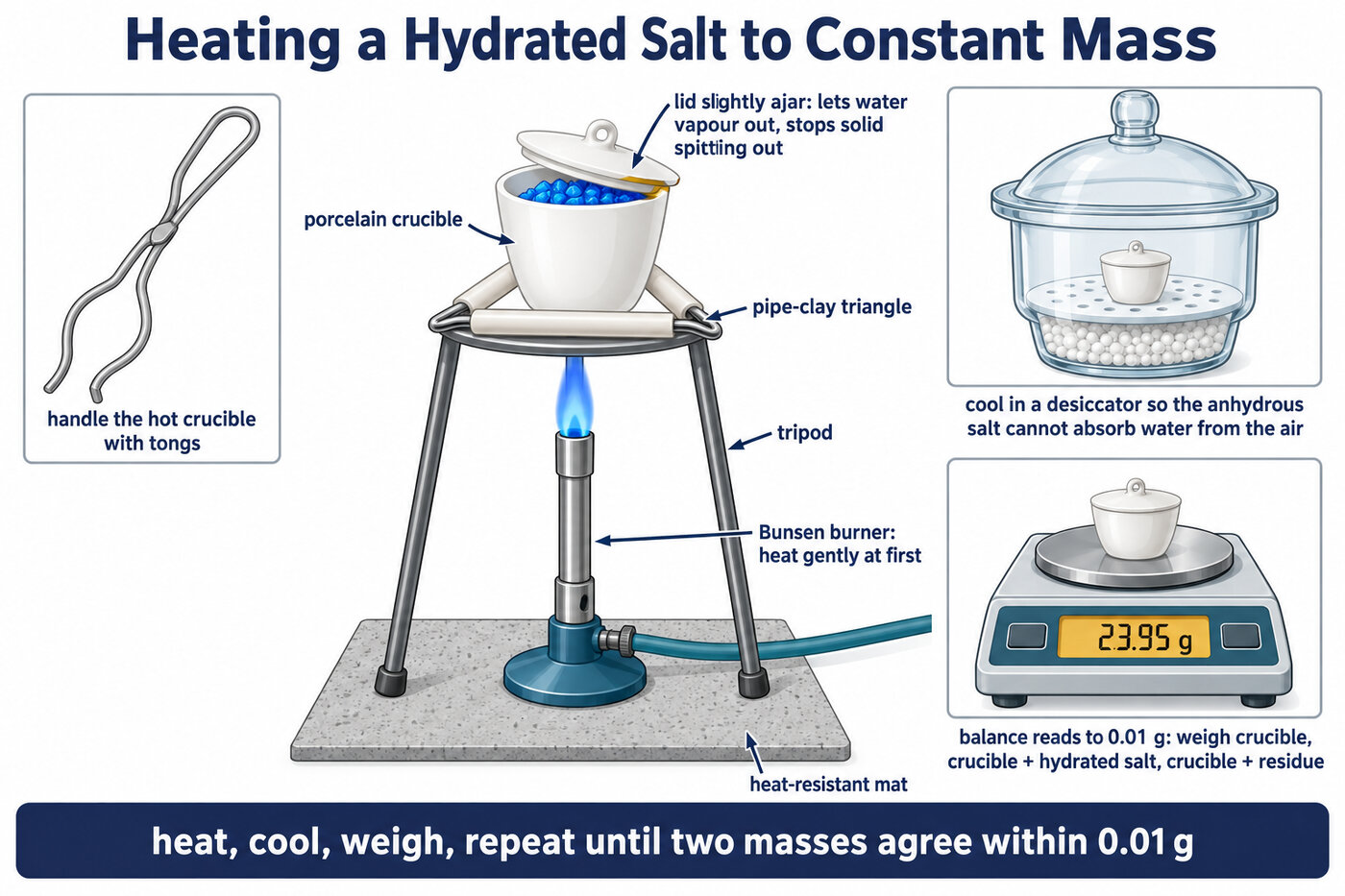
The apparatus for heating a hydrated salt to constant mass: crucible and lid on a pipe-clay triangle, a desiccator for cooling and a balance reading to 0.01 g.
Technique point: Always weigh the crucible with its lid, and use the same balance for every weighing, so that any zero error cancels when the masses are subtracted.
Check: Heating a New Salt to Constant Mass
Order the method for a different hydrated salt.
Results and Calculating x
The table gives a complete set of results. The mass fell sharply after the first heating and then by only 0.07 g and 0.01 g, so the last two weighings show that constant mass was reached.
| Measurement | Mass / g |
|---|---|
| Crucible and lid | 22.35 |
| Crucible, lid and hydrated CuSO₄ | 24.85 |
| After heating 1 | 24.03 |
| After heating 2 | 23.96 |
| After heating 3 | 23.95 |

Heating hydrated copper(II) sulfate to constant mass: the blue crystals turn white and the last two weighings agree within 0.01 g.
Worked Example. Mr of CuSO₄ = 63.5 + 32.1 + (4 × 16.0) = 159.6; Mr of H₂O = 18.0.
Step 1: mass of anhydrous CuSO₄ = 23.95 − 22.35 = 1.60 g
Step 2: mass of water lost = 24.85 − 23.95 = 0.90 g
Step 3: moles of CuSO₄ = 1.60 ÷ 159.6 = 0.0100 mol; moles of H₂O = 0.90 ÷ 18.0 = 0.0500 mol
Step 4: x = 0.0500 ÷ 0.0100 = 4.99, which rounds to 5
Answer: the formula is CuSO₄·5H₂O. The same data give the Mr of the hydrated salt directly.
Mr = 2.50 g ÷ 0.0100 mol = 249, and (249 − 159.6) ÷ 18.0 = 5.0 water molecules per formula unit, which is the form of the question suggested in the specification for magnesium sulfate.
Round x to the nearest whole number only at the end, and say why: a value of 4.99 comes from experimental error, not from a fraction of a water molecule.
Exam wording: “Heat to constant mass: heat, cool in a desiccator and weigh, repeating until two consecutive masses agree within 0.01 g, to make sure all the water has been removed.”
Check: Finding x for Hydrated Zinc Sulfate
Work through the calculation for a different hydrated salt.
Thermal Decomposition of a Group 2 Carbonate
The same crucible method measures how far a thermal decomposition has gone. A Group 2 carbonate loses carbon dioxide on heating, so the mass lost is the mass of CO₂, and the moles of CO₂ equal the moles of carbonate decomposed.
CaCO₃(s) → CaO(s) + CO₂(g)
Worked Example. 2.00 g of calcium carbonate (Mr 100.1) is heated strongly in a crucible without a lid for several periods, and the mass of solid falls to 1.34 g.
Step 1: moles of CaCO₃ at the start = 2.00 ÷ 100.1 = 0.0200 mol
Step 2: mass of CO₂ lost = 2.00 − 1.34 = 0.66 g; moles of CO₂ = 0.66 ÷ 44.0 = 0.0150 mol
Step 3: percentage converted to CaO = 0.0150 ÷ 0.0200 × 100 = 75.1%
Answer: 75.1% of the calcium carbonate was converted to calcium oxide. Complete decomposition would have left 0.0200 × 56.1 = 1.12 g of CaO.
Calcium carbonate needs a temperature of about 900 °C, close to the limit of a Bunsen flame, so incomplete decomposition is expected.
Magnesium carbonate decomposes at a much lower temperature because the smaller Mg²⁺ ion polarises the carbonate ion more.
A simple check on the residue is to add dilute acid: effervescence shows that some carbonate is left.
Remember: The mass lost is the gas. Convert it to moles of CO₂ and use the 1 : 1 ratio with the carbonate, not the mass of the residue alone.
Check: Percentage Decomposition of Magnesium Carbonate
Apply the same calculation to a different Group 2 carbonate.
Composition of Copper(II) Carbonate
The compound sold as “copper(II) carbonate” is green, and heating it to constant mass shows what it really is. It turns black as copper(II) oxide forms. Two formulae are possible, and each predicts a different mass of residue from the same starting mass.
CuCO₃(s) → CuO(s) + CO₂(g)
CuCO₃·Cu(OH)₂(s) → 2CuO(s) + CO₂(g) + H₂O(g)
| Possible formula | Mr | Residue from 2.00 g | Residue as % of the start |
|---|---|---|---|
| CuCO₃ | 123.5 | 2.00 × 79.5 ÷ 123.5 = 1.29 g | 64.4% |
| CuCO₃·Cu(OH)₂ | 221.0 | 2.00 × (2 × 79.5) ÷ 221.0 = 1.44 g | 71.9% |
A student heats 2.00 g of the green solid to constant mass and obtains 1.44 g of black residue, 72.0% of the starting mass.
This matches the second formula, so the solid is basic copper(II) carbonate, CuCO₃·Cu(OH)₂, and not CuCO₃.
Measuring the carbon dioxide given off would decide the formula just as well.
Key idea: To choose between formulae, predict the result (residue mass, mass lost or gas volume) for each one and see which the experiment matches.
Composition From a Gas Volume
A carbonate in a mixture can also be measured by the volume of carbon dioxide it gives with excess acid, collected over water or in a gas syringe.
The volume gives the moles of CO₂, the equation gives the moles of carbonate, and the moles give its mass and its percentage in the sample.
Only the carbonate reacts to give gas, so any unreactive impurity makes the percentage less than 100%.
The apparatus, the method and its errors (gas escaping before the bung is fitted, carbon dioxide dissolving in the water) are the same as on Practical Skills: Gas Volumes (molar volume of a gas).
The gas method is quicker than heating to constant mass and suits carbonates that decompose only at high temperature, but carbon dioxide dissolving in the water makes the volume, and so the percentage, slightly too low.
Remember: Mass method: mass lost = mass of CO₂. Gas method: volume ÷ 24.0 dm³ mol⁻¹ (at room temperature and pressure) = moles of CO₂. Both lead to moles of carbonate by the equation.
Check: Which Compound Is It?
Use a residue mass to decide between two possible formulae for a new compound.
Errors, Uncertainty and Improvements
Every error in this practical changes one of two masses, the water (or gas) lost or the residue, and so pushes the answer one way. Name the error, give its direction and give an improvement that removes it.
| Source of error | Effect on x (or on the % decomposed) | Improvement |
|---|---|---|
| Incomplete dehydration or decomposition | Too little lost: x (or the %) too low | Heat to constant mass: repeat until two masses agree within 0.01 g |
| Decomposition beyond the anhydrous salt (overheating) | Extra gas lost: x too high | Heat gently once the solid is white; keep below red heat |
| Solid spitting out of the crucible | Extra mass lost: x too high | Heat gently at first with the lid ajar |
| Anhydrous salt absorbing water while cooling | Residue too heavy: x too low | Cool in a desiccator and weigh as soon as it is cool |
| Weighing while still warm | Convection currents give a falsely low reading, so the loss looks too large | Let the crucible reach room temperature in the desiccator |
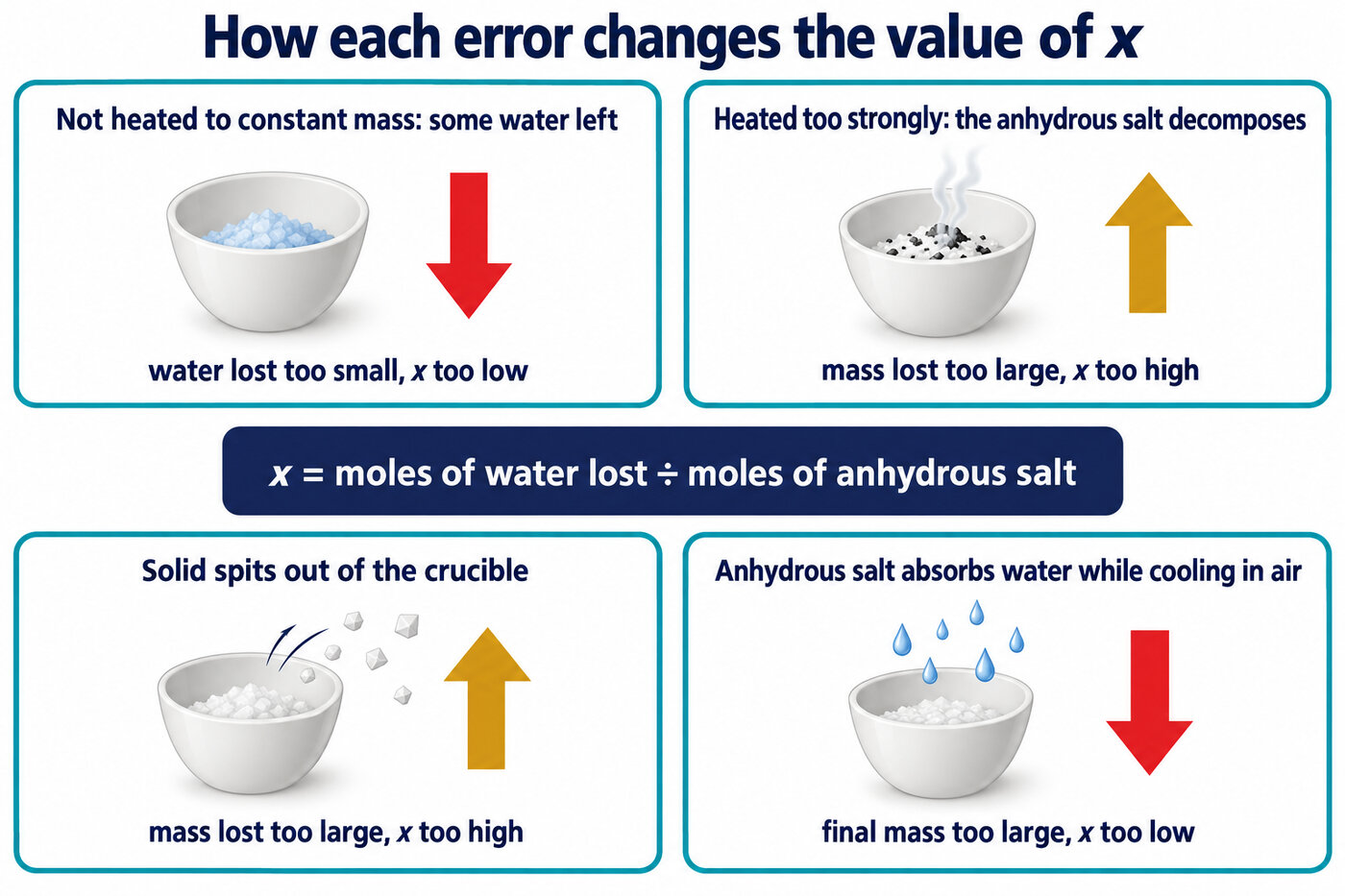
The direction of each error when finding the water of crystallisation: incomplete heating and water absorbed on cooling make x too low; overheating and spitting make it too high.
Percentage uncertainties. A 2 d.p. balance has an uncertainty of ±0.005 g per reading, and each mass in this practical is the difference of two readings, so it carries ±0.01 g.
For the water lost, 0.01 ÷ 0.90 × 100 = 1.1%; for the anhydrous salt, 0.01 ÷ 1.60 × 100 = 0.63%.
A larger sample, or a 3 d.p. balance, reduces both; halving the sample to 1.25 g would double the percentage uncertainty in the water lost to about 2.2%.
Exam focus: Do not write “heat it for longer”. Write “heat to constant mass”, and say what it shows: that all the water (or carbon dioxide) has been removed.
Check: Errors in Heating Experiments
Choose the correct statements about the errors in heating experiments.
Common Mistakes
The same errors appear in students’ write-ups and exam answers year after year. Each one costs a mark that the corrected version earns.
- Dividing the mass of water by the mass of salt instead of dividing the moles of water by the moles of anhydrous salt.
- Using the Mr of the hydrated salt to find the moles of anhydrous salt.
- Rounding x from 4.6 to 5 without comment. A value that far from a whole number means an error in the experiment, and it should be said.
- Writing “heat for longer” instead of “heat to constant mass”.
- Forgetting the desiccator, or weighing the crucible while it is still warm.
- Getting the direction of an error wrong: overheating and spitting make x too high; incomplete heating and water absorbed on cooling make it too low.
- Quoting the uncertainty of one balance reading (±0.005 g) for a mass found by difference (±0.01 g).
Common Exam Points
Say
“Heat to constant mass, cooling in a desiccator before each weighing, until two consecutive masses agree within 0.01 g.” “x = moles of water lost ÷ moles of anhydrous salt.” “The mass lost is the mass of carbon dioxide, so moles of CO₂ = moles of carbonate decomposed.”
Do not say
“Heat until it looks white.” (The colour is not proof that all the water has gone.) “The error is human error.” “x = 4.6, so the formula is CuSO₄·4.6H₂O.”
Watch for
Data where the mass has not reached constant mass; questions that give a percentage composition instead of masses; a choice between two formulae from a residue mass; percentage uncertainty for a mass found by difference; the percentage conversion of a Group 2 carbonate to its oxide.
FAQs
Short answers to the questions students most often ask about gravimetric analysis.
Why do we heat to constant mass rather than for a fixed time?
Because a fixed time may not remove all the water or carbon dioxide. When two consecutive weighings agree within the resolution of the balance, nothing more is being lost, so the dehydration or decomposition is complete.
Why is the crucible cooled in a desiccator?
An anhydrous salt absorbs water from the air as it cools, which would make the final mass too high and x too low. A hot crucible also sets up air currents that make the balance read too low. The desiccator lets it cool in dry air.
Why is the lid left slightly ajar?
With the lid fully on, water vapour cannot escape; with it off, the solid can spit out when it is first heated. A small gap lets the vapour out and keeps the solid in.
What if my value of x is not a whole number?
Round it to the nearest whole number for the formula, but comment on it. A value such as 4.6 points to an error, most often incomplete heating (too low) or spitting and overheating (too high).
How do I find which formula a compound has?
Work out what each possible formula predicts, for example the mass of residue from the mass you heated, then compare with your result. The formula whose prediction matches is the one supported by the experiment.
Copyright and author footprint: This OLS revision page was written for Online Learning System by Dr. Mohammed Al-Fatah. It is designed for A Level Chemistry revision and should not be copied or redistributed without permission.
Keep this note — free
Save your progress across every AQA topic. A free account remembers which topics you have covered, saves your question scores, and syncs across your phone and laptop.
- Track every topic you have finished
- Keep your practice-question scores
- No payment, no card, free forever
Already registered? Log in