Rate Equations, Orders and the Rate Constant
A concise revision guide to the rate equation rate = k[A]ᵐ[B]ⁿ: what order with respect to a substance and overall order mean, why orders come only from experiment, what the rate constant is, and how to work out its units for any overall order.
- 11.1i
- 11.1ii
- 11.1iii
- 11.1iv
- 11.1v
What these spec points say
- 11.1i understand the terms: rate of reaction
- 11.1ii understand the terms: rate equation, rate=k[A]m[B]n where m and n are 0, 1 or 2
- 11.1iii understand the terms: order with respect to a substance in a rate equation
- 11.1iv understand the terms: overall order of a reaction
- 11.1v understand the terms: rate constant
AS Recap: Rates and Collision Theory
Three quick questions on what you already know: rate as a change in concentration per unit time, why collisions need energy above the activation energy, and how a rate is read from a gradient.
What the Rate Equation Says
At AS you learned that a higher concentration usually gives a faster reaction. The rate equation makes that relationship exact.
For a reaction between A and B it is written rate = k[A]ᵐ[B]ⁿ, and each symbol has a fixed meaning.
| Symbol | Meaning |
|---|---|
| rate | The change in concentration of a reactant or product per unit time, usually in mol dm⁻³ s⁻¹ |
| [A] | The square brackets mean the concentration of A in mol dm⁻³ |
| m and n | The powers are the orders of reaction with respect to A and B |
| k | The rate constant, a number that links the concentrations to the rate at a particular temperature |
The equation is a statement about how the rate responds when a concentration changes. If m is 1, doubling [A] doubles the rate; if m is 2, doubling [A] quadruples it; if m is 0, changing [A] does nothing at all.
Definition: The rate equation, rate = k[A]ᵐ[B]ⁿ, gives the rate of reaction in terms of the concentrations of the species that affect it. k is the rate constant and m and n are the orders with respect to A and B; each is 0, 1 or 2 at A Level.
Order With Respect to a Substance
The order with respect to a substance is the power to which its concentration is raised in the rate equation. Three values are met at A Level.
| Order | Proportionality | Effect of changing [A] |
|---|---|---|
| Zero order | Rate ∝ [A]⁰, so the rate is independent of [A] | Doubling the concentration leaves the rate unchanged, and the substance does not appear in the rate equation at all, because [A]⁰ = 1. |
| First order | Rate ∝ [A] | Doubling [A] doubles the rate, trebling it trebles the rate. |
| Second order | Rate ∝ [A]² | Doubling [A] multiplies the rate by 2², which is 4, and trebling it multiplies the rate by 9. |
The quickest way to find an order from data is the doubling test: double one concentration while keeping every other concentration the same, and see what happens to the rate. Rate × 1 means zero order, rate × 2 means first order, rate × 4 means second order.
Orders are found by experiment, and they have nothing to do with the balancing numbers in the equation.
The reaction 2NO + O₂ → 2NO₂ happens to have the rate equation rate = k[NO]²[O₂].
But the reaction between hydrogen peroxide and iodide ions, H₂O₂ + 2I⁻ + 2H⁺ → I₂ + 2H₂O, is first order in H₂O₂, first order in I⁻ and zero order in H⁺ even though the equation shows two of each.
The orders reflect the mechanism (page 6), which the balanced equation cannot show.
A substance can be made to behave as zero order by using it in a large excess. Its concentration then barely changes during the reaction, so it has no measurable effect on the rate and is described as pseudo-zero order.
This is how experiments isolate the order with respect to one reactant at a time.
Key idea: Order 0: rate does not change. Order 1: rate ∝ [A]. Order 2: rate ∝ [A]². The orders come from experiment, never from the balanced equation.
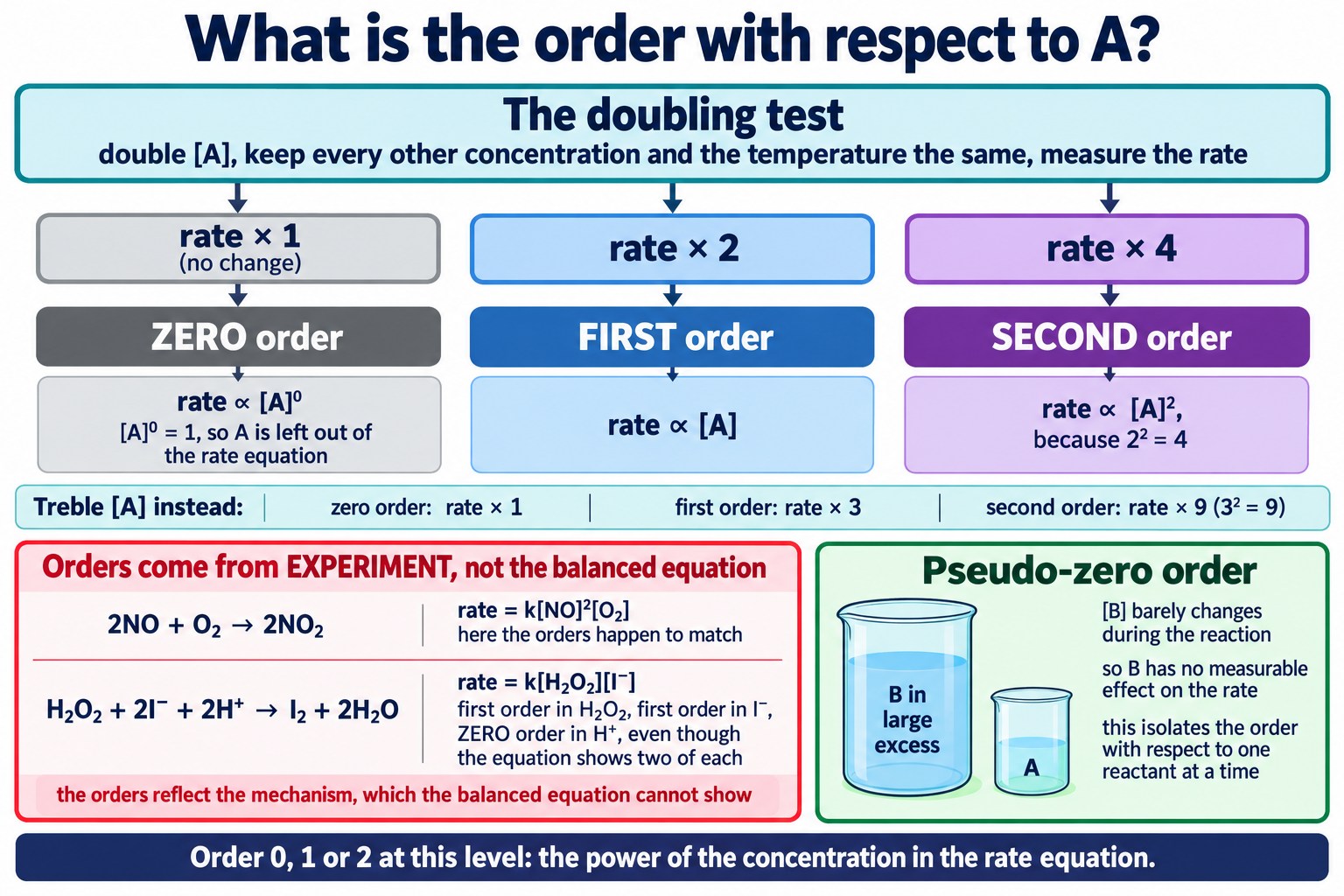
Double one concentration and watch the rate: unchanged means zero order, doubled means first order and quadrupled means second order, whatever the balanced equation shows.
Check: What an Order Means
Decide how the rate changes when a concentration is changed for orders and reactions not used on this page.
Overall Order and Writing Rate Equations
The overall order is the sum of the individual orders, m + n.
A reaction that is first order in A and second order in B has the rate equation rate = k[A][B]² and is third order overall.
A reaction that is first order in A and zero order in B has rate = k[A][B]⁰, which is written simply as rate = k[A], and is first order overall. Powers of 1 are not written, and a zero-order species is left out.
Two features of rate equations surprise students. First, a reactant in the balanced equation can be absent from the rate equation, as H⁺ is absent from the hydrogen peroxide and iodide example above.
Second, a species that is not in the balanced equation at all can appear in the rate equation, most often a catalyst.
The acid-catalysed reaction between iodine and propanone (page 5) has the rate equation rate = k[CH₃COCH₃][H⁺], with the catalyst H⁺ in it and the reactant iodine left out.
Key idea: Both follow from the rate equation describing the slowest step of the mechanism.
![The rate equation rate = k[A]ᵐ[B]ⁿ with each term labelled, graphs of rate against concentration for orders 0, 1 and 2, and the units of k for overall orders 1 to 3](https://www.onlinelearningsystem.net/xyz/wp-content/uploads/2026/09/kinetics-t11-01-rate-equation.jpg)
The rate equation with every symbol labelled, the three orders as rate–concentration sketches, and the units of k for overall orders 1, 2 and 3.
Exam wording: To write a rate equation from given orders, write k, then each species with a non-zero order raised to its order, and leave out any zero-order species: “first order in A, second order in B” becomes rate = k[A][B]².
The Rate Constant and Its Units
The rate constant, k, is the proportionality constant in the rate equation. At a fixed temperature it has a fixed value for a given reaction, however the concentrations change and however far the reaction has gone.
It is not a universal constant: k increases when the temperature rises, which is the real reason reactions speed up on heating.
It also changes if a catalyst is added because the mechanism changes (page 7 puts numbers on the temperature effect).
The units of k depend on the overall order, so they must be worked out for each rate equation.
The method is always the same: rearrange to make k the subject, substitute the units of rate and of each concentration, and cancel.
For rate = k[A][B]², k = rate ÷ ([A][B]²) = mol dm⁻³ s⁻¹ ÷ (mol dm⁻³ × mol² dm⁻⁶) = mol dm⁻³ s⁻¹ ÷ mol³ dm⁻⁹ = mol⁻² dm⁶ s⁻¹.
| Overall order | Example rate equation | Units of k | Pattern |
|---|---|---|---|
| 1 | rate = k[A] | s⁻¹ | mol dm⁻³ s⁻¹ ÷ mol dm⁻³ |
| 2 | rate = k[A][B] or k[A]² | mol⁻¹ dm³ s⁻¹ | mol dm⁻³ s⁻¹ ÷ (mol dm⁻³)² |
| 3 | rate = k[A][B]² or k[A]²[B] | mol⁻² dm⁶ s⁻¹ | mol dm⁻³ s⁻¹ ÷ (mol dm⁻³)³ |
| 0 | rate = k | mol dm⁻³ s⁻¹ | the same units as rate |
Exam focus: Always give k a unit. Work it out from the rate equation in the question, because the examiner sets the order; write the units in the order mol, dm, s, with negative powers, for example mol⁻¹ dm³ s⁻¹.
Check: Units of k
Work out the units of the rate constant for rate equations that are not the ones in the table above.
Common Exam Points
Say
“The order with respect to A is the power of [A] in the rate equation.” “Doubling [A] doubles the rate, so the reaction is first order with respect to A.” “k is constant at a fixed temperature and increases as the temperature rises.”
Do not say
“The order is 2 because there are two moles of it in the equation” (orders come only from experiment). “k is constant” without adding “at a fixed temperature”. “The rate constant has no units” (only a first-order overall reaction has the simple unit s⁻¹, and even that is a unit).
Watch for
Questions that give a rate equation and ask for the effect of changing two concentrations at once: apply each change separately and multiply the effects.
Questions that ask for the overall order want a single number, the sum of the powers. If a catalyst appears in the rate equation, that is intended: it is in the rate-determining step.
Check: Overall Order and Rate Equations
Write rate equations from given orders and state the overall order for reactions not used on this page.
FAQs
Use these quick answers to check the rate equation ideas that come up most often.
Can the order with respect to a substance be a fraction or negative?
At A Level the orders you meet are 0, 1 and 2, and every question is set so the data give one of those three. Check each comparison against the doubling rules: no change, doubles, quadruples.
Why is the rate constant called constant if it changes with temperature?
It is constant for a given reaction at a given temperature, whatever the concentrations. Change the temperature (or add a catalyst) and you get a new value of k. Concentration changes never alter k.
Why can I not read the orders off the balanced equation?
Because the balanced equation only shows the overall stoichiometry; the rate depends on the slowest step of the mechanism, which the equation does not show. Orders come only from experiment.
How do I work out the units of k without memorising a table?
Rearrange to k = rate ÷ (concentration terms) and cancel the units. For rate = k[A][B]² that is mol dm⁻³ s⁻¹ ÷ (mol dm⁻³)³, which simplifies to mol⁻² dm⁶ s⁻¹. Each extra order divides by another mol dm⁻³.
If a substance is zero order, is it still needed for the reaction?
Yes. It still reacts, and it still appears in the balanced equation, but changing its concentration does not change the rate because it is not involved in the rate-determining step. Its concentration term is [A]⁰ = 1, so it is left out of the rate equation.
Copyright notice: This OLS revision content, including the explanations, layout, diagrams, tables and embedded learning structure, is authored for Online Learning System by Dr. Mohammed Al-Fatah. It may not be copied, reproduced, redistributed or adapted without written permission.
Keep this note — free
Save your progress across every Edexcel IAL topic. A free account remembers which topics you have covered, saves your question scores, and syncs across your phone and laptop.
- Track every topic you have finished
- Keep your practice-question scores
- No payment, no card, free forever
Already registered? Log in