Activation Energy and the Arrhenius Equation
A concise revision guide to how temperature changes the rate constant: the Arrhenius equation k = Ae^(−Eₐ/RT), the straight-line form ln k = −Eₐ/RT + ln A, finding the activation energy from the gradient of a graph of ln k against 1/T, and calculations with the equation.
- 11.1viii
- 11.10-a
- 11.10-b
- 11.10-c
What these spec points say
- 11.1viii understand the terms: activation energy
- 11.10-a be able to use calculations to find activation energy from experimental data
- 11.10-b be able to use graphical methods to find activation energy from experimental data
- 11.10-c know that the Arrhenius equation will be given if needed

Temperature and the Rate Constant
Concentration changes affect the rate through the rate equation, but they leave k alone. Temperature is different: the rate constant itself increases with temperature, and for many reactions a rise of about 10 °C roughly doubles it.
Collision theory explains why. Warmer particles collide only slightly more often, but the fraction of collisions with energy of at least the activation energy, Eₐ, rises steeply.
This is because the high-energy tail of the Boltzmann distribution grows much faster than the average. The rate constant is the measure of how likely a collision is to succeed, so it grows with that fraction.
The same idea explains a catalyst in terms of k: by providing a route with a lower Eₐ, the catalyst increases the fraction of collisions that can react at a given temperature, so k for the catalysed reaction is larger.
Key idea: Concentration changes the rate; temperature (and a catalyst) changes the rate constant. A higher temperature means a larger k because a larger fraction of collisions have E ≥ Eₐ.
Check: Temperature and k
Qualitative questions on why k rises with temperature and what happens to k, and to the rate, when conditions change in reactions not mentioned on this page.
The Arrhenius Equation
The relationship between k and temperature is the Arrhenius equation:
k = Ae^(−Eₐ/RT)
| Symbol | Meaning |
|---|---|
| A | The pre-exponential factor (also called the Arrhenius constant or frequency factor), a constant for the reaction that has the same units as k |
| Eₐ | The activation energy in J mol⁻¹ |
| R | The gas constant, 8.31 J K⁻¹ mol⁻¹ |
| T | The temperature in kelvin |
Here the exponential term, e^(−Eₐ/RT), is the fraction of collisions with energy of at least Eₐ; it is always between 0 and 1 and it rises towards 1 as T rises.
A represents the rate constant the reaction would have if every collision were successful. It includes the collision frequency and the fraction of collisions with the right orientation.
The equation shows the two things that make a reaction fast: a large A (frequent, well-oriented collisions) and a small Eₐ.
It also shows why the effect of temperature is so large: because Eₐ/RT sits in an exponent, a small change in T makes a big change in e^(−Eₐ/RT).
Remember: the equation is given on the data sheet if it is needed; what has to be known is what each symbol means and how to use it.
Definition: k = Ae^(−Eₐ/RT): A, the pre-exponential factor with the units of k; Eₐ, the activation energy in J mol⁻¹; R = 8.31 J K⁻¹ mol⁻¹; T in K.
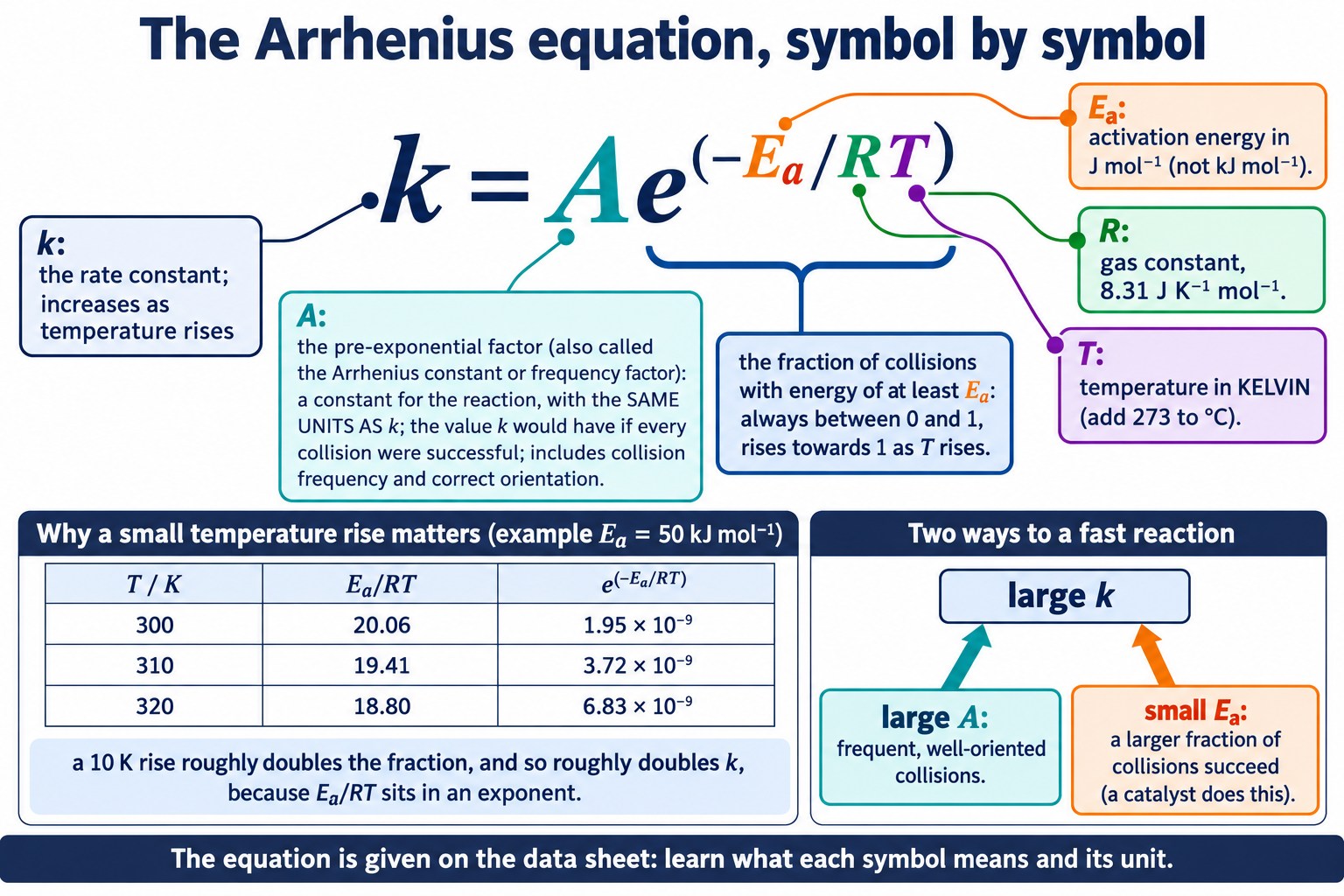
Each symbol in k = Ae^(−Eₐ/RT) has a fixed meaning and unit, and the exponential term is the fraction of collisions with enough energy, which roughly doubles for a 10 K rise.
The Straight-Line Form
Taking natural logarithms of both sides turns the exponential into something that can be plotted as a straight line:
ln k = −Eₐ/R × 1/T + ln A
Compare this with y = mx + c. If ln k is plotted on the y-axis against 1/T on the x-axis, the points lie on a straight line with gradient −Eₐ/R and intercept ln A.
The gradient is negative because k falls as 1/T rises (that is, as T falls).
Multiplying the gradient by −R gives Eₐ; taking the exponential of the intercept gives A.
In a real experiment k is rarely measured directly. Instead a reaction is timed at several temperatures with the same starting concentrations.
At fixed concentrations the rate is proportional to k, and in a clock reaction the rate is proportional to 1/t, so ln(rate) or ln(1/t) can be plotted instead of ln k.
The intercept changes, because the constant of proportionality is absorbed into it, but the gradient, and therefore Eₐ, is the same.
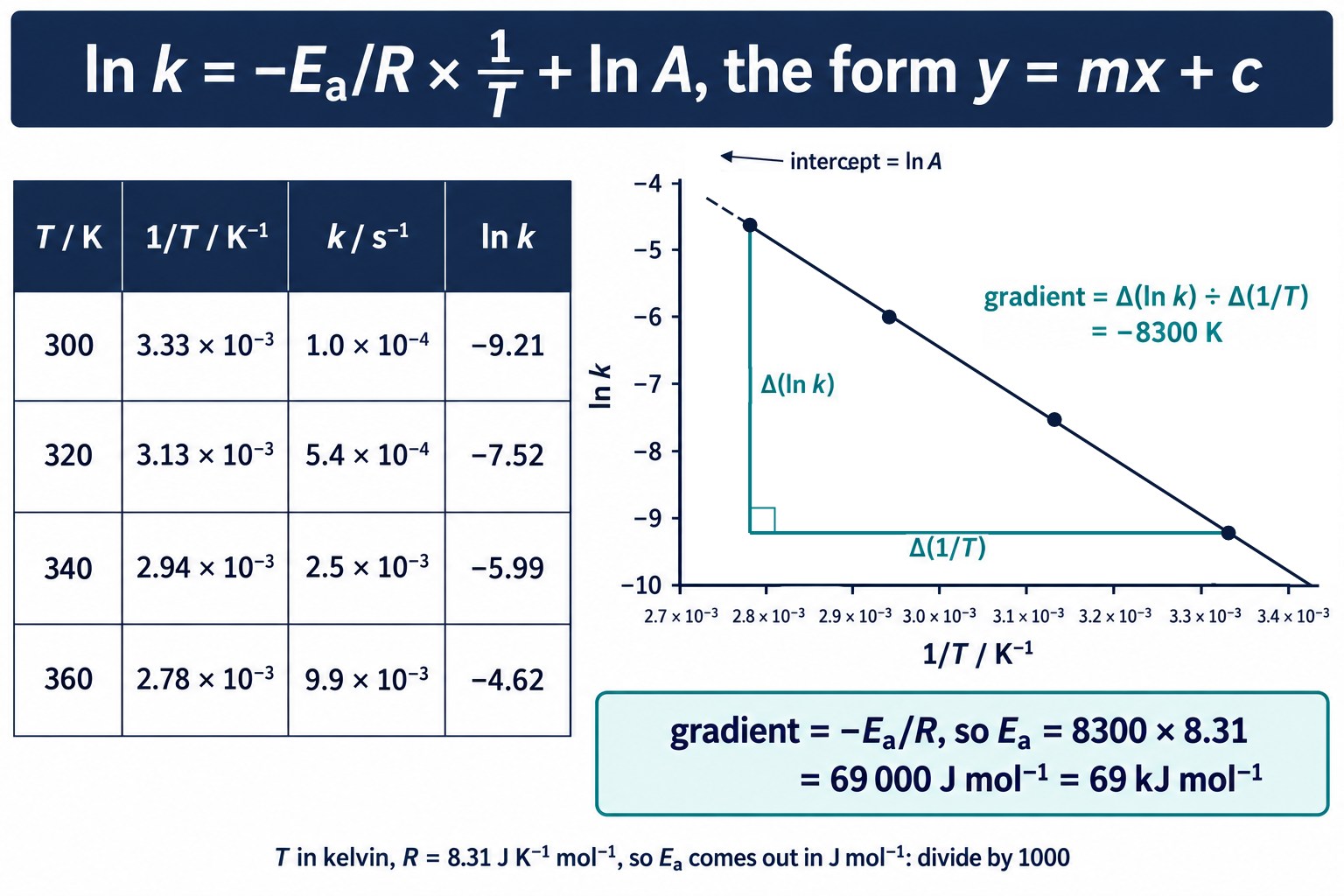
The Arrhenius plot: ln k against 1/T is a straight line of gradient −Eₐ/R, with the data and the working for Eₐ.
Exam wording: “A graph of ln k against 1/T is a straight line with gradient −Eₐ/R and intercept ln A, so Eₐ = −gradient × R.”
Check: The Arrhenius Graph
What is plotted on each axis, what the gradient and the intercept give, and why ln(1/t) can stand in for ln k, for data sets not shown on this page.
Finding Eₐ From a Graph
The figure above gives k at four temperatures. The steps are always the same:
- Convert each temperature to kelvin and calculate 1/T (typically 2.5 × 10⁻³ to 3.5 × 10⁻³ K⁻¹).
- Calculate ln k (or ln(1/t)) for each run; the values are negative for small k.
- Plot ln k against 1/T and draw the best-fit straight line.
- Measure the gradient using a large triangle with points far apart on the line, not two of the data points.
- Eₐ = −gradient × R, in J mol⁻¹; divide by 1000 for kJ mol⁻¹.
Step 1: From the plotted data the gradient is −8300 K (the unit of the gradient is K, because ln k has no unit and 1/T is in K⁻¹).
Step 2: So Eₐ = 8300 × 8.31 = 69 000 J mol⁻¹.
Answer: Eₐ = 69 kJ mol⁻¹, which is a typical value for a reaction that is conveniently slow at room temperature.
If the intercept is required, extending the line to 1/T = 0 gives ln A, and A = e^(ln A).
Exam focus: Three marks usually hide here: the gradient with its sign, multiplying by R (not dividing), and converting J to kJ. Quote Eₐ as a positive number with its unit.
Calculations With the Equation
Questions also use the equation directly, in either form. The working is a matter of substituting carefully: T in kelvin, R = 8.31 J K⁻¹ mol⁻¹, and Eₐ in joules per mole (not kilojoules) so that Eₐ/RT is a pure number.
Worked example: Find A. A first-order reaction has k = 2.5 × 10⁻³ s⁻¹ at 340 K and Eₐ = 69 kJ mol⁻¹. Eₐ/RT = 69 000 ÷ (8.31 × 340) = 24.4. Rearrange k = Ae^(−Eₐ/RT) to A = k ÷ e^(−24.4) = k × e^(24.4) = 2.5 × 10⁻³ × 3.9 × 10¹⁰ = 1.0 × 10⁸ s⁻¹. A has the same units as k.
Worked example: Find Eₐ. For a reaction with ln A = 18.4, k = 2.5 × 10⁻³ s⁻¹ at 340 K. ln k = −5.99. From ln k = −Eₐ/RT + ln A: −5.99 = −Eₐ/(8.31 × 340) + 18.4, so Eₐ/(2825) = 24.4 and Eₐ = 24.4 × 2825 = 69 000 J mol⁻¹ = 69 kJ mol⁻¹.
Two checks catch most slips. Eₐ must come out positive and of the order of tens to a few hundred kJ mol⁻¹.
And because k rises with temperature, if you calculate k at two temperatures the higher temperature must give the larger value. If it does not, a sign or a unit has gone wrong.
Core Practical 10 (activation energy of a reaction) is the practical version of this page: a clock reaction is timed at five or six temperatures, ln(1/t) is plotted against 1/T and Eₐ comes from the gradient.
Check: Gradient, Intercept and Units
Read a gradient and an intercept from Arrhenius data not used above, get the sign of Eₐ right and give it in the correct unit.
Common Exam Points
Say
“The rate constant increases with temperature because a greater proportion of collisions have energy ≥ Eₐ.” “Plot ln k against 1/T; gradient = −Eₐ/R; Eₐ = −gradient × R.” “T must be in kelvin.”
Do not say
“The activation energy decreases when the temperature rises” (Eₐ is fixed; the fraction of collisions that reach it rises). “Concentration changes k.” “Eₐ = gradient” without the −R.
Watch for
Data given in °C, rates given as times, and Eₐ asked for in kJ mol⁻¹ when R is in J: convert every time. The gradient of an ln k against 1/T graph is always negative; a positive Eₐ follows from the minus sign in −Eₐ/R.
FAQs
Use these quick answers to check the Arrhenius ideas.
Why do we plot ln k against 1/T and not k against T?
Because k against T is a curve, from which you cannot read Eₐ. Taking natural logarithms gives ln k = −Eₐ/RT + ln A, which has the form y = mx + c with x = 1/T, so the graph is a straight line whose gradient is −Eₐ/R.
Why is the gradient negative?
Because k increases with temperature, and 1/T decreases as T increases, so ln k falls as 1/T rises. Eₐ is positive, so the gradient −Eₐ/R must be negative; if yours comes out positive you have plotted the axes the wrong way round.
Which units do I use?
T in kelvin, so 1/T in K⁻¹, and R = 8.31 J K⁻¹ mol⁻¹. The gradient is then in K, and Eₐ = −gradient × R comes out in J mol⁻¹; divide by 1000 to quote it in kJ mol⁻¹. A gradient of about −6000 K, for example, gives an Eₐ of about 50 kJ mol⁻¹.
Do I need to know the Arrhenius equation by heart?
No, the equation is given, but you must be able to use it: rearrange it to find Eₐ, A or k, and take logarithms correctly. Practise finding Eₐ from a pair of k values at two temperatures as well as from the gradient of a graph.
What does the constant A mean?
The pre-exponential factor. It is related to the collision frequency and the fraction of collisions in the right orientation, and e^(−Eₐ/RT) is the fraction of collisions with energy above Eₐ. Multiplying the two gives the rate constant.
Copyright notice: This OLS revision content, including the explanations, layout, diagrams, tables and embedded learning structure, is authored for Online Learning System by Dr. Mohammed Al-Fatah. It may not be copied, reproduced, redistributed or adapted without written permission.
Keep this note — free
Save your progress across every Edexcel IAL topic. A free account remembers which topics you have covered, saves your question scores, and syncs across your phone and laptop.
- Track every topic you have finished
- Keep your practice-question scores
- No payment, no card, free forever
Already registered? Log in