Lattice Enthalpy Trends and Covalent Character
A concise revision guide to what decides the size of lattice enthalpy: ionic charge and ionic radius, the perfect ionic model, why experimental Born–Haber values differ from theoretical ones, polarisation of anions by cations and the covalent character it produces.
- 3.1.8.1v
What these spec points say
- 3.1.8.1v compare lattice enthalpies from Born-Haber cycles with those from calculations based on a perfect ionic model to provide evidence for covalent character in ionic compounds
Charge and Radius
The lattice enthalpy comes from the electrostatic attraction between oppositely charged ions. Two things decide how exothermic it is: the charges on the ions and their radii.
- The force between two charges grows with the size of the charges, so more highly charged ions attract more strongly.
- The force falls as the distance between them grows. Smaller ions sit closer together, so the attraction is stronger.
| Compound | Ions | Sum of ionic radii / pm | Lattice enthalpy / kJ mol⁻¹ |
|---|---|---|---|
| LiF | Li⁺, F⁻ | 209 | −1037 |
| NaF | Na⁺, F⁻ | 235 | −918 |
| NaCl | Na⁺, Cl⁻ | 283 | −787 |
| NaBr | Na⁺, Br⁻ | 298 | −742 |
| KBr | K⁺, Br⁻ | 334 | −671 |
| MgO | Mg²⁺, O²⁻ | 212 | −3791 |
| CaO | Ca²⁺, O²⁻ | 240 | −3401 |
Read the table two ways.
- Radius: down the first five rows the charges are all 1+ and 1−, and the lattice enthalpy becomes less exothermic as the ions get bigger.
- LiF is the most exothermic and KBr the least, because the ion centres are further apart.
- Charge: compare NaCl with MgO, whose ions are a similar size. Doubling both charges makes the lattice enthalpy nearly five times more exothermic.
- Charge matters more than radius.
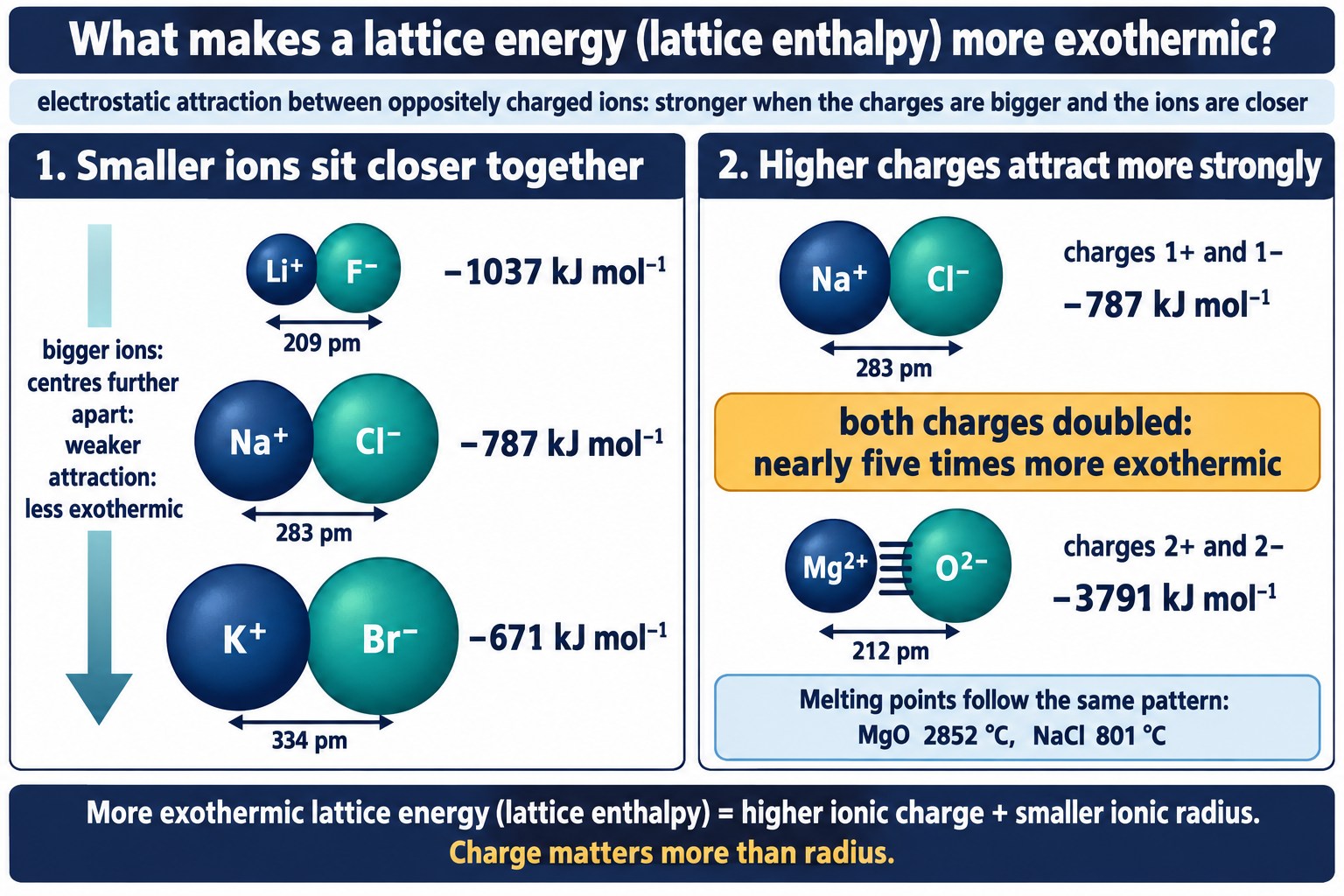
The two factors that decide the size of a lattice enthalpy: smaller ions sit closer together, and more highly charged ions attract far more strongly, with values for five compounds.
The same two factors set the melting point, so MgO (2852 °C) is used as a refractory lining while NaCl melts at 801 °C.
Key idea: More exothermic lattice enthalpy: higher ionic charge, smaller ionic radius (higher charge density on both ions). State both the factor and the reason: “smaller ions, so the ions are closer and the electrostatic attraction is stronger”.
Check: Comparing Values From Charge and Radius
Rank and explain the lattice enthalpy of pairs of compounds not on this page from the charges and radii of their ions.
The Perfect Ionic Model
A lattice enthalpy can be worked out in two independent ways.
- The experimental value comes from the Born–Haber cycle. Every step in it is measured, so the result is what the real lattice releases.
- The theoretical value comes from electrostatics. It assumes the perfect ionic model.
The perfect ionic model assumes that:
- the ions are perfect spheres
- each charge is concentrated at the centre of its ion (a point charge)
- the charge is spread evenly over the ion
- the only attraction is electrostatic.
Knowing the charges, the radii and the geometry of the lattice, the energy released can then be calculated.
| Compound | Experimental (Born–Haber) / kJ mol⁻¹ | Theoretical (perfect ionic model) / kJ mol⁻¹ | Gap / kJ mol⁻¹ | What it shows |
|---|---|---|---|---|
| Sodium chloride | −787 | −766 | 21 | the two values agree closely: close to purely ionic |
| Silver chloride | −905 | −770 | 135 | experimental markedly more exothermic: some covalent character |
For many compounds the two values agree closely, and the compound is close to purely ionic. For others the experimental value is markedly more exothermic than the theoretical one.
The real silver chloride lattice is held together more strongly than pure electrostatics predicts, so there must be extra bonding. The electrons are partly shared between the ions and the bonding has some covalent character.
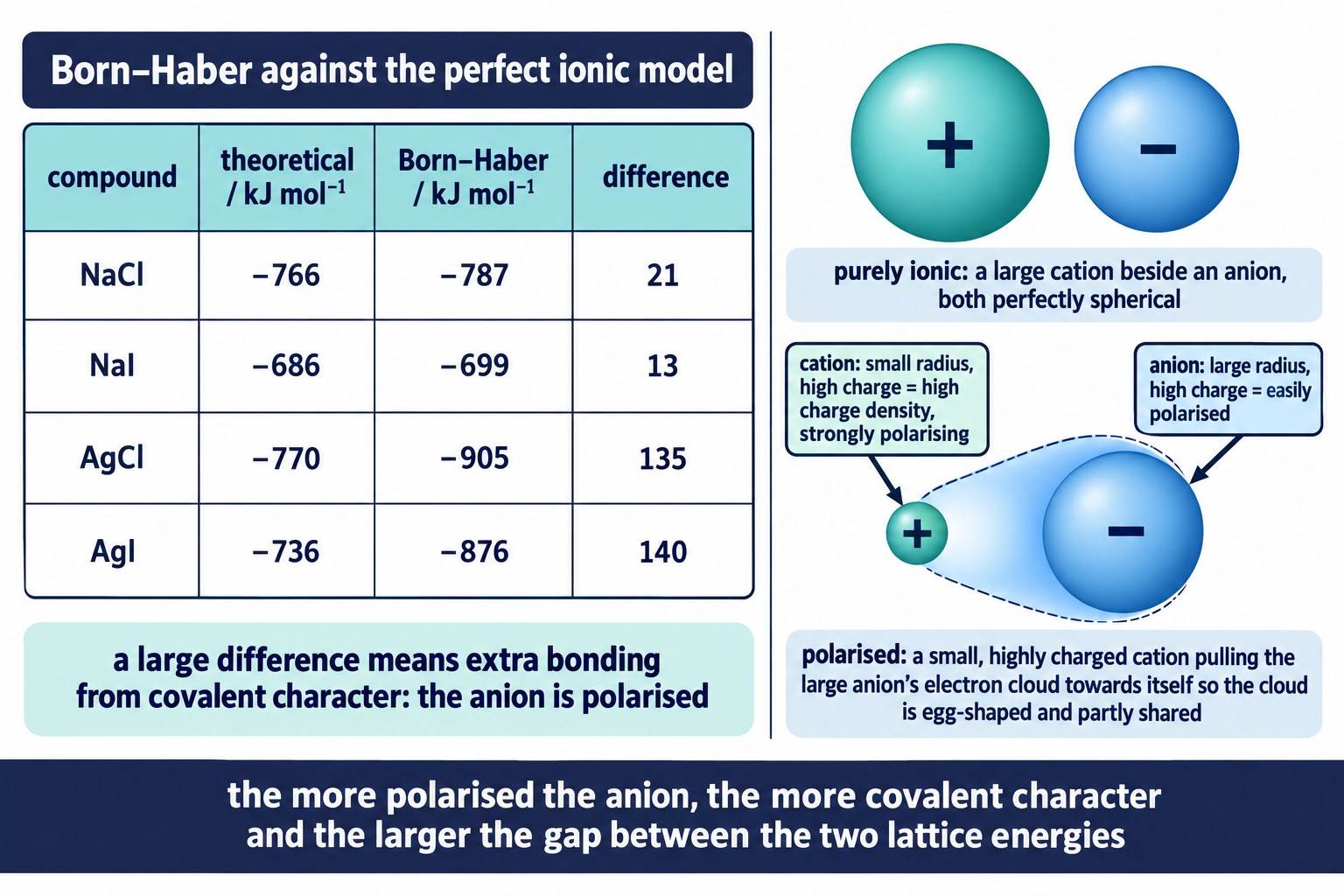
Experimental (Born–Haber) against theoretical (perfect ionic model) values for the sodium and silver halides, beside a small cation polarising a large anion.
The size of the gap is a measure of the degree of covalent bonding.
- A difference of a few per cent means an almost purely ionic compound.
- A difference of 15 to 20 per cent, as in the silver halides, means substantial covalent character.
- Note the direction: the experimental value is always the more exothermic of the two, because sharing electrons adds to the attraction and never subtracts from it.
Exam wording: Theoretical value: “assumes the perfect ionic model: spherical ions with the charge evenly distributed, attracted only electrostatically”. Comparison: “the experimental value is more exothermic than the theoretical value, so there is additional covalent bonding”.
Polarisation
The extra bonding comes from polarisation.
- A cation attracts the electron cloud of the anion next to it.
- If the pull is strong enough, the cloud is distorted towards the cation.
- Electron density builds up between the two nuclei, which is the beginning of a covalent bond.
The anion is said to be polarised and the cation is polarising.
The polarising power of a cation depends on its charge density.
- A small, highly charged cation (Li⁺, Be²⁺, Mg²⁺, Al³⁺, Ag⁺) has a strong electric field close to its surface and distorts anions strongly.
- A large 1+ cation (K⁺, Cs⁺) hardly distorts them at all.
The polarisability of an anion depends on its size and charge.
- A large anion (I⁻, S²⁻) holds its outer electrons loosely and far from its nucleus, so it is easily distorted.
- A highly charged anion is distorted more easily than a singly charged one of the same size.
The greater the polarisation, the greater the covalent character and the larger the gap between the theoretical and experimental values.
Polarisation of Anions: AlCl3 and AlF3
See how the small, highly charged Al3+ ion pulls on the electron clouds of the anions around it, distorting large Cl− far more than small F−.
© Dr. Mohammed Al-Fatah – onlinelearningsystem.net
The silver halides show both factors.
- Ag⁺ is more polarising than Na⁺ of similar size because its d electrons shield the nuclear charge poorly, so AgCl has far more covalent character than NaCl.
- Moving from AgCl to AgI the anion gets larger and more polarisable, so the gap grows further (140 kJ mol⁻¹ for AgI).
The same reasoning explains why aluminium chloride and beryllium chloride behave as covalent compounds. A 3+ or a very small 2+ cation polarises a chloride ion so strongly that the ionic model no longer describes the bonding.
Key idea: Polarising cation: small radius, high charge. Polarisable anion: large radius, high charge. Polarisation → electron density shared between the nuclei → covalent character → experimental value more exothermic than the theoretical value.
Check: Polarisation and Covalent Character
Decide which cation is more polarising, which anion is more polarisable, and which of two compounds shows more covalent character, for ion pairs not used on this page.
Common Exam Points
Say
- “The lattice enthalpy is more exothermic because the ions are smaller (or more highly charged), so the electrostatic attraction between them is stronger.”
- “The experimental value is more exothermic than the theoretical value, so the bonding has some covalent character.”
- “The cation polarises the anion: it distorts the electron cloud so that electron density lies between the nuclei.”
Do not say
- “The lattice enthalpy is bigger” without saying more exothermic or more negative.
- “The theoretical value is wrong” (it is right for a purely ionic compound; the compound is not purely ionic).
- “The anion polarises the cation.”
Watch for
- A comparison where the two compounds differ in both charge and radius: deal with charge first, it dominates.
- A question that gives three values and asks which compound is most covalent: look for the largest percentage gap, not the most exothermic value.
- A cation such as Ag⁺ that polarises more than its radius suggests.
Check: Theoretical Against Experimental
Given theoretical and Born–Haber values for compounds not on this page, say which is more covalent and explain the difference in terms of polarisation.
FAQs
Use these quick answers to check what decides the size of lattice enthalpy and how covalent character shows up.
Why is MgO’s lattice enthalpy so much bigger than NaCl’s?
Both ions in MgO carry a double charge, so the electrostatic attraction between them is roughly four times that between singly charged ions. On top of that Mg²⁺ and O²⁻ are smaller than Na⁺ and Cl⁻, so the ions sit closer together. Higher charge and smaller radius together give a value roughly five times larger.
Why does the Born–Haber value differ from the theoretical one?
The theoretical value assumes a perfect ionic model: spherical ions with the charge spread evenly, held together only by electrostatic attraction. In a real lattice the cation pulls the electron cloud of the anion towards itself, adding some covalent bonding and making the lattice more stable. The experimental (Born–Haber) value is therefore more exothermic, and the gap measures the covalent character.
What makes a cation good at polarising an anion?
A high charge density: a small cation with a large charge, such as Al³⁺ or Be²⁺. The anion is polarised most easily when it is large and highly charged, such as I⁻ or S²⁻, because its outer electrons are far from the nucleus and loosely held. Silver iodide shows far more covalent character than sodium fluoride for both reasons.
Why does lattice enthalpy fall from LiF to CsI?
Because the ions get bigger down both groups, so the distance between the centres of the cation and the anion increases and the electrostatic attraction weakens. The charges stay the same, so radius is the only thing changing. The same argument explains why the value falls from NaF to NaI along a series with the same cation.
How do I use the difference between the two values in an answer?
Quote both numbers, say which one is the experimental Born–Haber value, and give the difference as a percentage or in kJ mol⁻¹. A small difference means the compound is close to purely ionic; a large one, as for the silver halides, means significant covalent character caused by polarisation of the anion by the cation.
Copyright and author footprint: This OLS revision page was written for Online Learning System by Dr. Mohammed Al-Fatah. It is designed for A Level Chemistry revision and should not be copied or redistributed without permission.
Keep this note — free
Save your progress across every AQA topic. A free account remembers which topics you have covered, saves your question scores, and syncs across your phone and laptop.
- Track every topic you have finished
- Keep your practice-question scores
- No payment, no card, free forever
Already registered? Log in