Entropy and the Direction of Change
A concise revision guide to entropy: what it measures, why it rises with temperature and jumps at melting and boiling, why a perfect crystal at 0 K has zero entropy, why endothermic reactions can happen, and how to predict the sign of the entropy change for changes of state, dissolving and reactions that change the number of gas molecules.
- 3.1.8.2i
- 3.1.8.2ii
What these spec points say
- 3.1.8.2i understand that DeltaH alone is not sufficient to explain feasible change
- 3.1.8.2ii understand the concept of increasing disorder (entropy change, DeltaS) and how it accounts for feasibility of change
AS Recap: Enthalpy Changes
Three quick questions on what you already know: the sign of ΔH for exothermic and endothermic changes, what standard conditions are, and how a reaction profile shows the enthalpy change.
Enthalpy Alone Is Not Enough
At AS (3.1.4 Energetics) you learned that exothermic reactions give out heat and endothermic reactions take it in. It is tempting to think that reactions happen because they release energy.
Many do, but the rule fails too often to be the whole story. Every one of these changes happens on its own at room temperature, and every one absorbs heat:
- Ice melts above 0 °C even though melting is endothermic.
- Ammonium nitrate dissolves in water and the solution goes cold.
- Sodium hydrogencarbonate fizzes with citric acid in a cold pack, taking in heat.
- Ethanoic acid reacts with ammonium carbonate, taking in heat.
- Stir solid barium hydroxide octahydrate, Ba(OH)₂·8H₂O, with solid ammonium chloride and the flask gets cold enough to freeze to a wet block of wood.
So a second factor must be at work, one that can outweigh an unfavourable enthalpy change. That factor is entropy.
| Change | Why it happens |
|---|---|
| Burning magnesium in air | the enthalpy term wins |
| Dissolving ammonium nitrate | the entropy term wins |
Key idea: Endothermic changes can occur spontaneously at room temperature, so the enthalpy change alone does not decide whether a change happens. A second quantity, entropy, is needed.
What Entropy Is
Entropy, symbol S, is a measure of disorder: the number of ways the particles and their energy can be arranged.
The more ways there are of arranging the particles of a substance, and of sharing out the energy quanta among them, the higher its entropy.
| State | Particles | Number of arrangements | S of water / J K⁻¹ mol⁻¹ (about) |
|---|---|---|---|
| Crystalline solid | fixed in a lattice | few, so the entropy is low | 48 (ice) |
| Liquid | can move past one another | more | 70 (liquid water) |
| Gas | can be anywhere in the container | far greater | 189 (steam) |
For every substance, S increases from solid to liquid to gas. The jump at boiling is much larger than the jump at melting.
Units, the zero of entropy and temperature
- Entropy is measured in J K⁻¹ mol⁻¹: joules, not kilojoules. This matters when it is later combined with enthalpy values.
- Standard entropies, S⦵, are quoted at 298 K and 100 kPa.
- Unlike enthalpy, entropy has a true zero. A perfect crystal at 0 K has zero entropy, because there is only one way to arrange its particles and no energy quanta to share.
- As a substance is warmed its particles vibrate, rotate and move more. The energy can be shared in more ways, so the entropy rises with temperature.
- It follows that elements do not have zero entropy, unlike their enthalpies of formation: every substance above 0 K has a positive standard entropy.
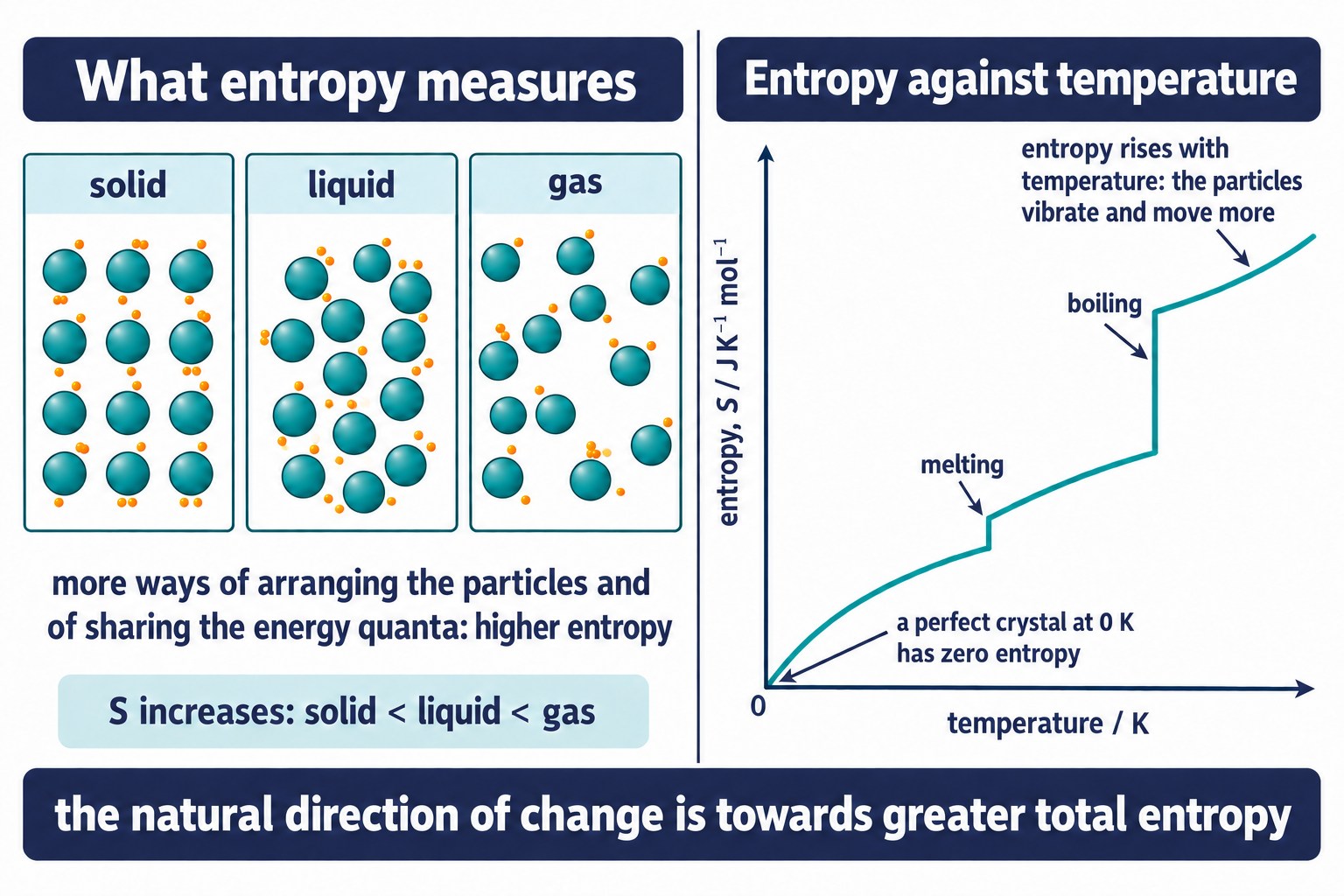
The same particles as a solid, liquid and gas with more ways of arranging them and their energy, and how entropy climbs with temperature, jumping at melting and boiling from zero at 0 K.
Definition: Entropy, S, is a measure of disorder: the number of ways the particles and their energy can be arranged. Units: J K⁻¹ mol⁻¹.
Remember: Entropy increases from solid to liquid to gas and rises with temperature; a perfect crystal at 0 K has zero entropy.
Check: What Entropy Measures
Rank substances and states by entropy and say how entropy changes with temperature, for substances not used on this page.
Why Entropy Changes
The entropy change of a process, ΔS, is positive if the products have more ways of arranging their particles and energy than the reactants, and negative if they have fewer.
Three kinds of change come up again and again. In each, the sign follows from the states and the numbers of particles.
Changes of state
- Melting and boiling free the particles to move, so ΔS is positive, and much larger for boiling than for melting.
- Freezing and condensing are the reverse, with negative ΔS.
- Warming a substance without a change of state also raises its entropy, because the extra energy quanta can be shared in more ways.
Dissolving an ionic lattice
- When sodium chloride dissolves, an ordered crystal becomes separate Na⁺ and Cl⁻ ions free to move anywhere in the solution, so the entropy of the ions rises greatly.
- There is a competing effect: each ion holds a shell of water molecules in place around it, so the water becomes more ordered.
- For most salts of singly charged ions the freeing of the ions wins and ΔS is positive, which is why so many endothermic salts dissolve.
- For small, highly charged ions the ordering of the water can make ΔS negative.
Changes in gas moles
Gases have such high entropies that they dominate the count. A reaction that makes more moles of gas than it uses has a positive ΔS; one that reduces the number of gas molecules has a negative ΔS.
| Reaction | Gas molecules | Sign of ΔS |
|---|---|---|
| CaCO₃(s) → CaO(s) + CO₂(g) | one solid becomes a solid and a gas | positive |
| N₂(g) + 3H₂(g) → 2NH₃(g) | four moles of gas become two | negative |
| 2Mg(s) + O₂(g) → 2MgO(s) | a gas is used up and none is made | negative |
| H₂(g) + Cl₂(g) → 2HCl(g) | unchanged | small; the sign cannot be predicted without data |
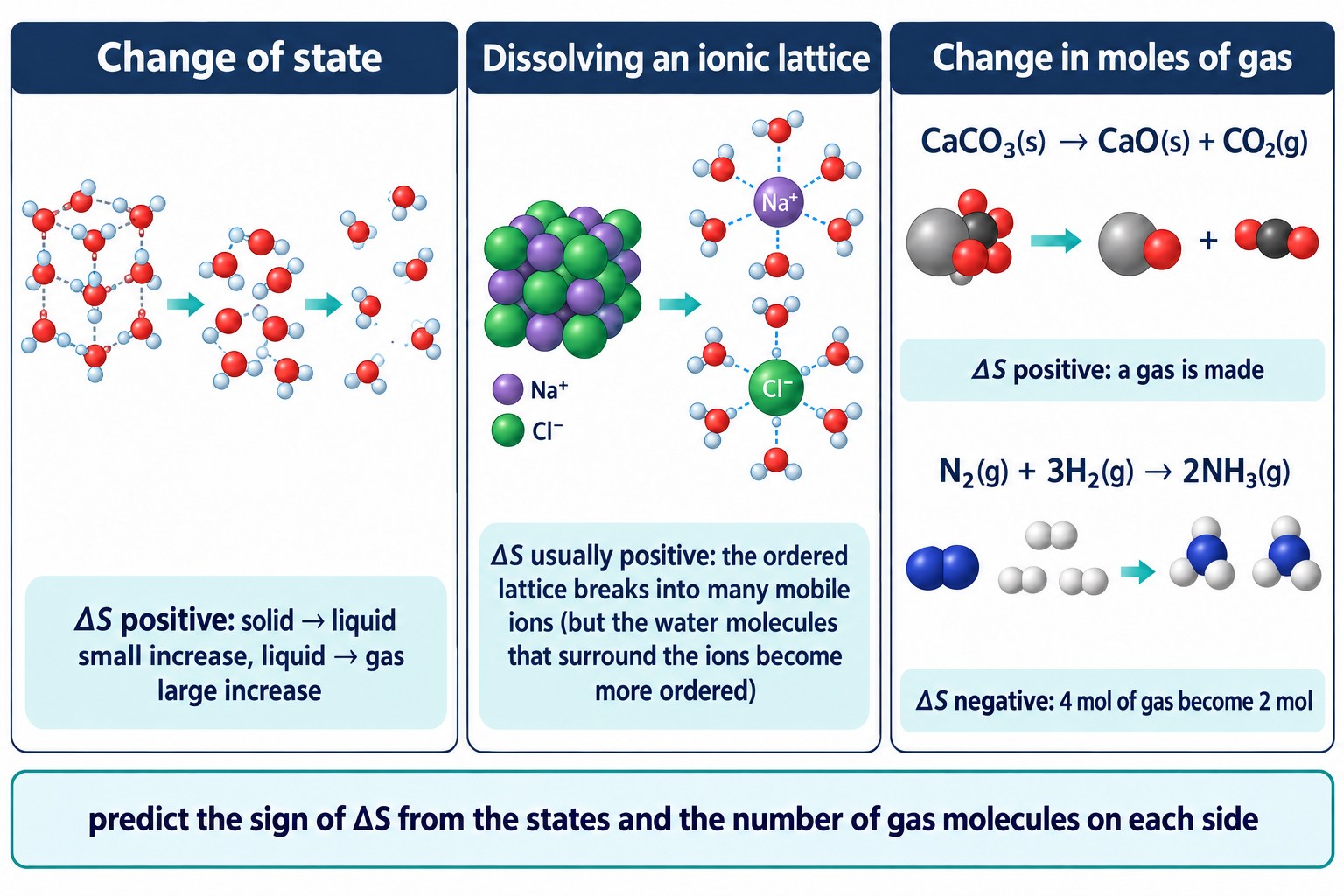
Why entropy changes: changes of state, an ionic lattice breaking into hydrated ions (with the water becoming more ordered around them), and reactions that make or use up gas molecules, each with the sign of ΔS.
Exam wording: “ΔS is positive because a gas is produced from a solid, so the products have more ways of arranging the particles and their energy.” Count the moles of gas on each side first; only if they are equal look further.
Check: Predicting the Sign of ΔS
Predict and explain the sign of the entropy change for changes of state, dissolving and reactions not used on this page.
The Natural Direction of Change
Open a bottle of perfume in a corner of a room and within minutes the smell is everywhere. The molecules never gather back into the bottle.
There are enormously more arrangements with the molecules spread through the room than with them all in one corner, so spreading out is overwhelmingly the more probable outcome.
The natural direction of change is the direction of increasing total entropy. Each of these increases the total number of arrangements, and none reverses itself:
- a gas filling a room
- two gases mixing
- a hot object cooling to room temperature
Why the total matters
The word total is essential, because a change can lower the entropy of the substances involved and still happen.
- Water freezes below 0 °C although ice has a lower entropy than liquid water.
- Magnesium burns although the reaction uses up a gas.
In each case heat is given out to the surroundings and spreads among their particles, raising their entropy.
- The reacting substances are the system; everything else is the surroundings.
- It is the sum that must be positive: ΔS_total = ΔS_system + ΔS_surroundings.
- The colder the surroundings, the more a given amount of heat raises their entropy, which is why freezing happens below 0 °C but not above.
The next two pages show how this idea is built into the Gibbs equation, which is the form you will use in calculations.
Key idea: Changes happen in the direction that increases the total entropy of the system and its surroundings. Heat given out to the surroundings raises their entropy, so an exothermic reaction can be feasible even when the entropy of the system falls.
Common Exam Points
Say
- “Entropy is a measure of disorder: the number of ways the particles and their energy can be arranged.”
- “ΔS is positive because the number of moles of gas increases.”
- “Endothermic reactions can be feasible because the increase in entropy outweighs the enthalpy change.”
- “A perfect crystal at 0 K has zero entropy.”
Do not say
- “Entropy is energy” (its units are J K⁻¹ mol⁻¹, not kJ mol⁻¹).
- “Elements have zero entropy” (they have zero enthalpy of formation, not zero entropy).
- “The reaction happens because it is exothermic” (some exothermic reactions do not happen, and some endothermic ones do).
Watch for
- Questions that ask you to explain the sign of ΔS without data: talk about states and moles of gas, and mention the ordering of water molecules when a salt dissolves.
- Questions about the direction of change: the answer is always in terms of the total entropy increasing, not the entropy of the reactants alone.
Check: The Direction of Change
Explain, in terms of entropy, why changes not described on this page happen or do not happen.
FAQs
Use these quick answers to check the entropy ideas that come up most often.
Why can an endothermic reaction happen on its own?
Because enthalpy is not the only thing that matters. If the entropy increase in the reaction is large enough to outweigh the energy taken in from the surroundings, the change is still feasible. Dissolving ammonium nitrate and the reaction of barium hydroxide with ammonium chloride are cold to the touch but happen on their own, driven by the gain in entropy.
Is entropy the same as disorder?
Disorder is the everyday picture, but entropy is really a measure of the number of ways the particles and their energy quanta can be arranged. The more arrangements available, the higher the entropy. A gas has far more ways to spread its molecules and energy than a solid, which is why it looks more disordered.
Why is the entropy of a gas so much bigger than that of a liquid or a solid?
Gas molecules move freely through the whole container, so there is an enormous number of positions and energies available to them. In a liquid the particles are close together but can still move past each other; in a solid they only vibrate about fixed positions. Boiling therefore causes a much bigger jump in entropy than melting.
Do elements have zero entropy?
No. Elements have zero enthalpy of formation by definition, but their standard entropies are positive, for example about 5.7 J K⁻¹ mol⁻¹ for graphite and 131 J K⁻¹ mol⁻¹ for hydrogen gas. Only a perfect crystal at 0 K has zero entropy, because there is then only one arrangement.
How do I predict the sign of ΔS without any data?
Count the gas molecules on each side, because gases dominate. More moles of gas on the product side means ΔS is positive; fewer means it is negative. If the gas count does not change, look at changes of state (solid to liquid to gas raises entropy) and dissolving a solid, which usually raises it.
Copyright and author footprint: This OLS revision page was written for Online Learning System by Dr. Mohammed Al-Fatah. It is designed for A Level Chemistry revision and should not be copied or redistributed without permission.
Keep this note — free
Save your progress across every AQA topic. A free account remembers which topics you have covered, saves your question scores, and syncs across your phone and laptop.
- Track every topic you have finished
- Keep your practice-question scores
- No payment, no card, free forever
Already registered? Log in