Lattice Enthalpy and Born–Haber Cycles
A concise revision guide to lattice enthalpy, the enthalpy changes of atomisation and electron affinity, how to construct a Born–Haber cycle for sodium chloride and magnesium chloride, and how to calculate lattice enthalpy or any other missing step from the cycle.
- 5.2.1(a)-i
- 5.2.1(a)-ii
- 5.2.1(b)(i)
- 5.2.1(b)(ii)
What these spec points say
- 5.2.1(a)-i explanation of the term lattice enthalpy (formation of 1 mol of ionic lattice from gaseous ions, ΔLEH)
- 5.2.1(a)-ii use of lattice enthalpy as a measure of the strength of ionic bonding in a giant ionic lattice (see also 2.2.2 b–c)
- 5.2.1(b)(i) use of the lattice enthalpy of a simple ionic solid (e.g. NaCl, MgCl2) and relevant energy terms for the construction of Born–Haber cycles
- 5.2.1(b)(ii) use of the lattice enthalpy of a simple ionic solid (e.g. NaCl, MgCl2) and relevant energy terms for related calculations
AS Recap: Hess’s Law and Ionic Bonding
Three quick questions on what you already know: Hess’s law, the standard enthalpy change of formation, and what holds the ions together in a giant ionic lattice.
What Lattice enthalpy Measures
When oppositely charged gaseous ions come together into a giant lattice, a great deal of energy is released. The lattice enthalpy measures how much.
- For sodium chloride, Na⁺(g) + Cl⁻(g) → NaCl(s) releases 787 kJ per mole of solid formed.
- So the lattice enthalpy of sodium chloride is −787 kJ mol⁻¹.
- It is always exothermic: the lattice is lower in energy than the separated ions.
Definition: Lattice enthalpy: the energy change when one mole of an ionic solid is formed from its gaseous ions under standard conditions. It is always negative (exothermic).
The lattice enthalpy is a direct measure of ionic bond strength: the more exothermic it is, the stronger the attraction between the ions.
It cannot be measured directly, because gaseous ions cannot be combined in a calorimeter. It is found from quantities that can be measured, linked by Hess’s law (from 3.2.1 Enthalpy Changes) in a Born–Haber cycle.
Exam wording: “The energy change when one mole of an ionic solid is formed from its gaseous ions.” Three details carry the marks: one mole, solid formed, ions gaseous.
A value that is quoted positive refers to the reverse process, breaking the lattice into gaseous ions. Its sign must be reversed before it goes into a cycle.
The Sodium Chloride Giant Ionic Lattice
Build sodium chloride from one Na+ and its six Cl− neighbours up to the unit cell and the giant lattice, then see how the structure explains its properties.
© Dr. Mohammed Al-Fatah – onlinelearningsystem.net
The Enthalpy Changes in the Cycle
A Born–Haber cycle turns the elements into gaseous ions one step at a time, and each step has a defined enthalpy change. Every definition refers to one mole of something, and the exact wording matters.
| Enthalpy change | Definition | Equation (sodium chloride) | Value / kJ mol⁻¹ |
|---|---|---|---|
| Enthalpy of formation, ΔfH | one mole of compound formed from its elements in their standard states | Na(s) + ½Cl₂(g) → NaCl(s) | −411 |
| Enthalpy of atomisation, ΔatH | one mole of gaseous atoms formed from the element in its standard state | Na(s) → Na(g); ½Cl₂(g) → Cl(g) | +107 (Na); +122 (Cl) |
| First ionisation energy, IE₁ | one mole of gaseous atoms each loses one electron to form gaseous 1+ ions | Na(g) → Na⁺(g) + e⁻ | +496 |
| Second ionisation energy, IE₂ | one mole of gaseous 1+ ions each loses one electron to form gaseous 2+ ions | Mg⁺(g) → Mg²⁺(g) + e⁻ | +1451 (Mg) |
| First electron affinity, EA₁ | one mole of gaseous atoms each gains one electron to form gaseous 1− ions | Cl(g) + e⁻ → Cl⁻(g) | −349 |
| Second electron affinity, EA₂ | one mole of gaseous 1− ions each gains one electron to form gaseous 2− ions | O⁻(g) + e⁻ → O²⁻(g) | +798 (O) |
Three of these need care.
- Atomisation makes one mole of atoms, not molecules, and it is always endothermic. For chlorine it is ½Cl₂(g) → Cl(g).
- So ΔatH(Cl) is half the Cl–Cl bond enthalpy: ½ × 244 = +122 kJ mol⁻¹.
- The first electron affinity is exothermic for the halogens and oxygen: the nucleus attracts the incoming electron.
- The second electron affinity is always endothermic: the electron is pushed onto an ion that is already negative, so repulsion must be overcome.
Exam wording: Ionisation energies and electron affinities are always for gaseous atoms or ions, and always per mole of electrons removed or gained. Write the state symbols in every equation.
Check: Definitions and Equations
Match each enthalpy change to its definition and its equation with state symbols, and decide which steps are endothermic, for compounds other than the ones on this page.
Building the Born–Haber Cycle for Sodium Chloride
The cycle is an energy level diagram. Start with the elements in their standard states, Na(s) + ½Cl₂(g), on a horizontal line.
Build upwards through the endothermic steps and downwards through the exothermic ones, ending at the solid.
- Atomise the sodium: Na(s) → Na(g), ΔatH = +107 kJ mol⁻¹, up.
- Ionise the sodium: Na(g) → Na⁺(g) + e⁻, IE₁ = +496, up.
- Atomise the chlorine: ½Cl₂(g) → Cl(g), ΔatH = +122, up.
- Add the electron to chlorine: Cl(g) + e⁻ → Cl⁻(g), EA₁ = −349, down to the gaseous ions Na⁺(g) + Cl⁻(g).
- Form the lattice: Na⁺(g) + Cl⁻(g) → NaCl(s), the lattice enthalpy, a long arrow down to the solid.
The direct route from elements to solid is the enthalpy of formation, ΔfH = −411, a shorter arrow down from the starting line.
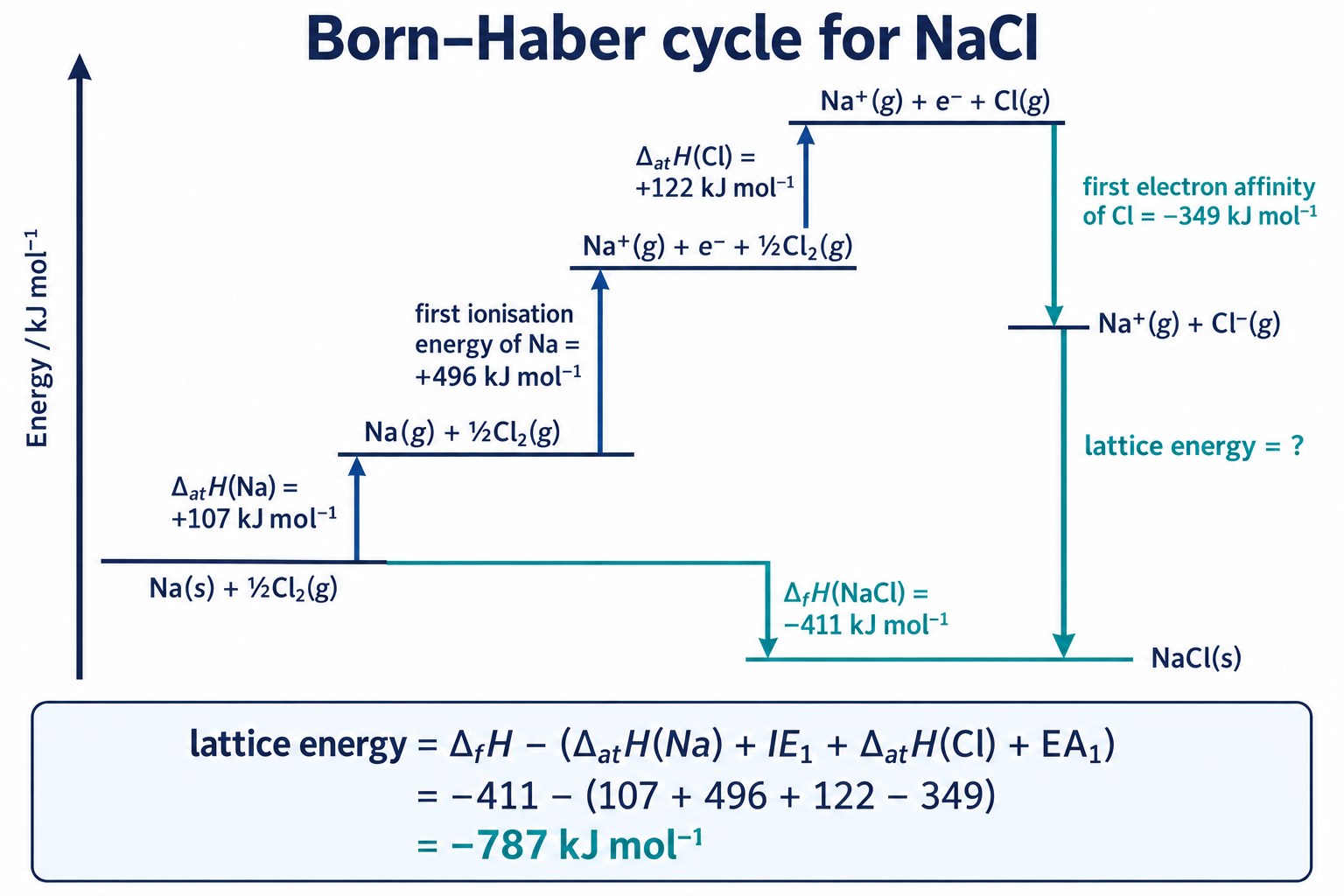
The Born–Haber cycle for sodium chloride as an energy level diagram: four steps up and down to the gaseous ions, then the lattice enthalpy down to the solid, with the enthalpy of formation as the direct route.
Hess’s law says the two routes from elements to solid have the same total enthalpy change:
ΔfH = ΔatH(Na) + IE₁(Na) + ΔatH(Cl) + EA₁(Cl) + LE
Step 1: rearrange for the lattice enthalpy, written LE.
LE = ΔfH − [ΔatH(Na) + IE₁(Na) + ΔatH(Cl) + EA₁(Cl)]
Step 2: substitute. Every value goes in with its own sign.
LE = −411 − (107 + 496 + 122 − 349)
Step 3: add up the bracket, then subtract it.
LE = −411 − 376
Answer: LE = −787 kJ mol⁻¹
Worked example: LE = ΔfH − (sum of the steps from the elements to the gaseous ions) = −411 − (+376) = −787 kJ mol⁻¹. A lattice forming must be exothermic, so a positive answer means an arithmetic slip.
Magnesium Chloride: Two Chlorines and a 2+ Ion
The cycle for MgCl₂ has the same shape with two changes.
- The formula has two chloride ions, so the chlorine steps are doubled.
- 2 × ΔatH(Cl) = 2 × 122 = +244 and 2 × EA₁(Cl) = 2 × (−349) = −698.
- The cation is Mg²⁺, so both ionisation energies are needed, one after the other: IE₁ = +738 and IE₂ = +1451.
With ΔatH(Mg) = +148 and ΔfH(MgCl₂) = −641:
LE = −641 − (148 + 738 + 1451 + 244 − 698) = −641 − 1883 = −2524 kJ mol⁻¹
The lattice enthalpy is more than three times that of sodium chloride. The 2+ ion attracts each chloride far more strongly, and there are twice as many of them.
That is why the large second ionisation energy is worth paying, and magnesium forms MgCl₂ rather than MgCl.
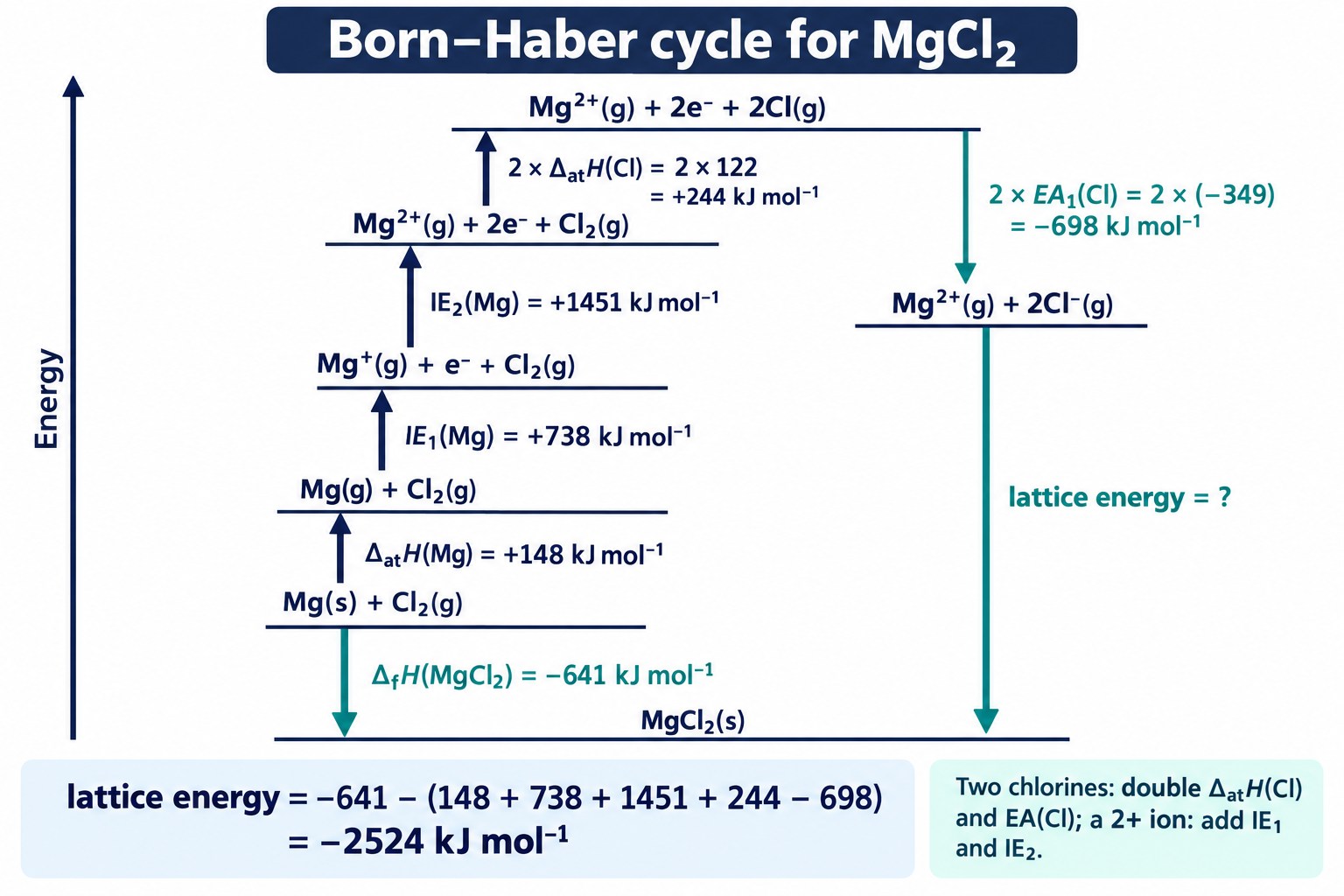
The Born–Haber cycle for magnesium chloride: two ionisation energies, doubled chlorine steps, and a lattice enthalpy of −2524 kJ mol⁻¹.
For an oxide such as MgO the anion is O²⁻, so the cycle needs both electron affinities of oxygen.
- EA₁ = −141 and EA₂ = +798, a total of +657 kJ mol⁻¹.
- The O²⁻ ion exists in the solid only because the lattice enthalpy of the oxide (−3791 kJ mol⁻¹ for MgO) repays that cost many times over.
Key idea: Multiply every step by the number of moles of that atom or ion in the formula, and include every ionisation energy or electron affinity up to the charge on the ion.
Check: Constructing and Reading a Cycle
Put the steps of a Born–Haber cycle in order, decide which arrows point up, and read a value from a completed cycle for a compound that is not on this page.
Finding a Different Unknown
Any step in the cycle can be the unknown. If the lattice enthalpy is known, a question may ask for the electron affinity, the enthalpy of formation or an ionisation energy instead.
The method is the same every time.
- Write the Hess equation for the cycle.
- Put in every known value with its sign.
- Rearrange for the unknown.
Example 1: for sodium chloride, find EA₁(Cl) given LE = −787.
EA₁ = ΔfH − ΔatH(Na) − IE₁ − ΔatH(Cl) − LE
EA₁ = −411 − 107 − 496 − 122 − (−787) = −349 kJ mol⁻¹
Subtracting a negative lattice enthalpy adds 787.
Example 2: find ΔfH given everything else. Add all the steps.
ΔfH = 107 + 496 + 122 − 349 − 787 = −411 kJ mol⁻¹
Two rules keep the algebra honest.
- An arrow going up the diagram enters the equation positive and one going down enters negative.
- A route that runs against an arrow reverses that value’s sign.
Exam focus: Set the two routes equal, substitute with signs, rearrange, then check the sign of the answer: formation and lattice values negative, atomisation and ionisation positive, first electron affinity negative for a halogen.
Common Exam Points
Say
- “Lattice enthalpy: the energy change when one mole of an ionic solid is formed from its gaseous ions.”
- “Enthalpy of atomisation: one mole of gaseous atoms from the element in its standard state.”
- “The second electron affinity is endothermic because an electron is added to an ion that is already negative, so repulsion must be overcome.”
Do not say
- “Atomisation of chlorine is Cl₂(g) → 2Cl(g)” (that is two moles of atoms, twice ΔatH).
- “Electron affinity is the energy needed to add an electron” (for a halogen it is released).
- “The lattice enthalpy of MgCl₂ includes one electron affinity” (two chlorides, two electron affinities).
Watch for
- A lattice enthalpy quoted as a positive value: it is a dissociation and its arrow points up.
- A question that gives the bond enthalpy of Cl₂ rather than the atomisation enthalpy: halve it.
- A Group 2 halide or an oxide, where a step is doubled or a second ionisation energy or electron affinity is added.
Check: Calculations With a Missing Step
Full Born–Haber calculations for compounds not on this page: find the lattice enthalpy, then an electron affinity or an enthalpy of formation, keeping every sign right.
FAQs
Use these quick answers to check the lattice enthalpy definitions and the Born–Haber cycle.
Why is the second electron affinity endothermic?
Because the second electron is being added to an ion that is already negative. The repulsion between the incoming electron and the O⁻ or S⁻ ion has to be overcome, so energy must be supplied. The first electron affinity of oxygen is exothermic, about −141 kJ mol⁻¹, but the second is about +798 kJ mol⁻¹.
Which way does the lattice enthalpy arrow point?
Downwards. Lattice enthalpy is defined for gaseous ions coming together to form one mole of the solid ionic lattice, so it is always exothermic and the value is negative. In a Born–Haber cycle it is the final step from the gaseous ions to the solid.
Why do I have to include the enthalpy of atomisation for the non-metal as well as the metal?
Because the cycle must start from the elements in their standard states and turn every one of them into separate gaseous atoms before ions can be made. For a chloride that means breaking half a mole of Cl₂ per mole of Cl⁻, so ΔatH for chlorine (about +121 kJ mol⁻¹) is needed once for KCl and twice for CaCl₂.
Why do I sometimes have to double an ionisation energy or electron affinity?
Because the cycle is per mole of compound, and a formula such as CaBr₂ needs two moles of Br⁻. Every quantity that refers to bromine, the atomisation and the first electron affinity, is multiplied by two, while the calcium terms, two successive ionisation energies, appear once each.
How do I avoid sign errors when calculating the missing value?
Write the cycle as a Hess route: going round one way must equal going round the other. Enthalpy of formation equals the sum of atomisation, ionisation and electron affinity terms plus the lattice term. Rearrange once for the unknown, substitute with every sign attached, and check the answer makes sense, for example that a lattice value is large and negative.
Copyright and author footprint: This OLS revision page was written for Online Learning System by Dr. Mohammed Al-Fatah. It is designed for A Level Chemistry revision and should not be copied or redistributed without permission.
Keep this note — free
Save your progress across every OCR A topic. A free account remembers which topics you have covered, saves your question scores, and syncs across your phone and laptop.
- Track every topic you have finished
- Keep your practice-question scores
- No payment, no card, free forever
Already registered? Log in