Enthalpy of Solution and Hydration
A concise revision guide to the enthalpy changes of solution and hydration: their definitions, the energy cycle and energy level diagram that link them to lattice enthalpy, the calculation for sodium chloride, and how ionic charge and radius decide the size of the hydration enthalpy.
- 5.2.1(c)(i)
- 5.2.1(c)(ii)
- 5.2.1(d)(i)
- 5.2.1(d)(ii)
- 5.2.1(e)-iii
- 5.2.1(e)-iv
What these spec points say
- 5.2.1(c)(i) explanation and use of the term enthalpy change of solution (dissolving of 1 mol of solute, ΔsolH)
- 5.2.1(c)(ii) explanation and use of the term enthalpy change of hydration (dissolving of 1 mol of gaseous ions in water, ΔhydH)
- 5.2.1(d)(i) use of the enthalpy change of solution of a simple ionic solid (e.g. NaCl, MgCl2) and relevant energy terms (enthalpy change of hydration and lattice enthalpy) for the construction of enthalpy cycles
- 5.2.1(d)(ii) use of the enthalpy change of solution of a simple ionic solid (e.g. NaCl, MgCl2) and relevant energy terms (enthalpy change of hydration and lattice enthalpy) for related calculations
- 5.2.1(e)-iii qualitative explanation of the effect of ionic charge on the exothermic value of an enthalpy change of hydration
- 5.2.1(e)-iv qualitative explanation of the effect of ionic radius on the exothermic value of an enthalpy change of hydration
Two Definitions
Dissolving an ionic solid in water is a two-part process.
- The lattice is pulled apart into separate ions, which costs energy.
- Each ion is then surrounded by water molecules, which releases energy.
The overall change and the second part each have a named enthalpy change.
Definition: Enthalpy change of solution, ΔsolH: the enthalpy change when one mole of a solute dissolves in enough water that further dilution causes no further enthalpy change. Example: NaCl(s) + aq → Na⁺(aq) + Cl⁻(aq).
Definition: Enthalpy change of hydration, ΔhydH: the enthalpy change when one mole of gaseous ions forms one mole of aqueous ions. Example: Na⁺(g) + aq → Na⁺(aq). It is always exothermic.
Notice the states.
- Hydration starts from gaseous ions, exactly where the lattice enthalpy ends, which is what lets the three quantities be joined in one cycle.
- Solution starts from the solid and may be exothermic or endothermic, depending on which of the two parts is larger.
- Each ion has its own hydration enthalpy, so a compound has one ΔsolH but a separate ΔhydH for each kind of ion.
- Each ΔhydH is multiplied by the number of that ion in the formula.
Exam wording: Solution: “one mole of solute dissolves in enough water for no further enthalpy change on dilution” (the “infinitely dilute” condition). Hydration: “one mole of gaseous ions is converted to one mole of aqueous ions”.
The Energy Cycle
The cycle has three corners: the solid, the gaseous ions and the aqueous ions.
- Solid to gaseous ions is the reverse of forming the lattice, so its enthalpy change is −LE.
- Gaseous ions to aqueous ions is the sum of the hydration enthalpies.
- By Hess’s law the direct route, ΔsolH, equals the sum of the two.
ΔsolH = −LE + ΣΔhydH
For sodium chloride: LE = −787 kJ mol⁻¹, ΔhydH(Na⁺) = −406 and ΔhydH(Cl⁻) = −378.
Step 1: break the lattice. NaCl(s) → Na⁺(g) + Cl⁻(g) needs +787.
Step 2: hydrate the ions. Na⁺(g) + Cl⁻(g) → Na⁺(aq) + Cl⁻(aq) releases −406 + (−378) = −784.
Step 3: add the two.
ΔsolH = +787 − 784 = +3 kJ mol⁻¹
Dissolving sodium chloride is very slightly endothermic, which is why the water cools a little.
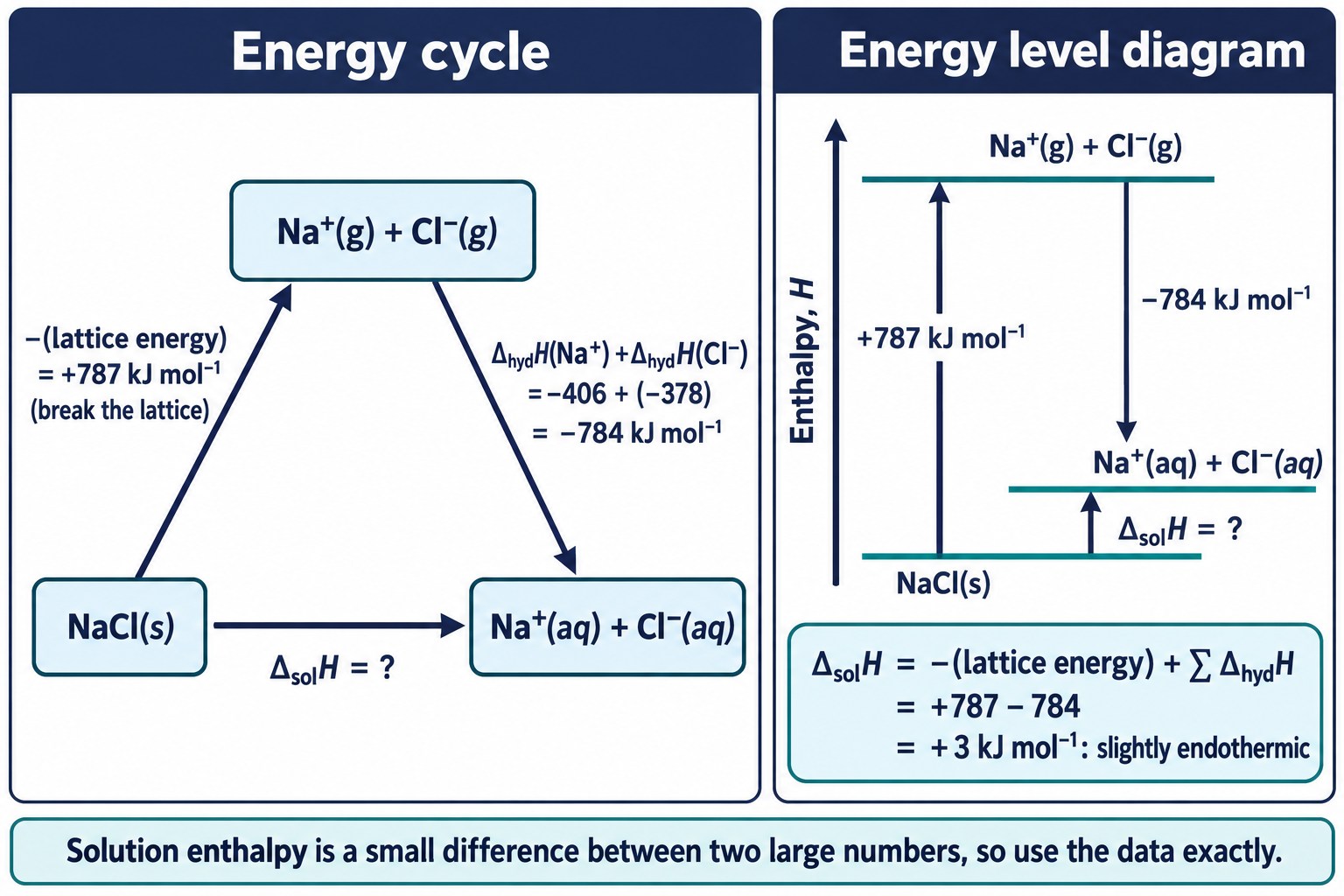
The energy cycle and the energy level diagram for dissolving sodium chloride: up by −LE to the gaseous ions, down by the two hydration enthalpies to the aqueous ions, and the small enthalpy of solution as the direct route.
The same data draw as an energy level diagram.
- The gaseous ions sit at the top, the solid at the bottom, and the aqueous ions just 3 kJ mol⁻¹ above the solid.
- The arrow up from the solid is the lattice enthalpy reversed.
- The arrow down is the total hydration enthalpy.
- ΔsolH is the small gap between the two lower levels.
Questions use either form, and the arithmetic is identical.
The sign of the first step trips people up.
- The lattice enthalpy is the enthalpy change for forming the lattice, −787 kJ mol⁻¹.
- The cycle uses the reverse, breaking it, so the value goes in as +787.
- Write −LE and substitute, rather than trying to remember whether the answer “should” be positive.
Worked example: ΔsolH = −LE + ΣΔhydH = −(−787) + (−406 − 378) = +787 − 784 = +3 kJ mol⁻¹. For MgCl₂ the chloride term is doubled: ΔsolH = −LE + ΔhydH(Mg²⁺) + 2ΔhydH(Cl⁻).
Check: The Cycle and the Calculation
Build the solution cycle for a salt not used on this page, decide the direction of each arrow, and calculate the missing enthalpy change from the other two.
Why Hydration Is Exothermic and What Decides Its Size
Water is polar, so its molecules turn to face an ion.
- Around a cation the water molecules turn their δ− oxygen atoms inwards.
- Around an anion they turn their δ+ hydrogen atoms inwards.
- The ion–dipole attractions that form release energy, so the hydration enthalpy is always exothermic.
How exothermic depends on how strongly the ion attracts the water dipoles, which is the same charge density argument that decides the lattice enthalpy.
| Ion | Ionic radius / pm | ΔhydH / kJ mol⁻¹ | What the comparison shows |
|---|---|---|---|
| Mg²⁺ | 72 | −1926 | small and 2+: very strong attraction to water |
| Ba²⁺ | 135 | −1305 | same charge, larger radius: weaker attraction |
| Na⁺ | 102 | −406 | similar size to Mg²⁺ but only 1+: far weaker |
| F⁻ | 133 | −506 | small anion: strong attraction to the δ+ hydrogens |
| Cl⁻ | 181 | −364 | same charge, larger radius: weaker attraction |
Two rules follow.
- A smaller ion has a more exothermic hydration enthalpy, because the water dipoles get closer to the centre of charge: F⁻ against Cl⁻, Mg²⁺ against Ba²⁺.
- A higher charge gives a much more exothermic hydration enthalpy, because the field around the ion is stronger and more water molecules are held more tightly: Mg²⁺ against Na⁺.
Charge matters more than radius, exactly as it does for the lattice enthalpy.
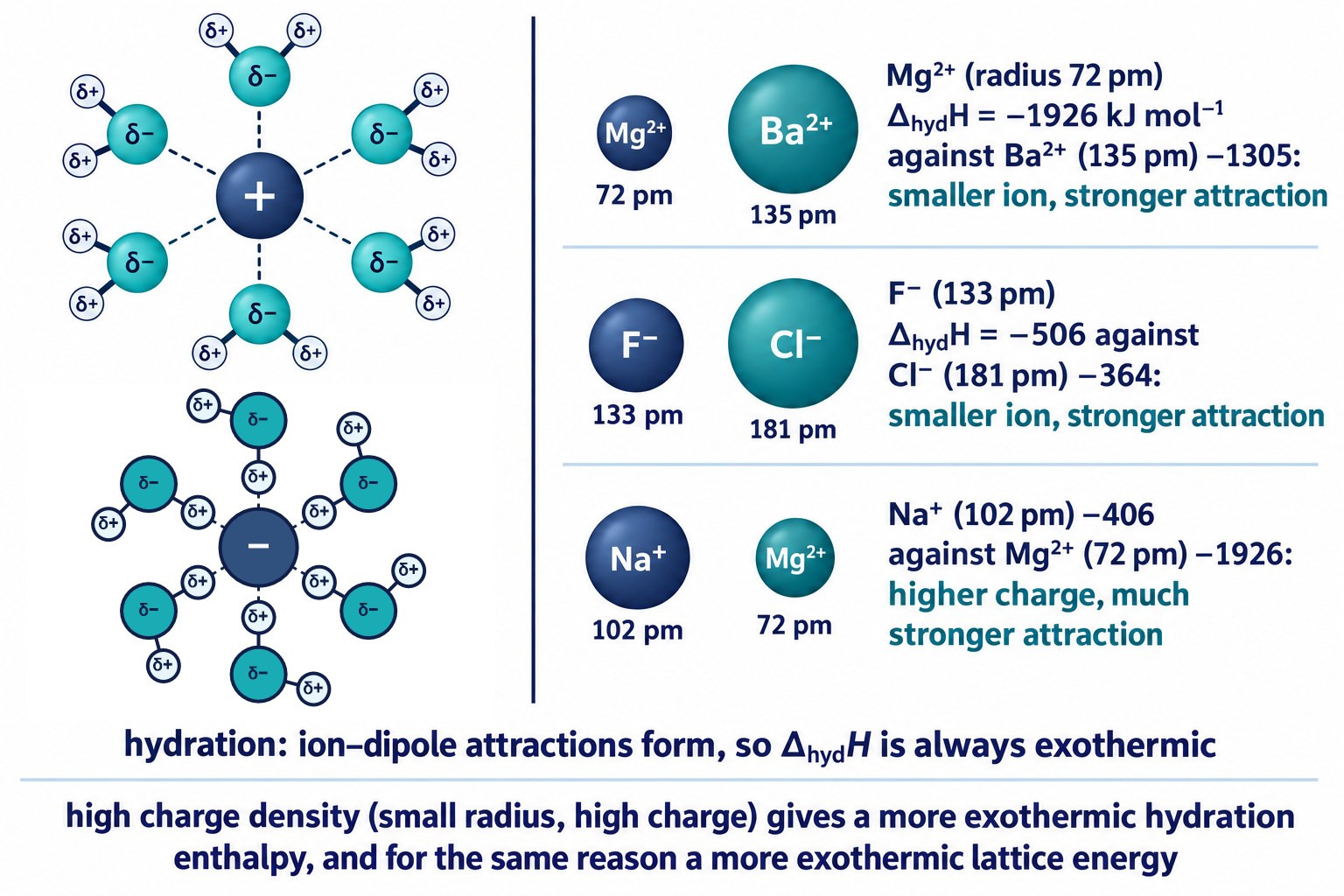
Water molecules oriented around a cation (oxygen inwards) and an anion (hydrogen inwards), with Mg²⁺ against Ba²⁺ and F⁻ against Cl⁻ compared.
Key idea: Both the lattice enthalpy and the hydration enthalpy become more exothermic with higher ionic charge and smaller ionic radius. The enthalpy of solution is the difference between them, so it depends on which of the two responds more.
Check: Charge and Radius Effects
Compare the hydration enthalpies of pairs of ions not used on this page and explain the difference in terms of charge, radius and ion–dipole attraction.
Reading ΔsolH
An enthalpy of solution is a small difference between two large numbers.
- Sodium chloride needs 787 kJ mol⁻¹ to break the lattice and gets 784 back from hydration.
- The result, +3, is smaller than the uncertainty in either figure.
- So questions expect you to use the data given exactly and not to round early.
| ΔsolH | What it usually means | Example |
|---|---|---|
| Exothermic | almost always a soluble salt | lithium chloride, anhydrous magnesium chloride |
| Slightly endothermic | often freely soluble: the entropy gain outweighs the small enthalpy cost | sodium chloride |
| Very endothermic | usually insoluble: dissolving is not feasible | silver chloride |
A slightly endothermic ΔsolH does not stop a salt dissolving. The ions spreading through the water bring a large gain in entropy that outweighs the small enthalpy cost.
A very endothermic ΔsolH means the lattice enthalpy is so much larger than the hydration enthalpies can repay that dissolving is not feasible.
Silver chloride is a familiar case, with a lattice enthalpy strengthened by covalent character that hydration cannot match.
The same two factors, the lattice enthalpy falling and the hydration enthalpy falling at different rates down a group, are behind the solubility trends of the Group 2 hydroxides and sulfates in 3.1.2 Group 2.
Exam focus: Explain a difference in ΔsolH by naming the two terms that make it up, saying which one changed more and why (charge, radius) and then giving the sign of the result.
Check: Interpreting Solution Enthalpies
Use given values of the lattice enthalpy and hydration enthalpies for salts not on this page to decide the sign of ΔsolH and to comment on what it suggests about solubility.
Common Exam Points
Say
- “Enthalpy of hydration: one mole of gaseous ions forms one mole of aqueous ions.”
- “The hydration enthalpy is exothermic because ion–dipole attractions form between the ion and water molecules.”
- “ΔsolH = −(lattice enthalpy) + the sum of the hydration enthalpies.”
Do not say
- “Hydration is when the solid dissolves in water” (that is solution; hydration starts from gaseous ions).
- “The lattice enthalpy is added” when the cycle needs its reverse.
- “Mg²⁺ has a more exothermic hydration enthalpy because it is more reactive” (it is smaller and more highly charged).
Watch for
- A formula with two anions (MgCl₂, CaBr₂): double the anion hydration enthalpy.
- A value quoted as an enthalpy of lattice dissociation, which goes into the cycle positive as it is.
- A question that gives ΔsolH and asks for a hydration enthalpy: rearrange the same equation.
FAQs
Use these quick answers to check the enthalpy of solution and hydration ideas.
Why is hydration always exothermic?
Because new attractions are being made without any being broken. Water is polar, so its δ− oxygen atoms cluster round a cation and its δ+ hydrogen atoms round an anion, and forming those ion–dipole attractions releases energy. There is no lattice to break in the hydration step; that cost belongs to the lattice term.
How are enthalpy of solution, lattice enthalpy and hydration enthalpy linked?
Dissolving can be imagined as two steps: pull the lattice apart into gaseous ions, then hydrate each ion. So ΔsolH = −(lattice enthalpy) + sum of the hydration enthalpies. Remember to count each hydration term once per mole of that ion in the formula.
Why is the enthalpy of solution often close to zero?
Because it is the small difference between two very large numbers. Breaking the lattice might cost about +750 kJ mol⁻¹ and hydrating the ions might release about −740 kJ mol⁻¹, leaving a solution enthalpy of only about +10 kJ mol⁻¹. That is why many salts dissolve with barely any temperature change.
Why does Mg²⁺ have a much more exothermic hydration enthalpy than Na⁺?
Because it has twice the charge in a smaller ion, so its charge density is far higher and it attracts the δ− oxygen of water much more strongly. Hydration enthalpy becomes more exothermic as the charge increases and as the radius decreases, the same two factors that control the size of the lattice term.
Does a positive enthalpy of solution mean the salt will not dissolve?
No. Many salts with a small positive ΔsolH, such as potassium nitrate, dissolve readily because the entropy of the ions and water increases when the lattice breaks up. A positive ΔsolH only makes dissolving less likely and, usually, makes the solubility rise with temperature.
Copyright and author footprint: This OLS revision page was written for Online Learning System by Dr. Mohammed Al-Fatah. It is designed for A Level Chemistry revision and should not be copied or redistributed without permission.
Keep this note — free
Save your progress across every OCR A topic. A free account remembers which topics you have covered, saves your question scores, and syncs across your phone and laptop.
- Track every topic you have finished
- Keep your practice-question scores
- No payment, no card, free forever
Already registered? Log in