Core Practical 1: Molar Volume of a Gas
A guided Edexcel A Level Chemistry revision walkthrough for measuring the molar volume of carbon dioxide using calcium carbonate, ethanoic acid, gas collection over water, graphing and mole calculations.
What Does This Practical Measure?
The aim of this core practical is to find the volume occupied by one mole of carbon dioxide gas. The experiment produces carbon dioxide by reacting calcium carbonate with ethanoic acid, then measures the volume of gas collected.
Different masses of calcium carbonate produce different volumes of carbon dioxide. These results are plotted on a graph, then the graph is used to estimate the volume of carbon dioxide made from 0.25 g of CaCO3.
Key idea: One mole of calcium carbonate produces one mole of carbon dioxide, so the moles of CO2 are equal to the moles of CaCO3 used.
Measuring Gas Volumes
Gas volumes can be measured using a gas syringe or by collecting gas over water. In this practical, carbon dioxide is collected over water in an upturned measuring cylinder.
A gas syringe can reduce some errors because the gas is measured directly without dissolving in water. Collection over water is still useful, but it is most suitable for gases that are not very soluble and do not react with water.
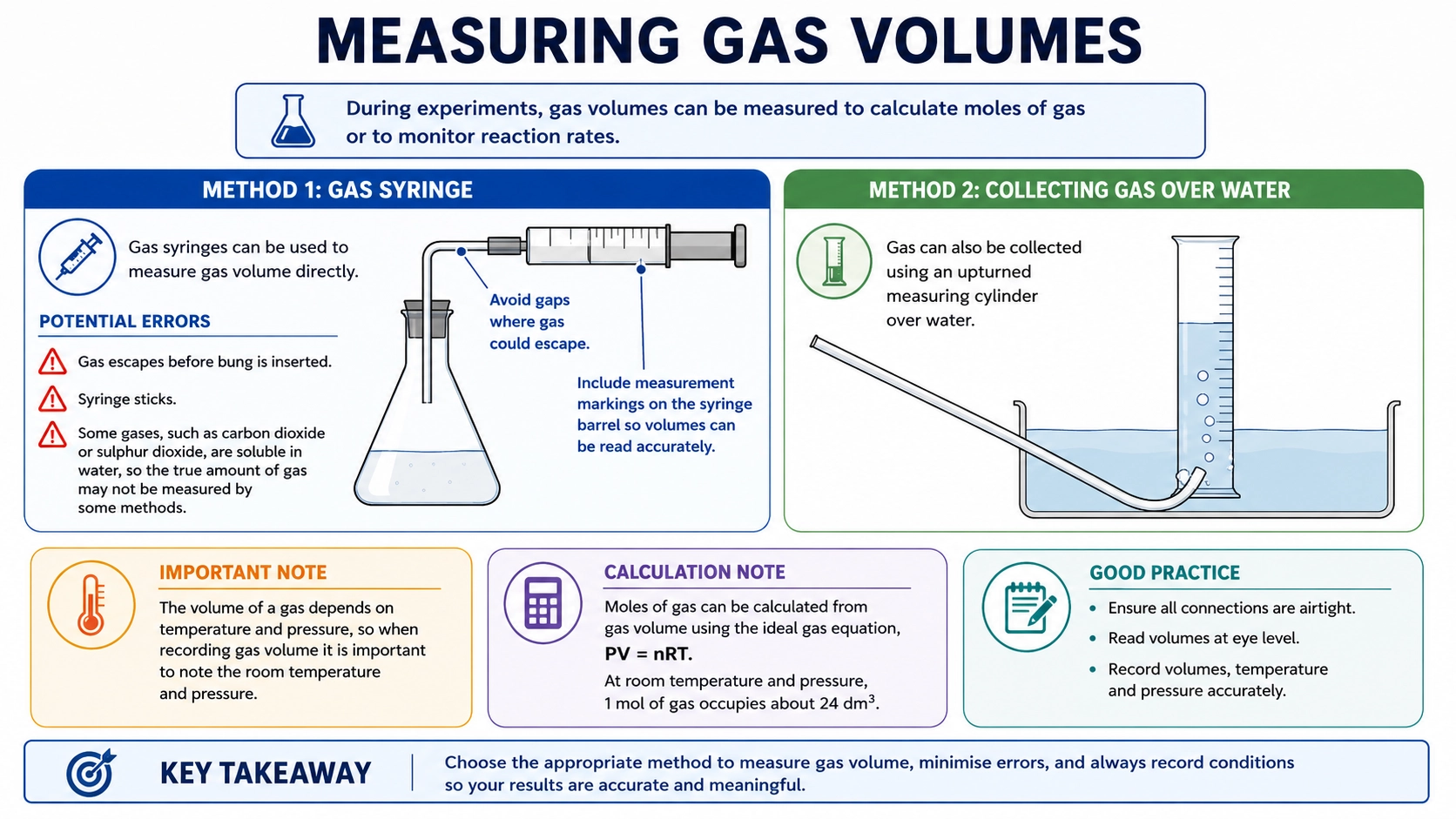
This visual compares gas syringes with collection over water, including common errors such as gas escape, syringe sticking and gases dissolving in water.
How the Apparatus Collects Carbon Dioxide
The reaction takes place in a boiling tube or similar reaction vessel containing ethanoic acid. Calcium carbonate is added, the bung is replaced quickly, and carbon dioxide travels through the delivery tube into the upturned measuring cylinder.
The carbon dioxide collects at the top of the measuring cylinder and displaces water. The volume of gas collected is then read from the graduations in cm3.
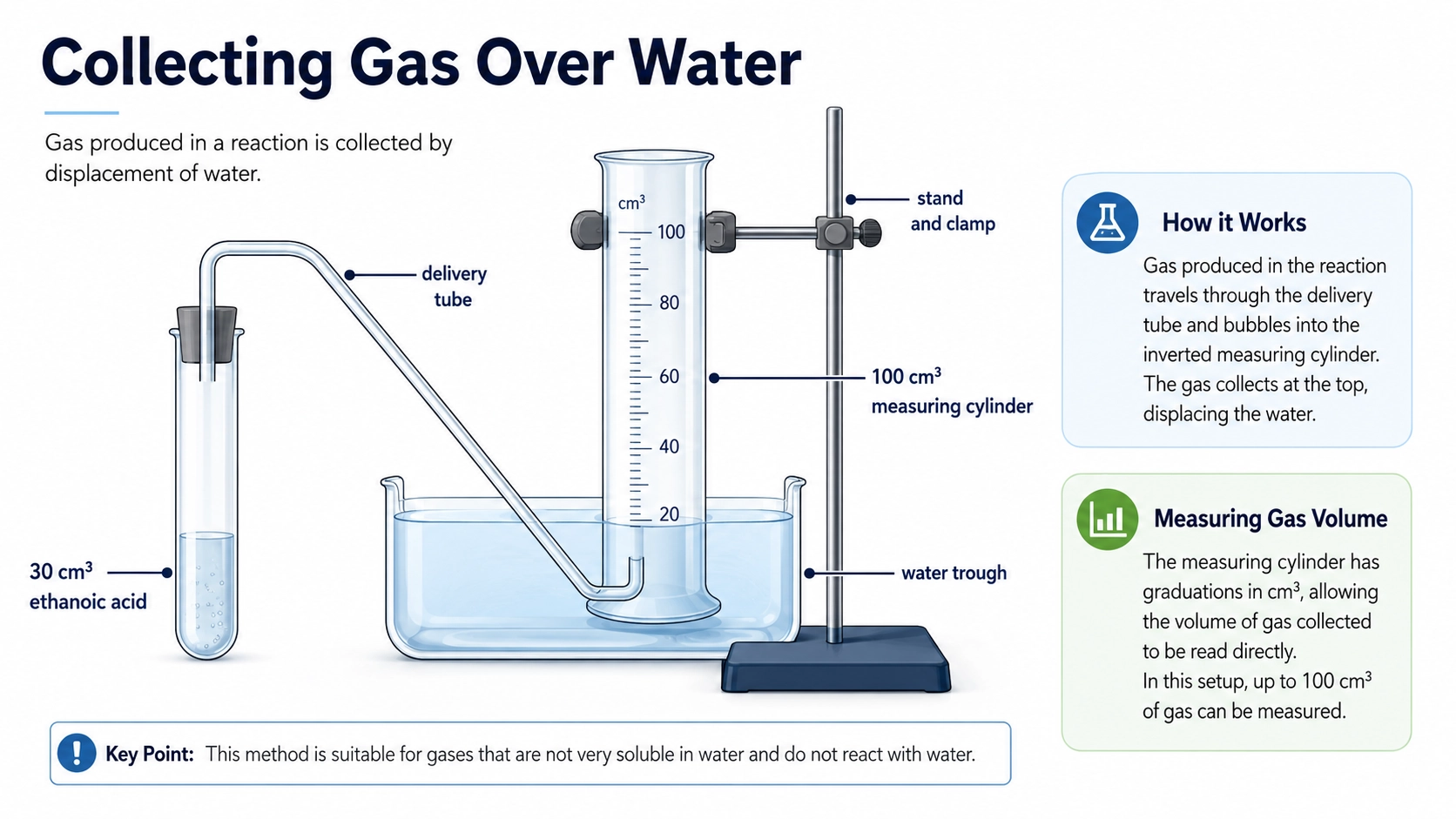
The delivery tube carries CO2 into the inverted measuring cylinder, where the gas displaces water and its volume is read directly.
Practical warning: The bung must be replaced quickly after adding CaCO3. Any gas produced before the bung is fitted will escape and make the measured gas volume too low.
Step-by-Step Method
The method is designed so that the actual mass of calcium carbonate transferred into the reaction vessel is known accurately. This is why the test tube is weighed before and after tipping out the solid.
Set up the gas collection apparatus with the delivery tube leading into an upturned measuring cylinder filled with water.
Measure 30 cm3 of 1 mol dm-3 ethanoic acid and place it in the reaction vessel.
Place about 0.05 g of powdered calcium carbonate into a test tube. Weigh the test tube and contents accurately.
Add the calcium carbonate to the ethanoic acid and quickly replace the bung to minimise gas loss.
When the reaction stops, record the volume of carbon dioxide collected in cm3.
Reweigh the test tube. The difference between the two masses gives the mass of CaCO3 actually used.
Repeat using larger masses of CaCO3, increasing by about 0.05 g each time. Do not exceed 0.40 g.
Why not exceed 0.40 g? Larger masses may produce more carbon dioxide than the 100 cm3 measuring cylinder can hold.
Using the Experimental Data
The raw results show how the volume of carbon dioxide changes as the mass of calcium carbonate increases. Experimental data is not perfectly neat, so the graph is used to find a more reliable trend.
| Mass of CaCO3 / g | Volume of CO2 collected / cm3 | What the result shows |
|---|---|---|
| 0.05 | 11 | Small mass gives a small gas volume. |
| 0.11 | 27 | Gas volume increases as mass increases. |
| 0.17 | 32 | This point is below the overall trend, showing experimental variation. |
| 0.21 | 50 | Close to the straight-line trend. |
| 0.24 | 59 | Useful point near the 0.25 g graph reading. |
| 0.32 | 74 | Higher mass gives a larger gas volume. |
| 0.33 | 80 | Close to the expected high-mass region. |
Graph rule: Plot mass of CaCO3 on the x-axis and volume of CO2 on the y-axis. The straight line of best fit should pass through the origin because zero CaCO3 should produce zero CO2.
Interactive Graph: From Data to Molar Volume
Calculating the Molar Volume
After plotting the graph, read the volume of carbon dioxide produced from 0.25 g of CaCO3. The sample graph gives about 60 cm3 of CO2.
moles of CaCO3 = 0.25 ÷ 100.1 = 0.00250 mol
The balanced equation shows a 1:1 mole ratio between CaCO3 and CO2, so:
molar volume = 60 ÷ 0.00250 = 24 000 cm3 mol-1
24 000 cm3 mol-1 = 24 dm3 mol-1
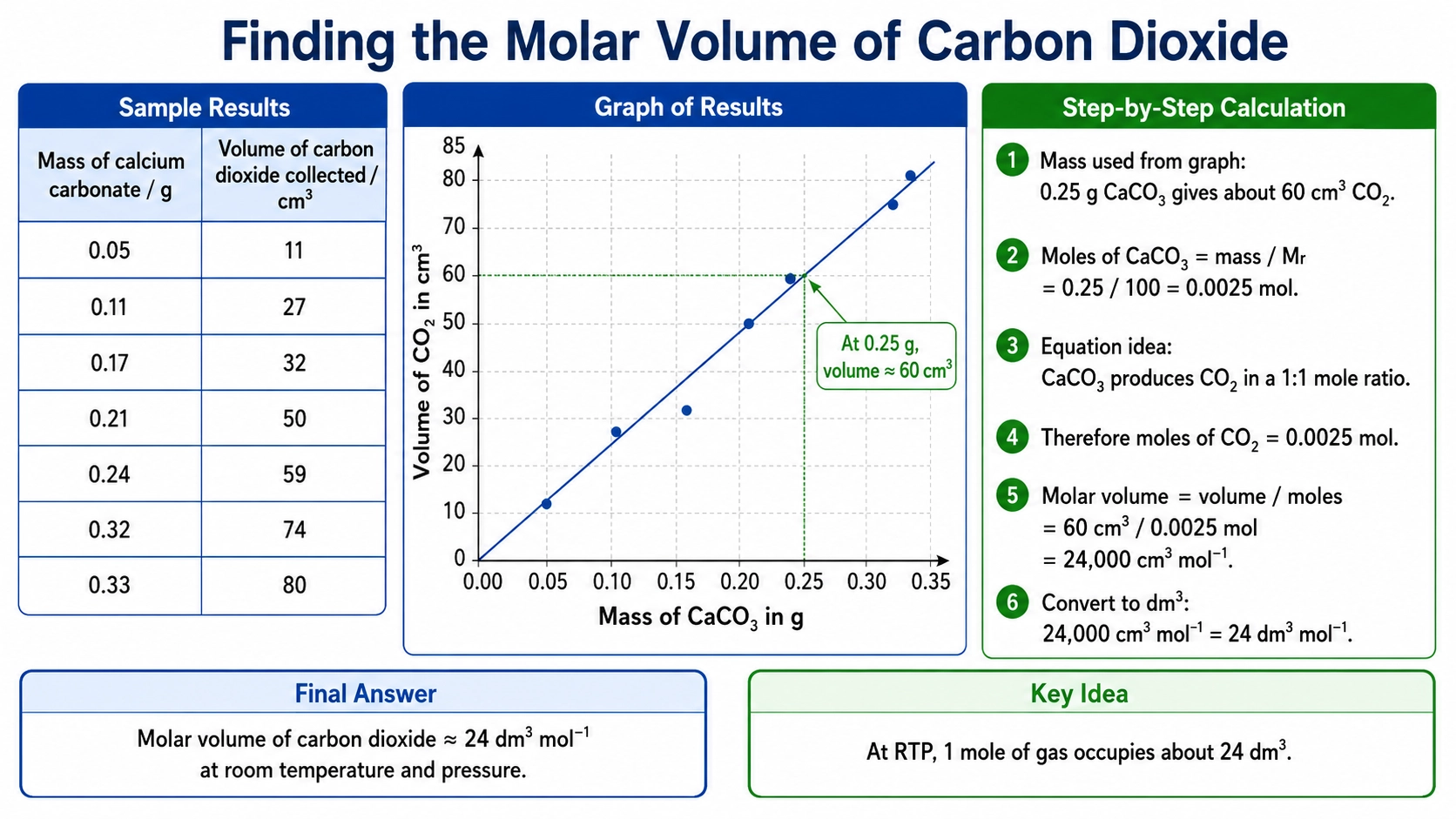
This worked visual connects the data table, graph read-off at 0.25 g and final molar volume calculation.
Checking That Ethanoic Acid Is in Excess
For the experiment to work properly, calcium carbonate should be the limiting reagent. This means the ethanoic acid must be in excess, even when the largest allowed mass of calcium carbonate is used.
moles of CaCO3 = 0.40 ÷ 100.1 = 0.003996 mol
moles of CH3COOH = 1.00 × 30 ÷ 1000 = 0.030 mol
The equation needs 2 moles of ethanoic acid for every 1 mole of calcium carbonate.
acid available = 0.030 mol
Conclusion: 0.030 mol of acid is much greater than 0.00799 mol needed, so ethanoic acid is in excess in all experimental runs.
Errors, Limitations and Improvements
Practical questions often test whether you can identify the main source of error and explain how it affects the calculated molar volume.
| Issue | Effect on result | Improvement |
|---|---|---|
| Gas escapes before the bung is replaced. | Measured CO2 volume is too low, so calculated molar volume is too low. | Use a sealed mixing arrangement or replace the bung as quickly as possible. |
| Carbon dioxide is slightly soluble in water. | Some CO2 is not collected, so the gas volume is too low. | Use a gas syringe instead of collecting the gas over water. |
| Delivery tube becomes blocked. | Gas cannot pass through safely and pressure can build up. | Remove the bung, clear the blockage, and repeat the experiment from the start. |
| Small mass has a high percentage uncertainty. | The calculated amount of CaCO3 is less reliable. | Use an appropriate balance and avoid relying on very small masses alone. |
Exam trap: Do not discard the first bubbles of gas. They are air displaced from the delivery tube, and the volume of CO2 left in the delivery tube at the end balances this.
Common Exam Points
- State the correct equation for CaCO3 reacting with CH3COOH.
- Explain why weighing the test tube before and after is more accurate than assuming all solid is transferred.
- Explain why the straight line should pass through the origin.
- Use the graph to read a gas volume for a chosen mass of CaCO3.
- Calculate moles of CaCO3 from mass and molar mass.
- Use the 1:1 mole ratio to find moles of CO2.
- Explain why gas loss or dissolving CO2 makes the calculated molar volume too low.
- Suggest a gas syringe as an improvement when the gas is soluble in water.
Core Practical 1 FAQs
These questions focus on the main exam points for measuring molar volume, interpreting the graph and evaluating the practical method.
Why is the bung replaced quickly?
The bung is replaced quickly to reduce the amount of carbon dioxide lost before the gas enters the delivery tube. Gas loss makes the measured volume too low.
Why is the line of best fit drawn through the origin?
If no calcium carbonate is used, no carbon dioxide should be produced. This means the graph should pass through zero mass and zero gas volume.
Why use 0.25 g of calcium carbonate for the calculation?
The graph is used to read the volume of carbon dioxide produced by 0.25 g of calcium carbonate. This mass is then converted into moles, allowing molar volume to be calculated.
Why can a gas syringe improve the experiment?
A gas syringe measures gas directly and avoids the problem of carbon dioxide dissolving in water during collection over water.
Why should the first bubbles not be ignored?
The first bubbles are air displaced from the delivery tube. The volume of carbon dioxide left in the delivery tube at the end balances this, so ignoring the first bubbles introduces an error.