CP4: Hydrolysis of Halogenoalkanes
In this core practical, you compare how quickly different halogenoalkanes hydrolyse. The rate is measured by timing how long it takes for a silver halide precipitate to appear after aqueous silver nitrate is added.
What This Practical Is Testing
This practical compares the relative rates of hydrolysis of different halogenoalkanes. Hydrolysis is the reaction of a molecule with water. For halogenoalkanes, water acts as a nucleophile and the product is an alcohol plus a halide ion.
The experiment has two linked comparisons. In Part 1, you compare primary chloro-, bromo- and iodoalkanes. In Part 2, you compare primary, secondary and tertiary bromoalkanes.
Hydrolyse
Water reacts with the halogenoalkane and releases a halide ion, X–.
Detect
Ag+ ions from silver nitrate react with X– to form a silver halide precipitate.
Compare
The shorter the time taken for cloudiness to appear, the faster the hydrolysis reaction.
Key idea: Silver nitrate does not cause the hydrolysis. It provides Ag+ ions so the halide ion formed by hydrolysis can be detected as a precipitate.
Safety and Apparatus
Wear eye protection and avoid skin contact with the reactants. Ethanol and halogenoalkanes are highly flammable, so there must be no naked flames. The laboratory should also be well ventilated because halogenoalkanes can produce fumes.
Solutions and chemicals
1-chlorobutane, 1-bromobutane, 1-iodobutane, 2-bromobutane, 2-bromo-2-methylpropane, ethanol and 0.05 mol dm-3 silver nitrate solution.
Equipment
250 cm3 beaker, test tubes with bungs, dropping pipettes, measuring cylinders, labels, stop clock and a kettle for preparing the warm water bath.
The Five Halogenoalkanes Used
Before interpreting the results, identify which halogenoalkanes are primary, secondary and tertiary. This matters because Part 2 compares how the structure of the halogenoalkane affects the rate of hydrolysis.
| Halogenoalkane | Classification | Where it is used | Comparison being made |
|---|---|---|---|
| 1-chlorobutane | Primary | Part 1 | Effect of different halogens |
| 1-bromobutane | Primary | Part 1 and Part 2 | Halogen comparison and structure comparison |
| 1-iodobutane | Primary | Part 1 | Effect of different halogens |
| 2-bromobutane | Secondary | Part 2 | Effect of primary, secondary and tertiary structure |
| 2-bromo-2-methylpropane | Tertiary | Part 2 | Effect of primary, secondary and tertiary structure |
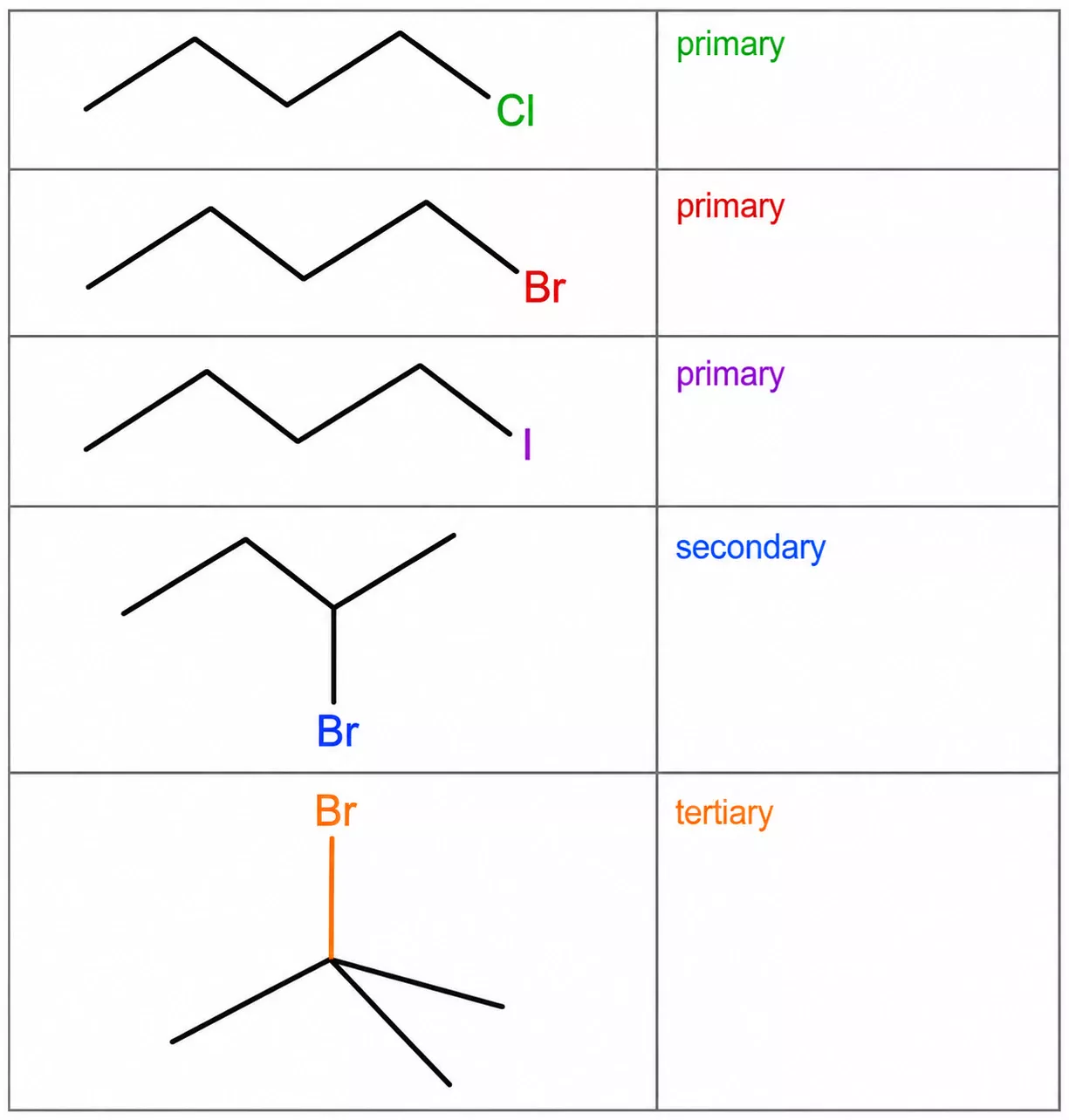
Primary, secondary and tertiary halogenoalkanes
Use the carbon bonded to the halogen to classify the halogenoalkane. Primary, secondary and tertiary structures are compared in Part 2 of the practical.
Method: How the Rate Is Measured
The reaction is carried out in a warm water bath at about 50 °C. This keeps the temperature controlled, because temperature affects the rate of reaction.
Prepare water bath
Fill a 250 cm3 beaker about three-quarters full with water at around 50 °C.
Add ethanol
Add 5 cm3 ethanol to each labelled test tube.
Add halogenoalkane
Add four drops of the relevant halogenoalkane to each ethanol tube.
Warm both solutions
Warm the halogenoalkane mixtures and silver nitrate test tubes in the same water bath.
Mix and time
Add silver nitrate to the halogenoalkane mixture and start the stop clock at the same time.
Stop when cloudy
Stop timing as soon as the solution becomes cloudy due to a silver halide precipitate.
Technique point: The test tubes containing the reacting mixture should stay in the water bath while timing. Otherwise, the temperature may fall and the rate comparison becomes less reliable.
What Happens During Hydrolysis?
Hydrolysis of a halogenoalkane is a nucleophilic substitution reaction. Water acts as the nucleophile because the oxygen atom has lone pairs of electrons. It attacks the electron-deficient carbon atom attached to the halogen.
The C-X bond breaks and the halide ion leaves. The products are an alcohol, a hydrogen ion and a halide ion.
R-X + H2O → R-OH + H+ + X– CH3CH2CH2CH2Br + H2O → CH3CH2CH2CH2OH + H+ + Br–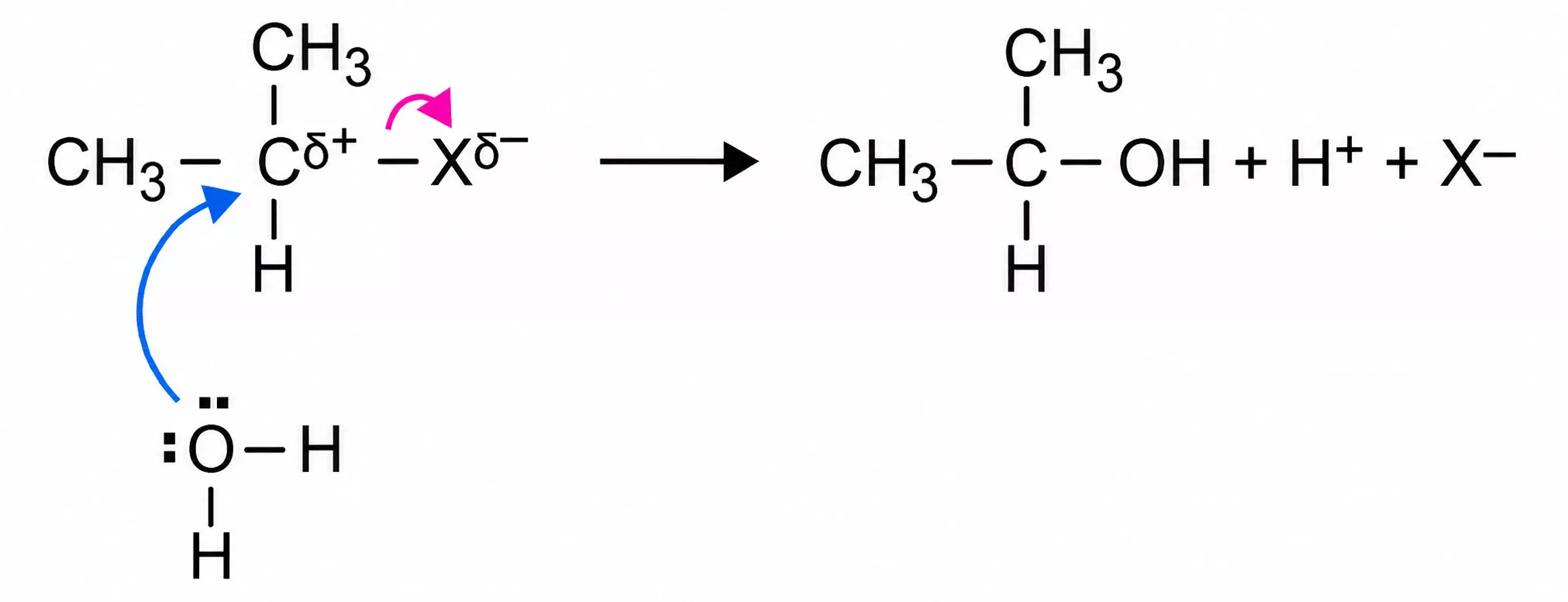
Nucleophilic substitution by water
The lone pair on oxygen attacks the δ+ carbon. The C-X bond breaks, forming an alcohol, H+ and X–.
Why Ethanol, Water and Silver Nitrate Are Used
Each chemical has a specific role. This is a common exam area because students often mix up the solvent, nucleophile and test reagent.
Ethanol
Halogenoalkanes are insoluble in water. Ethanol helps the halogenoalkane dissolve so it can react with water molecules.
Water
Water is the nucleophile in this practical. It reacts with the halogenoalkane during hydrolysis.
Silver nitrate
Ag+ ions react with the halide ion released during hydrolysis, forming a silver halide precipitate.
Why not hydroxide?
If hydroxide ions are present when AgNO3 is added, a precipitate of silver oxide or silver hydroxide can interfere with the test.
Exam wording: Do not write “ethanol is the nucleophile”. In this practical, ethanol is used to help dissolve the halogenoalkane. Water is the nucleophile.
How the Silver Halide Precipitate Shows the Rate
The precipitate only appears after hydrolysis has produced halide ions. Therefore, the time taken for cloudiness to appear tells you how quickly the halogenoalkane has hydrolysed.
| Halide ion formed | Silver halide precipitate | Colour | What it shows |
|---|---|---|---|
| Cl– | AgCl | White | A chloroalkane has hydrolysed. |
| Br– | AgBr | Cream | A bromoalkane has hydrolysed. |
| I– | AgI | Yellow | An iodoalkane has hydrolysed. |
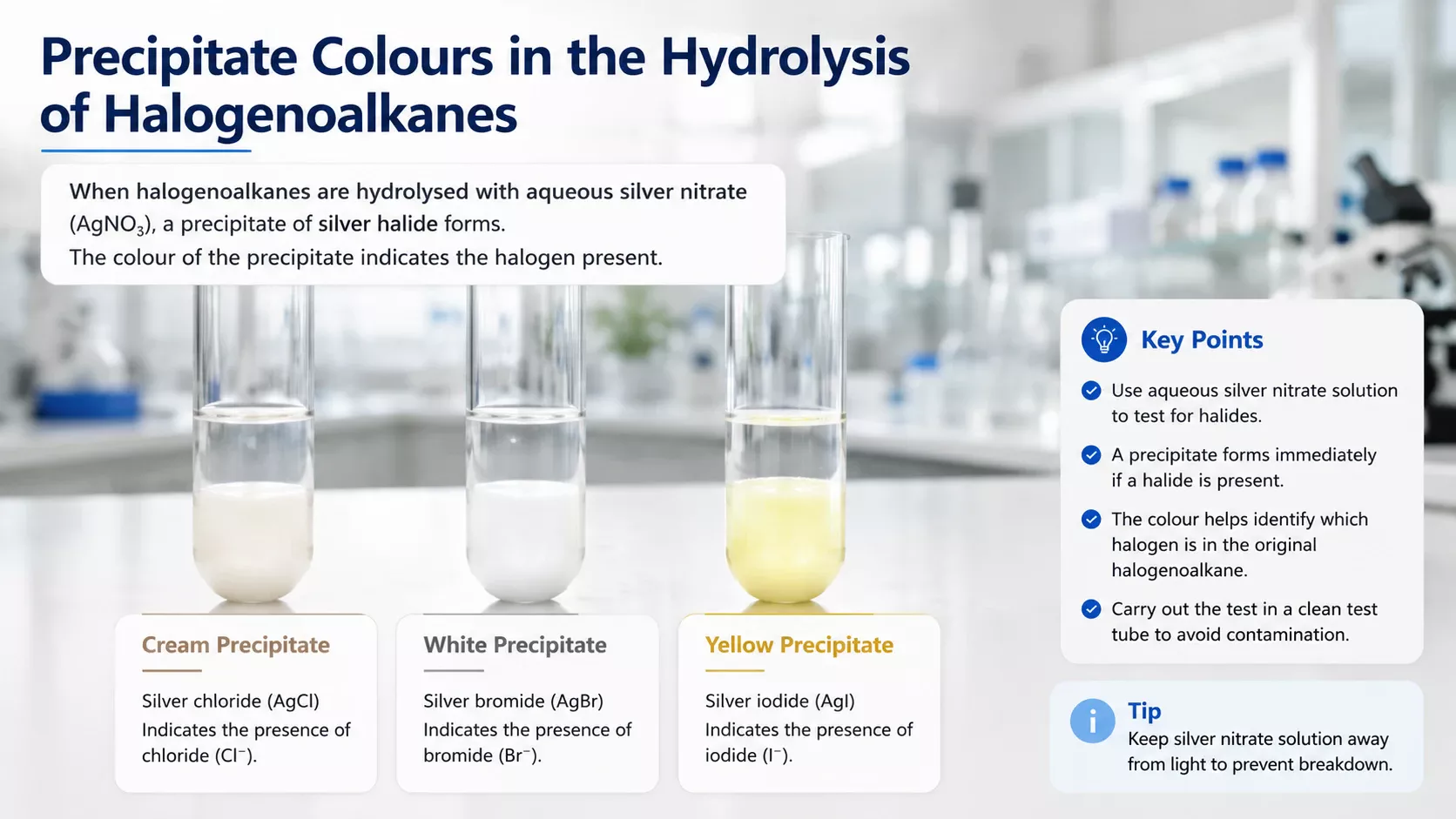
Precipitate colours in the halogenoalkane test
Silver chloride is white, silver bromide is cream and silver iodide is yellow. The colour identifies the halide ion released during hydrolysis.
Part 1: Comparing Chloro-, Bromo- and Iodoalkanes
In Part 1, the halogenoalkanes are all primary. This means the main variable is the halogen: chlorine, bromine or iodine.
| Halogenoalkane | C-X bond | Time for precipitate to form / s | Rate conclusion |
|---|---|---|---|
| 1-iodobutane | C-I | 52 | Fastest |
| 1-bromobutane | C-Br | 87 | Intermediate |
| 1-chlorobutane | C-Cl | 606 | Slowest |
Conclusion: The rate order is iodoalkane > bromoalkane > chloroalkane because the C-I bond is weakest and the C-Cl bond is strongest.
Part 2: Comparing Primary, Secondary and Tertiary Bromoalkanes
In Part 2, the halogen is kept the same because all three compounds are bromoalkanes. This means the main variable is whether the halogenoalkane is primary, secondary or tertiary.
| Halogenoalkane | Classification | Time for precipitate to form / s | Rate conclusion |
|---|---|---|---|
| 2-bromo-2-methylpropane | Tertiary | 3 | Fastest |
| 2-bromobutane | Secondary | 34 | Intermediate |
| 1-bromobutane | Primary | 59 | Slowest |
Conclusion: For these bromoalkanes, the observed rate order is tertiary > secondary > primary. A shorter time means a faster hydrolysis reaction.
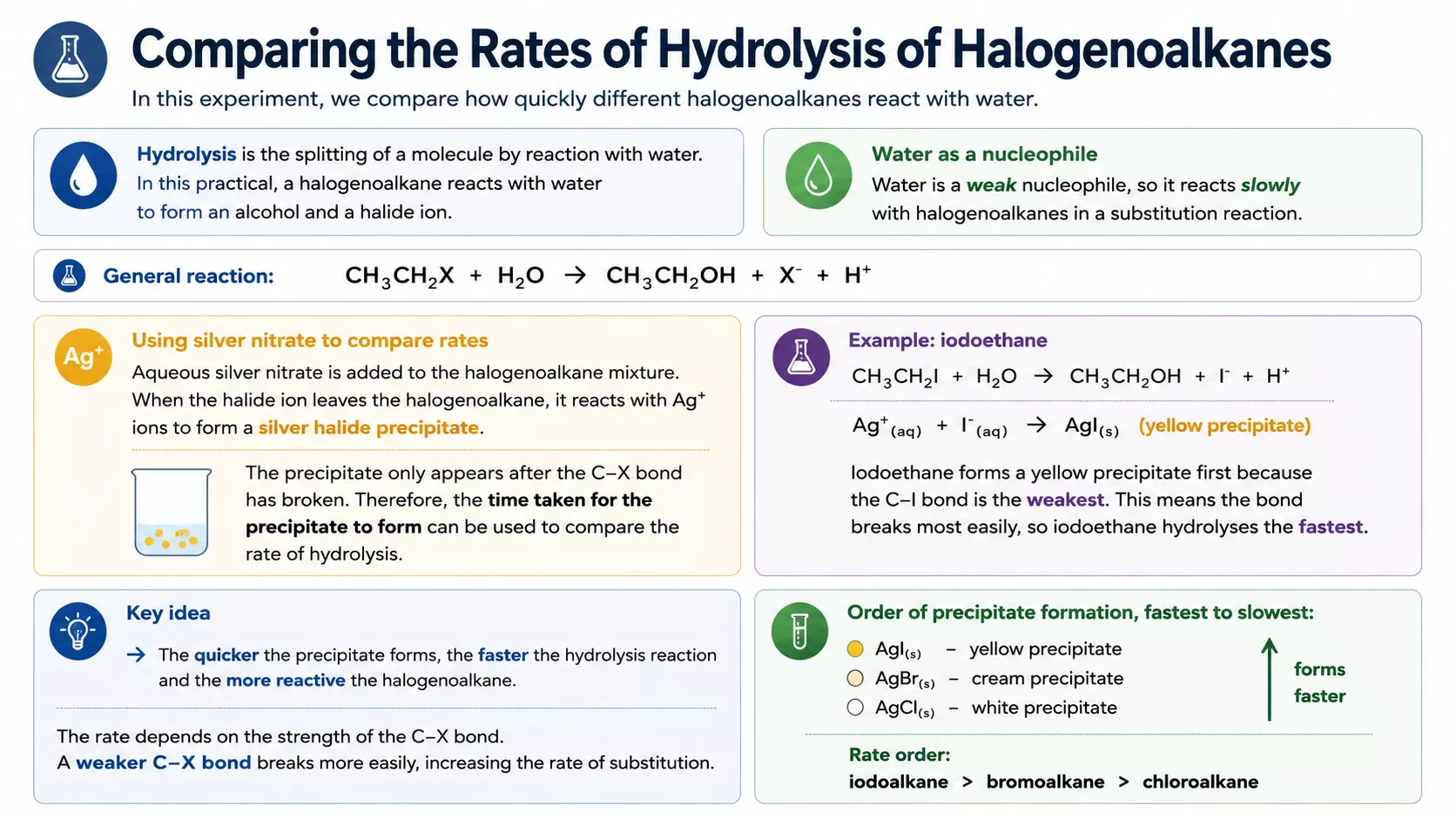
Comparing rates using precipitate formation
The faster the precipitate forms, the faster the halogenoalkane has hydrolysed. The timing data are used to rank the relative rates.
Interactive: From Cloudiness to Rate Order
Reveal the data in stages. The aim is to connect the time taken for the precipitate to appear with the rate of hydrolysis and the chemistry behind the trend.
Results board
Part 1: Comparing primary chloro-, bromo- and iodoalkanes.
| Halogenoalkane | Bond | Time / s | Rate |
|---|---|---|---|
| 1-iodobutane | C-I | ? | ? |
| 1-bromobutane | C-Br | ? | ? |
| 1-chlorobutane | C-Cl | ? | ? |
Part 2: Comparing primary, secondary and tertiary bromoalkanes.
| Halogenoalkane | Type | Time / s | Rate |
|---|---|---|---|
| 2-bromo-2-methylpropane | Tertiary | ? | ? |
| 2-bromobutane | Secondary | ? | ? |
| 1-bromobutane | Primary | ? | ? |
Walkthrough controls
Start here
Click the first button to reveal the Part 1 timing data. Remember: the precipitate forms only after hydrolysis has released a halide ion.
shorter time = faster hydrolysis
Exam-Style Data Interpretation
A common exam version compares equal amounts of 2-chloropropane, 2-bromopropane and 2-iodopropane. The same logic applies: shorter time means faster hydrolysis.
| Halogenoalkane | Time for precipitate to form / s | Halogen electronegativity | Mean C-halogen bond strength / kJ mol-1 |
|---|---|---|---|
| 2-iodopropane | 31 | 2.7 | 218 |
| 2-bromopropane | 74 | 3.0 | 284 |
| 2-chloropropane | 241 | 3.2 | 339 |
Why use equal moles?
Equal moles means the concentration of halogenoalkane is equal in each experiment, so concentration does not affect the relative rates.
Why is electronegativity not the controlling factor?
Chlorine is most electronegative, so it would make the carbon most δ+. If electronegativity controlled the rate, chloroalkanes would react fastest. The data show the opposite.
Why does bond strength explain the trend?
The carbon-halogen bond breaks during the reaction. A stronger bond is harder to break and gives a higher activation energy, so the reaction is slower.
Final exam conclusion
The C-I bond is weakest, so iodoalkanes hydrolyse fastest. The C-Cl bond is strongest, so chloroalkanes hydrolyse slowest.
Core Practical Questions and Answers
Use these as compact revision checks. They cover the main questions students are expected to answer from the practical.
Write the equation for 1-bromobutane with water.
CH3CH2CH2CH2Br + H2O → CH3CH2CH2CH2OH + H+ + Br–
What precipitate forms from 1-iodobutane?
Silver iodide, AgI. It is a yellow precipitate.
Why is ethanol used?
Halogenoalkanes are insoluble in water. Ethanol helps them dissolve so they can react with water molecules.
Why can water act as a nucleophile?
The oxygen atom in water has lone pairs of electrons that can attack the electron-deficient carbon atom.
Why is water used rather than hydroxide ions?
Hydroxide ions would form a precipitate with silver ions immediately, interfering with the silver nitrate test.
Classify the five halogenoalkanes used.
1-chlorobutane, 1-bromobutane and 1-iodobutane are primary. 2-bromobutane is secondary. 2-bromo-2-methylpropane is tertiary.
Common Mistakes
Mistake: “Silver nitrate causes hydrolysis.”
Fix: Water hydrolyses the halogenoalkane. Silver nitrate detects the halide ion produced.
Mistake: “Yellow precipitate means iodine was present.”
Fix: Yellow AgI means iodide ions formed after hydrolysis, so the original compound was an iodoalkane.
Mistake: “Electronegativity controls the rate.”
Fix: The data show bond strength is the better explanation here. C-I is weakest and reacts fastest.
Mistake: Forgetting ethanol’s role.
Fix: Ethanol helps dissolve the halogenoalkane. It is not the nucleophile in the hydrolysis explanation.
CP4 FAQs
How is the rate measured in CP4?
The rate is compared by measuring the time taken for a silver halide precipitate to appear. A shorter time means faster hydrolysis.
Why does 1-iodobutane react faster than 1-chlorobutane?
The C-I bond is weaker than the C-Cl bond, so it breaks more easily. This makes iodoalkanes hydrolyse faster than chloroalkanes.
Why is ethanol used in the practical?
Halogenoalkanes do not dissolve well in water. Ethanol helps dissolve the halogenoalkane so it can react with water.
Why must there be no naked flames?
Ethanol and halogenoalkanes are highly flammable, so naked flames would create a fire risk.
What is the role of silver nitrate?
Silver nitrate provides Ag+ ions. These react with released halide ions to form silver halide precipitates.