CP8: Enthalpy Change via Hess’s Law
A guided Edexcel A Level Chemistry revision walkthrough for measuring temperature change, calculating enthalpy change from calorimetry data, and using Hess’s Law to find the decomposition enthalpy of potassium hydrogencarbonate.
What Is This Practical Trying to Find?
The aim of this core practical is to calculate the enthalpy change for the thermal decomposition of potassium hydrogencarbonate.
This target reaction is difficult to measure directly by simple calorimetry because the solid must be heated. If heat is supplied from outside, the measured temperature change is no longer only caused by the chemical reaction.
Key idea: Instead of measuring the decomposition directly, two related reactions are measured experimentally. Hess’s Law is then used to calculate the enthalpy change for the decomposition reaction indirectly.
The Two Reactions Measured in CP8
Both measured reactions use hydrochloric acid in a polystyrene cup. The temperature change is measured after adding the solid carbonate or hydrogencarbonate.
Reaction 1: potassium carbonate
K2CO3(s) + 2HCl(aq) → 2KCl(aq) + CO2(g) + H2O(l)
The temperature rises, so this reaction is exothermic. Its enthalpy change is negative.
Reaction 2: potassium hydrogencarbonate
KHCO3(s) + HCl(aq) → KCl(aq) + CO2(g) + H2O(l)
The temperature falls, so this reaction is endothermic. Its enthalpy change is positive.
Sign trap: A temperature rise gives a negative ΔH. A temperature fall gives a positive ΔH. Students often calculate the size of q correctly but lose marks by giving the wrong sign.
Method: What Each Step Is Really For
The method is designed to measure a temperature change accurately while also finding the actual mass of solid transferred into the acid.
Place about 3 g of K2CO3 in a test tube and weigh the test tube with its contents. This gives the starting mass before transfer.
Use a burette to place 30 cm3 of 2 mol dm-3 HCl into a polystyrene cup supported in a beaker.
Record the starting temperature of the acid. This is the baseline used to calculate ΔT.
Add the potassium carbonate gradually, stir continuously, and record the highest temperature reached.
Reweigh the empty test tube. The difference between the two masses gives the actual mass of K2CO3 added.
Repeat the method using about 3.5 g of KHCO3. This time record the lowest temperature reached because the reaction is endothermic.
Why use a polystyrene cup? Polystyrene is a better insulator than glass, so less heat is lost to or gained from the surroundings. This gives a more reliable temperature change.
Measuring Temperature Change Accurately
In slow calorimetry experiments, the maximum or minimum temperature may not be measured exactly because heat transfer to the surroundings occurs while the reaction is still taking place.
The accurate method is to take temperature readings before mixing, continue taking readings after mixing, then extrapolate the cooling or warming line back to the mixing time.
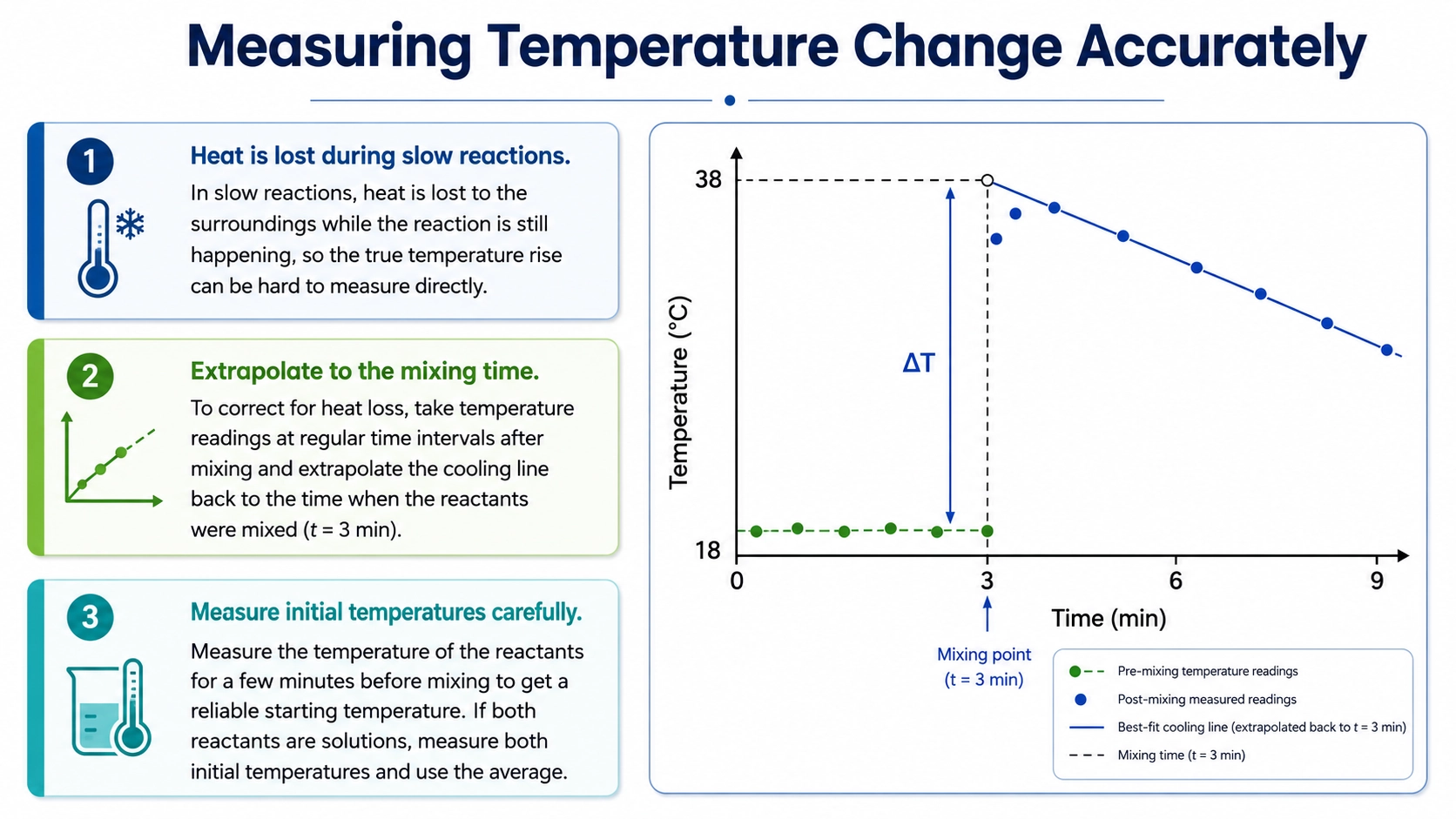
This visual shows why temperature readings are extrapolated back to the mixing point. The extrapolated value gives a more reliable ΔT than simply using the highest measured point.
Interactive Graph: Finding the Correct Temperature Change
This interactive graph shows how calorimetry data can be plotted and extrapolated back to the mixing time. It demonstrates why the highest measured temperature is not always the true temperature at the moment of mixing.
Important: this is a model dataset used to demonstrate the extrapolation method. It is included to support the practical technique and is not presented as the actual CP8 sample data table used later on this page.
How to use it: follow the numbered buttons on the right. Plot the readings, draw the cooling line, extrapolate back to the mixing time, and then reveal the corrected ΔT.
These readings establish the starting temperature before the reaction begins.
These are the measured temperatures after the reactants are mixed and heat loss has already started.
The vertical guide at t = 3 min marks when the reactants are mixed.
The corrected temperature change is found by extrapolating the line back to the mixing time rather than just taking the highest measured point.
What this shows: the extrapolated temperature at the mixing time is higher than the measured peak, so the corrected ΔT is larger and gives a more accurate energy change.
Using the Sample Data
The sample data below shows how the mass of each solid and the temperature change are obtained from the practical measurements.
| Measurement | K2CO3 reaction | KHCO3 reaction |
|---|---|---|
| Mass of test tube with solid / g | 25.12 | 25.67 |
| Mass of test tube after emptying / g | 23.04 | 22.34 |
| Mass of solid used / g | 2.08 | 3.33 |
| Start temperature / °C | 23.2 | 23.1 |
| Final extreme temperature / °C | 28.4 highest | 19.2 lowest |
| Temperature change / °C | +5.2 | -3.9 |
Exam focus: The sign of the temperature change tells you whether the process is exothermic or endothermic, but q = mcΔT is usually calculated using the magnitude of ΔT.
Core Equation: q = mcΔT
For reactions in aqueous solution, the energy change for the quantities used is calculated using:
| Symbol | Meaning | In this practical |
|---|---|---|
| q | energy change in joules | Calculated from the temperature change |
| m | mass of solution in grams | 30 cm3 solution is treated as 30 g |
| cp | specific heat capacity | 4.2 J g-1 °C-1 |
| ΔT | temperature change | Highest or lowest temperature minus starting temperature |
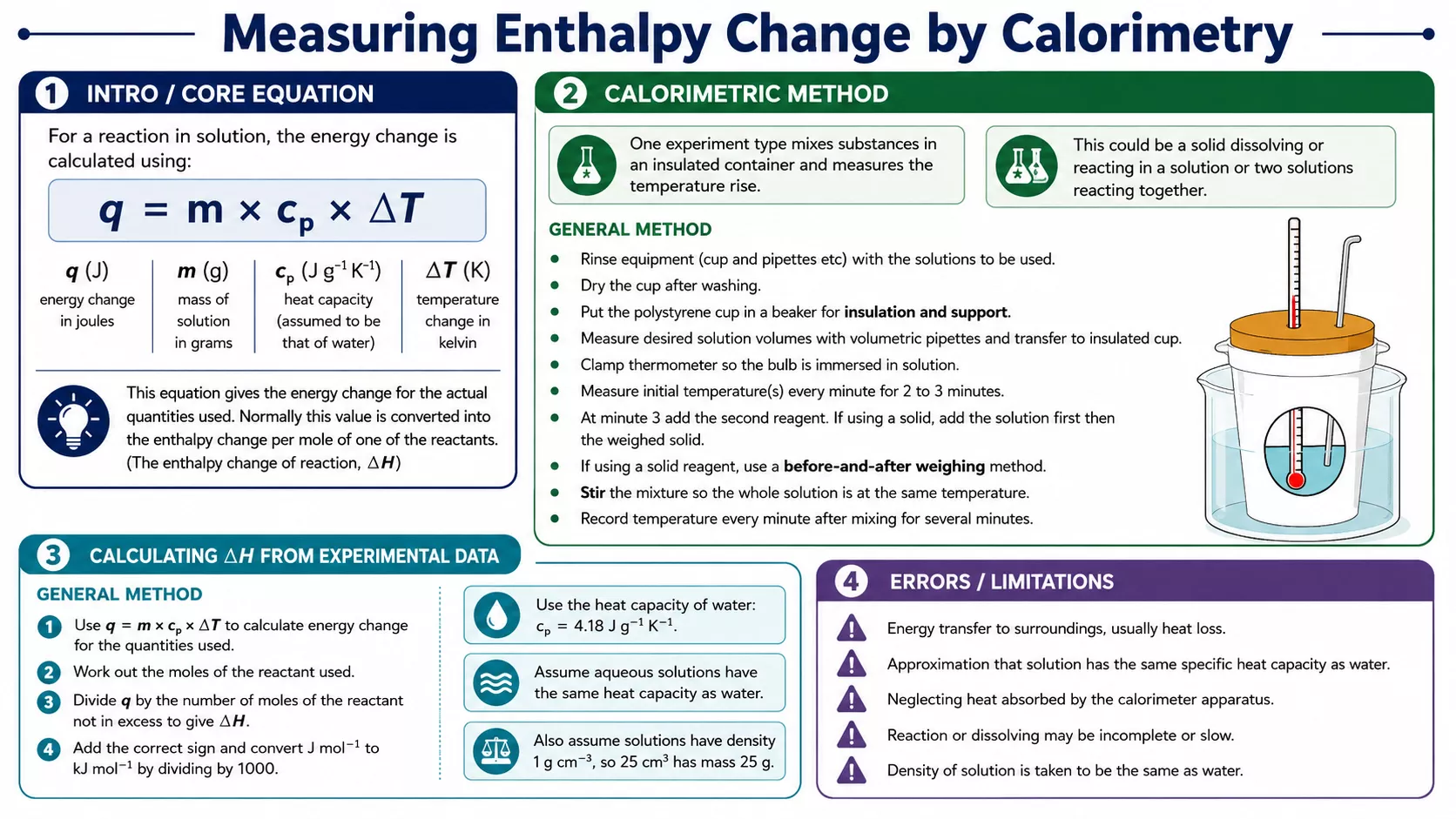
This visual summarises the core calorimetry equation, the insulated cup method, the steps for calculating ΔH and the main experimental limitations.
Worked Calculation: Energy Change for Each Reaction
Use the mass of solution, specific heat capacity and temperature change to calculate the energy transferred in each experiment.
Reaction 1: K2CO3
q = 655.2 J
q = 0.6552 kJ
The temperature rises, so the reaction releases heat. The enthalpy change will be negative.
Reaction 2: KHCO3
q = 491.4 J
q = 0.4914 kJ
The temperature falls, so the reaction absorbs heat. The enthalpy change will be positive.
Worked Calculation: Molar Enthalpy Change
To calculate ΔH in kJ mol-1, divide the energy change by the moles of the solid reactant used.
Reaction 1: K2CO3
moles = 2.08 ÷ 138.2
moles = 0.0151 mol
ΔH1 = -0.6552 ÷ 0.0151
ΔH1 = -43.5 kJ mol-1
Reaction 2: KHCO3
moles = 3.33 ÷ 100.1
moles = 0.0333 mol
ΔH2 = +0.4914 ÷ 0.0333
ΔH2 = +14.8 kJ mol-1
Important: ΔH1 is for one mole of K2CO3 reacting. ΔH2 is for one mole of KHCO3 reacting. Hess’s Law must account for this mole ratio.
Checking That Hydrochloric Acid Is in Excess
The acid must be in excess so that the carbonate or hydrogencarbonate is the limiting reagent. This means the calculated enthalpy change is based on the moles of solid used.
moles HCl = 2.00 × 30 ÷ 1000 = 0.0600 mol
For K2CO3
HCl needed = 2 × 0.0151 = 0.0302 mol
HCl available = 0.0600 mol
For KHCO3
HCl needed = 1 × 0.0333 = 0.0333 mol
HCl available = 0.0600 mol
Conclusion: 0.0600 mol of HCl is greater than the amount needed in both reactions, so hydrochloric acid is in excess.
Using Hess’s Law to Find the Target ΔH
The target reaction contains 2 moles of KHCO3, so reaction 2 must be doubled before combining the measured enthalpy changes.
2KHCO3(s) + 2HCl(aq) → 2KCl(aq) + 2CO2(g) + 2H2O(l)
Enthalpy change = 2ΔH2
2KCl(aq) + CO2(g) + H2O(l) → K2CO3(s) + 2HCl(aq)
Enthalpy change = -ΔH1
2KHCO3(s) → K2CO3(s) + CO2(g) + H2O(l)
ΔH3 = 29.6 + 43.5
ΔH3 = +73.1 kJ mol-1
Final answer: The decomposition of potassium hydrogencarbonate is endothermic, so the enthalpy change is positive.
Errors, Limitations and Improvements
Calorimetry is useful, but it is not perfectly accurate. Exam questions often ask students to explain why the measured value differs from the accepted value.
| Issue | Effect on result | Improvement |
|---|---|---|
| Heat transfer to or from the surroundings | The measured temperature change is smaller than the true temperature change. | Use a lid, insulate the cup better, and extrapolate the temperature curve. |
| Specific heat capacity of solution assumed to equal water | The calculated q value is only an approximation. | Use a more accurate heat capacity value for the solution if available. |
| Heat absorbed by the cup and thermometer ignored | Some energy transfer is not included in q = mcΔT. | Calibrate the calorimeter or use a correction factor. |
| Reaction may be incomplete or slow | The full temperature change may not be recorded directly. | Stir continuously and take regular temperature readings over time. |
| Potassium carbonate may be hydrated | The calculated moles of K2CO3 are inaccurate, and the temperature rise may be smaller than expected. | Use dry solid and store the carbonate properly before the practical. |
Common Exam Points
- State the two measured reactions correctly, including state symbols where required.
- Explain why the decomposition reaction cannot be measured directly using simple calorimetry.
- Use q = mcΔT with the correct mass, specific heat capacity and temperature change.
- Convert joules to kilojoules before calculating ΔH in kJ mol-1.
- Use the correct sign for exothermic and endothermic reactions.
- Show that hydrochloric acid is in excess by comparing moles available with moles required.
- Double reaction 2 before using Hess’s Law because the target reaction contains 2 moles of KHCO3.
- Explain heat loss, calorimeter heat absorption and incomplete reaction as limitations.
Extra Hess’s Law and Calorimetry Examples
After the main CP8 calculation, students should recognise the same calculation pattern in other enthalpy questions. These examples extend the core method using visual worked examples rather than long text blocks.
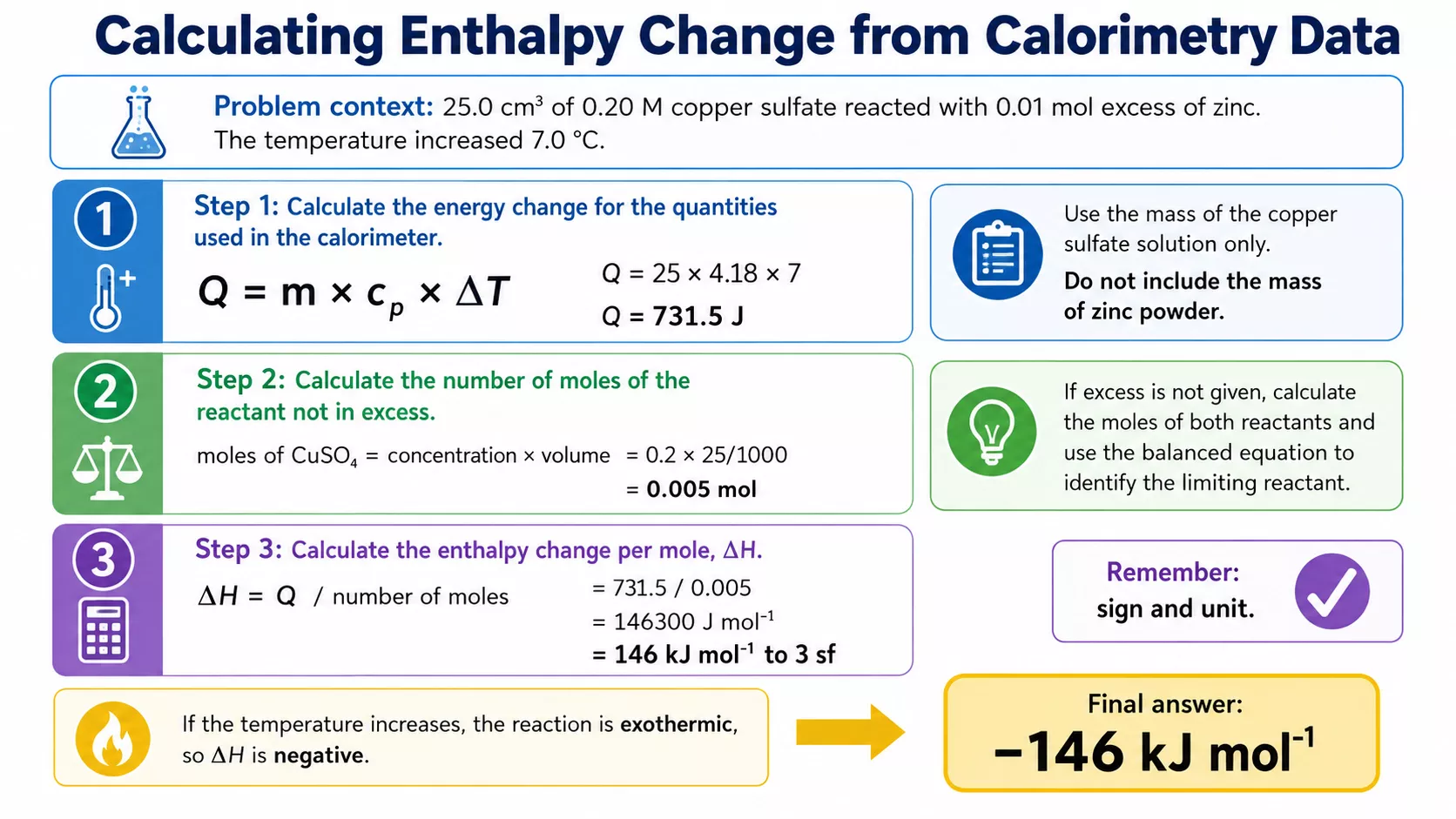
Use this example to reinforce the standard three-step method: calculate q, calculate moles of the reactant not in excess, then divide q by moles and apply the correct sign.
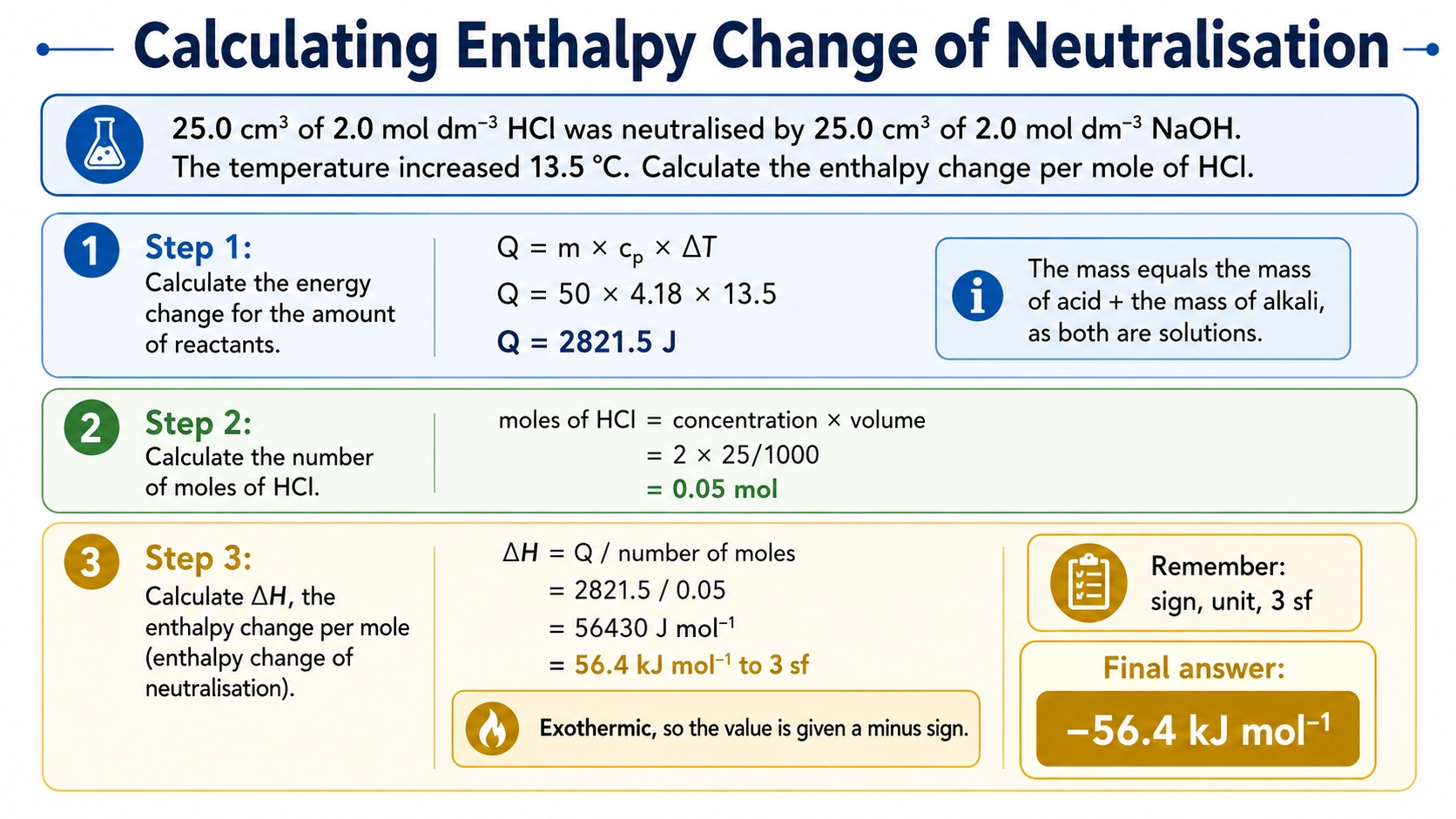
Neutralisation examples use the total mass of both solutions. The final value is given per mole of acid or alkali reacted, with a negative sign because the temperature increases.
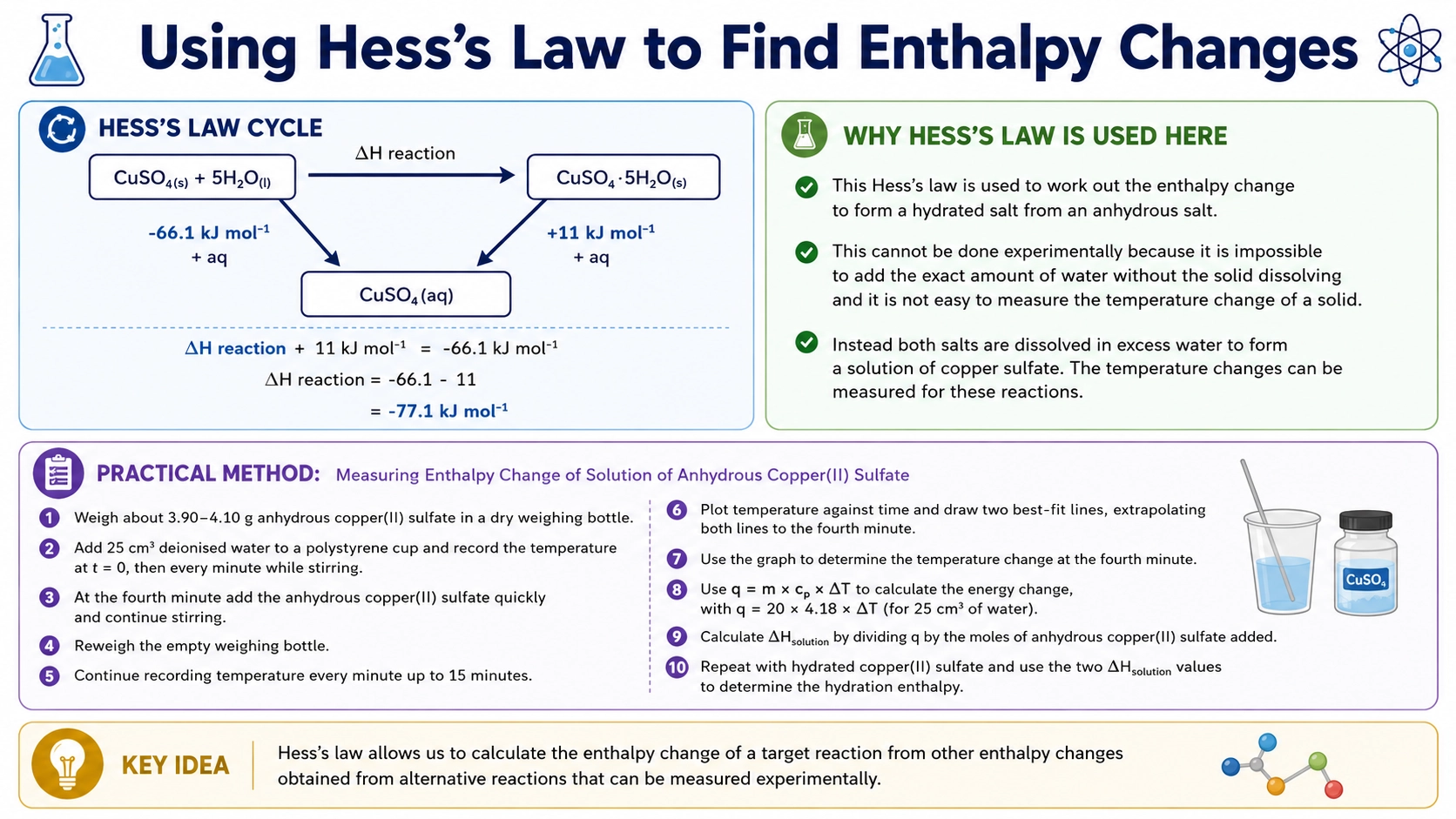
This example shows how Hess’s Law can be used when the target enthalpy change cannot be measured directly, such as forming a hydrated salt from an anhydrous salt.
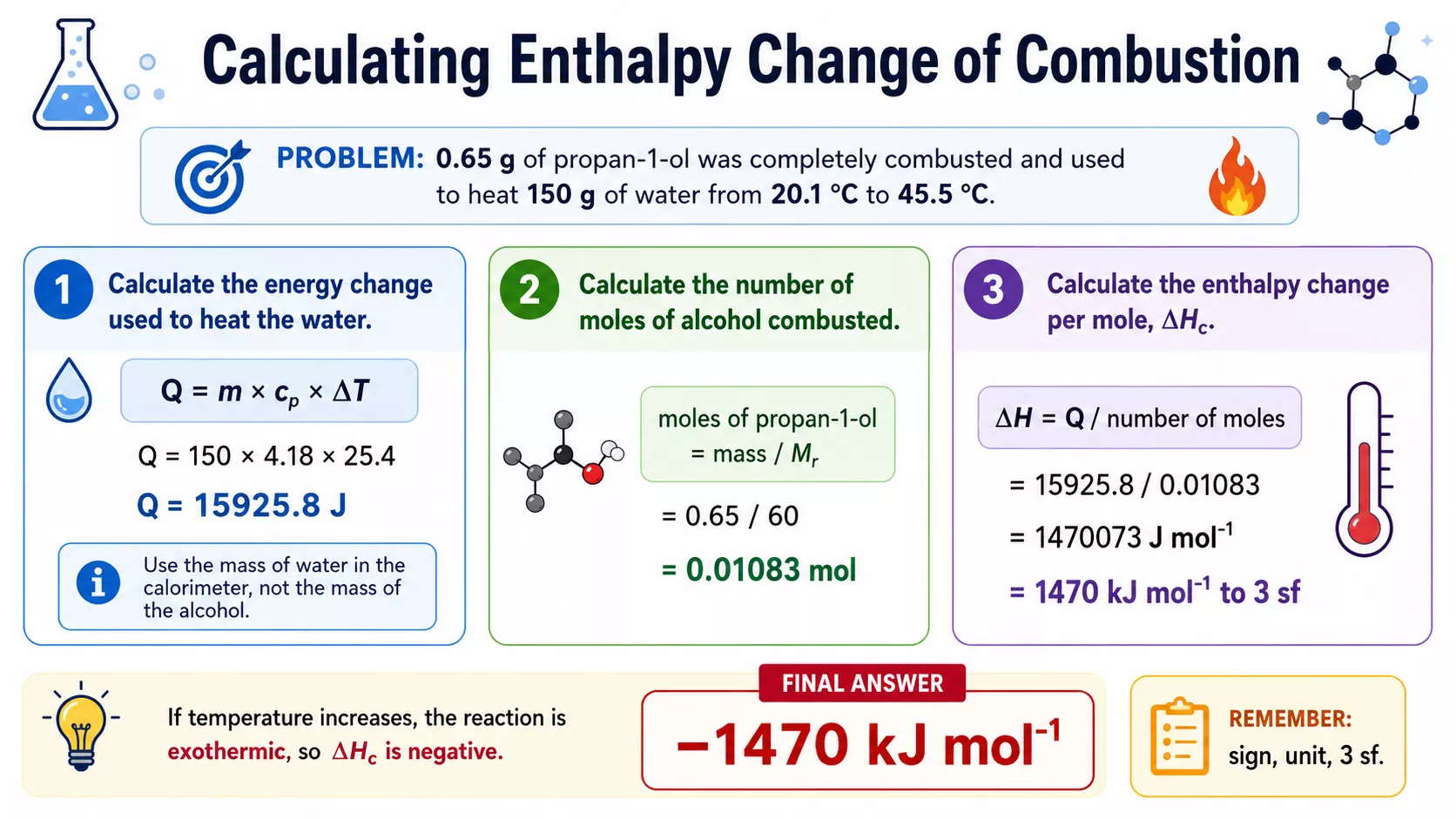
Combustion calorimetry still uses q = mcΔT, but the mass in the equation is the water heated by the flame, not the alcohol burned.
Exam strategy: Identify the target enthalpy change first. Then decide whether the measured equations need to be reversed, multiplied or combined to produce the target equation.
CP8 FAQs
These questions focus on the main exam points for calorimetry, enthalpy calculations and Hess’s Law.
Why can the decomposition of potassium hydrogencarbonate not be measured directly?
The solid must be heated to decompose. This means any temperature change would include energy supplied by the heating source, so the measured value would not only be due to the decomposition reaction.
Why is a polystyrene cup used?
A polystyrene cup reduces heat transfer between the reaction mixture and the surroundings. This makes the measured temperature change more accurate than using a glass beaker alone.
Why is hydrochloric acid in excess?
Hydrochloric acid is in excess so that the carbonate or hydrogencarbonate is the limiting reagent. This allows the enthalpy change to be calculated using the moles of solid added.
Why is reaction 2 doubled in the Hess calculation?
The target equation contains 2 moles of KHCO3, but reaction 2 is written for 1 mole of KHCO3. Therefore, ΔH2 must be multiplied by 2.
What is the most common calculation mistake in this practical?
The most common mistake is sign error. A temperature rise means the reaction is exothermic and ΔH is negative. A temperature fall means the reaction is endothermic and ΔH is positive.