Revision Notes by Specification Reference
Select a specification area to access structured AQA revision notes, practical links and exam practice as pages are released.
AQA
A Level
Chemistry
AQA A Level Chemistry is a linear qualification assessed at the end of the two-year course. The specification is organised into Physical Chemistry, Inorganic Chemistry and Organic Chemistry, with the first-year content also forming the AS subject content.
A Linear Qualification
AQA A Level Chemistry is assessed through three written papers taken at the end of the course. It is structured around specification code 7405 and uses the A*-E A Level grading scale.
Practical Endorsement
Students complete the required practical activities and develop practical competencies throughout the course. Practical understanding is assessed in the written papers, while the practical endorsement is reported separately.
AS Level Chemistry
AQA AS Chemistry is a separate standalone qualification. The AS content is drawn from the first-year A Level content across Physical, Inorganic and Organic Chemistry.
Paper 1 – Physical Chemistry and Inorganic Chemistry
Assesses relevant Physical Chemistry topics, Inorganic Chemistry and relevant practical skills. This includes atomic structure, amount of substance, bonding, energetics, equilibria, thermodynamics, acids and bases, periodicity, Group 2, Group 7, Period 3 and transition metals.
Paper 2 – Physical Chemistry and Organic Chemistry
Assesses relevant Physical Chemistry topics, Organic Chemistry and relevant practical skills. This includes amount of substance, bonding, energetics, kinetics, equilibria, rate equations and the full organic chemistry sequence.
Paper 3 – Practical Skills, Data and Synoptic Chemistry
Assesses any content from the specification and any practical skills. This paper includes practical technique, data handling, analysis, evaluation and synoptic problem solving across Physical, Inorganic and Organic Chemistry.
The Three Papers – How The A Level Is Assessed
The AQA A Level is assessed through three externally examined papers. Papers 1 and 2 divide the content by chemistry discipline, while Paper 3 draws across the full course and places a strong emphasis on practical skills, data interpretation and synoptic reasoning.
AQA Specification Pathway
AQA Chemistry is organised by discipline rather than Edexcel-style numbered topics. OLS course cards pool the relevant AQA specification references together so that students can study coherent course units while still seeing the exact AQA specification coverage.
Study AQA Chemistry with OLS
OLS AQA courses are built around specification references, with structured revision notes, worked examples, exam-style practice and clear links between practical skills and written exam questions.
View Courses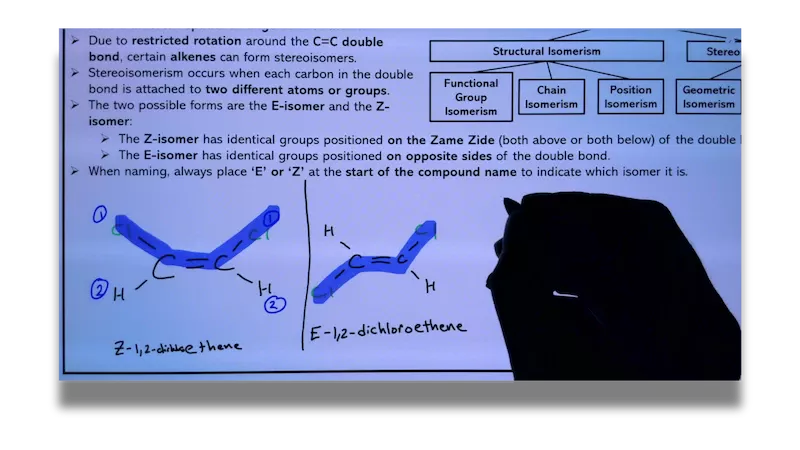
Take the A Level if…
AQA A Level – 7405You need chemistry for university entry, particularly for medicine, dentistry, pharmacy, biochemistry, chemical engineering or related science degrees. The full A Level is the standard two-year qualification used for UK university admissions.
Take the AS Level if…
AQA AS Level – 7404You want a recognised one-year chemistry qualification without committing to the full A Level. The AS is a standalone qualification and does not contribute to the final A Level grade.
Watch a Chemistry Lesson Preview
See how OLS uses visual explanation, molecular models and specialist teacher commentary to support difficult A Level Chemistry topics.
Official Specification
The official AQA Chemistry specification covering subject content, assessment structure, mathematical requirements, practical skills and required practical activities.
AQA Chemistry Specification →Past Papers & Mark Schemes
The official AQA assessment resources area, including exam papers, mark schemes and examiner reports for AQA A Level Chemistry.
AQA Past Papers →Chemistry Reference Library
LibreTexts Chemistry is a free, open-access chemistry library covering a wide range of topics at A Level and beyond, useful for deeper reading and alternative explanations of difficult concepts.
LibreTexts Chemistry →