Producing Alkenes
A concise revision guide to the three routes by which alkenes are produced for Cambridge International AS Level Chemistry: elimination of a hydrogen halide from a halogenoalkane, dehydration of an alcohol, and cracking of a longer-chain alkane.
Three Routes to an Alkene
Cambridge asks you to recall the reactions, including reagents and conditions, by which alkenes can be produced. There are three routes on the syllabus, and each one is an example of a reaction type you meet elsewhere in AS organic chemistry.
| Route | Starting material | Reagent and conditions | Type of reaction |
|---|---|---|---|
| Elimination | halogenoalkane | ethanolic NaOH, heat | elimination of HX |
| Dehydration | alcohol | heated Al2O3 catalyst, or concentrated H2SO4 and heat | elimination of H2O |
| Cracking | longer-chain alkane | heat with Al2O3 catalyst | C–C bond breaking to give a shorter alkane and an alkene |
Key idea: All three routes create a C=C bond. Elimination and dehydration remove a small molecule (HX or H2O) from adjacent carbon atoms; cracking splits a long chain and leaves a double bond in one of the fragments.
Quick Check: Route and Small Molecule
Five quick questions on starting materials that are not used on this page.
Elimination of HX from a Halogenoalkane
A halogenoalkane loses a hydrogen halide, HX, when it is heated with sodium hydroxide dissolved in ethanol. The hydroxide ion acts as a base: it removes a hydrogen atom from the carbon next to the C–X carbon, the halide ion leaves, and a double bond forms between the two carbon atoms.
For example, 2-bromopropane gives propene:
CH3CHBrCH3 + NaOH → CH3CH=CH2 + NaBr + H2O
The solvent matters. With ethanolic sodium hydroxide, elimination gives the alkene. With aqueous sodium hydroxide, the hydroxide ion acts as a nucleophile instead and substitution gives an alcohol. Exam questions often test this contrast.
| Condition | Role of OH− | Reaction | Product |
|---|---|---|---|
| NaOH in ethanol, heat | base | elimination | alkene |
| NaOH in water, heat | nucleophile | nucleophilic substitution | alcohol |
Exam focus: Write “ethanolic sodium hydroxide” or “NaOH dissolved in ethanol” and “heat”. Writing “NaOH(aq)” loses the mark because it describes the substitution reaction.
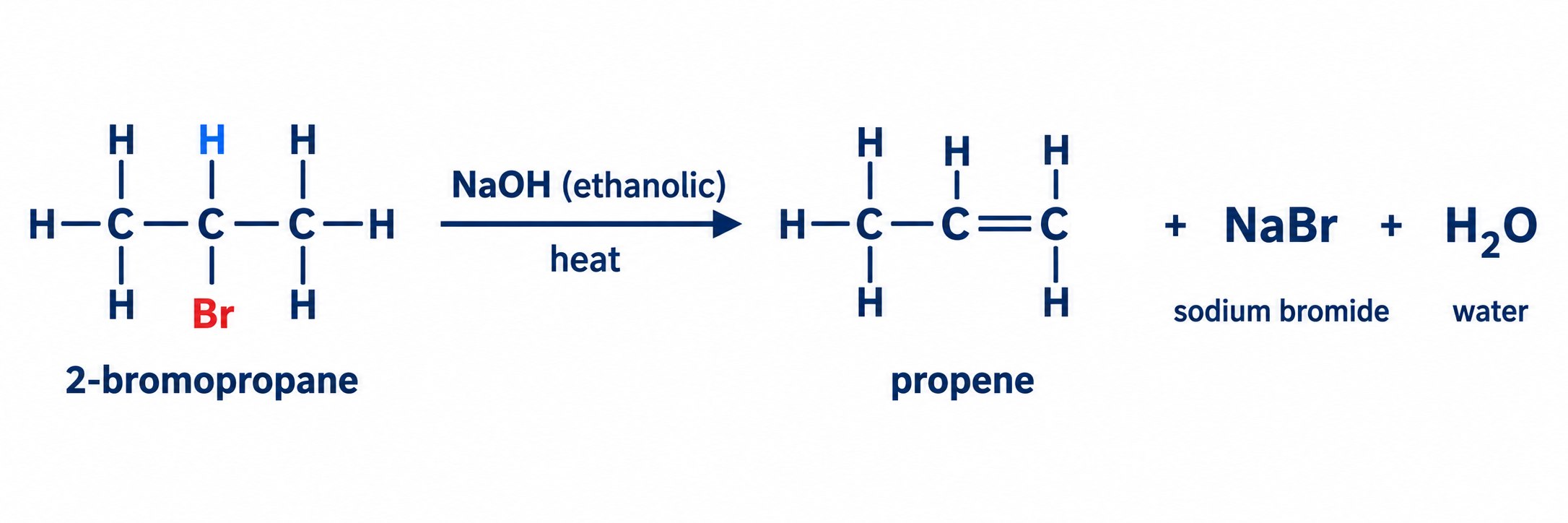
Elimination removes H and X from adjacent carbon atoms, leaving a C=C double bond.
Quick Check: Which Solvent Does What
Drag the words and numbers into place to compare the two experiments.
Quick Check: Explain What Went Wrong
Write a short explanation, then compare it with the mark points and the model answer.
Dehydration of an Alcohol
An alcohol loses a molecule of water to form an alkene in a dehydration reaction, which is another example of elimination. Cambridge gives two sets of conditions.
Route 1: heated catalyst
Alcohol vapour is passed over heated aluminium oxide, Al2O3. The catalyst removes the OH group and a hydrogen atom from the neighbouring carbon.
Route 2: concentrated acid
The alcohol is heated with concentrated sulfuric acid (concentrated phosphoric acid is also used). The acid protonates the OH group so that water can leave, and the alkene forms.
For example, ethanol gives ethene and water:
CH3CH2OH → CH2=CH2 + H2O
With longer alcohols, the hydrogen atom can be removed from either side of the carbon carrying the OH group, so a mixture of alkenes can form. Butan-2-ol, for example, gives but-1-ene together with cis- and trans-but-2-ene.
Key idea: Dehydration is elimination of water. State the catalyst or acid and the need for heat, and remember that unsymmetrical alcohols can give more than one alkene, including geometrical isomers.
Dehydration removes H and OH from adjacent carbon atoms to form the alkene.
Quick Check: How Many Alkenes?
Find the carbon atoms next to the one carrying the OH group before you choose.
Cracking of a Longer-Chain Alkane
Cracking breaks a long-chain alkane from crude oil into a shorter alkane and an alkene. The C–C bonds are broken by heating the alkane over an aluminium oxide catalyst.
For example, decane can be cracked into octane and ethene:
C10H22 → C8H18 + C2H4
Cracking matters industrially because the demand for short-chain alkanes as fuels and for alkenes as chemical feedstock is greater than the supply from fractional distillation alone. The same reaction is listed in 14.1 as a source of more useful alkanes.
Exam focus: Any balanced cracking equation must have one alkane and at least one alkene on the right, and the total number of carbon and hydrogen atoms must match the starting alkane.
Cracking a long-chain alkane always produces at least one alkene.
Quick Check: Balance the Cracking Equations
Type the missing formula or number into each equation.
Choosing a Route in Synthesis
Synthesis questions in Topic 21 ask you to work backwards from a target molecule. If the target is an alkene, look at what you are given.
| If you start with | Use | Then the alkene can be converted into |
|---|---|---|
| a halogenoalkane | ethanolic NaOH, heat | a diol (cold dilute acidified KMnO4) or an alcohol (steam and H3PO4) |
| an alcohol | heated Al2O3 or concentrated H2SO4 | a halogenoalkane (HX) or a dihalogenoalkane (X2) |
| a long-chain alkane | cracking with Al2O3 | an addition polymer |
Remember: Each route to an alkene is the reverse of a reaction you also need: elimination reverses the addition of HX, and dehydration reverses the hydration of an alkene with steam.
Quick Check: Pick the Accurate Statement
In each round, choose the one statement that is accurate.
Common Exam Mistakes
- Do not write NaOH(aq) for elimination. Aqueous hydroxide gives substitution to an alcohol; ethanolic hydroxide gives the alkene.
- Do not describe dehydration as oxidation. No oxygen is gained and no hydrogen is lost from the carbon skeleton overall; a molecule of water is eliminated.
- Do not forget that dehydrating an unsymmetrical alcohol can give more than one alkene, and that but-2-ene exists as cis and trans isomers.
- Do not leave a cracking equation unbalanced. Count carbon and hydrogen atoms on both sides.
QuickSnap
This text summary condenses the page into the essential exam ideas.
- Elimination: halogenoalkane + NaOH in ethanol, heat → alkene + NaX + H2O.
- Dehydration: alcohol → alkene + H2O, using heated Al2O3 or concentrated H2SO4 and heat.
- Cracking: long-chain alkane, heat with Al2O3 → shorter alkane + alkene.
- Solvent matters: ethanolic NaOH eliminates, aqueous NaOH substitutes.
- Mixtures: unsymmetrical alcohols and halogenoalkanes can give more than one alkene.
FAQs
These questions address the points students most often confuse when producing alkenes.
Why does the solvent change the product of the halogenoalkane reaction?
In ethanol the hydroxide ion behaves as a base and removes a proton, so HX is eliminated and an alkene forms. In water it behaves as a nucleophile and replaces the halogen, so an alcohol forms.
Which conditions does Cambridge accept for dehydration?
Either passing the alcohol vapour over heated aluminium oxide, or heating the alcohol with concentrated sulfuric acid. Concentrated phosphoric acid is also acceptable as the acid catalyst.
Can dehydration give more than one alkene?
Yes. If the carbon atoms on either side of the C–OH carbon both carry hydrogen atoms, elimination can occur in two directions, and the but-2-ene formed from butan-2-ol also exists as cis and trans isomers.
Is cracking an elimination reaction?
No. Cracking breaks a carbon–carbon bond in a long chain to give two smaller molecules, one of which is an alkene. Elimination removes a small molecule from adjacent carbon atoms of one molecule.
Master Alkenes for Cambridge International AS & A Level Chemistry
Continue from these free revision notes into the full Topic 14.2 Alkenes course. The guided video lessons are ready now; the Cambridge International MCQ bank, teacher-marked short-answer questions and KASP spec-point report are being written, and the course opens for enrolment as soon as they are complete.
Guided video teaching
Learn the chemistry and exam technique through structured video lessons with worked examples and walkthroughs.
Instant MCQ feedback
Auto-marked MCQ quizzes provide immediate diagnostic feedback for every answer choice.
Teacher-marked SAQs
Submit written exam responses and receive chemistry specialist feedback with improvement guidance.
Progress tracking
Identify strengths and weaknesses across the full Topic 14.2 specification with targeted reporting.
See how the course works
Click play to start the course preview animation.
Some ionic radii are shown.
| Ion | Ionic radius / nm |
|---|---|
| Na+ | 0.102 |
| K+ | 0.138 |
| F− | 0.133 |
| Cl− | 0.180 |
Which compound has the strongest ionic bonding?
Explain why the metallic bonding in magnesium is much stronger than that in sodium.
Copyright notice: This OLS revision content, including the explanations, layout, diagrams, tables and embedded learning structure, is authored for Online Learning System by Dr. Mohammed Al-Fatah. It may not be copied, reproduced, redistributed or adapted without written permission.
Keep this note — free
Save your progress across every Cambridge topic. A free account remembers which topics you have covered, saves your question scores, and syncs across your phone and laptop.
- Track every topic you have finished
- Keep your practice-question scores
- No payment, no card, free forever
Already registered? Log in