Reactions of Alkenes with KMnO4
A concise Cambridge International AS Level Chemistry revision guide to the oxidation of alkenes by hot, concentrated, acidified potassium manganate(VII): how the C=C bond is broken, which products each type of carbon gives, and how the products are used to locate a double bond in a larger molecule.
Two Very Different Oxidations
Cambridge 14.2.2 lists two oxidations of alkenes by acidified potassium manganate(VII), and the conditions decide which one happens. With cold, dilute KMnO4 the π bond is oxidised gently and the product is a diol: both carbons keep their bond to each other and each gains an OH group. This is covered on the KMnO4 page.
With hot, concentrated KMnO4 the oxidation goes further. Both the π bond and the σ bond of the C=C are broken, so the molecule is cleaved into two smaller fragments. Each fragment is then oxidised as far as its structure allows. Because the products depend on what was attached to each carbon of the double bond, this reaction can be worked backwards to find where the C=C bond was.
| Conditions | What happens to the C=C bond | Product | Colour change |
|---|---|---|---|
| Cold, dilute, acidified KMnO4 | Only the π bond breaks | A diol (two OH groups on adjacent carbons) | Purple to colourless |
| Hot, concentrated, acidified KMnO4 | Both bonds break: the molecule is cleaved | Ketones, carboxylic acids or CO2, depending on the carbon | Purple to colourless |
Key idea: Cold and dilute gives a diol. Hot and concentrated cleaves the double bond and oxidises the fragments.
What Each Carbon Becomes
Look at each carbon of the C=C bond and count the hydrogen atoms on it. That number decides the product from that half of the molecule.
| Carbon of the C=C bond | Number of H atoms | Fragment first formed | Final product with hot conc. KMnO4 |
|---|---|---|---|
| =CR2 (two alkyl groups) | 0 | Ketone | Ketone, R2C=O (cannot be oxidised further) |
| =CHR (one alkyl group) | 1 | Aldehyde | Carboxylic acid, RCOOH |
| =CH2 (end of chain) | 2 | Methanal | Carbon dioxide and water |
The pattern follows the rules for oxidising alcohols and aldehydes. A carbon with no hydrogen gives a ketone, which resists further oxidation. A carbon with one hydrogen gives an aldehyde, which hot manganate(VII) oxidises straight on to a carboxylic acid. A terminal CH2 gives methanal, which is oxidised all the way to carbon dioxide.
The number of hydrogen atoms on each alkene carbon decides its oxidation product.
Exam sentence: Hot concentrated acidified KMnO4 cleaves the C=C bond; a =CR2 carbon gives a ketone, a =CHR carbon gives a carboxylic acid and a =CH2 carbon gives carbon dioxide.
Quick Check: Which Product from Each End
Decide what each carbon of the double bond turns into with the hot concentrated reagent.
Worked Examples
But-2-ene, CH3CH=CHCH3. Both alkene carbons are =CHR, so each becomes a carboxylic acid. The only product is ethanoic acid, CH3COOH, formed twice.
2-Methylbut-2-ene, (CH3)2C=CHCH3. The left carbon is =CR2 and gives propanone, CH3COCH3. The right carbon is =CHR and gives ethanoic acid.
Propene, CH3CH=CH2. The CH carbon gives ethanoic acid; the CH2 carbon gives carbon dioxide and water.
| Alkene | Left carbon | Right carbon | Products |
|---|---|---|---|
| But-2-ene | =CHR | =CHR | Ethanoic acid (x2) |
| 2-Methylbut-2-ene | =CR2 | =CHR | Propanone + ethanoic acid |
| Propene | =CHR | =CH2 | Ethanoic acid + CO2 + H2O |
| Cyclohexene | =CHR | =CHR (same ring) | Hexanedioic acid, HOOC(CH2)4COOH |
Notice the ring example. Cleaving a C=C bond inside a ring does not give two molecules; it opens the ring to give one molecule with a functional group at each end.
Cut the molecule at the double bond, then oxidise each end according to the number of hydrogens it carries.
Quick Check: Predict Both Fragments
Work each alkene out on paper, then flip the card to check both products.
Quick Check: Explain a Ring Cleavage
Write a short explanation, then compare it with the mark points and the model answer.
Locating a Double Bond from the Products
Cambridge asks you to use the identities of the cleavage products to determine the position of the alkene linkage in a larger molecule. Work backwards: each carbonyl or carboxyl carbon in the products was one carbon of the original C=C bond.
Step 1: identify the products
Name each product and decide whether it is a ketone, a carboxylic acid or carbon dioxide.
Step 2: find the alkene carbons
The C=O carbon of a ketone and the COOH carbon of an acid were the two carbons of the double bond. CO2 came from a =CH2 end.
Step 3: rejoin the fragments
Remove the oxygen atoms from those two carbons and join them with a C=C bond to rebuild the alkene.
For example, an alkene C5H10 that gives propanone and ethanoic acid must have been (CH3)2C=CHCH3, 2-methylbut-2-ene. If instead it gave butanoic acid and carbon dioxide, the double bond was at the end of the chain: pent-1-ene.
Exam focus: If carbon dioxide is one of the products, the double bond was at the end of the chain. If a ketone forms, that carbon carried two alkyl groups.
Quick Check: Name the Alkene
Rejoin the two product carbons to work out which alkene was used.
Quick Check: Spot the Accurate Prediction
In each round, choose the one statement that predicts the products correctly.
Common Exam Mistakes
- Giving a diol as the product of hot concentrated KMnO4. The diol forms only with cold dilute reagent.
- Stopping at the aldehyde. Under these conditions an aldehyde fragment is oxidised on to the carboxylic acid.
- Forgetting that a terminal =CH2 gives carbon dioxide, not methanoic acid.
- Splitting a ring alkene into two molecules. Cleaving a ring gives one chain with a group at each end.
Exam sentence: The double bond is cleaved by hot, concentrated, acidified potassium manganate(VII) and the fragments are oxidised to ketones, carboxylic acids or carbon dioxide.
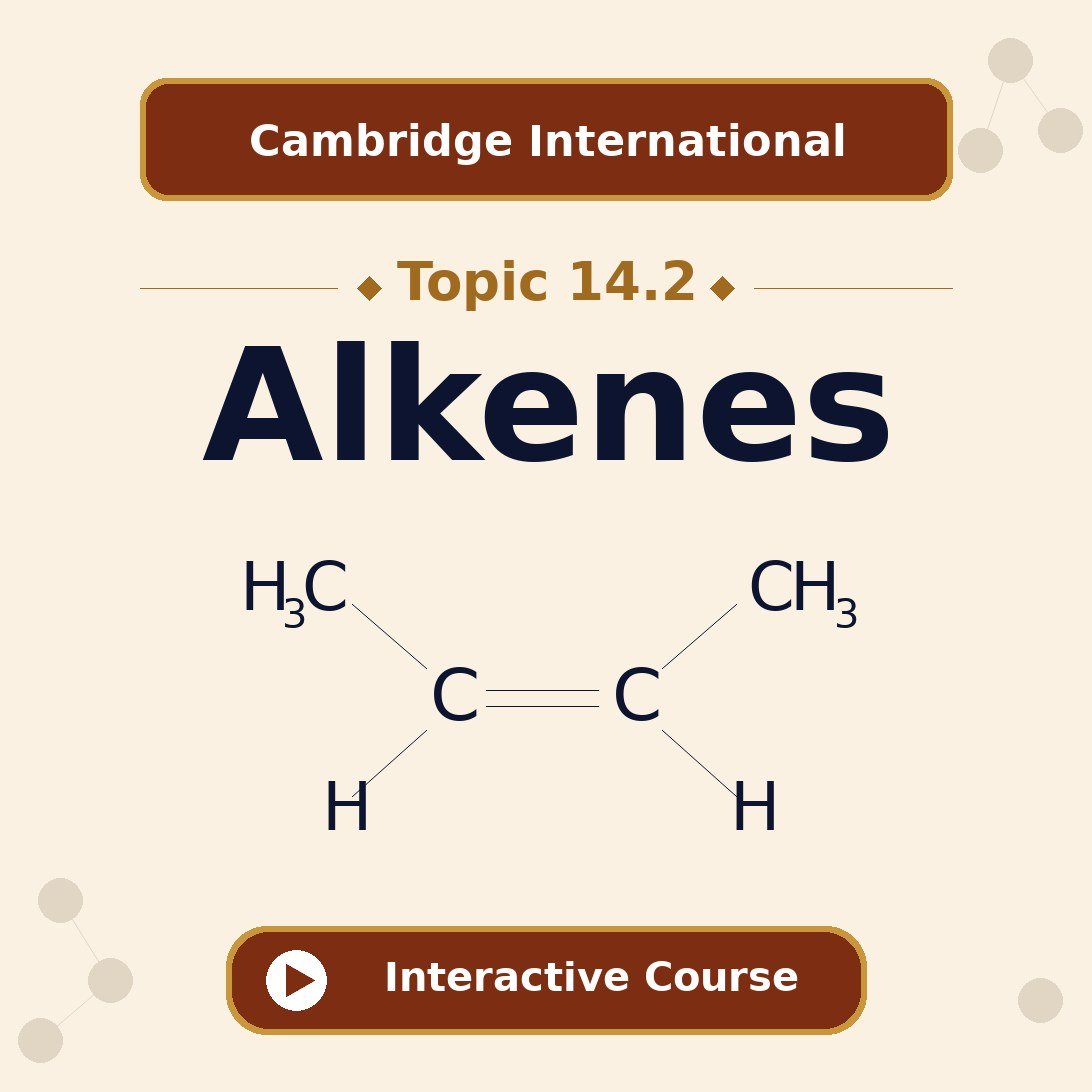
Master Alkenes for Cambridge International AS & A Level Chemistry
Continue from these free revision notes into the full Topic 14.2 Alkenes course. The guided video lessons are ready now; the Cambridge International MCQ bank, teacher-marked short-answer questions and KASP spec-point report are being written, and the course opens for enrolment as soon as they are complete.
Guided video teaching
Learn the chemistry and exam technique through structured video lessons with worked examples and walkthroughs.
Instant MCQ feedback
Auto-marked MCQ quizzes provide immediate diagnostic feedback for every answer choice.
Teacher-marked SAQs
Submit written exam responses and receive chemistry specialist feedback with improvement guidance.
Progress tracking
Identify strengths and weaknesses across the full Topic 14.2 specification with targeted reporting.
See how the course works
Click play to start the course preview animation.
Some ionic radii are shown.
| Ion | Ionic radius / nm |
|---|---|
| Na+ | 0.102 |
| K+ | 0.138 |
| F− | 0.133 |
| Cl− | 0.180 |
Which compound has the strongest ionic bonding?
Explain why the metallic bonding in magnesium is much stronger than that in sodium.
Copyright notice: This OLS revision content, including the explanations, layout, diagrams, tables and embedded learning structure, is authored for Online Learning System by Dr. Mohammed Al-Fatah. It may not be copied, reproduced, redistributed or adapted without written permission.
Keep this note — free
Save your progress across every Cambridge topic. A free account remembers which topics you have covered, saves your question scores, and syncs across your phone and laptop.
- Track every topic you have finished
- Keep your practice-question scores
- No payment, no card, free forever
Already registered? Log in