Markovnikov Addition and the Inductive Effect
A concise Cambridge International AS Level Chemistry revision guide to the inductive effect of alkyl groups, the relative stability of primary, secondary and tertiary carbocations, and how these explain Markovnikov addition of hydrogen halides to unsymmetrical alkenes.
The Problem with Unsymmetrical Alkenes
When HBr adds to ethene there is only one possible product, because both carbons of the C=C bond are identical. When HBr adds to propene, CH3CH=CH2, the hydrogen can attach to either carbon, so two products are possible: 2-bromopropane and 1-bromopropane.
Experiment shows that 2-bromopropane is the major product. Cambridge 14.2.5 asks you to explain this using the inductive effect of alkyl groups on the stability of the carbocation formed during electrophilic addition. The rule that summarises the outcome is called Markovnikov’s rule.
Markovnikov’s rule: When H-X adds to an unsymmetrical alkene, the hydrogen atom attaches to the carbon of the double bond that already carries the greater number of hydrogen atoms.
Quick Check: Which Alkenes Have a Choice?
Click every alkene that could give more than one bromoalkane.
The Inductive Effect of Alkyl Groups
An alkyl group such as CH3 is slightly electron-releasing. Through the σ bond that joins it to the rest of the molecule, it pushes electron density towards a neighbouring carbon atom. This push along a σ bond is called the positive inductive effect.
A carbocation is a carbon atom that has lost a share of an electron pair and carries a positive charge. Electron density released by alkyl groups spreads out that positive charge over more of the molecule. A charge that is spread out is more stable than a charge concentrated on one atom, so the more alkyl groups attached to the positive carbon, the more stable the carbocation.
| Carbocation | Alkyl groups on C+ | Inductive stabilisation | Relative stability |
|---|---|---|---|
| Primary, RCH2+ | 1 | Least | Least stable |
| Secondary, R2CH+ | 2 | More | More stable |
| Tertiary, R3C+ | 3 | Most | Most stable |
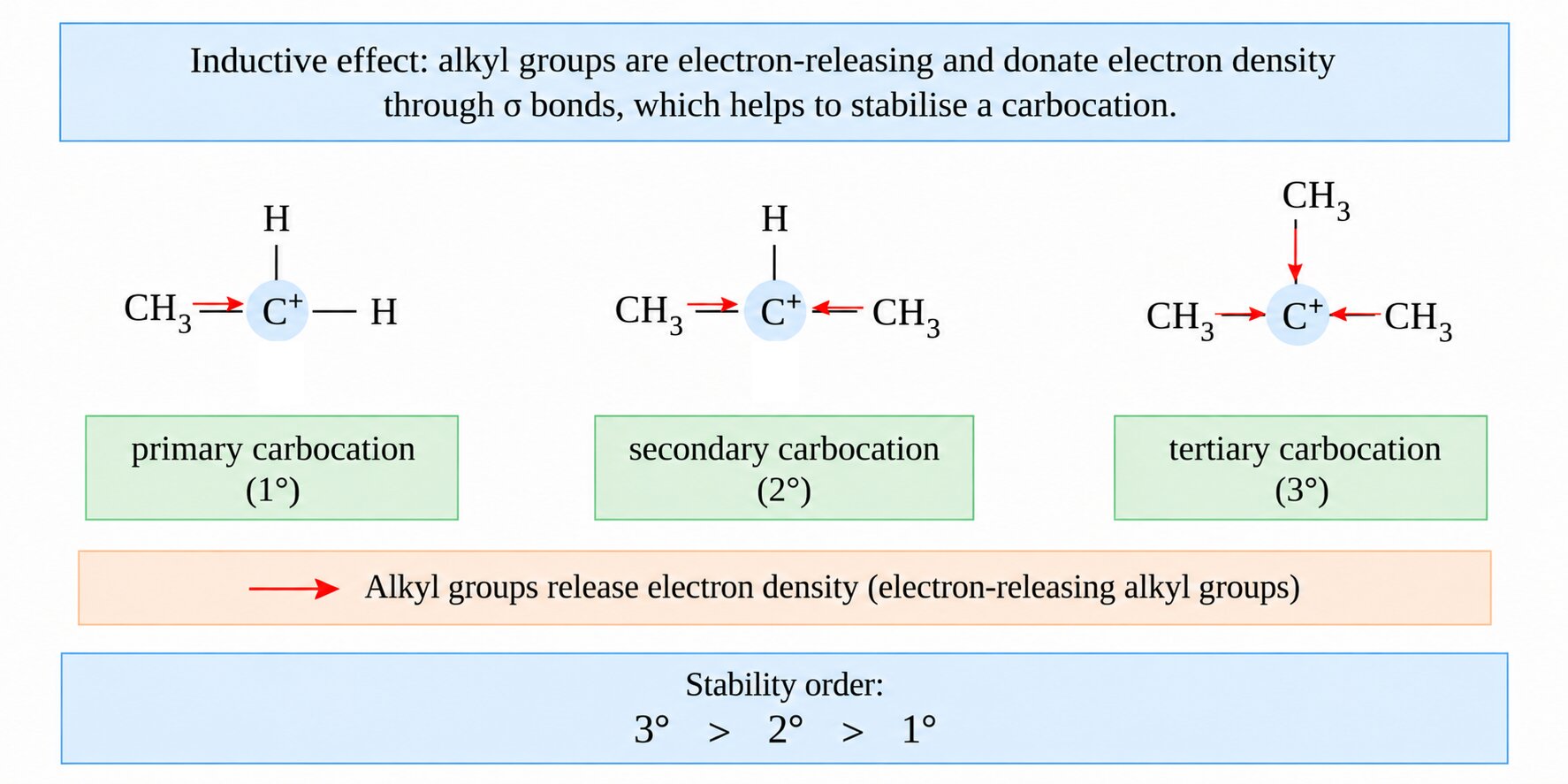
Each alkyl group pushes electron density towards the positive carbon, spreading the charge and stabilising the ion.
Exam sentence: Alkyl groups have a positive inductive effect: they release electron density towards the positively charged carbon, spreading the charge and stabilising the carbocation, so a tertiary carbocation is more stable than a secondary, which is more stable than a primary.
Quick Check: Classifying Carbocations
Five quick questions on carbocations written as formulae.
Explaining Markovnikov Addition
In electrophilic addition the π bond attacks Hδ+ first, and the carbocation forms on the other carbon of the double bond. With propene there are two possibilities.
Route A: H adds to the CH2 carbon
The positive charge is left on the middle carbon, which carries two alkyl groups (CH3 and the new CH3). This is a secondary carbocation.
Route B: H adds to the middle carbon
The positive charge is left on the end carbon, which carries only one alkyl group. This is a primary carbocation.
Which route wins
The secondary carbocation is more stable, so it forms faster and in greater amount. Br– then attacks it, giving 2-bromopropane as the major product.
The rule about hydrogen atoms is simply a shortcut for this argument: adding H to the carbon that already has more hydrogens leaves the positive charge on the carbon with more alkyl groups, which is the more stable carbocation.
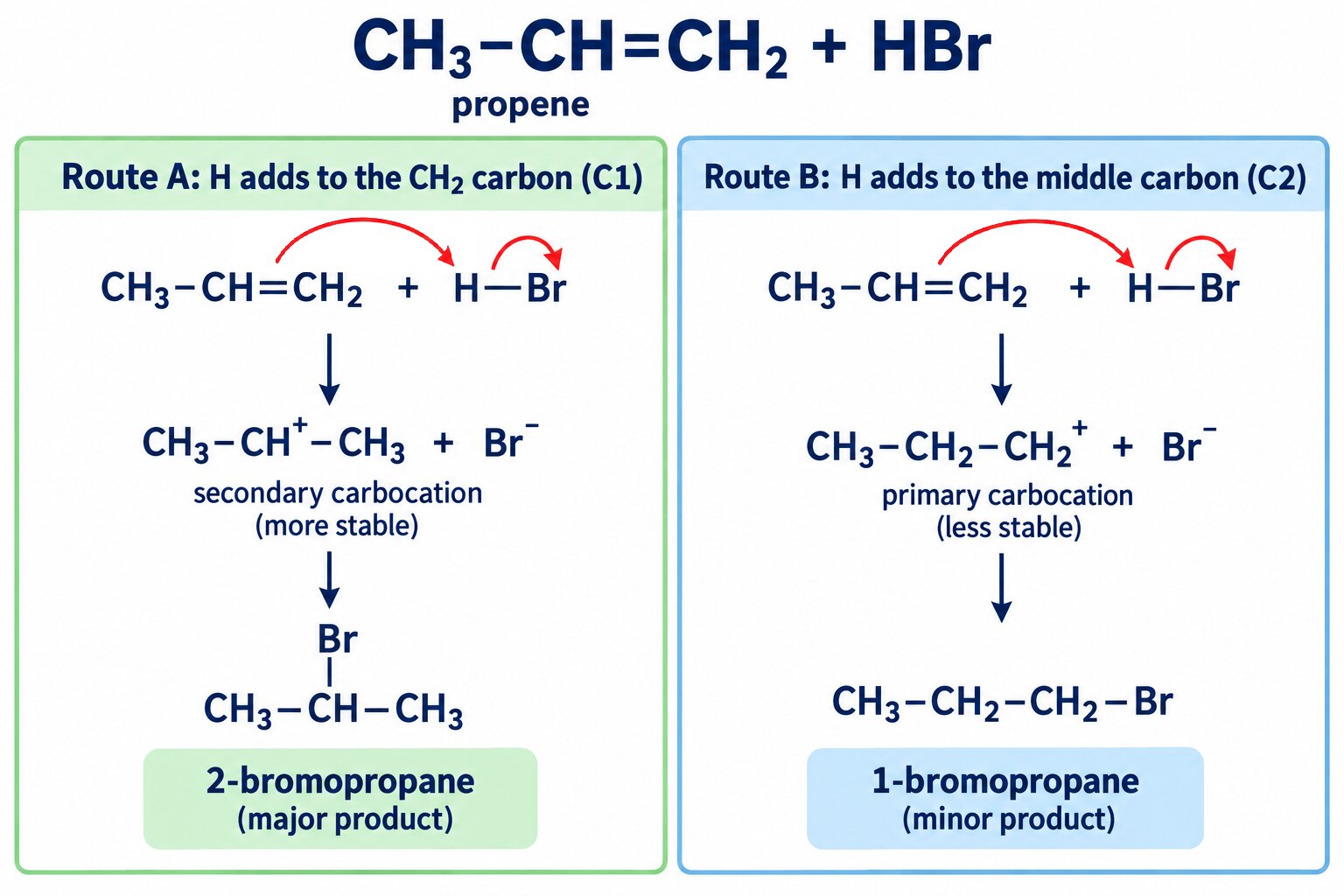
The more stable secondary carbocation forms faster, so 2-bromopropane is the major product.
Exam focus: Cambridge wants the explanation, not just the rule. Name both carbocations, state which is more stable and why (inductive effect of alkyl groups), and then identify the major product.
Quick Check: Build the Explanation
Drag the words and numbers into place to work through a new addition.
Quick Check: Explain the Major Product
Write a short explanation, then compare it with the mark points and the model answer.
Worked Examples
| Alkene + HBr | More stable carbocation | Major product | Minor product |
|---|---|---|---|
| Propene | Secondary | 2-Bromopropane | 1-Bromopropane |
| But-1-ene | Secondary | 2-Bromobutane | 1-Bromobutane |
| 2-Methylpropene | Tertiary | 2-Bromo-2-methylpropane | 1-Bromo-2-methylpropane |
| But-2-ene | Both secondary (identical) | 2-Bromobutane only | None |
The last row is a common trap. But-2-ene is symmetrical, so both possible carbocations are secondary and identical. There is only one product, and Markovnikov’s rule is not needed.
Exam sentence: HBr adds to propene to give mainly 2-bromopropane because the secondary carbocation intermediate is stabilised by the inductive effect of two alkyl groups and is therefore more stable than the primary carbocation.
Quick Check: When Neither Route Wins
Work out both carbocations before you choose.
Quick Check: Pick the Accurate Statement
In each round, choose the one statement that is accurate.
Common Exam Mistakes
- Quoting the rule without the reason. The marks are for carbocation stability and the inductive effect.
- Saying the bromide ion chooses the carbon. Br– attacks whichever carbocation has formed; the choice is made when H+ adds.
- Describing the inductive effect as alkyl groups withdrawing electrons. They release electron density.
- Applying the rule to a symmetrical alkene such as but-2-ene or ethene, where there is only one product.
Master Alkenes for Cambridge International AS & A Level Chemistry
Continue from these free revision notes into the full Topic 14.2 Alkenes course. The guided video lessons are ready now; the Cambridge International MCQ bank, teacher-marked short-answer questions and KASP spec-point report are being written, and the course opens for enrolment as soon as they are complete.
Guided video teaching
Learn the chemistry and exam technique through structured video lessons with worked examples and walkthroughs.
Instant MCQ feedback
Auto-marked MCQ quizzes provide immediate diagnostic feedback for every answer choice.
Teacher-marked SAQs
Submit written exam responses and receive chemistry specialist feedback with improvement guidance.
Progress tracking
Identify strengths and weaknesses across the full Topic 14.2 specification with targeted reporting.
See how the course works
Click play to start the course preview animation.
Some ionic radii are shown.
| Ion | Ionic radius / nm |
|---|---|
| Na+ | 0.102 |
| K+ | 0.138 |
| F− | 0.133 |
| Cl− | 0.180 |
Which compound has the strongest ionic bonding?
Explain why the metallic bonding in magnesium is much stronger than that in sodium.
Copyright notice: This OLS revision content, including the explanations, layout, diagrams, tables and embedded learning structure, is authored for Online Learning System by Dr. Mohammed Al-Fatah. It may not be copied, reproduced, redistributed or adapted without written permission.
Keep this note — free
Save your progress across every Cambridge topic. A free account remembers which topics you have covered, saves your question scores, and syncs across your phone and laptop.
- Track every topic you have finished
- Keep your practice-question scores
- No payment, no card, free forever
Already registered? Log in