Catalytic Converters
A concise revision guide to catalytic converters in car exhaust systems, including the pollutants removed, the catalyst metals used, key conversion reactions and why converters work best at high temperatures.
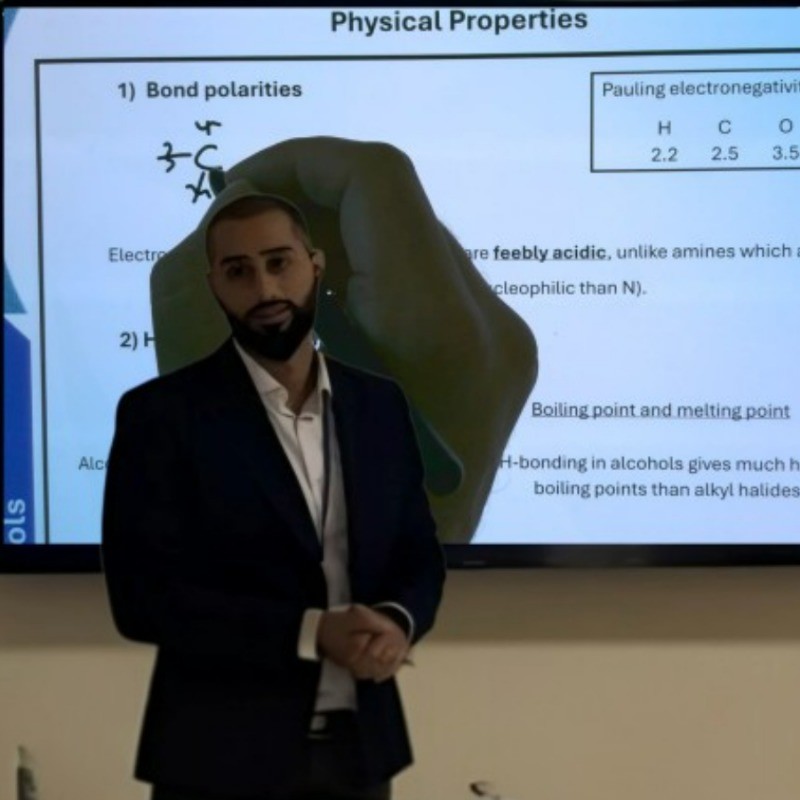
GCSE Recap: Catalysts and Surface Area
Before you start, check the GCSE ideas about catalysts and surface area that a catalytic converter depends on.
Why Catalytic Converters Are Used
Catalytic converters are fitted to car exhaust systems to reduce harmful emissions released during combustion.
They remove carbon monoxide, CO, nitrogen oxides, NOx, and unburned hydrocarbons from exhaust gases.
These pollutants are converted into less harmful products: carbon dioxide, CO2, nitrogen, N2, and water, H2O.
Key idea: A catalytic converter does not stop combustion pollutants forming in the engine. It reduces the harmful gases after they enter the exhaust system.
Quick Check: Which Gases Decrease?
Click every gas whose amount is smaller after the exhaust has passed through the converter.
Structure of a Catalytic Converter
Inside the converter is a ceramic honeycomb structure. The honeycomb design provides a very large surface area so the exhaust gases can contact the catalyst efficiently.
The ceramic structure is coated with a thin layer of catalyst metals, commonly including platinum, palladium and rhodium.
These metals speed up the reactions that convert harmful exhaust gases into less harmful products. The catalyst itself is not used up in the overall process.
The reactions happen on the surface of the catalyst. Pollutant molecules are first held on the metal surface, which is called adsorption, and this weakens the bonds in them. The new molecules then form and leave the surface again, which is called desorption, freeing that part of the surface for more gas. A large surface area means that more molecules can be adsorbed and react at the same time.
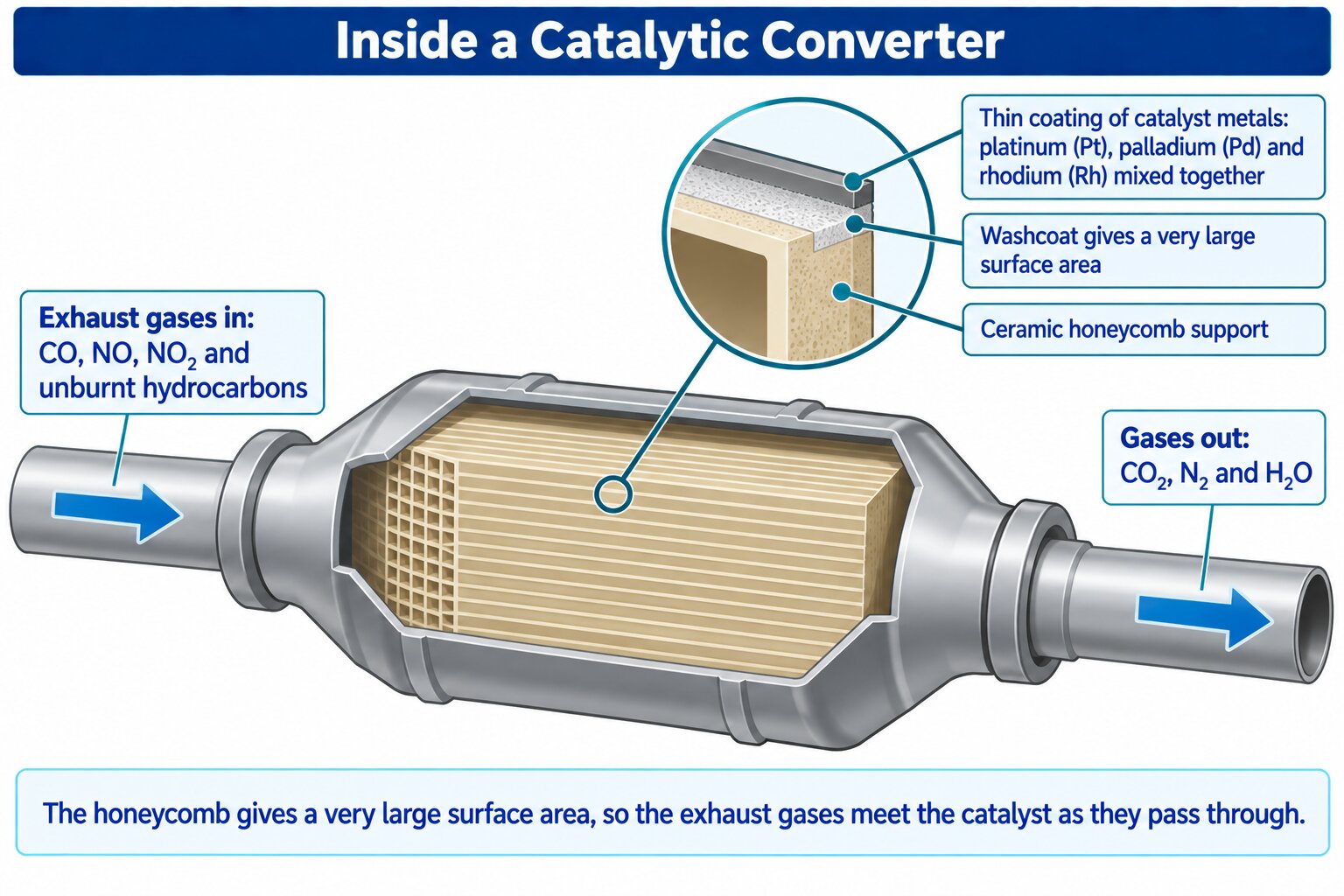
The honeycomb structure gives a large catalyst surface area for exhaust gases to react on as they pass through the converter.
Quick Check: Change the Design
Predict what happens when the honeycomb is swapped for a solid block with one wide hole.
Key Reaction: Carbon Monoxide and Nitrogen Monoxide
One important reaction in a catalytic converter involves carbon monoxide reacting with nitrogen monoxide.
The carbon monoxide is oxidised to carbon dioxide, while nitrogen monoxide is reduced to nitrogen.
Carbon monoxide gains oxygen, so it is oxidised. Nitrogen monoxide loses its oxygen, so it is reduced. Nitrogen dioxide, NO2, is removed in the same way, reacting with carbon monoxide to give nitrogen and carbon dioxide. That is why the converter is described as removing nitrogen oxides, NOx, and not only NO.
Key equation: 2CO + 2NO → 2CO2 + N2
| Reactant | Problem | Product formed |
|---|---|---|
| Carbon monoxide, CO | Toxic gas from incomplete combustion | Carbon dioxide, CO2 |
| Nitrogen monoxide, NO | Nitrogen oxide pollutant from hot engines | Nitrogen, N2 |
Quick Check: Oxidised or Reduced?
Answer these quick questions about what is oxidised, what is reduced and how many molecules react.
Unburned Hydrocarbons in Exhaust Gases
Exhaust gas still contains some oxygen, so carbon monoxide and unburned hydrocarbons are also oxidised by oxygen on the catalyst: 2CO + O2 → 2CO2, and the hydrocarbons are oxidised to carbon dioxide and water. Removing all three pollutants is why the unit is called a three-way catalytic converter.
Unburned hydrocarbons can also react with nitrogen oxides inside a catalytic converter.
For example, octane, C8H18, can react with nitrogen monoxide to produce carbon dioxide, nitrogen and water.
Example equation: C8H18 + 25NO → 8CO2 + 12½N2 + 9H2O
Remember: double every number if you are told not to use fractions: 2C8H18 + 50NO → 16CO2 + 25N2 + 18H2O.
Exam focus: When asked about catalytic converters, name both the harmful gases removed and the less harmful products formed. Do not just state that the converter “cleans the exhaust”.
Quick Check: Balance the Equations
Type the missing balancing numbers for three reactions the page does not show.
Temperature and Effectiveness
Catalytic converters work best at high temperatures. This is why they are most effective once the engine has warmed up.
At low temperatures, the reactions occur more slowly, so the converter is less effective immediately after a cold start.
As the exhaust system becomes hotter, more pollutant molecules have energy greater than the activation energy, so more of the collisions on the catalyst surface are successful and the rate rises.
| Condition | Effect on converter | Exam conclusion |
|---|---|---|
| Cold engine | Catalyst reactions are slower | More pollutants may leave the exhaust |
| Warm engine | Catalyst reactions are faster and more effective | Pollutants are converted more efficiently |
Quick Check: Explain the Heated Converter
Write a short explanation, then compare it with the mark points and the model answer.
Master Introduction to Organic Chemistry and Alkanes for AQA A Level Chemistry
Continue from these free revision notes into the full 3.3.1 and 3.3.2 Introduction to Organic Chemistry and Alkanes course. The six guided video lessons are ready now; the AQA MCQ bank, teacher-marked short-answer questions, supplementary lessons and KASP spec-point report are being written, and the course opens for enrolment as soon as they are complete.
Guided video teaching
Learn the chemistry and exam technique through structured video lessons with worked examples and walkthroughs.
Instant MCQ feedback
Auto-marked MCQ quizzes provide immediate diagnostic feedback for every answer choice.
Teacher-marked SAQs
Submit written exam responses and receive chemistry specialist feedback with improvement guidance.
Progress tracking
Identify strengths and weaknesses across the full 3.3.1 and 3.3.2 specification with targeted reporting.
See how the course works
Click play to start the course preview animation.
Some ionic radii are shown.
| Ion | Ionic radius / nm |
|---|---|
| Na+ | 0.102 |
| K+ | 0.138 |
| F− | 0.133 |
| Cl− | 0.180 |
Which compound has the strongest ionic bonding?
Explain why the metallic bonding in magnesium is much stronger than that in sodium.
Catalytic Converter FAQs
These questions cover the main exam points on catalytic converters in car exhaust systems.
What does a catalytic converter do?
A catalytic converter reduces harmful emissions from car exhaust gases by converting carbon monoxide, nitrogen oxides and unburned hydrocarbons into less harmful products.
Which catalyst metals are used in catalytic converters?
Catalytic converters commonly use platinum, palladium and rhodium coated onto a ceramic honeycomb structure.
What are the products formed in a catalytic converter?
The main less harmful products are carbon dioxide, nitrogen and water.
Why do catalytic converters work better when the engine is warm?
They work better at high temperatures because the catalyst reactions occur faster once the engine and exhaust system have warmed up.
Copyright notice: This OLS revision content, including the explanations, layout, diagrams, tables and embedded learning structure, is authored for Online Learning System by Dr. Mohammed Al-Fatah. It may not be copied, reproduced, redistributed or adapted without written permission.
Keep this note — free
Save your progress across every AQA topic. A free account remembers which topics you have covered, saves your question scores, and syncs across your phone and laptop.
- Track every topic you have finished
- Keep your practice-question scores
- No payment, no card, free forever
Already registered? Log in