Propagation
A concise revision guide to the propagation stage of free-radical substitution, including hydrogen abstraction, alkyl radical formation, haloalkane production and regeneration of the halogen radical.
What Happens During Propagation?
Propagation is the chain-carrying stage of free-radical substitution. It uses a free radical formed in initiation and produces another free radical so the reaction can continue.
In the substitution of an alkane by a halogen, propagation normally occurs in two repeated steps. First, a halogen radical removes a hydrogen atom from the alkane. Second, the alkyl radical formed reacts with a halogen molecule to make the haloalkane product.
Key idea: In propagation, a free radical is present in both the reactants and the products. This is why the mechanism continues as a chain reaction.
Quick Check: Counting the Radicals
Decide whether one propagation step changes how many radicals are in the mixture.
First Propagation Step: Hydrogen Abstraction
In the first propagation step, a halogen free radical removes a hydrogen atom from the alkane. This forms a hydrogen halide and an alkyl free radical.
For chlorination of methane, the chlorine radical removes one hydrogen atom from methane. The products are hydrogen chloride and a methyl radical.
CH4 + Cl• → HCl + •CH3
Exam focus: The dot belongs on the radical species. The methyl radical is written as •CH3 or CH3•, not CH3+ or CH3–.
Quick Check: Find the Fault
Read the student's equation carefully and decide what is wrong with it.
Second Propagation Step: Haloalkane Formation
In the second propagation step, the alkyl radical reacts with a halogen molecule. This forms the main substitution product, a haloalkane, and regenerates another halogen free radical.
For chlorination of methane, the methyl radical reacts with a chlorine molecule to form chloromethane and another chlorine radical.
•CH3 + Cl2 → CH3Cl + Cl•
Why this matters: The chlorine radical is regenerated, so it can remove hydrogen from another methane molecule. This keeps the chain reaction going.
Quick Check: Both Steps for Cyclohexane
Drag the formulae into place to build the two propagation steps for a different alkane.
Propagation as a Chain Reaction
A chain reaction continues because a reactive species consumed in one step is regenerated in a later step. In free-radical substitution, the regenerated species is the halogen free radical.
The two propagation steps can repeat many times before radicals are removed during termination.
| Propagation feature | What it means | Example |
|---|---|---|
| Radical in reactants | A halogen radical starts the propagation sequence by reacting with the alkane. | Cl• reacts with CH4. |
| Radical in products | A new radical is produced, so further reaction is possible. | •CH3 forms in the first propagation step. |
| Radical regenerated | The halogen radical is remade and can attack another alkane molecule. | Cl• is regenerated when •CH3 reacts with Cl2. |
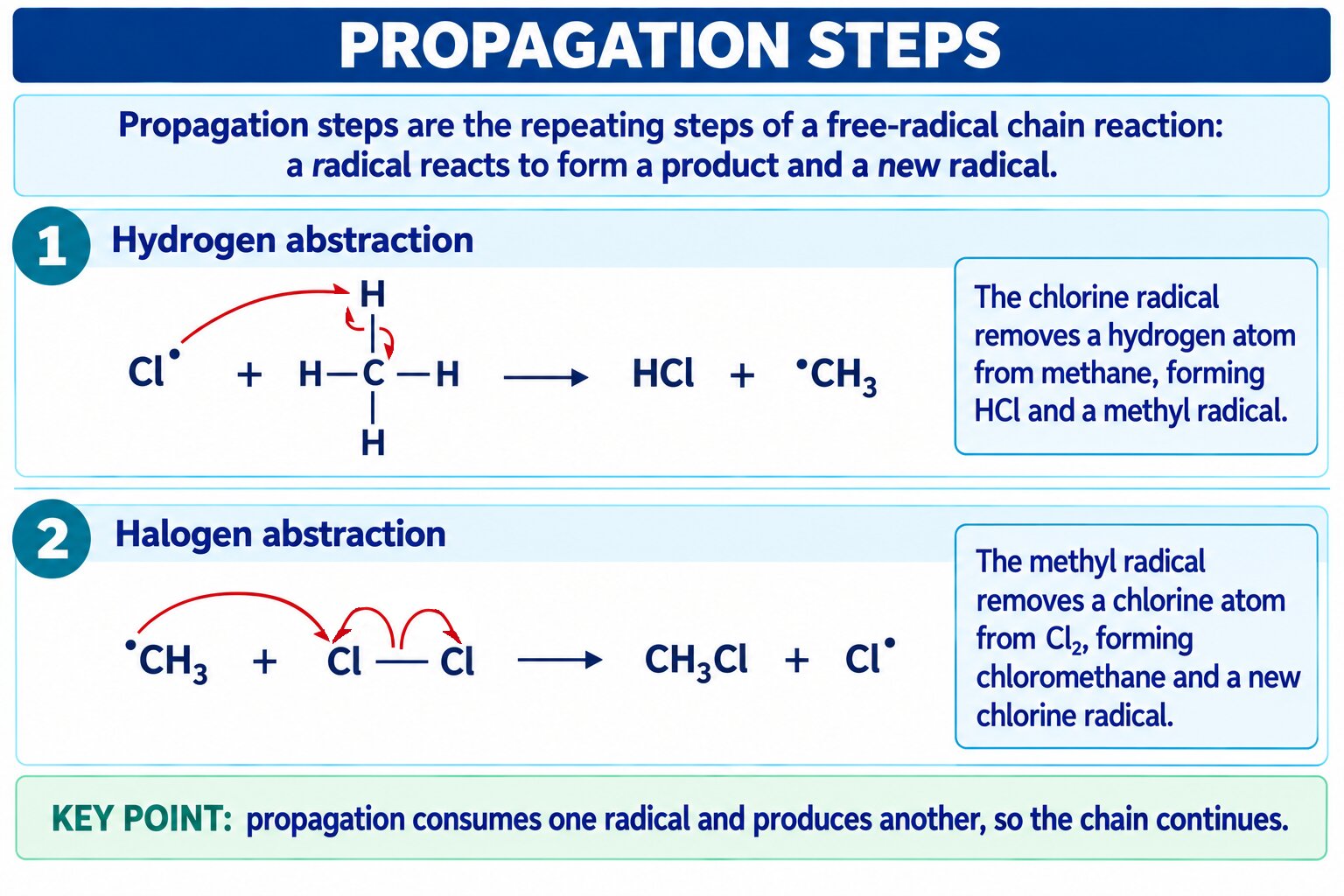
The propagation sequence contains two radical reactions: hydrogen abstraction followed by haloalkane formation and regeneration of the halogen radical.
Quick Check: One Turn of the Chain
Drag the six events into the order in which they happen.
Example: Bromination of Propane
With propane, a bromine free radical can remove a hydrogen atom from the middle carbon. This forms hydrogen bromide and a secondary propyl free radical.
This secondary radical is more stable than a primary radical. It can then react with Br2 to form 2-bromopropane and regenerate Br•.
CH3CH2CH3 + Br• → HBr + CH3CH•CH3
CH3CH•CH3 + Br2 → CH3CHBrCH3 + Br•
Common mistake: Do not stop after the first propagation step. The second step is needed to form the haloalkane and regenerate the halogen radical.
Quick Check: Complete the Pair of Steps
Work out the missing species in each step and type them in.
Master Introduction to Organic Chemistry and Alkanes for AQA A Level Chemistry
Continue from these free revision notes into the full 3.3.1 and 3.3.2 Introduction to Organic Chemistry and Alkanes course. The six guided video lessons are ready now; the AQA MCQ bank, teacher-marked short-answer questions, supplementary lessons and KASP spec-point report are being written, and the course opens for enrolment as soon as they are complete.
Guided video teaching
Learn the chemistry and exam technique through structured video lessons with worked examples and walkthroughs.
Instant MCQ feedback
Auto-marked MCQ quizzes provide immediate diagnostic feedback for every answer choice.
Teacher-marked SAQs
Submit written exam responses and receive chemistry specialist feedback with improvement guidance.
Progress tracking
Identify strengths and weaknesses across the full 3.3.1 and 3.3.2 specification with targeted reporting.
See how the course works
Click play to start the course preview animation.
Some ionic radii are shown.
| Ion | Ionic radius / nm |
|---|---|
| Na+ | 0.102 |
| K+ | 0.138 |
| F− | 0.133 |
| Cl− | 0.180 |
Which compound has the strongest ionic bonding?
Explain why the metallic bonding in magnesium is much stronger than that in sodium.
Propagation FAQs
These questions summarise the key exam points for the propagation step in free-radical substitution.
What is propagation in free-radical substitution?
Propagation is the chain-carrying stage of the mechanism. A free radical reacts to form a product and another free radical, allowing the reaction to continue.
What happens in the first propagation step?
A halogen radical removes a hydrogen atom from the alkane. This forms a hydrogen halide and an alkyl free radical.
What happens in the second propagation step?
The alkyl radical reacts with a halogen molecule. This forms a haloalkane and regenerates a halogen free radical.
Why is propagation called a chain reaction?
It is called a chain reaction because the halogen radical is regenerated and can react with further alkane molecules, repeating the propagation steps many times.
What are the propagation equations for chlorination of methane?
The two propagation equations are CH4 + Cl• → HCl + •CH3 and •CH3 + Cl2 → CH3Cl + Cl•.
Copyright notice: This OLS revision content, including the explanations, layout, diagrams, tables and embedded learning structure, is authored for Online Learning System by Dr. Mohammed Al-Fatah. It may not be copied, reproduced, redistributed or adapted without written permission.
Keep this note — free
Save your progress across every AQA topic. A free account remembers which topics you have covered, saves your question scores, and syncs across your phone and laptop.
- Track every topic you have finished
- Keep your practice-question scores
- No payment, no card, free forever
Already registered? Log in