Fractional Distillation
A concise revision guide to how crude oil is separated into useful petroleum fractions by fractional distillation, including the role of boiling point, molecular size and London forces.
GCSE Recap: Separating Liquids by Boiling Point
Answer three quick GCSE questions before you start.
Where This Sits in the OCR A Specification
Fractional distillation itself is not examined by OCR, but the explanation of why boiling points rise with chain length (induced dipole-dipole interactions, 4.1.2(c)) is, so read the section on why the fractions separate carefully.
Alkanes, Crude Oil and Petroleum Fractions
Alkanes are saturated hydrocarbons. They contain only carbon and hydrogen atoms, and they contain only single carbon-carbon bonds.
The general formula is CnH2n+2, where n is the number of carbon atoms in the molecule. It fits branched alkanes just as well as straight-chain ones. The only alkanes it does not fit are cycloalkanes, whose carbon chain is joined into a ring.
Alkanes are mainly obtained from crude oil. Crude oil is a complex mixture made up mainly of alkane hydrocarbons.
Petroleum fraction: a collection of hydrocarbons with a similar chain length and therefore a similar range of boiling points.
Key idea: Fractional distillation does not separate crude oil into single pure compounds. It separates crude oil into groups of hydrocarbons with similar boiling point ranges.
Quick Check: Spot the Alkanes
Use the general formula to pick out the alkanes in a crude oil sample.
How Fractional Distillation Separates Crude Oil
Before separation takes place, crude oil is pre-heated so that most of it vaporises. The hot vapours are then fed into a tall fractionating column.
The part that does not vaporise runs to the base of the column and is drawn off there as the residue. That residue is the bitumen fraction, which is why bitumen appears at the bottom of the diagram.
Inside the column, the temperature decreases as you move upwards. This produces a temperature gradient.
As the vapours rise through the column, different hydrocarbons condense at different heights, depending on their boiling points. The column is fitted with trays, and the liquid that condenses collects on the tray at the level where the temperature has dropped to its boiling point.
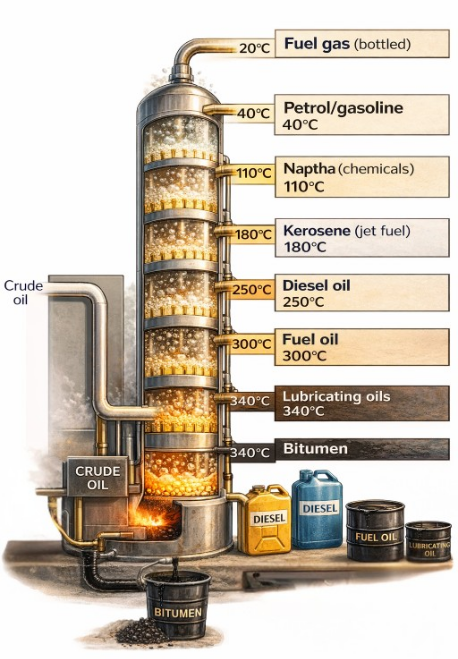
Smaller, lower boiling point hydrocarbons leave nearer the top of the column, while larger, higher boiling point hydrocarbons condense lower down.
Important: Fractional distillation is a physical separation process. It does not break covalent bonds and it does not chemically change the hydrocarbons.
Quick Check: Through the Furnace and Up the Column
Put the stages in order, starting with the crude oil in the storage tank.
Why the Fractions Separate
The separation depends on boiling point, which is linked to the size of the hydrocarbon molecules.
- Larger molecules have more electrons and a larger surface area in contact with their neighbours, so the London forces between them are stronger and they have higher boiling points.
- Smaller molecules have weaker London forces, so they boil at lower temperatures.
- Hydrocarbons with similar molecular size, mass and boiling point condense together to form a fraction.
| Hydrocarbon size | London forces | Boiling point | Where it condenses |
|---|---|---|---|
| Smaller hydrocarbons | Weaker London forces between molecules. | Lower boiling points. | Nearer the top of the column, where temperatures are lower. |
| Larger hydrocarbons | Stronger London forces between molecules. | Higher boiling points. | Lower down in the column, where temperatures are higher. |
Exam focus: Link increasing chain length to stronger London forces, higher boiling point and condensation lower in the fractionating column.
Remember: London forces are also called van der Waals forces or induced dipole-dipole interactions. Use the name your own specification uses, because all three mean the same force here.
Quick Check: Explain Where Two Alkanes Condense
Write a short explanation, then compare it with the mark points and the model answer.
Common Petroleum Fractions
The fractions obtained from crude oil are useful because they contain hydrocarbons with similar properties and similar boiling point ranges. Many fractions are used as fuels because alkanes release large amounts of energy when burned.
| Fraction | Typical position in column | Main use |
|---|---|---|
| Fuel gas | Very near the top. | Bottled gas. |
| Petrol or gasoline | Near the top. | Fuel for cars. |
| Naphtha | Upper part of the column. | Chemicals and feedstock. |
| Kerosene | Middle part of the column. | Jet fuel. |
| Diesel oil | Lower middle part of the column. | Diesel fuel. |
| Fuel oil and lubricating oils | Lower part of the column. | Heavy fuels and lubrication. |
| Bitumen | Bottom of the column, the residue that never vaporised. | Road surfacing and roofing. |
Quick Check: Which Fraction?
Use the boiling ranges to place four alkanes in the correct fractions.
Fractional Distillation Is a Physical Process
Fractional distillation separates hydrocarbons by differences in boiling point. It is a physical process, not a chemical reaction.
During vaporisation and condensation, the process overcomes weak London forces between molecules. It does not break the strong covalent bonds inside the hydrocarbon molecules.
| Type of force or bond | What happens during fractional distillation? | Exam wording |
|---|---|---|
| London forces between molecules | These weak intermolecular forces are overcome when fractions vaporise. | Fractional distillation overcomes intermolecular forces. |
| Covalent bonds within molecules | These bonds are not broken during fractional distillation. | No chemical reaction takes place. |
Remember: If covalent bonds are broken and new molecules are made, the process is chemical. Fractional distillation does not do this.
Quick Check: Separation or Reaction?
Decide quickly whether each change is physical or chemical.
Common Exam Mistakes
- Do not say fractional distillation separates hydrocarbons by chemical reaction. It is a physical process.
- Do not say covalent bonds are broken. Fractional distillation overcomes London forces between molecules.
- Do not say all hydrocarbons leave the top of the column. Larger hydrocarbons condense lower down.
- Do not confuse fractional distillation with cracking. Cracking breaks larger hydrocarbons into smaller molecules.
- Do not describe a petroleum fraction as one compound. A fraction is a mixture of hydrocarbons with similar boiling points.

Master Basic Concepts of Organic Chemistry and Alkanes for OCR A Level Chemistry A
Continue from these free revision notes into the full 4.1.1 and 4.1.2 Basic Concepts of Organic Chemistry and Alkanes course. The guided video lessons are ready now; the OCR A MCQ bank, teacher-marked short-answer questions and KASP spec-point report are being written, and the course opens for enrolment as soon as they are complete.
Guided video teaching
Learn the chemistry and exam technique through structured video lessons with worked examples and walkthroughs.
Instant MCQ feedback
Auto-marked MCQ quizzes provide immediate diagnostic feedback for every answer choice.
Teacher-marked SAQs
Submit written exam responses and receive chemistry specialist feedback with improvement guidance.
Progress tracking
Identify strengths and weaknesses across the full 4.1.1 and 4.1.2 specification with targeted reporting.
See how the course works
Click play to start the course preview animation.
Some ionic radii are shown.
| Ion | Ionic radius / nm |
|---|---|
| Na+ | 0.102 |
| K+ | 0.138 |
| F− | 0.133 |
| Cl− | 0.180 |
Which compound has the strongest ionic bonding?
Explain why the metallic bonding in magnesium is much stronger than that in sodium.
Fractional Distillation FAQ
These short answers summarise the key exam points from this page.
What is fractional distillation of crude oil?
Fractional distillation is a physical separation process that separates crude oil into fractions based on different boiling point ranges.
Why do smaller hydrocarbons leave nearer the top of the column?
Smaller hydrocarbons have weaker London forces between molecules, so they have lower boiling points and condense nearer the top where the column is cooler.
Why do larger hydrocarbons condense lower down?
Larger hydrocarbons have stronger London forces between molecules, so they have higher boiling points and condense lower down where the column is hotter.
Are covalent bonds broken during fractional distillation?
No. Fractional distillation only overcomes weak intermolecular forces between molecules. It does not break covalent bonds within the hydrocarbon molecules.
Copyright notice: This OLS revision content, including the explanations, layout, diagrams, tables and embedded learning structure, is authored for Online Learning System by Dr. Mohammed Al-Fatah. It may not be copied, reproduced, redistributed or adapted without written permission.
Keep this note — free
Save your progress across every OCR A topic. A free account remembers which topics you have covered, saves your question scores, and syncs across your phone and laptop.
- Track every topic you have finished
- Keep your practice-question scores
- No payment, no card, free forever
Already registered? Log in