Cracking
A concise revision guide to cracking larger hydrocarbons into smaller, more useful molecules, including alkanes, alkenes, the need for high temperature and the economic reasons for catalytic cracking.
GCSE Recap: Alkenes, Bromine Water and Bond Breaking
Answer three quick GCSE questions before you start.
Where This Sits in the OCR A Specification
OCR does not examine cracking in 4.1.2; it is mentioned in 4.1.3 as a way of producing alkenes. Treat this page as background.
What Is Cracking?
Cracking is a chemical process in which large hydrocarbon molecules are broken down into smaller, more useful molecules.
This happens by the breaking of carbon-carbon covalent bonds, written as C-C bonds, within the larger hydrocarbon molecule.
Cracking is used because smaller hydrocarbons are often in greater demand, especially as fuels and as feedstocks for making plastics and other chemicals.
Cracking: the breaking down of long-chain hydrocarbons into shorter-chain hydrocarbons by breaking C-C bonds.
Key idea: Unlike fractional distillation, cracking is a chemical process because covalent bonds are broken and new molecules are formed.
Products of Cracking
During cracking, high relative molecular mass, Mr, alkanes are converted into a mixture of smaller alkanes and alkenes. Hydrogen gas may also be produced.
An alkane cannot crack into smaller alkanes only. There are not enough hydrogen atoms to go round, so at least one product must be an alkene, or hydrogen itself. Check any set of products by counting the atoms on each side.
For example, decane can be cracked into octane and ethene:
C10H22 → C8H18 + C2H4
In this example, C10H22 is a larger alkane, C8H18 is a smaller alkane and C2H4 is an alkene.
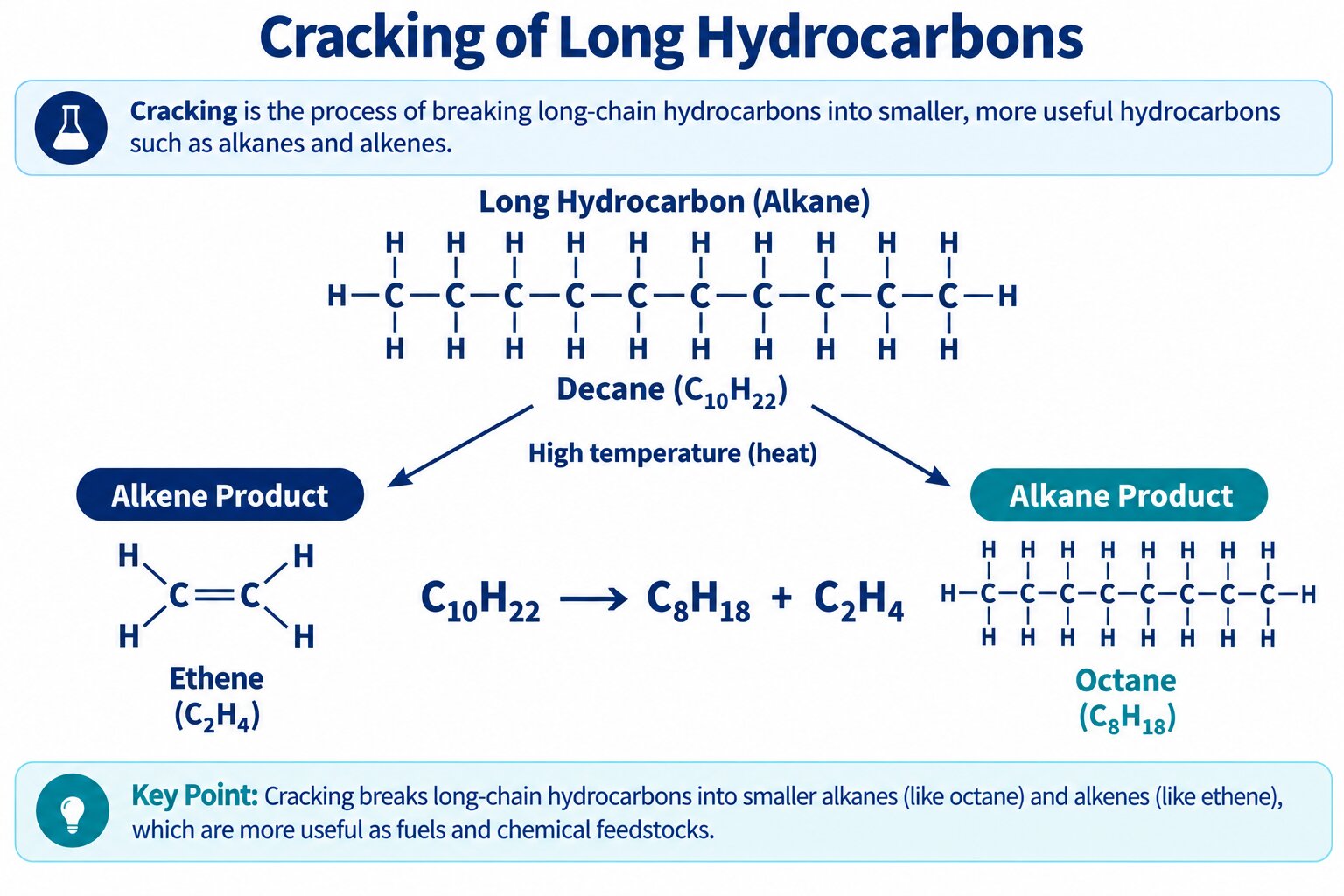
A long-chain hydrocarbon is converted into smaller, more useful molecules by breaking C-C bonds.
| Product type | Example from the equation | Why it matters |
|---|---|---|
| Smaller alkane | C8H18, octane. | Smaller alkanes are useful as motor fuels. |
| Alkene | C2H4, ethene. | Alkenes are useful feedstocks for making polymers and other chemicals. |
| Hydrogen gas | H2 may be produced in some cracking reactions. | Hydrogen can be formed alongside smaller hydrocarbons, depending on the reaction pathway. |
Quick Check: Find the Missing Product
Count the atoms in each equation, then type the formula of X.
Why Cracking Needs High Temperature
Cracking involves the breaking of strong covalent bonds. This means the reaction requires a large amount of energy.
High temperatures are used to provide enough energy for the C-C bonds in larger hydrocarbons to break.
There are two routes. Thermal cracking uses a very high temperature and a high pressure (about 1200 K and 7000 kPa) and gives a high proportion of alkenes. Catalytic cracking passes the vapour over a zeolite catalyst at a lower temperature and only a slight pressure (about 720 K), and gives mainly branched and aromatic molecules for motor fuels.
The catalyst provides a route of lower activation energy, so the same rate is reached at a lower temperature. That is what saves energy and money, not a vague improvement in efficiency.
Important: Do not describe cracking as a physical separation. Cracking changes the molecules present, so it is a chemical reaction.
| Process | What happens to bonds? | Type of change |
|---|---|---|
| Fractional distillation | Weak London forces between molecules are overcome. | Physical separation. |
| Cracking | Strong C-C covalent bonds within molecules are broken. | Chemical reaction. |
Quick Check: Bonds, Energy and Evidence
In each round, pick the one statement that is accurate.
Economic Reasons for Catalytic Cracking
Catalytic cracking is economically important because it converts less useful long-chain hydrocarbons into shorter molecules that are in greater demand.
- Petroleum fractions that contain shorter carbon chains, such as petrol and naphtha, are in greater demand than fractions made from longer hydrocarbon molecules.
- Longer hydrocarbons are often produced in excess, so they are cracked to increase the supply of shorter, more useful molecules.
- The products formed during cracking are generally more valuable and commercially useful than the original hydrocarbons.
- Ethene is an important raw material used to manufacture poly(ethene), ethane-1,2-diol and ethanol.
- Smaller alkanes are widely used as motor fuels because they are more volatile and ignite more easily, which is what a petrol engine needs, and because they meet consumer demand more effectively.
Exam focus: Link cracking to demand and supply. Longer hydrocarbons are less useful and often in excess, while shorter alkanes and alkenes are more commercially valuable.
Quick Check: Explain Why the Refinery Cracks Fuel Oil
Write a short explanation that uses the data, then compare it with the mark points and the model answer.
Cracking and Alkene Feedstocks
One of the most important outcomes of cracking is the production of alkenes. These molecules contain a C=C double bond, making them more reactive than alkanes.
Alkenes are useful because they can be converted into many products, including polymers and alcohols. Ethene is a key example because it is used to make poly(ethene), ethane-1,2-diol and ethanol.
| Cracking product | Commercial use | Reason it is useful |
|---|---|---|
| Shorter alkanes | Motor fuels. | They are in greater demand, and they are more volatile, so they ignite more easily in an engine. |
| Alkenes | Chemical feedstocks. | They can be used to make polymers and other industrial chemicals. |
| Ethene | Poly(ethene), ethane-1,2-diol and ethanol manufacture. | It is a reactive alkene and an important raw material. |
Quick Check: Pick Out the Alkene Feedstocks
Click every product in the stream that is an alkene.
Common Exam Mistakes
- Do not say cracking is a physical process. It is a chemical process.
- Do not say only alkanes are produced. Cracking can produce smaller alkanes and alkenes.
- Do not forget that hydrogen gas may also be produced.
- Do not confuse cracking with fractional distillation. Fractional distillation separates fractions, while cracking changes molecules.
- Do not describe cracking only as a way to make fuels. It also produces alkenes for chemical synthesis.
Master Basic Concepts of Organic Chemistry and Alkanes for OCR A Level Chemistry A
Continue from these free revision notes into the full 4.1.1 and 4.1.2 Basic Concepts of Organic Chemistry and Alkanes course. The guided video lessons are ready now; the OCR A MCQ bank, teacher-marked short-answer questions and KASP spec-point report are being written, and the course opens for enrolment as soon as they are complete.
Guided video teaching
Learn the chemistry and exam technique through structured video lessons with worked examples and walkthroughs.
Instant MCQ feedback
Auto-marked MCQ quizzes provide immediate diagnostic feedback for every answer choice.
Teacher-marked SAQs
Submit written exam responses and receive chemistry specialist feedback with improvement guidance.
Progress tracking
Identify strengths and weaknesses across the full 4.1.1 and 4.1.2 specification with targeted reporting.
See how the course works
Click play to start the course preview animation.
Some ionic radii are shown.
| Ion | Ionic radius / nm |
|---|---|
| Na+ | 0.102 |
| K+ | 0.138 |
| F− | 0.133 |
| Cl− | 0.180 |
Which compound has the strongest ionic bonding?
Explain why the metallic bonding in magnesium is much stronger than that in sodium.
Cracking FAQ
Quick answers to common cracking questions for OCR A Level Chemistry A.
What is cracking in organic chemistry?
Cracking is a chemical process where large hydrocarbon molecules are broken into smaller, more useful molecules by breaking carbon-carbon covalent bonds.
What products are formed during cracking?
Cracking usually forms a mixture of smaller alkanes and alkenes. Hydrogen gas may also be produced depending on the reaction.
Why does cracking need a high temperature?
Cracking needs a high temperature because strong covalent C-C bonds must be broken, so enough energy is required for the reaction to occur.
Why is catalytic cracking economically useful?
Catalytic cracking converts longer hydrocarbons that may be in excess into shorter alkanes and alkenes that are in greater demand and have higher commercial value.
Copyright notice: This OLS revision content, including the explanations, layout, diagrams, tables and embedded learning structure, is authored for Online Learning System by Dr. Mohammed Al-Fatah. It may not be copied, reproduced, redistributed or adapted without written permission.
Keep this note — free
Save your progress across every OCR A topic. A free account remembers which topics you have covered, saves your question scores, and syncs across your phone and laptop.
- Track every topic you have finished
- Keep your practice-question scores
- No payment, no card, free forever
Already registered? Log in