Flue-Gas Desulfurisation
A concise AQA A Level Chemistry revision guide to removing sulfur dioxide from the flue gases of power stations using calcium oxide or calcium carbonate: the equations, why an acidic gas reacts with a basic solid, and what happens to the products (3.3.2.3).
GCSE Recap: From Limestone to Quicklime
Before you start, check where quicklime comes from, why it costs more than limestone, and what a base does to an acid.
Why Sulfur Dioxide Has to Be Removed
Coal and some crude-oil fractions contain sulfur compounds. When the fuel burns in a power station the sulfur is oxidised to sulfur dioxide, SO2, which leaves in the flue gases, the waste gases that go up the chimney (the flue). Sulfur dioxide dissolves in water in the atmosphere to form sulfurous acid, and is oxidised to sulfuric acid, giving acid rain.
AQA 3.3.2.3 asks you to explain why sulfur dioxide can be removed from flue gases using calcium oxide or calcium carbonate. The key idea is an acid-base reaction: sulfur dioxide is an acidic oxide, and calcium oxide and calcium carbonate are basic, so they neutralise it.
Key idea: Sulfur dioxide is an acidic, non-metal oxide. Calcium oxide (a basic metal oxide) and calcium carbonate (a carbonate) both react with acids, so they react with sulfur dioxide and remove it from the gas stream.
Quick Check: A Ship's Exhaust Scrubber
Apply the acid-base idea to a scrubber that uses no calcium compound at all.
Removal with Calcium Oxide
Calcium oxide, lime, reacts directly with sulfur dioxide to form calcium sulfite (calcium sulfate(IV)):
CaO(s) + SO2(g) → CaSO3(s)
This is a neutralisation: the basic oxide and the acidic oxide combine to form a salt. In practice the calcium oxide is mixed with water to make a slurry of calcium hydroxide, which is sprayed into the flue gases in a scrubber. The calcium sulfite is then oxidised by air to calcium sulfate:
2CaSO3(s) + O2(g) → 2CaSO4(s)
Exam sentence: Calcium oxide is a basic oxide, so it neutralises the acidic sulfur dioxide, forming calcium sulfite which is oxidised to calcium sulfate.
Quick Check: Equations for Other Bases
Work each equation and each number out on paper, then type your answer in.
Removal with Calcium Carbonate
Calcium carbonate, limestone, is cheaper than lime and works in the same way, but carbon dioxide is released as well:
CaCO3(s) + SO2(g) → CaSO3(s) + CO2(g)
Again the calcium sulfite is oxidised to calcium sulfate in the scrubber. Powdered limestone in water is the most common desulfurisation method in coal-fired power stations because limestone is abundant and inexpensive.
| Calcium oxide (lime) | Calcium carbonate (limestone) | |
|---|---|---|
| Equation with SO2 | CaO + SO2 → CaSO3 | CaCO3 + SO2 → CaSO3 + CO2 |
| Type of reaction | Acidic oxide + basic oxide (neutralisation) | Acidic oxide + carbonate (neutralisation) |
| Gas released | None | Carbon dioxide, a greenhouse gas |
| Cost | Higher: lime is made by heating limestone | Lower: limestone is quarried and ground |
| Final product after oxidation | Calcium sulfate (gypsum) | Calcium sulfate (gypsum) |
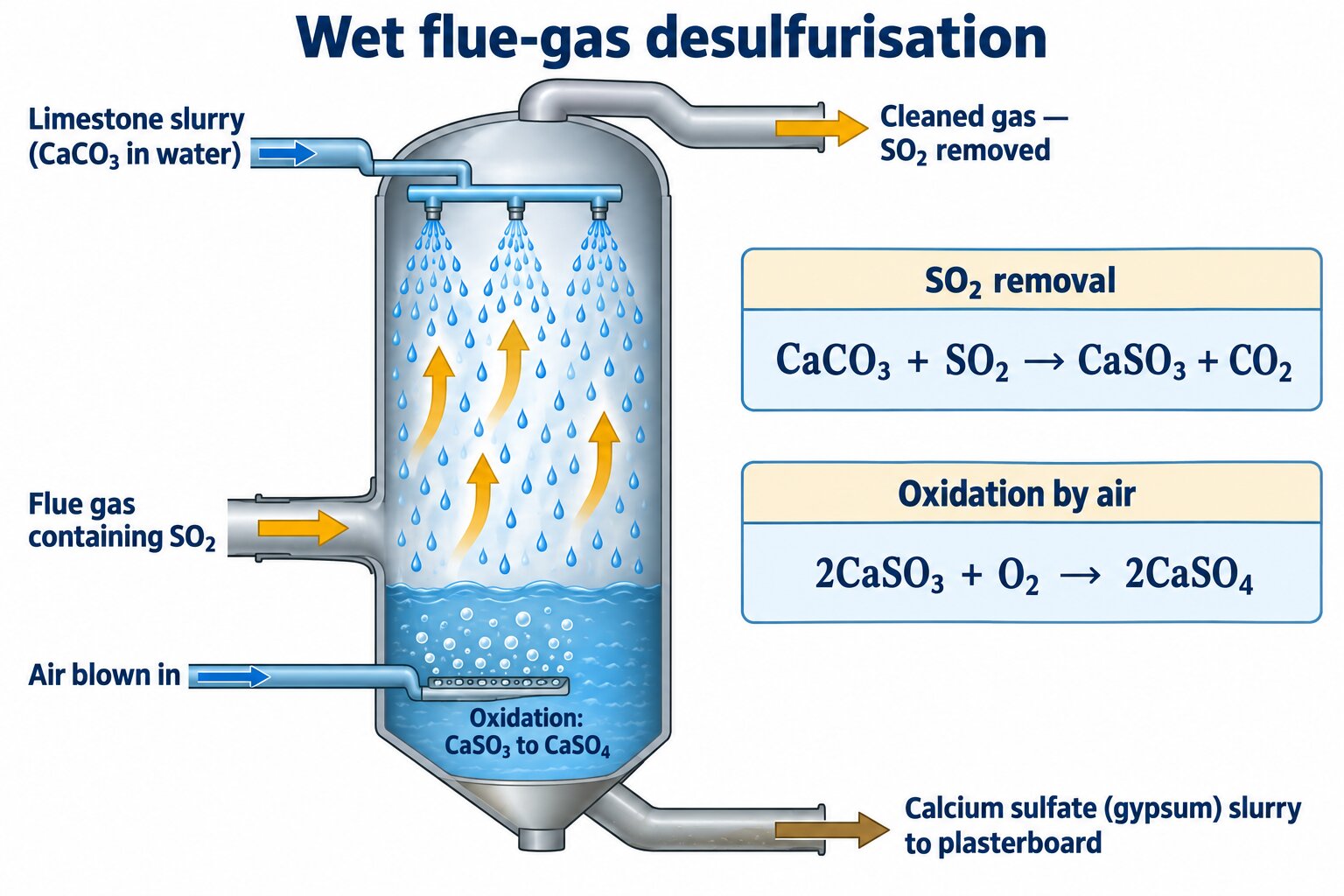
A wet scrubber: limestone slurry neutralises the sulfur dioxide, and air oxidises the calcium sulfite to calcium sulfate, sold as gypsum.
Exam focus: If asked for a disadvantage of using calcium carbonate, say that carbon dioxide is released, which contributes to global warming. If asked for an advantage, say it is cheaper and more abundant than calcium oxide.
Quick Check: Lime or Limestone?
In each round, choose the one statement that is accurate for the boiler house described.
What Happens to the Calcium Sulfate
Flue-gas desulfurisation produces large amounts of calcium sulfate. Hydrated calcium sulfate is gypsum, CaSO4·2H2O, which is used to make plasterboard and cement. Selling the gypsum offsets part of the cost of the process, so the sulfur is turned from a pollutant into a useful product.
| Stage | Species | Role |
|---|---|---|
| Before scrubbing | SO2 | Acidic pollutant that would cause acid rain |
| Neutralisation | CaSO3 | Calcium sulfite formed from CaO or CaCO3 |
| Oxidation with air | CaSO4 | Calcium sulfate, hydrated to gypsum |
| Use | CaSO4·2H2O | Plasterboard and cement |
Key idea: The process removes about 90 per cent of the sulfur dioxide from the flue gases and produces gypsum that can be sold.
Quick Check: Explain the Rejected Delivery
Write a short explanation, then compare it with the mark points and the model answer.
Common Exam Mistakes
- Describing the reaction as combustion or oxidation. The removal step is a neutralisation: acidic SO2 reacts with basic CaO or CaCO3.
- Writing calcium sulfate, CaSO4, as the direct product of the reaction with SO2. The first product is calcium sulfite, CaSO3; sulfate forms only after oxidation by air.
- Forgetting the carbon dioxide in the calcium carbonate equation, so the equation does not balance.
- Confusing flue-gas desulfurisation with the catalytic converter, which removes CO, NOx and unburned hydrocarbons from vehicle exhausts, not SO2 from power stations.
Exam sentence: Sulfur dioxide is an acidic gas, so it is removed from flue gases by reaction with the base calcium oxide or with calcium carbonate, forming calcium sulfite and then calcium sulfate.
Master Introduction to Organic Chemistry and Alkanes for AQA A Level Chemistry
Continue from these free revision notes into the full 3.3.1 and 3.3.2 Introduction to Organic Chemistry and Alkanes course. The six guided video lessons are ready now; the AQA MCQ bank, teacher-marked short-answer questions, supplementary lessons and KASP spec-point report are being written, and the course opens for enrolment as soon as they are complete.
Guided video teaching
Learn the chemistry and exam technique through structured video lessons with worked examples and walkthroughs.
Instant MCQ feedback
Auto-marked MCQ quizzes provide immediate diagnostic feedback for every answer choice.
Teacher-marked SAQs
Submit written exam responses and receive chemistry specialist feedback with improvement guidance.
Progress tracking
Identify strengths and weaknesses across the full 3.3.1 and 3.3.2 specification with targeted reporting.
See how the course works
Click play to start the course preview animation.
Some ionic radii are shown.
| Ion | Ionic radius / nm |
|---|---|
| Na+ | 0.102 |
| K+ | 0.138 |
| F− | 0.133 |
| Cl− | 0.180 |
Which compound has the strongest ionic bonding?
Explain why the metallic bonding in magnesium is much stronger than that in sodium.
Oxides of Sulfur FAQs
Common questions about sulfur dioxide pollution from combustion.
Why does combustion produce sulfur dioxide?
Combustion produces sulfur dioxide when the fuel contains sulfur-based impurities or sulfur-containing organic molecules. The sulfur reacts with oxygen to form SO2.
What is the equation for sulfur burning in oxygen?
The balanced equation is S + O2 → SO2.
How does sulfur dioxide cause acid rain?
Sulfur dioxide is an acidic gas. Once released into the atmosphere, it dissolves in rainwater and contributes to the formation of acid rain.
Why is coal an important source of sulfur dioxide pollution?
Coal often contains a relatively high sulfur content, so burning coal in power stations can release large quantities of sulfur oxides.
What damage can acid rain cause?
Acid rain can damage buildings, harm aquatic life and affect soil chemistry.
Copyright notice: This OLS revision content, including the explanations, layout, diagrams, tables and embedded learning structure, is authored for Online Learning System by Dr. Mohammed Al-Fatah. It may not be copied, reproduced, redistributed or adapted without written permission.
Keep this note — free
Save your progress across every AQA topic. A free account remembers which topics you have covered, saves your question scores, and syncs across your phone and laptop.
- Track every topic you have finished
- Keep your practice-question scores
- No payment, no card, free forever
Already registered? Log in