Bonding, Shape and Properties of Alkanes
A concise OCR A Level Chemistry A revision guide to 4.1.2(a) to (d): the σ-bonds in alkanes and their free rotation, the tetrahedral shape and 109.5° bond angle explained by electron pair repulsion, the boiling-point trends with chain length and branching, and why alkanes are so unreactive.
GCSE Recap: Chain Length and Four Bonds to Carbon
Three quick questions on the GCSE ideas about alkanes that this page builds on.
Alkanes Are Held Together by σ-Bonds
Alkanes are saturated hydrocarbons: every bond is a single C-C or C-H bond. OCR 4.1.2(a) describes each of these single bonds as a σ-bond (sigma bond), formed by the overlap of orbitals directly between the bonding atoms. The electron density of a σ-bond lies on the line joining the two nuclei.
Because the overlap is along the bond axis, the two atoms can rotate about it without breaking the bond. This free rotation of the σ-bond is why a butane molecule can twist into many different shapes (conformations) and why, unlike alkenes, alkanes show no E/Z isomerism.
Sigma and Pi Bonds: End-On and Sideways Overlap
Bring two atoms together and watch their orbitals overlap: end-on between the nuclei for a σ bond, and sideways above and below the plane for a π bond.
© Dr. Mohammed Al-Fatah – onlinelearningsystem.net
Exam sentence: The C-C and C-H bonds in alkanes are σ-bonds formed by the overlap of orbitals directly between the bonding atoms, and there is free rotation about each σ-bond.
Quick Check: What Free Rotation Means
Use the idea of free rotation about a σ-bond on a molecule that is not an alkane.
Tetrahedral Shape and the 109.5° Bond Angle
Each carbon atom in an alkane is bonded to four other atoms, so it is surrounded by four bonding pairs of electrons and no lone pairs. OCR 4.1.2(b) asks you to explain the shape using electron pair repulsion, the same idea as in 2.2.2.
- The four bonding pairs of electrons around the carbon atom repel each other.
- They move as far apart as possible to minimise the repulsion.
- Four pairs are furthest apart in a tetrahedral arrangement, with bond angles of 109.5°.
In a longer alkane every carbon atom is tetrahedral, so the chain is not straight but a zig-zag; this is why skeletal formulae are drawn with zig-zag lines.
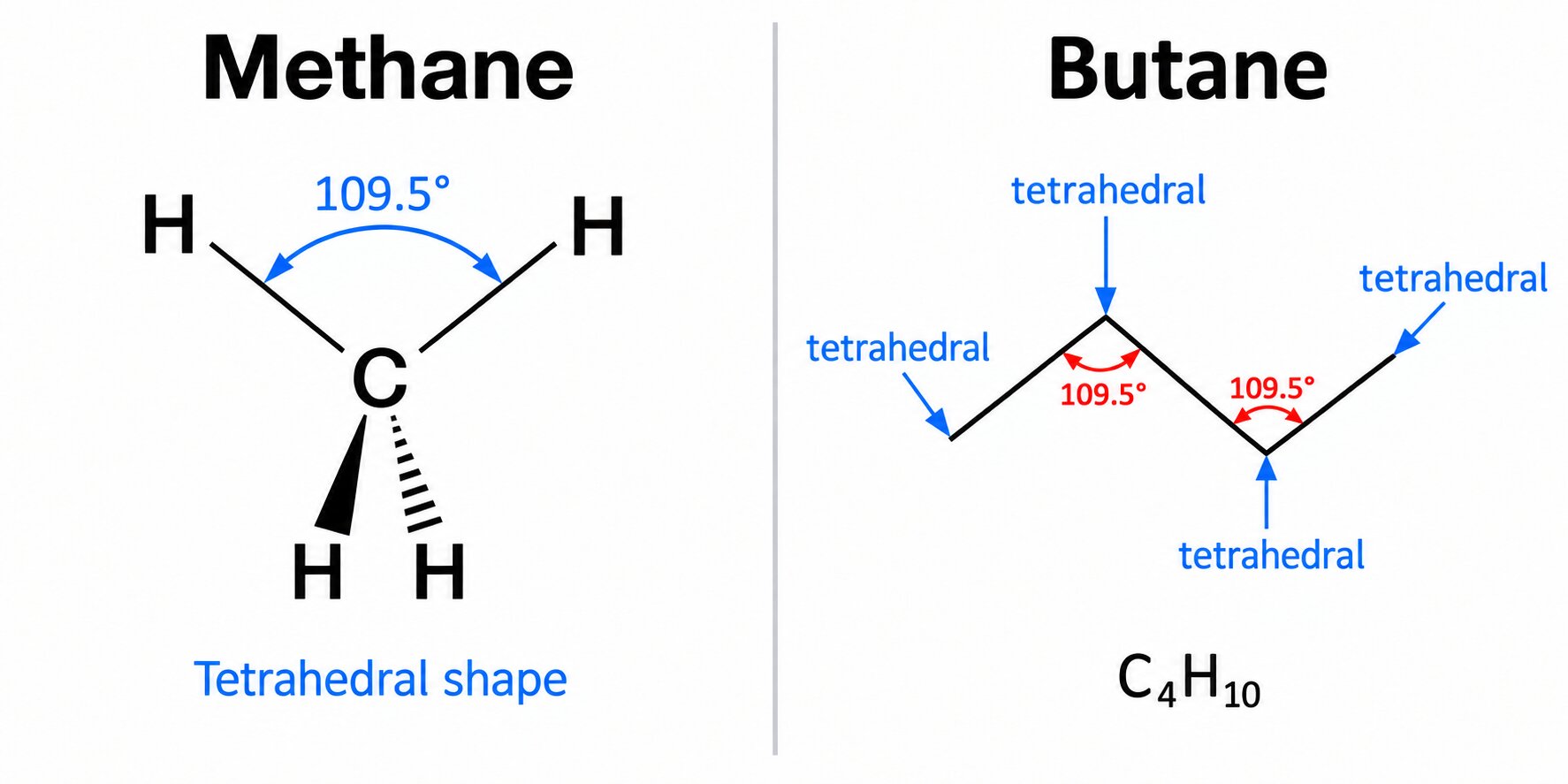
Four bonding pairs repel equally and take up a tetrahedral arrangement with 109.5° bond angles; a chain of tetrahedral carbons is a zig-zag.
Exam focus: The three marks are usually: four bonding pairs (no lone pairs) around carbon; electron pairs repel and move as far apart as possible; tetrahedral, 109.5°.
Quick Check: Pairs, Shapes and Angles
Four rapid questions on bonding pairs, shapes and bond angles.
Boiling Points: Chain Length and Branching
Alkane molecules are non-polar, so the only intermolecular forces between them are induced dipole-dipole interactions (London forces). Boiling point depends on how strong these forces are, and OCR 4.1.2(c) asks you to explain two trends.
Chain length
As the carbon chain gets longer, each molecule has more electrons and a larger surface area in contact with its neighbours. The London forces are stronger, more energy is needed to separate the molecules, and the boiling point rises. Methane boils at -162 °C, butane at -1 °C, octane at 126 °C.
Branching
Branched isomers have lower boiling points than the straight-chain alkane with the same molecular formula. The branches stop the molecules packing closely together, so there are fewer points of contact between molecules, the London forces are weaker and less energy is needed to overcome them.
| Isomer of C5H12 | Structure | Boiling point / °C | Reason |
|---|---|---|---|
| Pentane | Straight chain | 36 | Largest surface contact, strongest London forces |
| 2-Methylbutane | One branch | 28 | Less contact between molecules |
| 2,2-Dimethylpropane | Two branches, almost spherical | 10 | Least contact, weakest London forces |
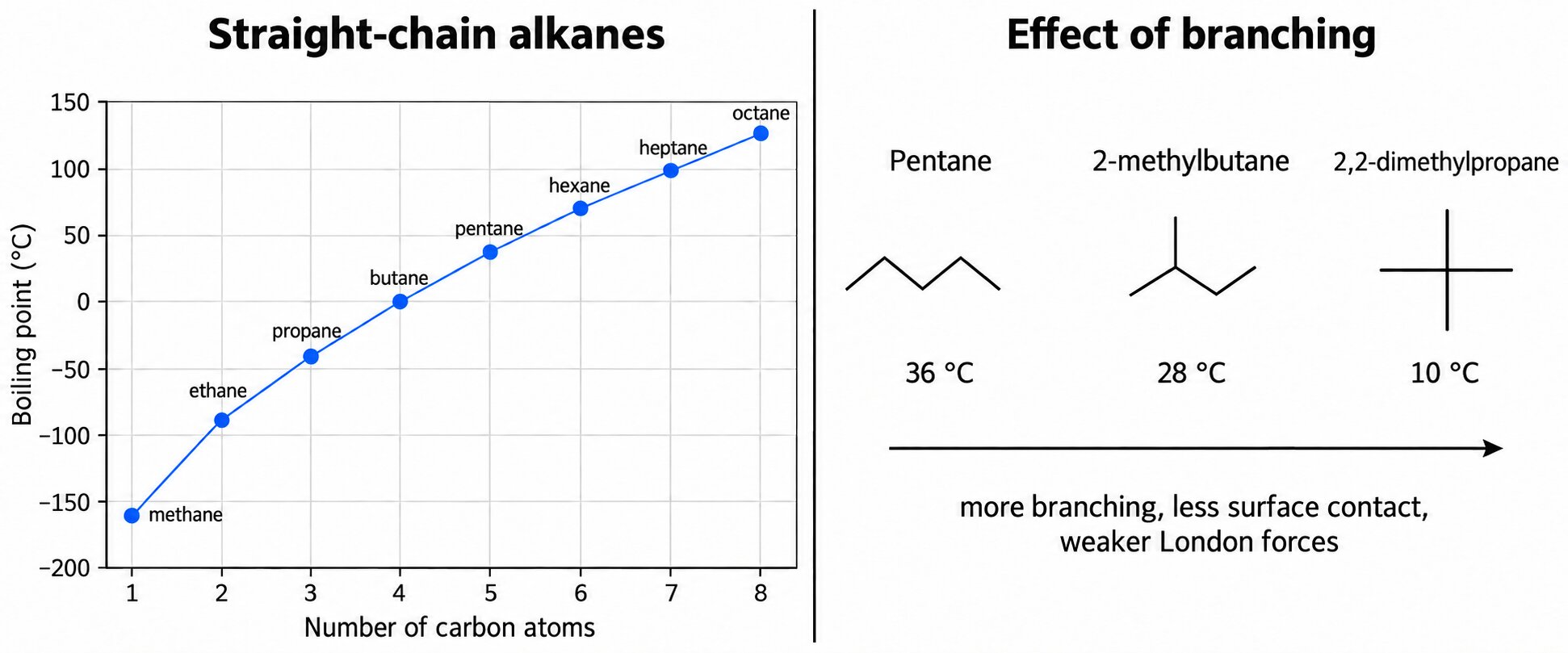
Boiling point rises with chain length and falls with branching, because both change the strength of the London forces between molecules.
Exam sentence: Longer chains have more electrons and more surface contact, so the induced dipole-dipole interactions are stronger and the boiling point is higher; branching reduces surface contact, weakens the London forces and lowers the boiling point.
Quick Check: Compare Propane and Decane
Count the electrons first, then drag the words into the gaps.
Quick Check: Explain a 17 Degree Difference
Two isomers, one formula and two very different boiling points.
Why Alkanes Are So Unreactive
Alkanes do not react with acids, bases, oxidising agents or reducing agents at room temperature, and the only reactions on the OCR specification are combustion and radical substitution. OCR 4.1.2(d) gives two reasons, and an exam answer needs both.
| Reason | Explanation | Consequence |
|---|---|---|
| High bond enthalpy of the σ-bonds | C-C (+347 kJ mol-1) and C-H (+413 kJ mol-1) bonds are strong, so a lot of energy is needed to break them | Reactions need high temperatures, a flame or ultraviolet radiation to start |
| Very low polarity of the σ-bonds | Carbon and hydrogen have similar electronegativities, so C-H bonds have almost no dipole and C-C bonds have none | No δ+ or δ- centres, so nucleophiles and electrophiles are not attracted to the molecule |
Compare this with a haloalkane, where the polar C-Cl bond gives a δ+ carbon that nucleophiles attack, or an alkene, where the π-bond has a low bond enthalpy and a high electron density. Alkanes have neither feature.
Exam sentence: Alkanes are unreactive towards most reagents because the C-C and C-H σ-bonds have high bond enthalpies and very low polarity, so there is no site for a nucleophile or electrophile to attack.
Quick Check: Explain the Lack of Reaction
Write a short explanation, then compare it with the mark points and the model answer.
Common Exam Mistakes
- Explaining the boiling-point trend with “bigger molecules are heavier”. Mass is not the reason; the number of electrons and the surface contact are.
- Calling the intermolecular forces “van der Waals” without saying which type. OCR wants induced dipole-dipole interactions or London forces.
- Saying branched alkanes have “weaker bonds”. The covalent bonds are the same; it is the forces between molecules that are weaker.
- Giving only one reason for low reactivity. Both the high bond enthalpy and the low polarity are needed.
- Quoting 109.5° without the electron-pair-repulsion explanation, or saying there are lone pairs on carbon.
Exam sentence: Each carbon in an alkane has four bonding pairs that repel to a tetrahedral arrangement at 109.5°; the molecules are held together only by London forces, which strengthen with chain length and weaken with branching.
Master Basic Concepts of Organic Chemistry and Alkanes for OCR A Level Chemistry A
Continue from these free revision notes into the full 4.1.1 and 4.1.2 Basic Concepts of Organic Chemistry and Alkanes course. The guided video lessons are ready now; the OCR A MCQ bank, teacher-marked short-answer questions and KASP spec-point report are being written, and the course opens for enrolment as soon as they are complete.
Guided video teaching
Learn the chemistry and exam technique through structured video lessons with worked examples and walkthroughs.
Instant MCQ feedback
Auto-marked MCQ quizzes provide immediate diagnostic feedback for every answer choice.
Teacher-marked SAQs
Submit written exam responses and receive chemistry specialist feedback with improvement guidance.
Progress tracking
Identify strengths and weaknesses across the full 4.1.1 and 4.1.2 specification with targeted reporting.
See how the course works
Click play to start the course preview animation.
Some ionic radii are shown.
| Ion | Ionic radius / nm |
|---|---|
| Na+ | 0.102 |
| K+ | 0.138 |
| F− | 0.133 |
| Cl− | 0.180 |
Which compound has the strongest ionic bonding?
Explain why the metallic bonding in magnesium is much stronger than that in sodium.
Free Radical Substitution FAQs
These questions summarise the core exam points on alkane substitution and free radicals.
Why are alkanes usually unreactive?
Alkanes are usually unreactive because they contain strong C-C and C-H bonds. These bonds require a large amount of energy to break.
What condition is needed for alkanes to react with chlorine?
Ultraviolet light is needed. UV light provides enough energy to break the Cl-Cl bond by homolytic fission, forming chlorine radicals.
What is a free radical?
A free radical is a species with an unpaired electron. The unpaired electron is usually represented using a dot, such as Cl•.
Why is the reaction called substitution?
It is called substitution because a hydrogen atom in the alkane is replaced by a halogen atom.
Why can a mixture of products form?
After the first substitution, the haloalkane product can undergo further substitution. This can replace more hydrogen atoms and produce a mixture of chlorinated products.
Copyright notice: This OLS revision content, including the explanations, layout, diagrams, tables and embedded learning structure, is authored for Online Learning System by Dr. Mohammed Al-Fatah. It may not be copied, reproduced, redistributed or adapted without written permission.
Keep this note — free
Save your progress across every OCR A topic. A free account remembers which topics you have covered, saves your question scores, and syncs across your phone and laptop.
- Track every topic you have finished
- Keep your practice-question scores
- No payment, no card, free forever
Already registered? Log in