Titration Calculations
A concise OCR A Level Chemistry A revision guide to titration calculations: moles from concentration and volume, the mole ratio from the balanced equation, concordant titres and the mean titre, and unstructured problems on purity and relative molecular mass.
GCSE Recap: Neutralisation and Reacting Ratios
Before you start, check the GCSE chemistry this page is built on.
What a Titration Tells You
A titration measures the exact volume of one solution needed to react completely with a measured volume of another. One solution has a known concentration (the standard solution); the other is the unknown. Because the balanced equation fixes the mole ratio, the volumes and the known concentration let you calculate the unknown concentration, an unknown volume, the relative molecular mass of an acid, or the purity of a sample.
Every titration calculation follows the same four steps:
- Moles of the known solution: n = c × V (with V in dm³, so divide cm³ by 1000).
- Mole ratio from the equation: read the coefficients to find moles of the other reactant.
- Moles of the unknown: apply the ratio.
- Convert to the quantity asked for: concentration (n ÷ V), volume (n ÷ c), mass (n × M) or Mr (m ÷ n).
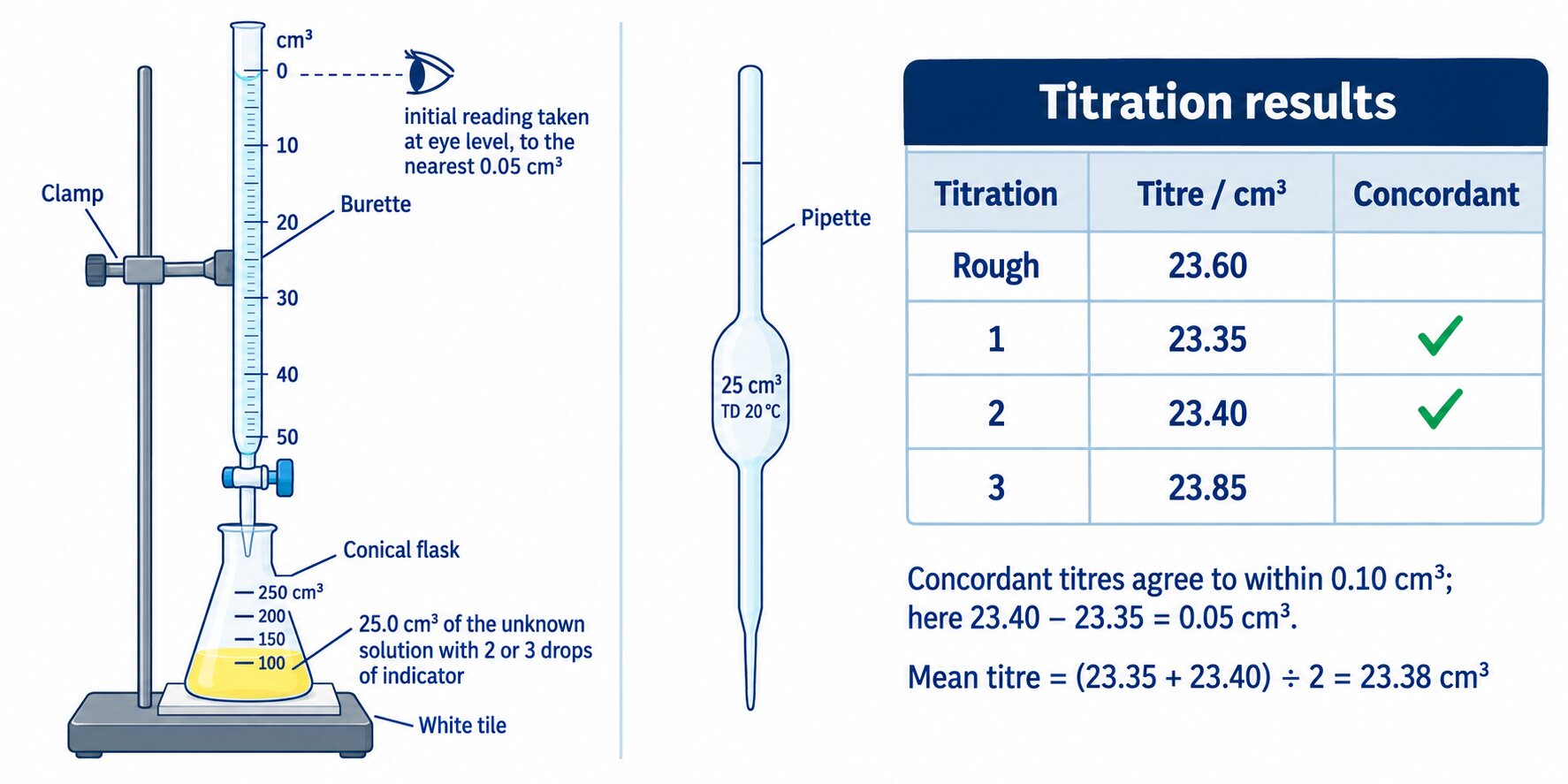
The burette delivers the standard solution into a pipetted volume of the unknown; the mean of the concordant titres is used in the calculation.
Key idea: Known moles → ratio → unknown moles → answer. Write the four steps every time and the marks follow.
Worked Example 1: Concentration of an Acid
25.0 cm³ of sodium hydroxide solution of concentration 0.100 mol dm⁻³ is neutralised by 21.40 cm³ of hydrochloric acid. Find the concentration of the acid.
NaOH + HCl → NaCl + H₂O
- n(NaOH) = 0.100 × 25.0 / 1000 = 2.50 × 10⁻³ mol
- Ratio NaOH : HCl = 1 : 1
- n(HCl) = 2.50 × 10⁻³ mol
- c(HCl) = 2.50 × 10⁻³ / (21.40 / 1000) = 0.117 mol dm⁻³ (3 significant figures)
Exam sentence: Quote the answer to the same number of significant figures as the least precise piece of data, usually three.
Quick Check: A 1 : 1 Titration
Work it out on paper before you choose; three of the options come from the usual slips.
Worked Example 2: A 1 : 2 Ratio
A 25.0 cm³ sample of sulfuric acid needs 18.75 cm³ of 0.200 mol dm⁻³ potassium hydroxide for complete neutralisation. Find the concentration of the acid.
H₂SO₄ + 2KOH → K₂SO₄ + 2H₂O
- n(KOH) = 0.200 × 18.75 / 1000 = 3.75 × 10⁻³ mol
- Ratio H₂SO₄ : KOH = 1 : 2, so n(H₂SO₄) = 3.75 × 10⁻³ / 2 = 1.875 × 10⁻³ mol
- c(H₂SO₄) = 1.875 × 10⁻³ / 0.0250 = 0.0750 mol dm⁻³
The ratio is where most marks are lost. A diprotic acid needs two moles of hydroxide per mole of acid, so the acid moles are half the alkali moles, not double.
Key idea: Decide the direction of the ratio by asking which substance the question wants: divide when going from the “2” reactant to the “1” reactant, multiply the other way.
Quick Check: Ratios in Both Directions
Work each titration out fully, then flip the card to compare your working.
Mean Titres and Concordant Results
A titration is repeated until two or more titres agree within 0.10 cm³; these are concordant. Only concordant titres are averaged, and the rough (first) titre is never included.
| Titration | Rough | 1 | 2 | 3 |
|---|---|---|---|---|
| Final reading / cm³ | 24.10 | 47.45 | 23.40 | 46.85 |
| Initial reading / cm³ | 0.00 | 24.10 | 0.00 | 23.40 |
| Titre / cm³ | 24.10 | 23.35 | 23.40 | 23.45 |
Titres 1, 2 and 3 are all within 0.10 cm³, so the mean titre is (23.35 + 23.40 + 23.45) / 3 = 23.40 cm³. Burette readings are recorded to two decimal places, the second being 0 or 5.
Exam sentence: Concordant titres are those within 0.10 cm³ of each other; the mean titre is calculated from concordant titres only.
Quick Check: Choosing the Titres
Click every titre that belongs in that student's mean.
Unstructured Problems: Mass, Purity and Relative Molecular Mass
Harder questions give no steps. The same four moves still apply; the only difference is what you convert to at the end.
Purity of a solid. 1.25 g of impure sodium carbonate is dissolved and made up to 250 cm³. A 25.0 cm³ portion needs 22.50 cm³ of 0.100 mol dm⁻³ hydrochloric acid.
Na₂CO₃ + 2HCl → 2NaCl + H₂O + CO₂
- n(HCl) = 0.100 × 22.50 / 1000 = 2.25 × 10⁻³ mol, so n(Na₂CO₃) in 25.0 cm³ = 1.125 × 10⁻³ mol
- In the whole 250 cm³: 1.125 × 10⁻³ × 10 = 1.125 × 10⁻² mol
- Mass of Na₂CO₃ = 1.125 × 10⁻² × 106.0 = 1.1925 g, so purity = 1.1925 / 1.25 × 100 = 95.4%
Relative molecular mass of an acid. If 0.500 g of a monoprotic acid HA needs 20.00 cm³ of 0.250 mol dm⁻³ NaOH, then n(HA) = 5.00 × 10⁻³ mol and Mr = 0.500 / 5.00 × 10⁻³ = 100.
Key idea: When a sample is made up to 250 cm³ and 25.0 cm³ portions are titrated, scale the moles in the portion up by 10 before converting to mass.
Quick Check: Purity and Relative Molecular Mass
Four problems with no steps given; type the final answer for each.
Quick Check: Pick the Accurate Statement
In each round, choose the one statement that is accurate.
Common Exam Mistakes
- Forgetting to convert cm³ to dm³ before using n = c × V.
- Applying the mole ratio the wrong way round for diprotic acids or carbonates.
- Including the rough titre in the mean, or averaging titres that are not concordant.
- Using the pipette volume where the burette volume belongs, or the reverse.
- Rounding too early: keep at least four figures until the final answer.
Exam sentence: Moles of the standard solution from c × V, moles of the unknown from the equation ratio, then the quantity asked for.
Copyright notice: This OLS revision content, including the explanations, layout, diagrams, tables and embedded learning structure, is authored for Online Learning System by Dr. Mohammed Al-Fatah. It may not be copied, reproduced, redistributed or adapted without written permission.
Keep this note — free
Save your progress across every OCR A topic. A free account remembers which topics you have covered, saves your question scores, and syncs across your phone and laptop.
- Track every topic you have finished
- Keep your practice-question scores
- No payment, no card, free forever
Already registered? Log in