Standard Solutions and Titration Technique
A concise OCR A Level Chemistry A revision guide to preparing a standard solution of known concentration in a volumetric flask and carrying out an acid-base titration accurately: rinsing, pipetting, indicator choice, rough and accurate titres and concordant results (2.1.4(d)).

GCSE Recap: Concentration, Neutralisation and Dilution
Before you start, check three ideas from GCSE that this page measures accurately.
What a Standard Solution Is
A standard solution has an accurately known concentration. It is made by dissolving an accurately weighed mass of a pure solid in water and making the solution up to an exact volume in a volumetric flask. Its concentration is then c = n / V, with n from the mass and V from the flask.
The solid must be a primary standard: pure, stable in air, not hydrated in a variable way, and of high relative formula mass so that weighing errors are small. Anhydrous sodium carbonate is the classic example; sodium hydroxide is not suitable because it absorbs water and carbon dioxide from the air.
Key idea: A standard solution is only as accurate as the mass weighed and the volume of the flask; the concentration is calculated, not measured.
Quick Check: When the Solid Is Not Pure
Decide what damp pellets do to the concentration the student calculates.
Preparing the Standard Solution
- Weigh the solid accurately by difference into a clean beaker (for 0.100 mol dm⁻³ Na₂CO₃ in 250 cm³: 0.0250 mol × 106.0 = 2.65 g).
- Dissolve in a small volume of distilled water, stirring with a glass rod until no solid remains.
- Transfer the solution to a 250 cm³ volumetric flask through a funnel, then rinse the beaker, rod and funnel with distilled water into the flask so that no solute is left behind.
- Make up to the mark with distilled water, adding the last few cm³ dropwise until the bottom of the meniscus sits on the line at eye level.
- Stopper and invert the flask several times to mix; the concentration is not uniform until you do.
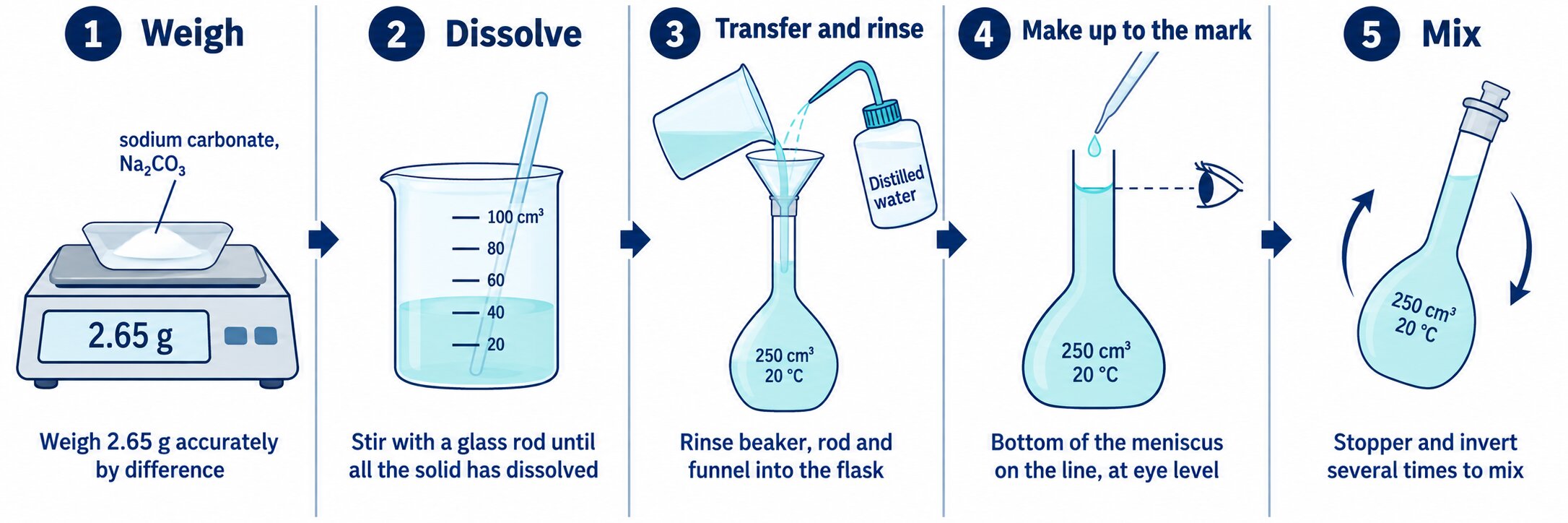
Every rinsing goes into the flask: the solute must all end up in the 250 cm³.
Exam sentence: Rinse the beaker into the volumetric flask so that all the solute is transferred, make up to the mark with distilled water and invert to mix.
Quick Check: What Do You Weigh Out?
Work each one out on paper, then type the number.
Carrying Out the Titration
- Rinse the burette with the solution it will contain and the pipette with the solution it will measure. Rinse the conical flask with distilled water only.
- Fill the burette using a funnel, remove the funnel, run solution through the tap to fill the jet, and read the initial volume at eye level to 0.05 cm³.
- Pipette 25.0 cm³ of the other solution into the conical flask, letting it drain and touching the tip on the liquid surface; never blow out the last drop.
- Add two or three drops of a suitable indicator.
- Do a rough titration quickly to find the approximate end point, swirling the flask on a white tile.
- Repeat accurately, adding dropwise near the end point and rinsing the flask walls with distilled water, until you have at least two concordant titres within 0.10 cm³.
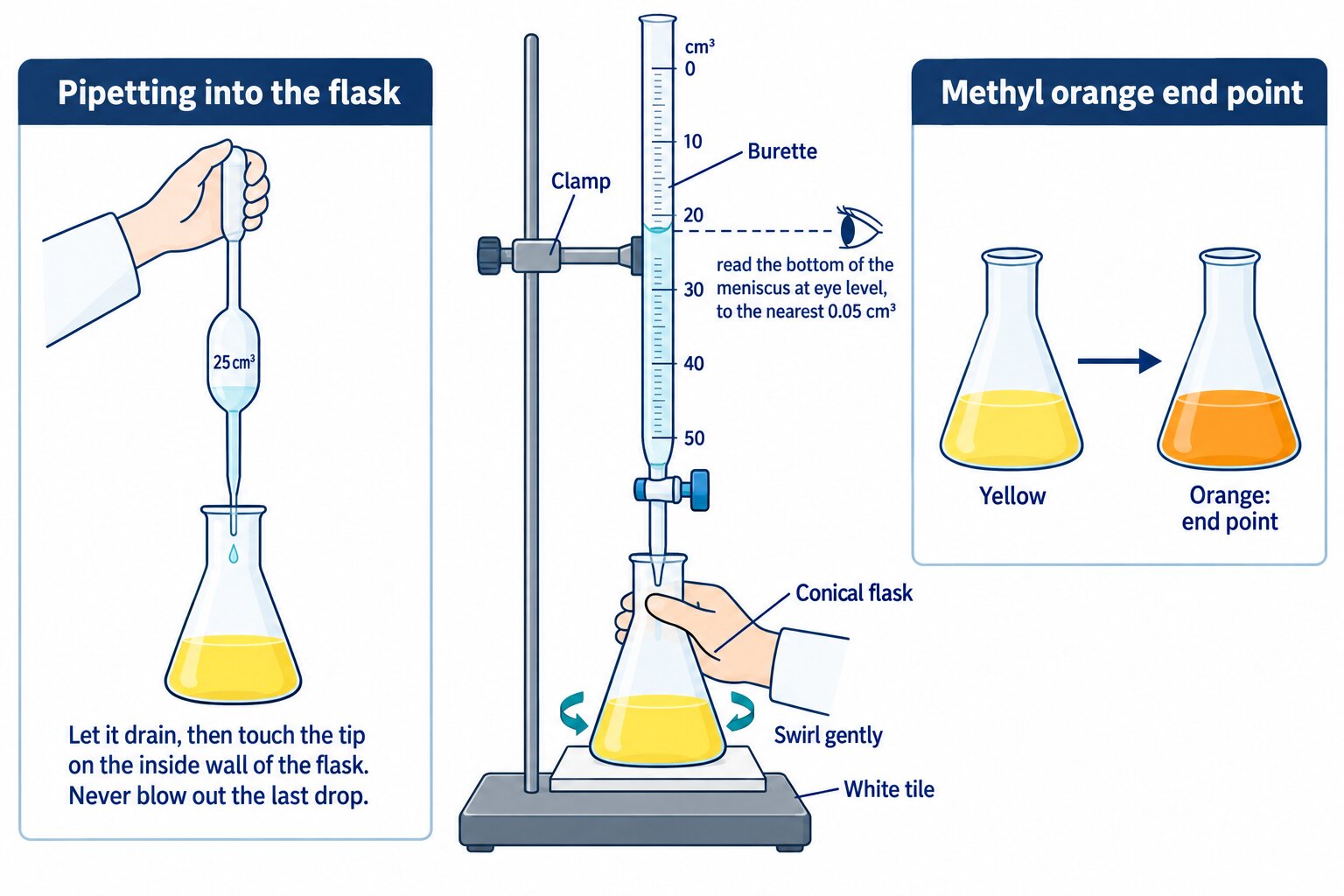
Dropwise addition near the end point and a white tile under the flask make the colour change sharp and easy to see.
Key idea: The rough titre finds the end point quickly; the accurate titres, added dropwise at the end, give the concordant results used in the calculation.
Quick Check: The Order of an Accurate Titration
Drag the steps into the order they have to be done in.
Quick Check: What Does the Slip Do to the Titre?
For each slip, decide whether the recorded titre comes out larger, smaller or unchanged.
Choosing the Indicator
The indicator must change colour sharply at the equivalence point of the particular acid and base.
| Indicator | Colour in acid | Colour in alkali | Suitable for |
|---|---|---|---|
| Methyl orange | Red | Yellow | Strong acid with strong or weak base |
| Phenolphthalein | Colourless | Pink | Strong base with strong or weak acid |
Universal indicator is never used: its gradual colour change gives no sharp end point. Use the minimum number of drops, because indicators are themselves weak acids or bases and consume a little of the reagent.
Quick Check: Pick the Indicator
Choose the indicator and give the colour change as the flask would show it.
Common Exam Mistakes
- Rinsing the burette or pipette with water, which dilutes the solution and changes the titre.
- Leaving the funnel in the burette, so drips change the reading.
- Reading the burette from above or below eye level (parallax).
- Stopping after one accurate titre; concordant results are required.
- Choosing universal indicator.
Exam sentence: Rinse the burette with the solution it will hold, remove the funnel, read at eye level to 0.05 cm³, add dropwise near the end point and repeat until concordant.
Copyright notice: This OLS revision content, including the explanations, layout, diagrams, tables and embedded learning structure, is authored for Online Learning System by Dr. Mohammed Al-Fatah. It may not be copied, reproduced, redistributed or adapted without written permission.
Keep this note — free
Save your progress across every OCR A topic. A free account remembers which topics you have covered, saves your question scores, and syncs across your phone and laptop.
- Track every topic you have finished
- Keep your practice-question scores
- No payment, no card, free forever
Already registered? Log in