Acids and Alkalis
A concise OCR A Level Chemistry A revision guide to the formulae of the common acids and alkalis, acids as sources of H⁺ ions and alkalis as sources of OH⁻ ions in water, and the difference between strong and weak acids in terms of dissociation (2.1.4(a), (b)).
GCSE Recap: pH, Dilution and Neutralisation
Before you start, check what you already know about acids, alkalis and the pH scale.
The Common Acids and Alkalis
OCR expects the formulae of four acids and three alkalis to be known without prompting.
| Acid | Formula | Alkali | Formula |
|---|---|---|---|
| Hydrochloric acid | HCl | Sodium hydroxide | NaOH |
| Sulfuric acid | H₂SO₄ | Potassium hydroxide | KOH |
| Nitric acid | HNO₃ | Ammonia | NH₃ |
| Ethanoic acid | CH₃COOH |
Ethanoic acid is written CH₃COOH rather than C₂H₄O₂ to show that only one of its four hydrogens is acidic: the one on the carboxyl group.
Key idea: Sulfuric acid is diprotic: one mole gives two moles of H⁺. The other three acids are monoprotic.
Quick Check: How Much Alkali Is Needed
Decide which of these four acids needs twice as much alkali per mole.
What Makes an Acid an Acid
An acid releases hydrogen ions, H⁺, when it dissolves in water. Hydrogen chloride gas is a covalent molecule, but in water it dissociates: HCl(aq) → H⁺(aq) + Cl⁻(aq). The H⁺ ions are what give acids their reactions with metals, carbonates and bases.
An alkali is a soluble base that releases hydroxide ions, OH⁻, in water. Sodium hydroxide is ionic and simply separates: NaOH(aq) → Na⁺(aq) + OH⁻(aq). Ammonia is different: it reacts with water to make hydroxide ions, NH₃(aq) + H₂O(l) ⇌ NH₄⁺(aq) + OH⁻(aq), which is why ammonia solution is alkaline even though the formula contains no OH.
Neutralisation is the reaction of these two ions: H⁺(aq) + OH⁻(aq) → H₂O(l), the ionic equation for every acid-alkali reaction.
Exam sentence: Acids release H⁺ ions in aqueous solution; alkalis release OH⁻ ions in aqueous solution; neutralisation forms water from H⁺ and OH⁻.
Quick Check: A Base with No OH Group
Work out where the hydroxide ions in this solution come from.
Strong and Weak Acids
The difference is not concentration but the extent of dissociation.
- A strong acid dissociates completely in water: every HCl molecule becomes H⁺ and Cl⁻. Hydrochloric, sulfuric and nitric acids are strong.
- A weak acid dissociates only partially: in ethanoic acid a small fraction of the molecules give up H⁺ and most stay as CH₃COOH. The equilibrium CH₃COOH(aq) ⇌ CH₃COO⁻(aq) + H⁺(aq) lies well to the left.
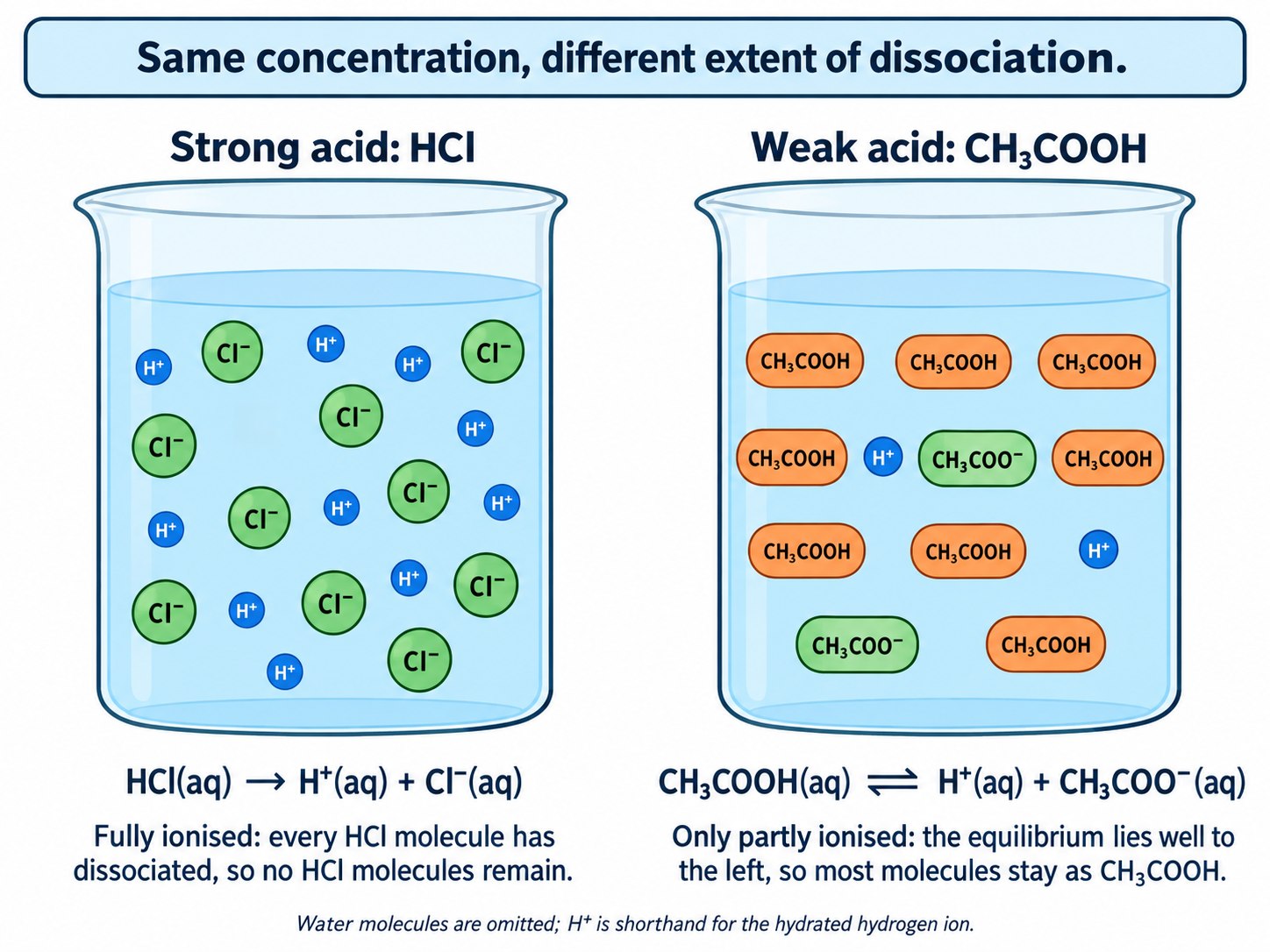
Particle diagrams of a strong acid, HCl, fully ionised into H⁺ and Cl⁻, and a weak acid, CH₃COOH, in which only a few molecules have dissociated into CH₃COO⁻ and H⁺
Same concentration, different dissociation: a strong acid is fully ionised, a weak acid only slightly.
Because a weak acid has far fewer H⁺ ions at the same concentration, it has a higher pH, conducts electricity less well and reacts more slowly with magnesium or a carbonate. It still needs the same volume of alkali in a titration, because the equilibrium shifts right as H⁺ is removed until every molecule has reacted.
Key idea: Strong means fully dissociated; concentrated means a lot of acid per dm³. A dilute strong acid and a concentrated weak acid are both possible.
Quick Check: Two Acids, One Concentration
Use the two pH values to complete the comparison.
Quick Check: Strong, Weak, Concentrated or Dilute
In each round, pick the one statement that is accurate.
Common Exam Mistakes
- Writing that a weak acid is a dilute acid. Strength is about dissociation, concentration about moles per dm³.
- Saying ammonia contains OH⁻: it makes OH⁻ by reacting with water.
- Treating all four hydrogens in CH₃COOH as acidic; only the carboxyl hydrogen dissociates.
- Using a single arrow for the dissociation of a weak acid; it is an equilibrium.
Exam sentence: A strong acid is fully dissociated in aqueous solution; a weak acid is only partially dissociated, so an equilibrium exists between the acid molecules and their ions.
Copyright notice: This OLS revision content, including the explanations, layout, diagrams, tables and embedded learning structure, is authored for Online Learning System by Dr. Mohammed Al-Fatah. It may not be copied, reproduced, redistributed or adapted without written permission.
Keep this note — free
Save your progress across every OCR A topic. A free account remembers which topics you have covered, saves your question scores, and syncs across your phone and laptop.
- Track every topic you have finished
- Keep your practice-question scores
- No payment, no card, free forever
Already registered? Log in