Analytical Chemistry
Infrared Spectroscopy
Infrared spectroscopy is one of the most powerful tools in modern chemistry, used to identify bonds, study molecular vibrations and even monitor greenhouse gases like CO₂ and methane. Discover how bond stretching, bending and dipole moments allow molecules to absorb infrared radiation and why this technique is essential for A-Level Chemistry.
Greenhouse Gases
Climate change affects the global environment and is strongly influenced by human activity. To limit atmospheric pollution, countries have created international agreements such as the Kyoto Protocol. These agreements aim to reduce emissions of major greenhouse gases including CO₂, methane (CH₄), nitrous oxide (N₂O), and ozone (O₃). Monitoring these gases is important for understanding their environmental impact.
Measurements show that carbon dioxide levels in the atmosphere have increased significantly over the past 50 years. Data from ice cores indicate that before industrialisation, atmospheric CO₂ was about 278 ppm. Between 1000 and 1800, it varied by only about 7 ppm, showing that natural levels were relatively stable.

However, between 1958 and 2004, atmospheric CO₂ increased from around 315 ppm to 378 ppm. Compared with the pre-industrial level of 278 ppm, this represents an increase of about 100 ppm, which is approximately 36% higher. This rise is largely linked to human activities such as burning fossil fuels and deforestation.
Atmospheric gas concentrations are commonly measured using infrared spectroscopy, because greenhouse gases absorb infrared radiation at specific wavelengths. This allows scientists to detect and quantify the gases present in the atmosphere.
How Molecular Bond Vibrations Produce Infrared Absorption
Even when molecules are part of a solid structure, the atoms within them are not completely still. The bonds between atoms constantly vibrate, stretching and compressing while the molecule also bends slightly. Each of these vibrations happens at a specific frequency, which depends on the atoms involved in the bond and how they are connected.
All molecules can absorb energy. When a molecule absorbs energy that matches the vibrational energy of one of its bonds, the vibration becomes stronger. In other words, the amplitude of the vibration increases and the bond enters what is called an excited state.
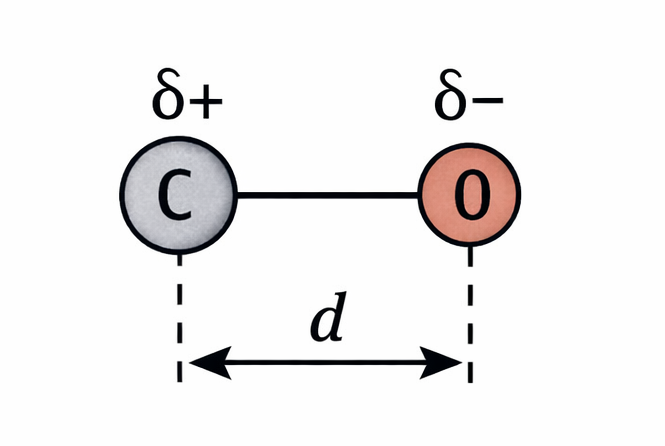
After a short time, the molecule returns to its ground state and releases the absorbed energy. This energy can be detected, and because each bond vibrates at its own characteristic frequency, the detected energy provides information about the types of bonds present in the molecule. These frequencies lie in the infrared region of the electromagnetic spectrum, which is why this technique is called infrared (IR) spectroscopy.
Like other analytical techniques such as X-ray diffraction, infrared spectroscopy gives chemists a powerful way to investigate molecules and the bonds that hold them together.
However, not every bond in a molecule will absorb infrared radiation. For absorption to occur, the vibration must cause a change in the dipole moment of the bond.
A dipole moment exists when there is a separation of charge in a bond. It is defined as the magnitude of the charge multiplied by the distance between the charges. Many bonds have a dipole moment because the atoms involved have different electronegativities, meaning the electrons are shared unevenly. When these bonds vibrate, the dipole moment changes, allowing the bond to absorb infrared radiation.
For a more detailed look at the underlying theory, you can explore this overview of infrared spectroscopy from Chemistry LibreTexts, which covers the same concepts at undergraduate level.
When Bonds Absorb Infrared Radiation
Not all molecules absorb infrared radiation. In symmetrical molecules, there may be no overall dipole moment. This can happen if there is no separation of charge, such as in diatomic molecules made from the same element, or when the dipole moments of individual bonds cancel each other out. When this occurs, infrared radiation is not absorbed.
However, when bonds stretch or bend, the dipole moment of the molecule can change. If this change occurs during the vibration, the bond is able to absorb infrared radiation.
Some bonds produce strong infrared absorptions, particularly polar bonds such as C–O, C=O and O–H. These bonds have significant differences in electronegativity between the atoms, so their dipole moments change noticeably during vibration. In contrast, non-polar bonds such as C–C and C=C usually produce much weaker absorptions.
There are two main types of molecular vibration:
- Stretching vibrations, where the bond length increases and decreases.
- Bending vibrations, where the bond angle changes.
Bending vibrations require less energy than stretching vibrations, so they occur at lower energy and longer wavelengths in the infrared region.
In planar molecules, such as sulphur dioxide (SO₂) and carbon dioxide (CO₂), infrared radiation can be absorbed through either bond stretching or bond bending vibrations.
Sulphur Dioxide (SO₂)
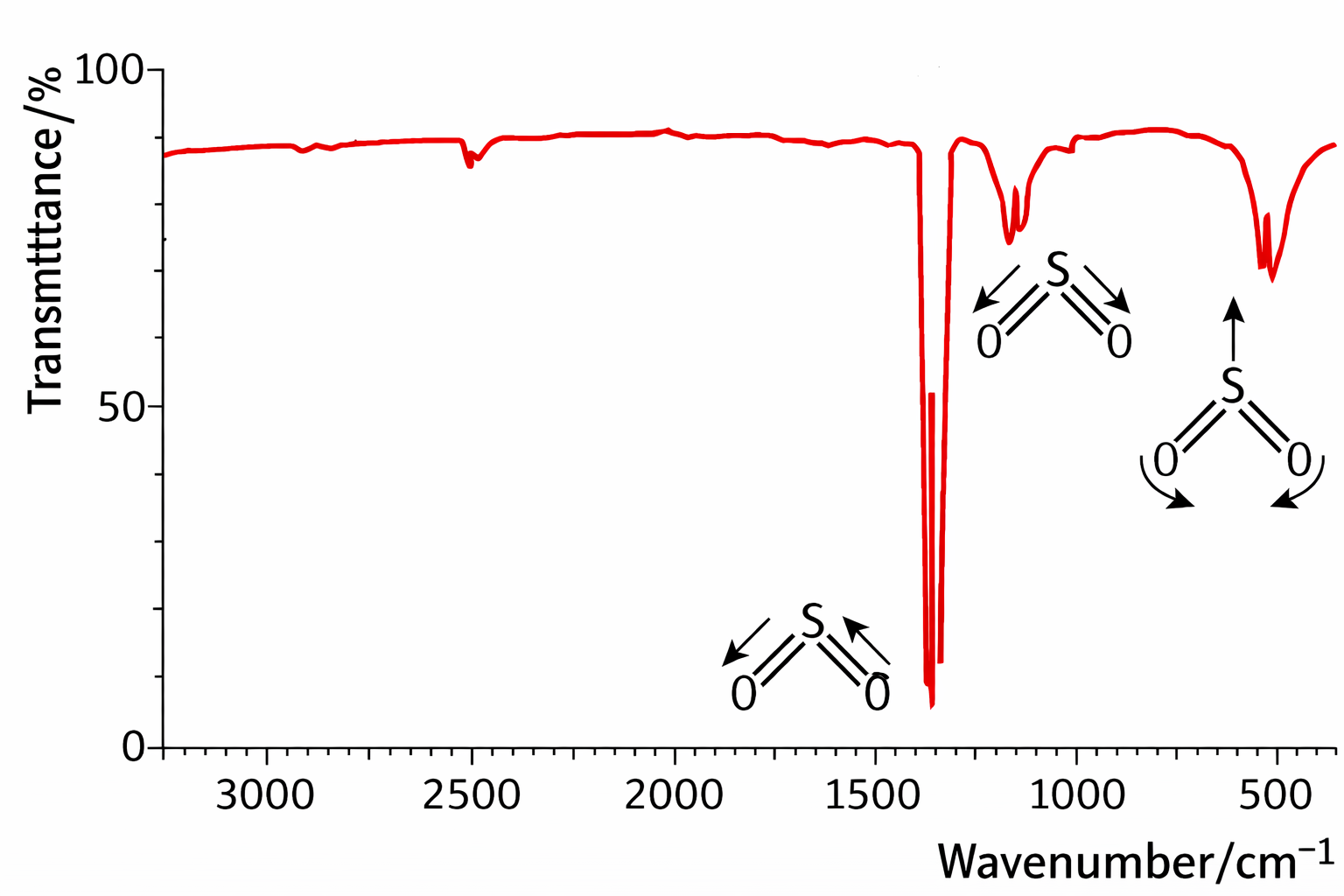
Each type of molecular vibration can cause a change in the dipole moment of the molecule. When this happens, the molecule is able to absorb infrared radiation at the frequency corresponding to that vibration. Because different vibrational motions occur at different energies, each one produces a separate absorption in the infrared spectrum.
As a result, a molecule can show multiple absorption peaks, with each peak representing a specific type of bond vibration. For example, sulphur dioxide (SO₂) has three possible vibrational motions. Since each of these vibrations changes the dipole moment, all three absorb infrared radiation.
This means the infrared spectrum of sulphur dioxide shows three distinct absorption peaks, each corresponding to one of its vibrational modes.
Sulphur Dioxide (SO₂)
Sulphur dioxide has three different possible vibrations, each occurring at a different infrared frequency.
Sulphur dioxide: three vibrations
Choose a vibration to watch the atoms move. Every one of them changes the dipole moment, so SO₂ shows three infrared peaks.
Why all three absorb infrared
SO₂ is bent, so its S–O bond dipoles do not cancel. Stretching or bending changes the size of the overall dipole, and a vibration that changes the dipole moment absorbs infrared radiation.
Carbon dioxide (CO₂)
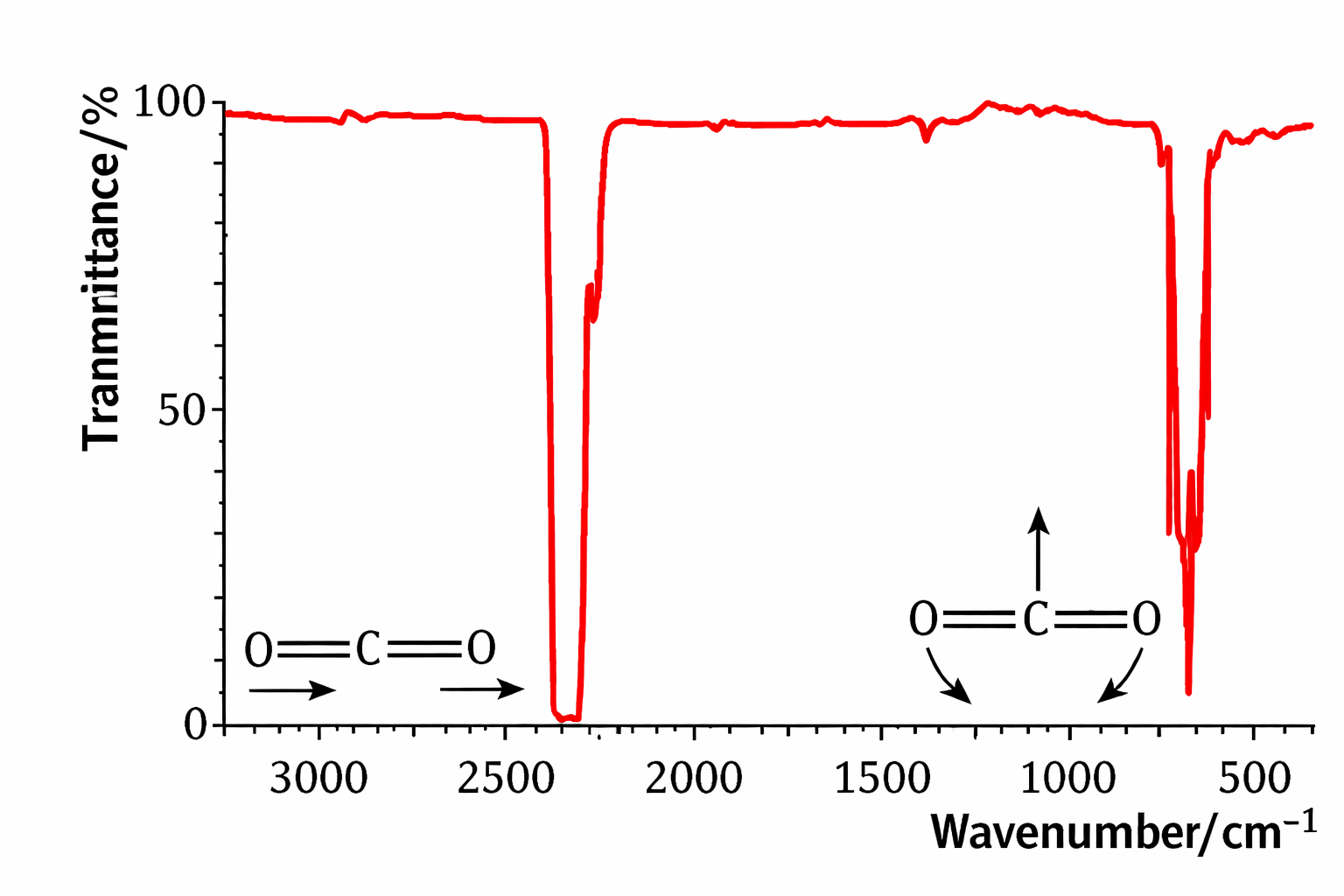
Consequently, the infrared spectrum of carbon dioxide shows absorptions only for asymmetrical stretching and bending vibrations, while symmetrical stretching is not detected.
Carbon Dioxide (CO₂)
Carbon dioxide (CO₂) is a linear molecule, meaning its atoms lie in a straight line. Because of this symmetry, some vibrations do not cause a change in the dipole moment of the molecule.
During symmetrical stretching, both C=O bonds stretch and compress at the same time. The effect on one side of the molecule is balanced by the identical effect on the other side. As a result, there is no overall change in dipole moment, so this vibration does not absorb infrared radiation.
However, asymmetrical stretching (where one bond stretches while the other compresses) and bond bending both create a temporary imbalance in charge distribution. Because the dipole moment changes during these vibrations, they do absorb infrared radiation.
Carbon dioxide: which vibrations absorb?
Choose a vibration. The badge says whether it changes the dipole moment, and so whether it absorbs infrared radiation.
Symmetry decides
CO₂ is linear, so in the symmetric stretch the two C=O dipoles stay equal and opposite and the molecule never has a dipole: no absorption. The asymmetric stretch and the bend both create a dipole, so they absorb.
Vibrations in Larger Molecules
As molecules become larger and more complex, the number of possible vibrational modes increases. Different parts of the molecule can move in different ways, including stretching, bending, twisting, and rocking motions.
Each of these vibrations occurs at a specific frequency and produces its own absorption in the infrared spectrum. This means that larger molecules typically show many absorption peaks, with each peak corresponding to a particular type of molecular vibration.
Although the number of peaks increases with molecular size, certain types of bonds absorb infrared radiation in predictable regions of the spectrum. For example, bonds such as O–H, C=O, and C–H absorb at characteristic frequencies regardless of the rest of the molecule.
Six ways a CH₂ group vibrates
In a larger molecule each –CH₂– group can stretch and bend in several ways. Choose one to watch it on a CH₂ group in a carbon chain.
More atoms, more peaks
Each kind of motion has its own frequency, so larger molecules show many peaks. Stretches of C–H bonds absorb at higher wavenumbers than the bending motions, which is why the C–H stretch is easy to spot.
Because of this, infrared spectroscopy is extremely useful for identifying functional groups within molecules. By analysing the positions of absorption peaks in the infrared spectrum, chemists can determine which types of bonds — and therefore which functional groups — are present in a compound.
You can read more about how chemists use this technique in the classroom in this infrared spectroscopy resource from the Royal Society of Chemistry.
Keep reading
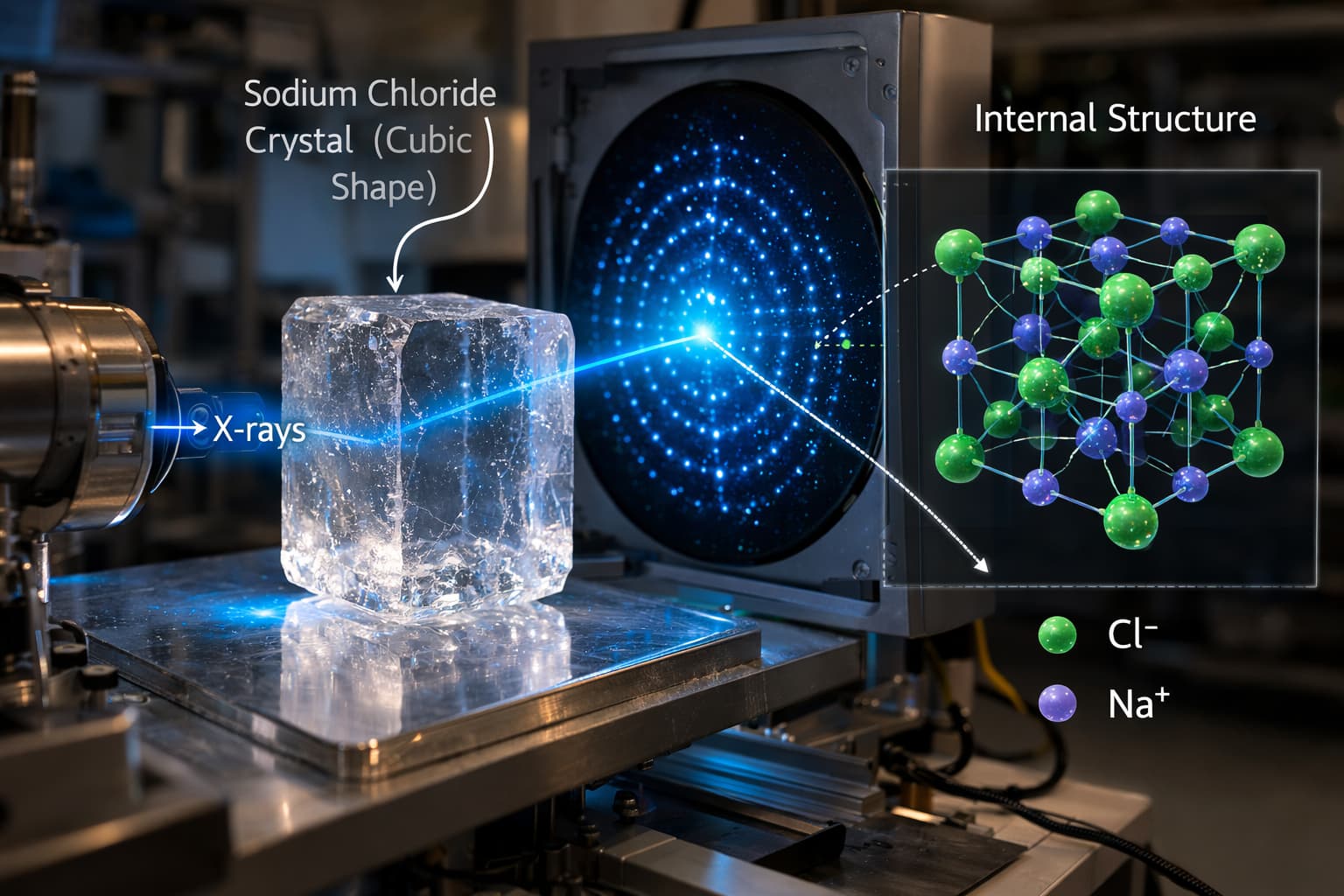 Crystal StructuresHow X-Rays Reveal the Structure of Metal CrystalsX-ray diffraction, face-centred and body-centred cubic lattices in 3D, and extension questions on the shapes of sulphur compounds.Read article →
 Sports EngineeringThe Science Inside a World Cup FootballExplore the layered materials inside a professional football and how modern engineering shapes touch, flight, bounce and durability.Read article →
 Atomic StructureDevelopment of the Modern Atomic ModelFrom Dalton’s solid spheres to Schrodinger’s quantum mechanical model: how Thomson, Rutherford, Bohr and Schrodinger changed our picture of the atom.Read on a-levelchemistry.co.uk →