Crystal Structures
How X-Rays Reveal the Structure of Metal Crystals
Explore the structure of metal crystals and how X-ray diffraction reveals their atomic arrangements. Learn about common crystal lattices such as face-centred and body-centred cubic structures, and how theories like electron pair repulsion help explain the molecular shapes of sulphur compounds.
How Do Scientists Know the Structure of Metal Crystals?
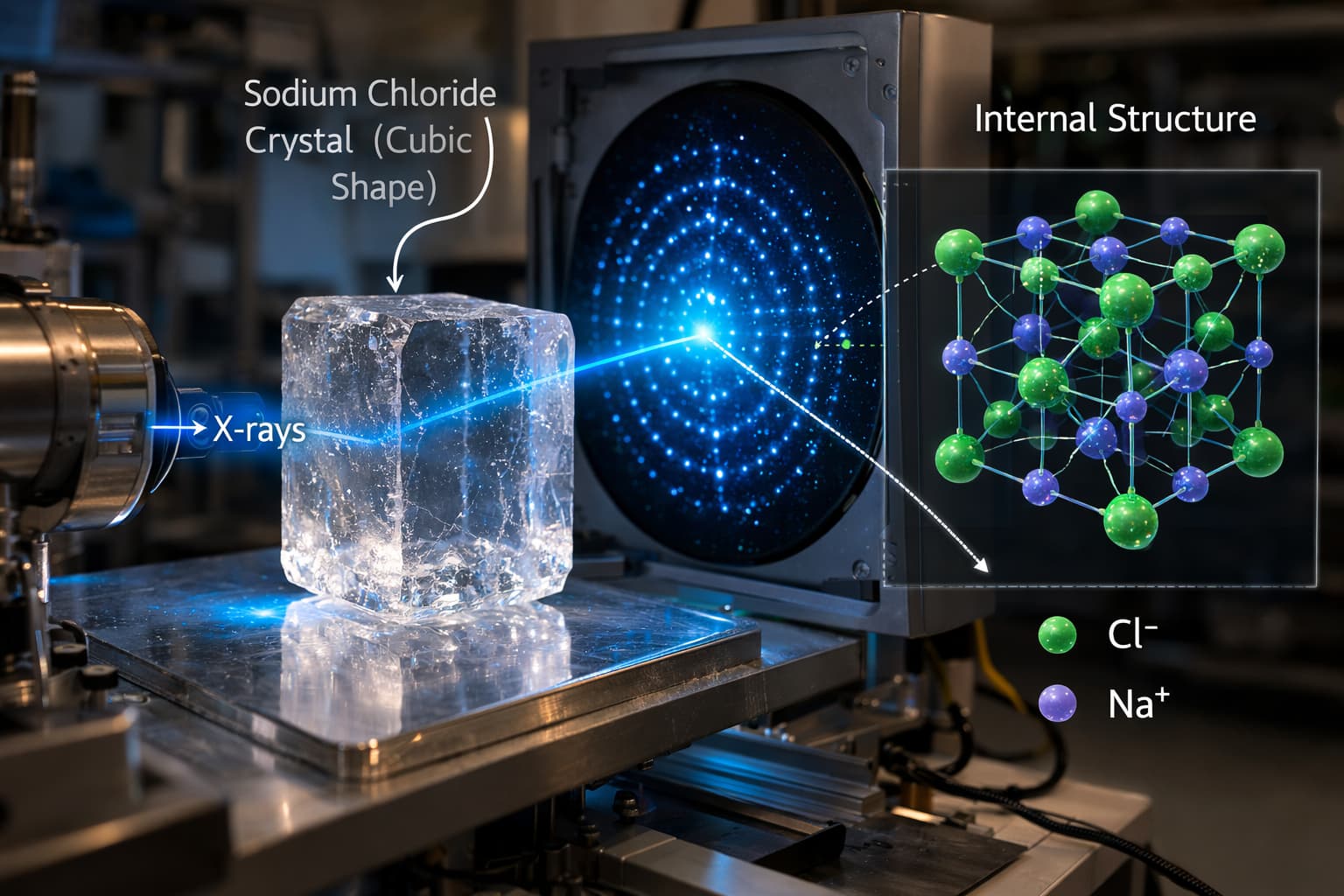
You might wonder how scientists know what the internal structure of metal crystals looks like. One clue comes from the overall shape of large crystals. For example, a large crystal of sodium chloride forms a cubic shape, which suggests that the ions inside are arranged in a repeating cubic pattern.
However, simply observing the outside of a crystal is not enough to fully understand how its particles are arranged. A major breakthrough came in the late nineteenth century with the discovery of X-rays, which provided a far more reliable way to investigate crystal structures.
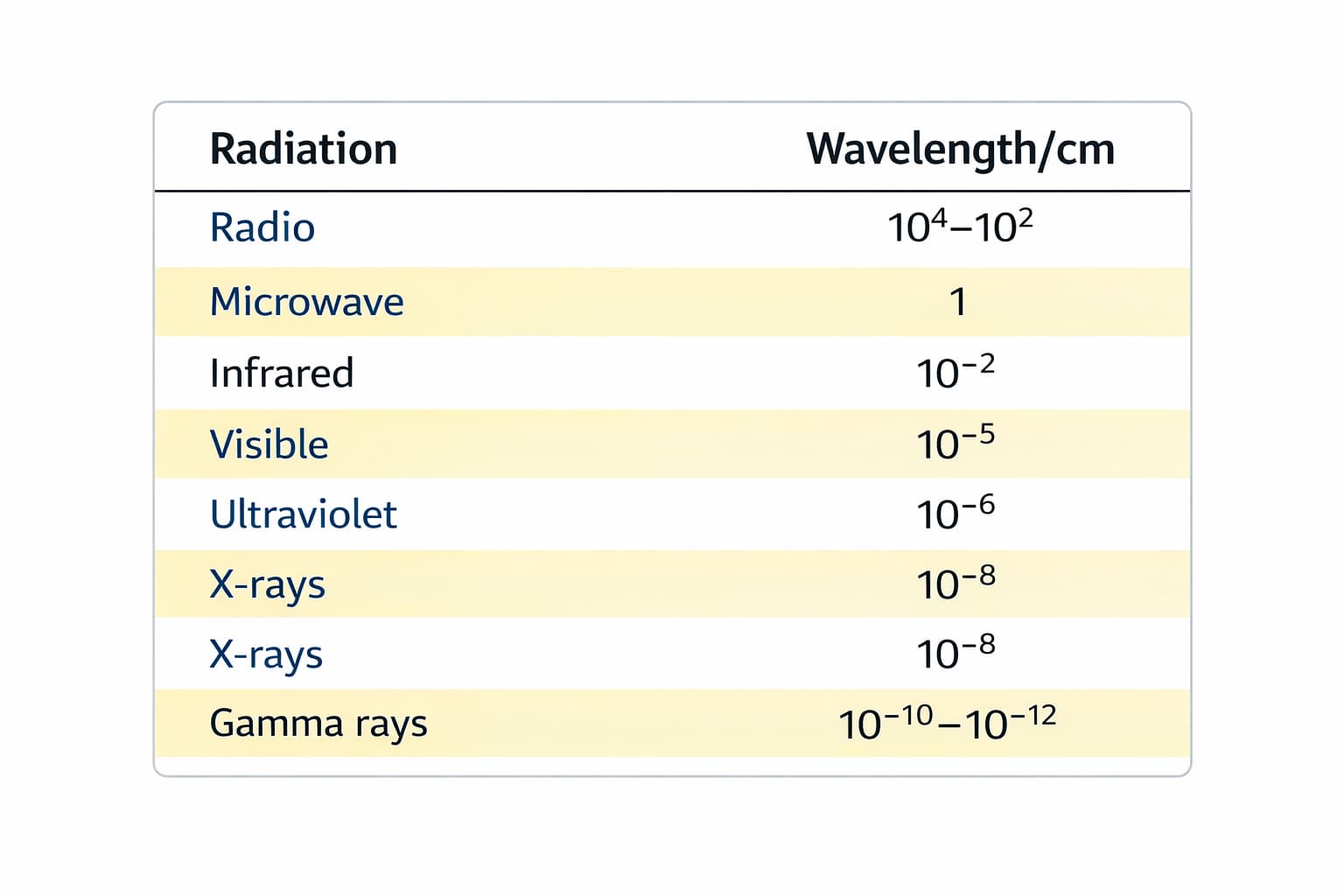
X-rays are a type of electromagnetic radiation, part of the same spectrum that includes visible light, infrared radiation, and radio waves. Because of their very short wavelength, X-rays can interact with atoms in a crystal, allowing scientists to determine how the particles are arranged inside the structure of metal crystals.
Using X-Rays to Investigate Crystal Structures
The wavelength of X-rays is roughly the same size as atoms, and much shorter than the wavelengths of visible light. Because of this, X-rays have higher energy and are able to penetrate materials more effectively. This property makes them extremely useful for studying the internal structure of crystals.
In a technique known as X-ray diffraction, a concentrated beam of X-rays is directed at a crystal. As the X-rays pass through the crystal, they are diffracted (scattered) by the atoms inside. The pattern produced depends on the arrangement and orientation of particles within the crystal lattice.
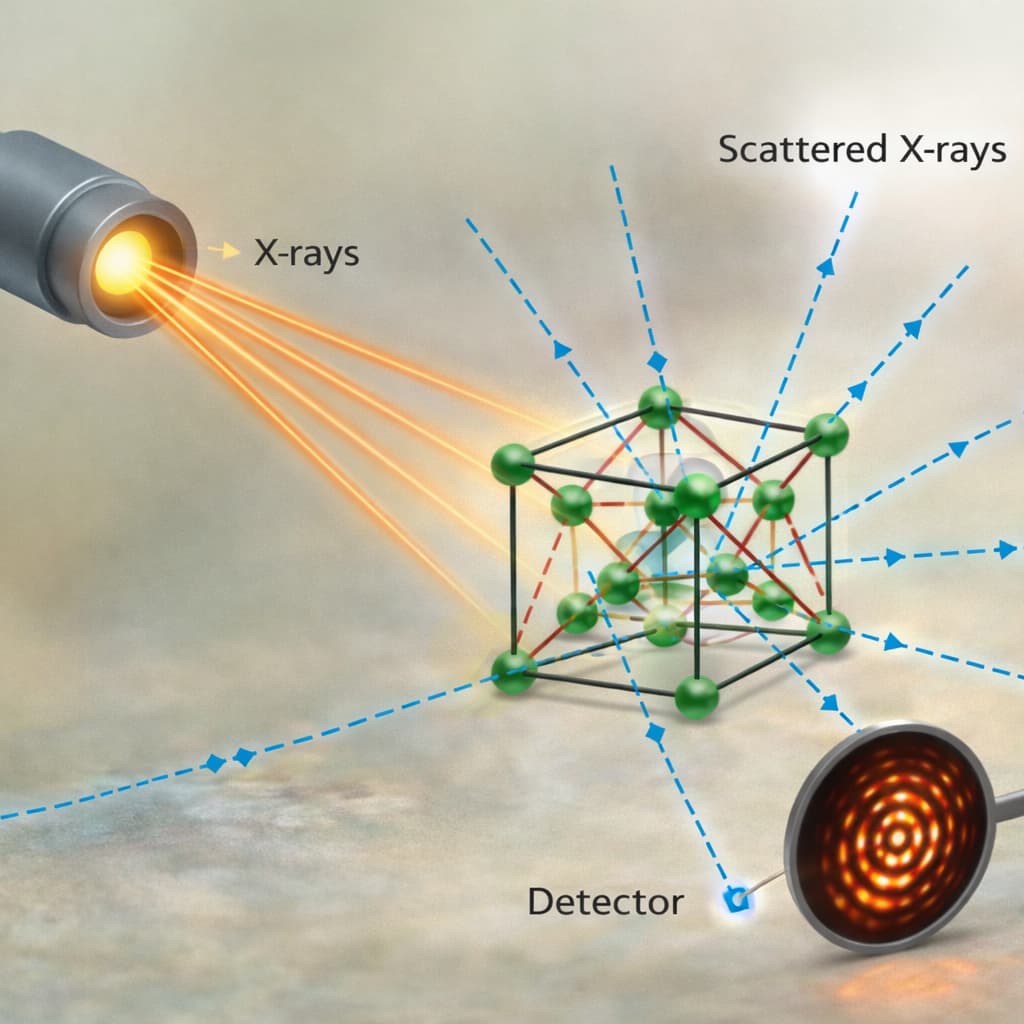
Scientists analyse the resulting diffraction pattern to determine how atoms or ions are organised inside the structure of metal crystals. This powerful method was developed at the Royal Institution in London by the father-son team William Bragg and Lawrence Bragg. Their work revolutionised the study of crystal structures, and in 1915 they were awarded the Nobel Prize in Physics for their discovery.
Although interpreting diffraction patterns can be complex, X-ray diffraction remains one of the most important techniques used to study the structure of materials.
The Unit Cell in Metal Crystals
Most structure of metal crystals have a simple repeating arrangement of atoms that determines the overall shape and structure of the crystal. The smallest repeating part of this structure is called the unit cell, and it describes how atoms are organised throughout the metal.
One important type of unit cell is the face-centred cubic (FCC) structure . In this structure, atoms are located at the eight corners of a cube, with additional atoms positioned at the centre of each of the six faces of the cube. When many of these unit cells repeat in all directions, they build up the full metal crystal.
Several metals adopt this structure, including aluminium, copper and gold. Interestingly, iodine also forms a structure based on a face-centred cubic arrangement. However, in iodine the positions in the structure are occupied by iodine molecules (I₂) rather than individual atoms.
This repeating pattern allows the crystal to extend in three dimensions while maintaining a consistent and organised atomic structure of metal crystals.
Face-centred cubic unit cell
Turn the unit cell, then switch views to see how the atoms really touch and how many neighbours each one has.
Counting the atoms
Each corner atom is shared by 8 unit cells and each face atom by 2, so one unit cell contains 8 × ⅛ + 6 × ½ = 4 atoms.
Body-Centred Cubic Structures
Some structure of metal crystals form a different type of unit cell known as a body-centred cubic (BCC) structure . In this arrangement, atoms are located at the eight corners of the cube, with an additional atom positioned at the centre of the cube.
As with other crystal structures, the faces of the cube are shared with neighbouring unit cells. When these unit cells repeat in all directions, they form the full three-dimensional structure of the metal crystal.
In a body-centred cubic structure, the atoms along the main diagonal of the cube touch each other. Metals with this structure are often described as having atoms that are closely packed together, although the packing is not as efficient as in a face-centred cubic structure.
Many alkali metals adopt this type of crystal structure, demonstrating how different arrangements of atoms can influence the properties of metals.
Body-centred cubic unit cell
Turn the unit cell, then switch views to see the atoms touching along the body diagonal and the centre atom’s neighbours.
Counting the atoms
Each corner atom is shared by 8 unit cells and the centre atom belongs to this cell alone, so one unit cell contains 8 × ⅛ + 1 = 2 atoms.
Sulphur Chemistry and Molecular Shapes
Electron pair repulsion theory can be used to predict the shapes of many molecules and ions. When applying this theory, it is important to consider how the electron pairs are arranged around the central atom. A key principle is that atoms of elements in the second period of the periodic table cannot expand their outer shell beyond eight electrons. In contrast, atoms in the third period and beyond can often accommodate more than eight electrons in their outer shell.
Sulphur forms two common oxides, SO₂ and SO₃. It also forms several anions, including sulphite, SO₃²⁻, and sulphate, SO₄²⁻. In addition, sulphur forms thio compounds, in which an oxygen atom is replaced by a sulphur atom within the molecule.
Electron Pair Repulsion Theory
Thiosulphate, S₂O₃²⁻, provides an example for applying electron pair repulsion theory.
In the species discussed in parts (i) and (ii), the sulphur atom has ten electrons in its outer shell.
(a) Determine the most likely molecular shape of each of the following:
(i) SO₂
(ii) SO₃²⁻
When considering this ion, the two electrons responsible for the 2⁻ charge must be included in the structure. This means that two of the oxygen atoms each carry one additional electron.
Molecular Shapes
(i) SO₂ – Bent (V-shaped)
The central sulphur atom has three regions of electron density: two bonding pairs (S-O) and one lone pair.
According to electron pair repulsion theory (VSEPR), three regions arrange trigonal planar around the sulphur.
Because one of these is a lone pair, the molecular shape, considering atoms only, becomes bent or angular with a bond angle slightly less than 120°.
(ii) SO₃²⁻ – Trigonal pyramidal
Around the central sulphur atom there are four regions of electron density: three bonding pairs (S-O) and one lone pair on sulphur.
Four regions arrange tetrahedrally in terms of electron pair geometry.
Because one position is occupied by a lone pair, the molecular shape is trigonal pyramidal, with bond angles slightly less than 109.5°.
Electron Pair Repulsion Theory
In the sulphate ion, SO₄²⁻, the sulphur atom accommodates twelve electrons in its outer shell.
(b) Using electron pair repulsion theory, determine the most likely molecular shape of each of the following ions:
(i) SO₄²⁻
(ii) S₂O₃²⁻
In both of these ions, two of the oxygen atoms each carry one additional electron.
Molecular Shapes
(i) SO₄²⁻ – Tetrahedral
The central sulphur atom has four regions of electron density: four S-O bonding pairs.
There are no lone pairs on the sulphur atom.
According to electron pair repulsion theory (VSEPR), four electron regions arrange tetrahedrally.
Therefore, the molecular shape is tetrahedral with bond angles of approximately 109.5°.
(ii) S₂O₃²⁻ – Tetrahedral around the central sulphur atom
The central sulphur atom is bonded to three oxygen atoms and one sulphur atom.
This gives four regions of electron density around the central sulphur.
There are no lone pairs on the central sulphur atom.
The electron pairs arrange tetrahedrally, giving a tetrahedral molecular shape around the central sulphur.
Sulphur Ring Structure
(c) Another important feature of sulphur chemistry is the ability of sulphur atoms to bond to one another.
Naturally occurring sulphur exists as S₈ molecules, in which eight sulphur atoms are connected by single bonds to form a ring structure.
Draw the structure of an S₈ ring, showing the likely three-dimensional shape of the molecule.
S₈ Structure
S₈ forms a puckered ring (“crown”) structure.
Eight sulphur atoms are joined by single S-S bonds in a ring.
The ring is not planar; the atoms alternate above and below the plane to minimise electron pair repulsion.
Dithionite Ion Structure
The dithionite ion, S₂O₄²⁻, is an example of an anion containing sulphur atoms that are directly linked together.
It can be considered as two SO₂ groups joined by a sulphur-sulphur bond.
(d) Draw the electron structure of the S₂O₄²⁻ ion and suggest the molecular shape around each sulphur atom.
Dithionite Ion Shape
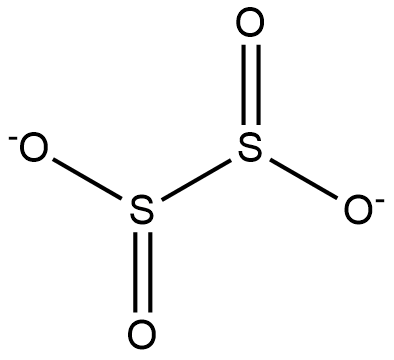
The dithionite ion, S₂O₄²⁻, contains two sulphur atoms that are directly joined together by a single S-S bond.
Each sulphur atom is also bonded to two oxygen atoms.
To determine the shape around each sulphur atom, we consider the number of regions of electron density.
Each sulphur atom has a bond to another sulphur atom (S-S), a double bond to an oxygen atom (S=O), a single bond to an oxygen atom (S-O⁻), and one lone pair of electrons.
This gives four regions of electron density around each sulphur atom.
The electron pairs arrange themselves in a tetrahedral arrangement to minimise repulsion.
Because one of these regions is a lone pair, the shape around each sulphur atom, considering the bonded atoms only, is trigonal pyramidal, with bond angles slightly less than 109.5°.
In the structure, one oxygen attached to each sulphur forms a double bond (S=O), while the other oxygen forms a single bond (S-O⁻) and carries a negative charge. This means the overall ion has a total charge of 2⁻.
Keep reading
 Analytical ChemistryInfrared SpectroscopyHow bond stretching, bending and changing dipole moments let molecules absorb infrared radiation, from greenhouse gases to interactive SO₂, CO₂ and CH₄ vibrations.Read article →
 Sports EngineeringThe Science Inside a World Cup FootballExplore the layered materials inside a professional football and how modern engineering shapes touch, flight, bounce and durability.Read article →
 Atomic StructureDevelopment of the Modern Atomic ModelFrom Dalton’s solid spheres to Schrodinger’s quantum mechanical model: how Thomson, Rutherford, Bohr and Schrodinger changed our picture of the atom.Read on a-levelchemistry.co.uk →