Covalent Bonding and Shapes of Molecules – Topic 3B/C
The Covalent Bonding and Shapes of Molecules Topic 3B/C Edexcel International A Level Chemistry course provides approximately 13 Hours of Guided Learning. Students work through guided video teaching, auto-marked MCQ practice, teacher-marked short-answer questions, and a specification assignment with a personalised progress report.
SAQ Assessments
169 Marks
Guided Video Teaching
Virtual Lesson
The recorded lessons teach the key chemistry and the exam technique needed to apply it accurately.
Students pause during exam-practice sections, attempt questions independently, then review the worked explanations and mark scheme approach.
Specialist Marking
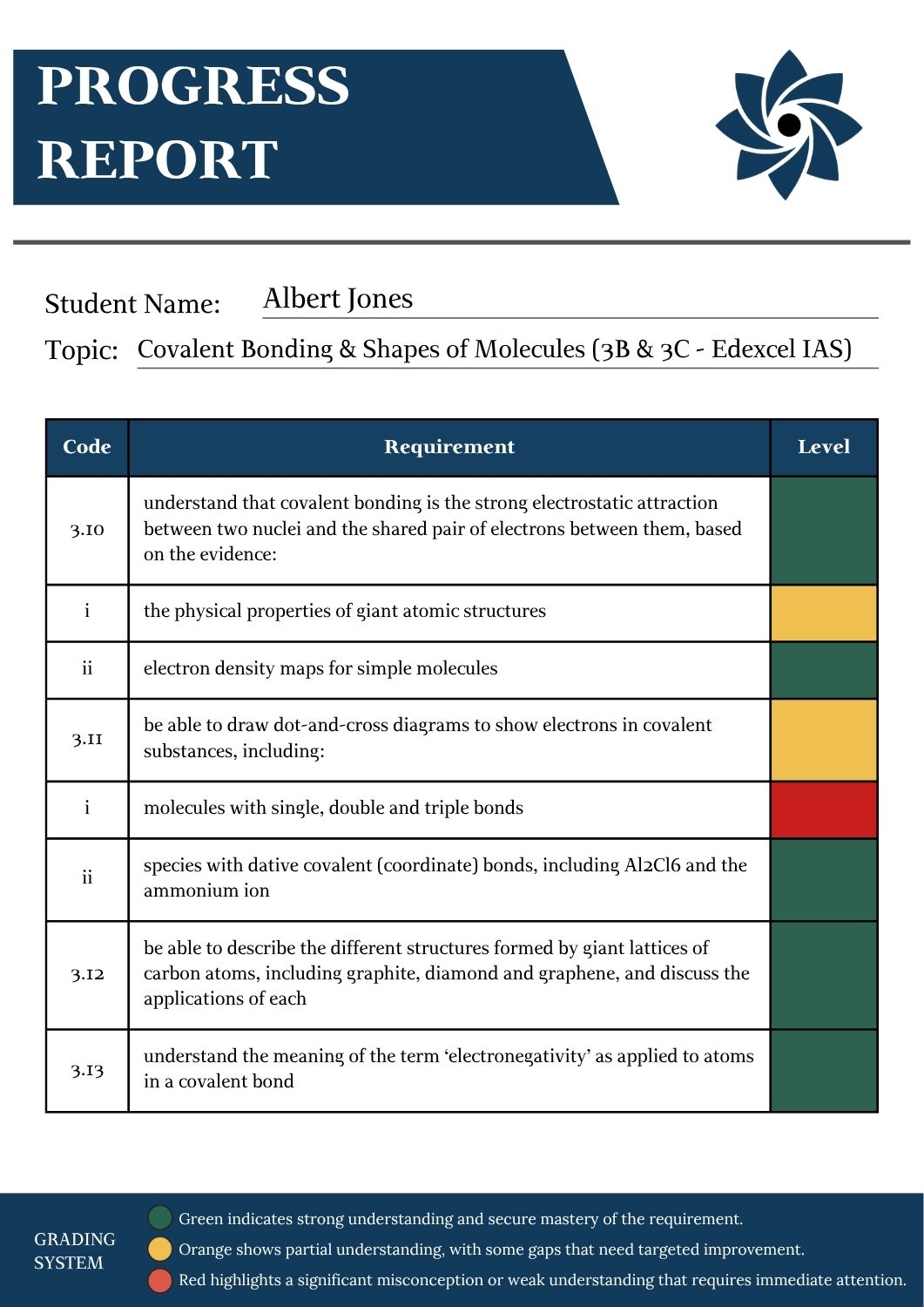
Assignment & Progress Report
The 44-mark assignment assesses the full Topic 3B/C specification, including covalent bonding, dot-and-cross diagrams, giant covalent structures, electronegativity, polarity, and molecular shapes.
After marking, students receive a colour-coded progress report showing secure areas, partial understanding, and specification points requiring further revision.

Instant Feedback
Multiple Choice Question Assessments
Four auto-marked MCQ quizzes provide 37 marks of targeted practice across Topic 3B/C.
Each option includes diagnostic feedback, so students can see why the correct answer is right and why each incorrect option loses marks.

Detailed Written Feedback
Short Answer Question Assessments
Seven teacher-marked short-answer quizzes provide 169 marks of written exam practice across Topic 3B/C.
Students may attempt all SAQ quizzes. A maximum of two SAQ quizzes can be submitted per week, and each submission is marked by a real chemistry teacher within three working days.
Feedback identifies what was correct, what was missing, and how to improve exam-standard written responses.

Exam Board Alignment
This course covers the following Edexcel International A Level Chemistry specification points:
3.10
understand that covalent bonding is the strong electrostatic attraction between two nuclei and the shared pair of electrons between them, based on the evidence:
i
the physical properties of giant atomic structures
ii
electron density maps for simple molecules
3.11
be able to draw dot-and-cross diagrams to show electrons in covalent substances, including:
i
molecules with single, double and triple bonds
ii
species with dative covalent (coordinate) bonds, including Al₂Cl₆ and the ammonium ion
3.12
be able to describe the different structures formed by giant lattices of carbon atoms, including graphite, diamond and graphene, and discuss the applications of each
3.13
understand the meaning of the term ‘electronegativity’ as applied to atoms in a covalent bond
3.14
know that ionic and covalent bonding are the extremes of a continuum of bonding type and be able to explain this in terms of electronegativity differences, leading to bond polarity in bonds and molecules, and to ionic bonding if the electronegativity is large enough
3.15
be able to distinguish between polar bonds and polar molecules and predict whether or not a given molecule is likely to be polar
Practical
Further suggested practical: Determine the effect of an electrostatic force on jets of liquids (water, ethanol and cyclohexane) and use the results to determine whether the molecules are polar or non-polar
3.16
understand the principles of the electron-pair repulsion theory, used to interpret and predict the shapes of simple molecules and ions
3.17
understand the terms ‘bond length’ and ‘bond angle’
3.18
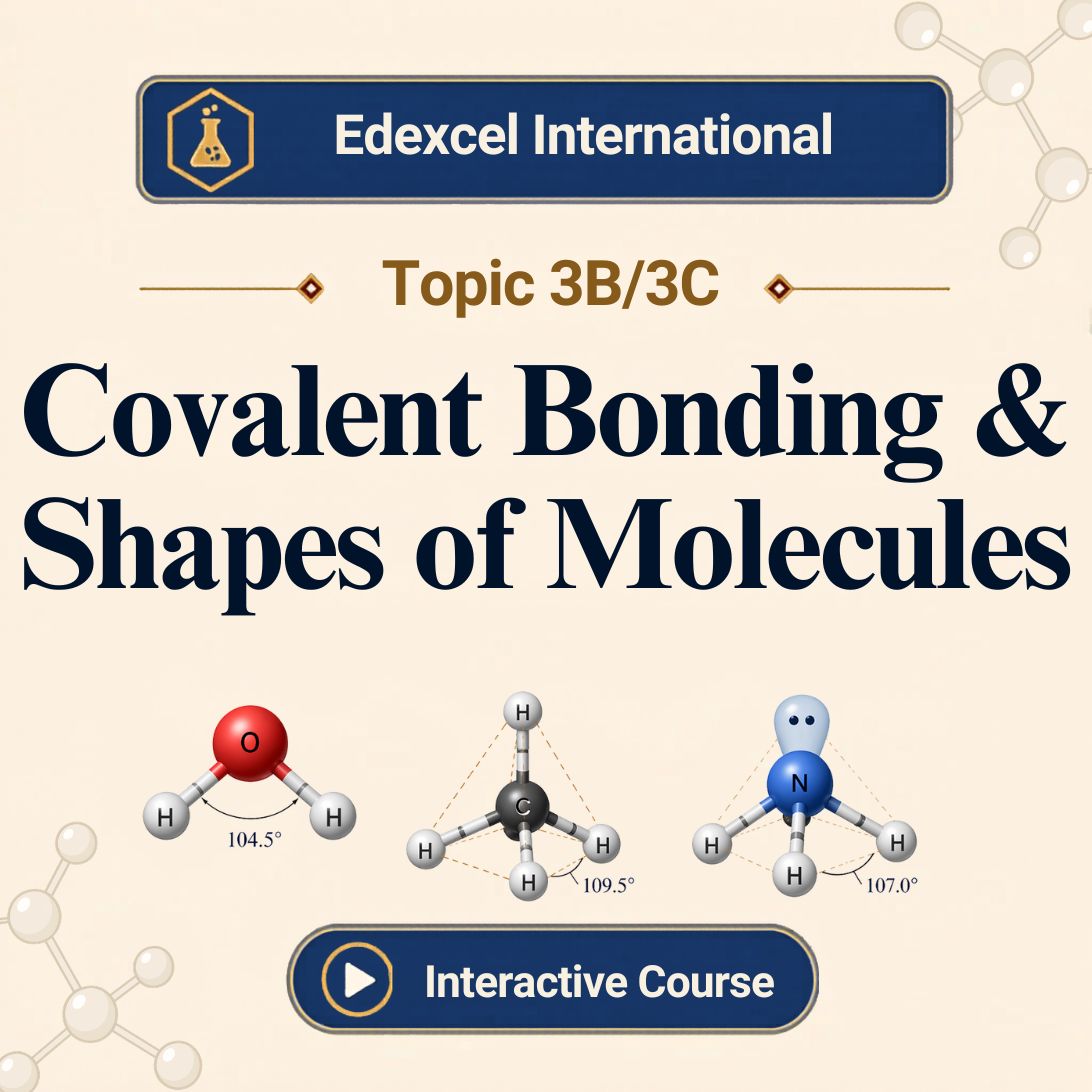
know and be able to explain the shapes of, and bond angles in, BeCl₂, BCl₃, CH₄, NH₃, NH₄⁺, H₂O, CO₂, gaseous PCl₅, SF₆ and C₂H₄
3.19
be able to apply the electron-pair repulsion theory to predict the shapes of, and bond angles in, molecules and ions analogous to those in 3.18
Specification Coverage
Students will be assessed on their ability to:
The following specification points outline the knowledge and skills students are expected to demonstrate.
3.10
understand that covalent bonding is the strong electrostatic attraction between two nuclei and the shared pair of electrons between them, based on the evidence:
i
the physical properties of giant atomic structures
ii
electron density maps for simple molecules
3.11
be able to draw dot-and-cross diagrams to show electrons in covalent substances, including:
i
molecules with single, double and triple bonds
ii
species with dative covalent (coordinate) bonds, including Al2Cl6 and the ammonium ion
3.12
be able to describe the different structures formed by giant lattices of carbon atoms, including graphite, diamond and graphene, and discuss the applications of each
3.13
understand the meaning of the term ‘electronegativity’ as applied to atoms in a covalent bond
3.14
know that ionic and covalent bonding are the extremes of a continuum of bonding type and be able to explain this in terms of electronegativity differences, leading to bond polarity in bonds and molecules, and to ionic bonding if the electronegativity is large enough
3.15
be able to distinguish between polar bonds and polar molecules and predict whether or not a given molecule is likely to be polar
3.16
understand the principles of the electron-pair repulsion theory, used to interpret and predict the shapes of simple molecules and ions
3.17
understand the terms ‘bond length’ and ‘bond angle’
3.18
know and be able to explain the shapes of, and bond angles in, BeCl2, BCl3, CH4, NH3, NH4+, H2O, CO2, gaseous PCl5, SF6 and C2H4
3.19
be able to apply the electron-pair repulsion theory to predict the shapes of, and bond angles in, molecules and ions analogous to those in 3.18
Complete Topic Package
Learn the content, practise exam questions, and identify exactly where marks are being lost.
This course combines guided video teaching, diagnostic MCQs, teacher-marked written assessment, and detailed specification reporting for Edexcel International A Level Chemistry.
Exam-focused learning with clear performance feedback