Sale!

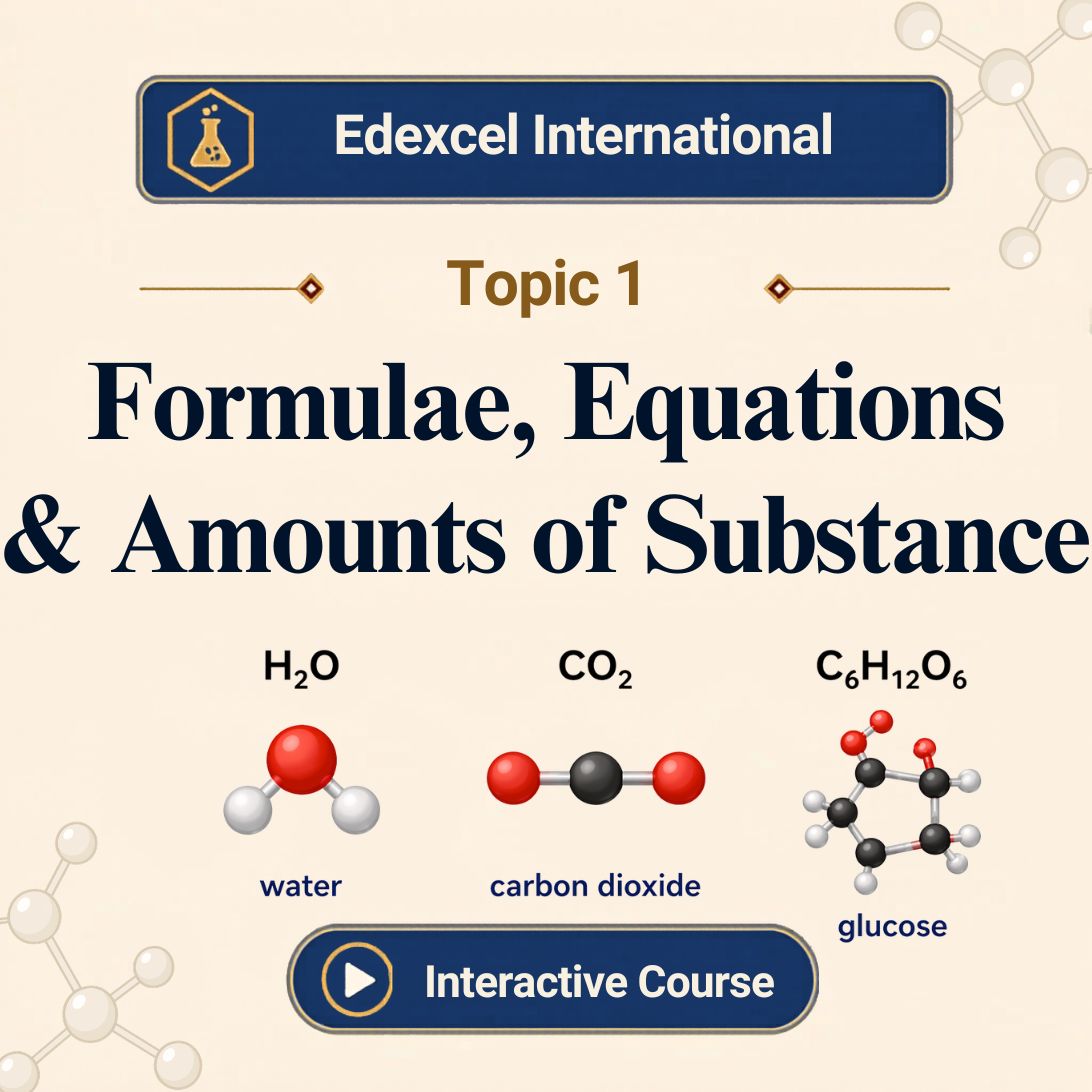
Formulae, Equations and Amount of Substance – Topic 1

Original price was: £99.00.Current price is: £49.00.

A complete Edexcel IAL Chemistry Topic 1 Formulae, Equations & Amount of Substance package:
• Study notes and a full virtual lesson
• Examiner-marked assignment with a colour-coded progress report
• 6 MCQ quizzes with instant feedback (123 marks total)
• 11 SAQ quizzes marked by a chemistry specialist with detailed written feedback (up to 145 marks)

Description

Formulae, Equations and Amounts of Substance – Topic 1

The Formulae, Equations and Amounts of Substance Topic 1 Edexcel International course is approximately XXX Hours of Guided Learning. This course is structured as a complete exam-focused learning system. Students move through interactive study notes, guided virtual teaching, targeted specification assignments, and performance reporting, ensuring knowledge is not only learned, but applied and refined to examination standard.

Guided Learning
XXX Hours
Video Lessons
XXX mins
MCQ Assessments
110 Marks
SAQ Assessment
173 Marks

Interactive Study

Study Notes

Structured digital study notes for Formulae, Equations and Amounts of Substance Topic 1 Edexcel International present the full specification content in a clear, exam-focused format. Interactive H5P elements are embedded throughout, allowing students to test understanding immediately through targeted retrieval questions and applied practice.

Learning is active, not passive – every key concept is reinforced during study.

Alkanes and organic chemistry H5P interactive study notes showing chain isomerism, position isomerism and functional group isomerism with drag and drop activity

Guided Video Teaching

Virtual Lesson

The Formulae, Equations and Amounts of Substance Topic 1 Edexcel International course includes a series of recorded virtual lessons designed to develop both core subject knowledge and the exam technique required for high-level performance.

XXX

The total duration for this Formulae, Equations and Amounts of Substance Topic 1 video content is XXX minutes (XXX hours XXX minutes).

Specialist Marking

Assignment & Specification Report

The Formulae, Equations and Amounts of Substance Topic 1 assignment covers every individual specification point from the Edexcel International A Level Chemistry specification, from formulae and equation writing to mole calculations, relative masses, concentration, empirical and molecular formulae, percentage yield, atom economy, and test-tube reactions. Across 28 marks, questions are structured as multiple-choice, short-answer, and extended-response tasks, requiring you to apply knowledge, interpret data, and, where relevant, complete multi-step quantitative calculations.

All responses are marked by a qualified Chemistry Specialist. Once marking is complete, you receive detailed written feedback alongside a personalised progress report, colour-coded red, orange, or green against each specification point. Red highlights significant misconceptions or weak understanding requiring immediate attention. Orange indicates partial understanding with gaps needing targeted improvement. Green confirms secure mastery. With specification points assessed individually, the report gives you precise visibility of exactly where your understanding stands, rather than a broad topic score that obscures the detail.

A Level Chemistry progress report showing student performance in formulae equations and amounts of substance with colour coded specification levels

Instant Feedback

Multiple Choice Question Assessments

Six multiple choice quizzes cover the full breadth of Formulae, Equations and Amounts of Substance Topic 1, totalling 123 marks across six structured assessments. Every quiz is auto-marked instantly, so there is no waiting, you find out how you performed the moment you submit.

What sets these quizzes apart from standard revision tools is the diagnostic feedback attached to every answer option. Selecting an incorrect answer does not simply tell you that you are wrong, it explains precisely why that option is incorrect and why the right answer is correct. This targets the exact misconceptions that cost marks in exams.

Across the quizzes, the questions are structured to build understanding progressively, from foundational knowledge of formulae, equations, and relative masses through to mole calculations, concentration, empirical formulae, percentage yield, atom economy, and test-tube reactions. This gives you a clear and immediate picture of which areas are secure and which require further attention before your IAL exam.

Alkanes and organic chemistry H5P interactive study notes showing chain isomerism, position isomerism and functional group isomerism with drag and drop activity

Detailed Written Feedback

Short Answer Question Assessments

Eleven short answer quizzes (A–K) cover Topic 1: Formulae, Equations and Amounts of Substance, with a total of 267 marks. Students select 5 quizzes to attempt, with up to 145 marks available if the highest-mark sets are chosen. To attempt more than five, contact us to arrange additional marking.

Each quiz requires written responses or uploaded working, reflecting real exam conditions where method, clarity, and correct chemical notation are essential.

All submissions are marked personally by a chemistry specialist and returned within three working days with detailed written feedback for every question. Students may submit one quiz per day to ensure marking quality and turnaround.

The questions assess core exam skills including balancing equations, mole calculations, empirical formulae, percentage yield, and practical reaction descriptions, targeting the precision and structure needed for top grades.

Alkanes and organic chemistry H5P interactive study notes showing chain isomerism, position isomerism and functional group isomerism with drag and drop activity

Exam Board Alignment

Formulae, Equations and Amounts of Substance Topic 1 Edexcel International

The Formulae, Equations and Amounts of Substance Topic 1 Edexcel International course covers the following Edexcel International A Level Chemistry specification points:

1.1
know the terms ‘atom’, ‘element’, ‘ion’, ‘molecule’, ‘compound’, ’empirical formula’ and ‘molecular formula’

1.2
know that the mole (mol) is the unit for the amount of a substance and be able to perform calculations using the Avogadro constant L (6.02 × 10²³ mol−1)

1.3
write balanced full and ionic equations, including state symbols, for chemical reactions

1.4
understand the terms:
i
‘relative atomic mass’ based on the 12C scale
ii
‘relative molecular mass’ and ‘relative formula mass’, including calculating these values from relative atomic masses. The term ‘relative formula mass’ should be used for compounds with giant structures.
iii
‘molar mass’ as the mass per mole of a substance in g mol−1
iv
parts per million (ppm), including gases in the atmosphere

1.5
calculate the concentration of a solution in mol dm−3 and g dm−3. Titration calculations are not required at this stage.

1.6
be able to use experimental data to calculate empirical and molecular formulae

1.7
be able to use chemical equations to calculate reacting masses and vice versa, using the concepts of amount of substance and molar mass

1.8
be able to use chemical equations to calculate volumes of gases and vice versa, using:
i
the concepts of amount of substance
ii
the molar volume of gases
iii
the expression pV = nRT for gases and volatile liquids

1.9
be able to calculate percentage yields and percentage atom economies (by mass) in laboratory and industrial processes, using chemical equations and experimental results. Atom economy = (molar mass of the desired product ÷ sum of the molar masses of all products) × 100%

1.10
be able to determine a formula or confirm an equation by experiment, including evaluation of the data

Core Practical 1
Measurement of the molar volume of a gas.

1.12
be able to relate ionic and full equations, with state symbols, to observations from simple test-tube experiments, to include:
i
displacement reactions
ii
typical reactions of acids
iii
precipitation reactions

Further Practicals
Further suggested practicals:
i
preparation of a salt and calculating the percentage yield of product, including the preparation of a double salt, such as ammonium iron(II) sulfate from iron, ammonia and sulfuric acid
ii
determine a chemical formula by experiment, such as the formula of copper(II) oxide by reduction
iii
determine a chemical equation by experiment, such as the reaction between lithium and water, or the reaction between magnesium and an acid
iv
carry out and interpret the results of simple test-tube reactions, as outlined in 1.12

Complete Topic Package

Learn the content, apply the chemistry, and identify exactly where marks are being lost.

This course combines interactive study notes, guided video teaching, auto-marked diagnostic quizzes, specialist-marked written assessments, and detailed specification reporting in one structured system for Edexcel International A Level Chemistry.

Exam-focused learning with clear performance feedback

Additional information

Course Level

AS Level | Unit 2 | Edexcel International A Level

Topic Code

1.1, 1.2, 1.3, 1.4, 1.5, 1.6, 1.7, 1.8, 1.9, 1.10, 1.11, 1.12

Content Includes

Study Notes | Virtual Lesson | Assignment | MCQs | SAQs | Progress Report

Assessment Types

MCQs (Instant Feedback), SAQs (Examiner-Marked), Assignment + Progress Report

Total Marks Included

MCQ: 110 marks, SAQ: 130 marks

Feedback Type

Instant Feedback, Delayed Written Feedback (3 working days per SAQ quiz), Colour-Coded Progress Report