Ionic Bonding and Metallic Bonding – Topic 3A/D
The Ionic Bonding and Metallic Bonding Topic 3A/D Edexcel International A Level Chemistry course provides approximately 11 Hours of Guided Learning. Students work through guided video teaching, auto-marked MCQ practice, teacher-marked short-answer questions, and a specification assignment with a personalised progress report.
Guided Video Teaching
Virtual Lesson
The recorded lessons teach the key chemistry and the exam technique needed to apply it accurately.
Students pause during exam-practice sections, attempt questions independently, then review the worked explanations and mark scheme approach.
Specialist Marking
Assignment & Progress Report
The 23-mark assignment assesses the full Topic 3A/D specification, including ions, ionic bonding, ionic radii, polarisation, metallic bonding, and the properties of metals.
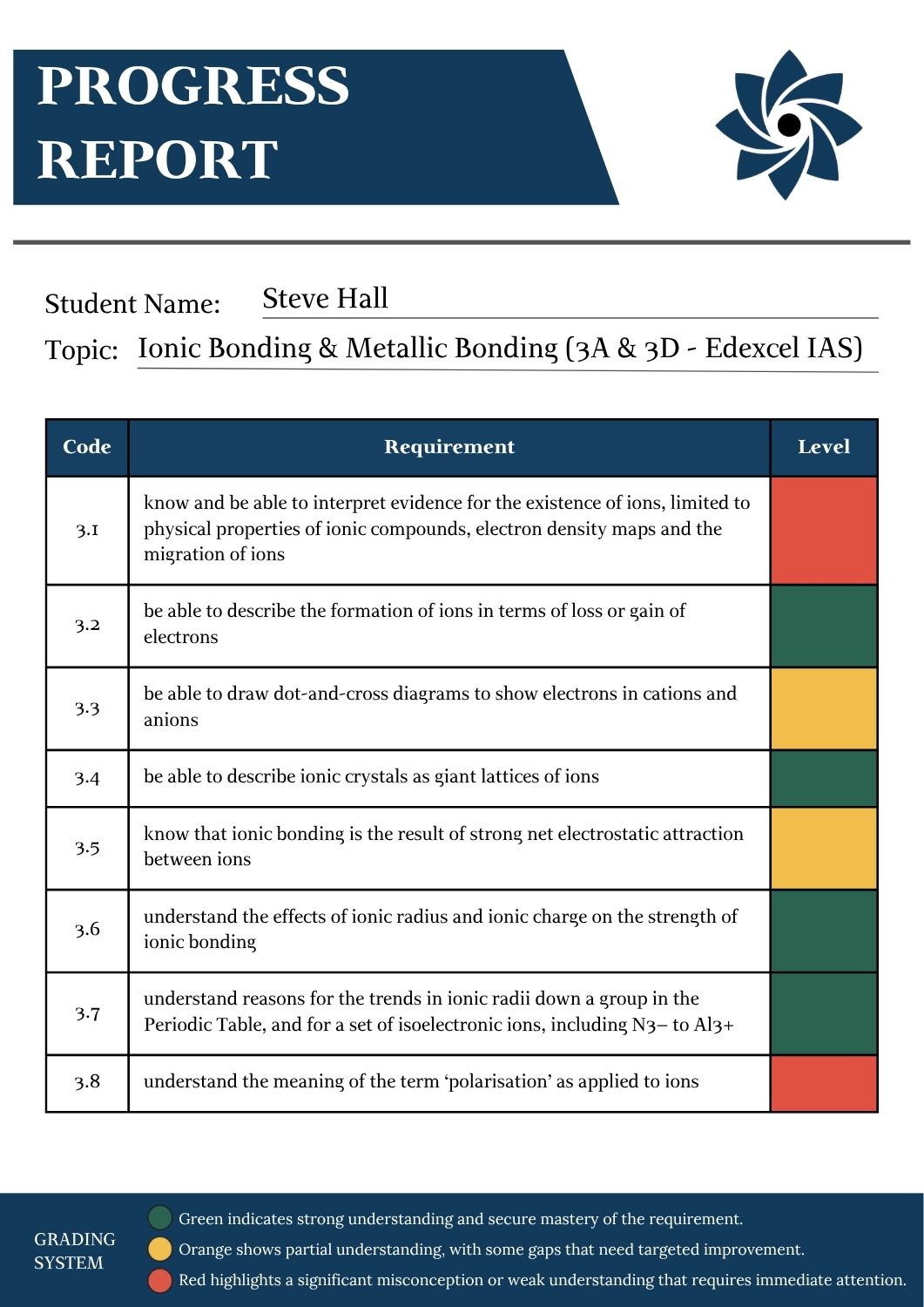
After marking, students receive a colour-coded progress report showing secure areas, partial understanding, and specification points requiring further revision.
Instant Feedback
Multiple Choice Question Assessments
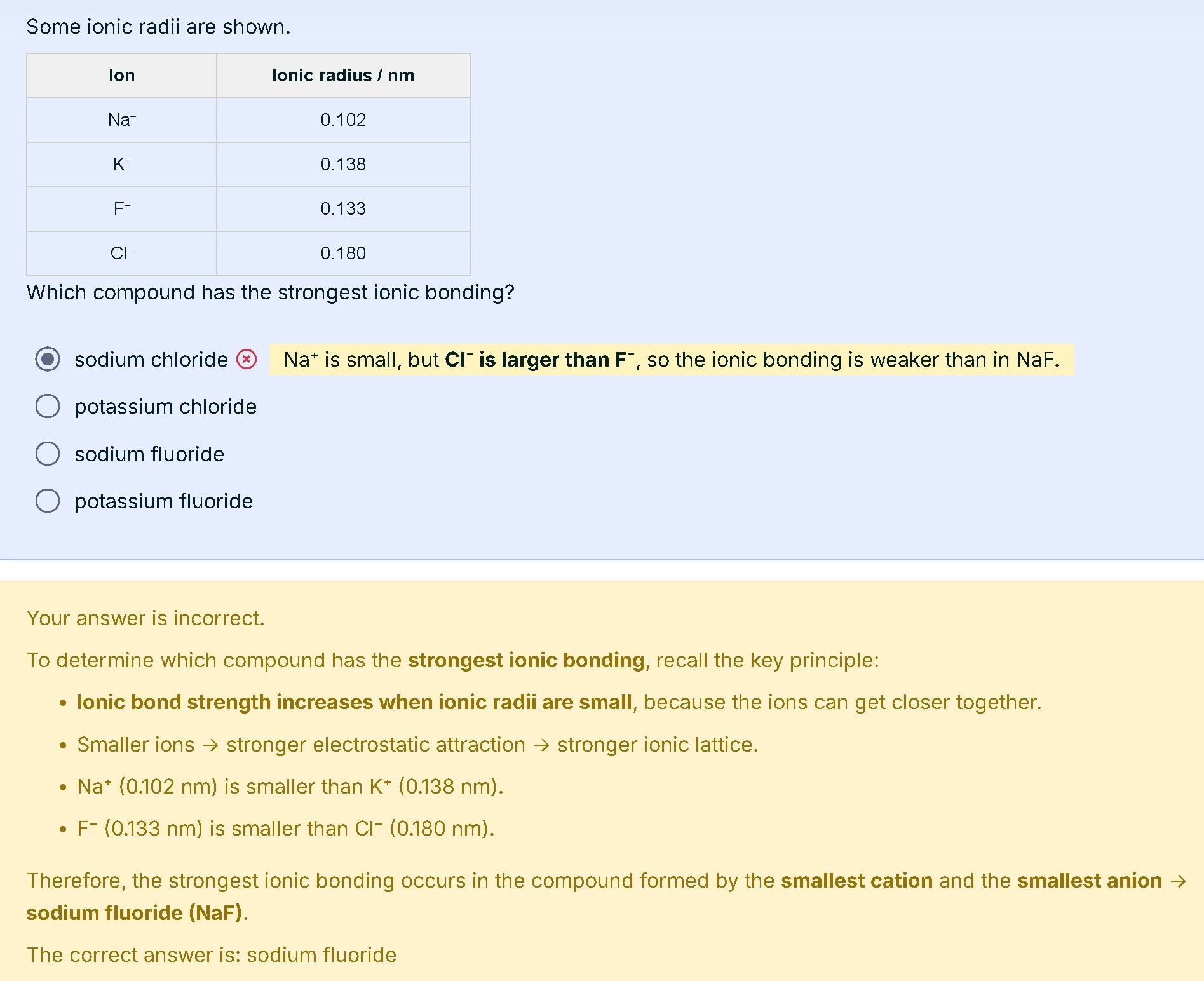
Three auto-marked MCQ quizzes provide 51 marks of targeted practice across Topic 3A/D.
Each option includes diagnostic feedback, so students can see why the correct answer is right and why each incorrect option loses marks.
Detailed Written Feedback
Short Answer Question Assessments
Three teacher-marked short-answer quizzes provide 68 marks of written exam practice across Topic 3A/D.
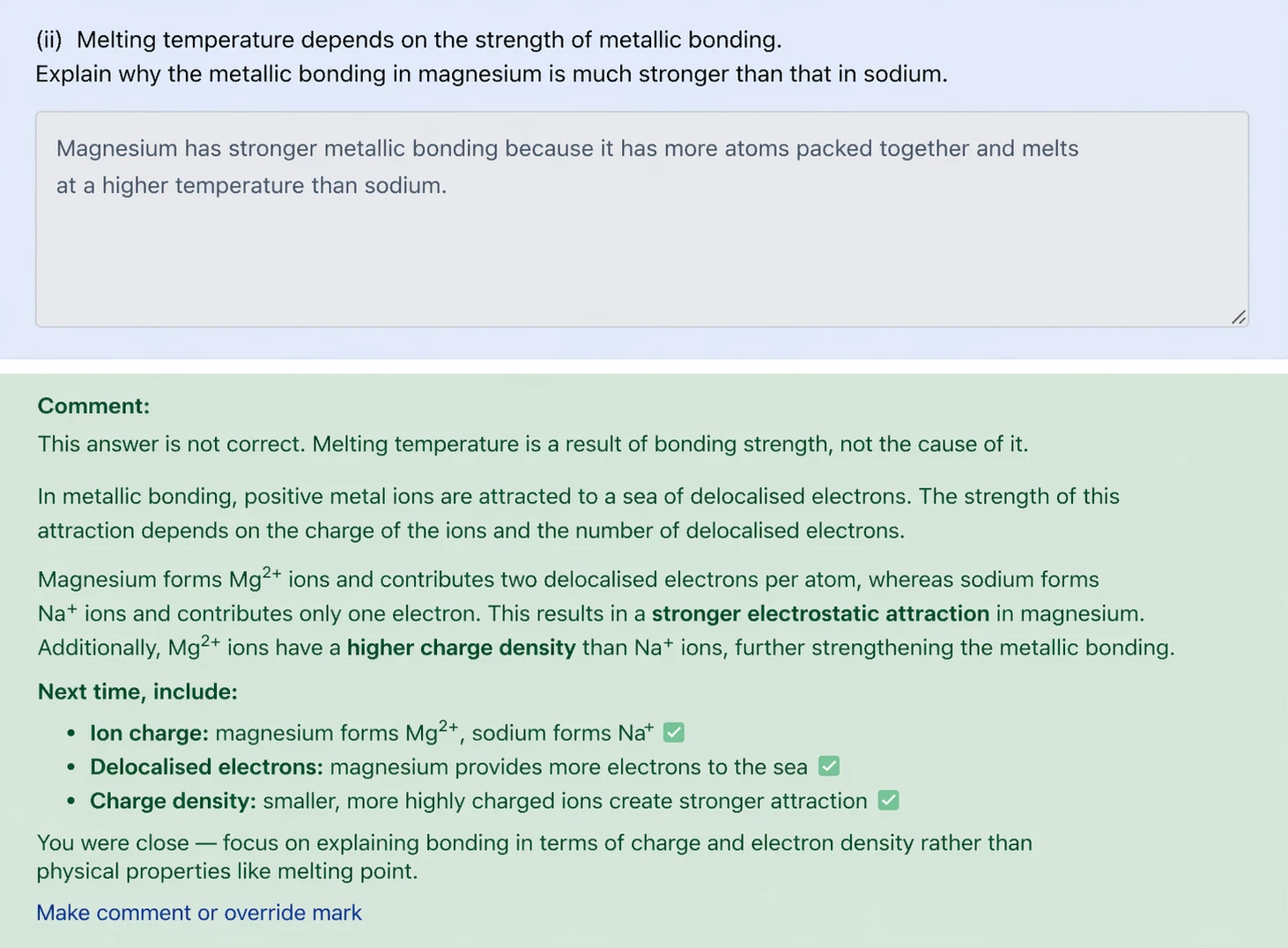
Students may attempt all SAQ quizzes. A maximum of two SAQ quizzes can be submitted per week, and each submission is marked by a real chemistry teacher within three working days.
Feedback identifies what was correct, what was missing, and how to improve exam-standard written responses.
Exam Board Alignment
This course covers the following Edexcel International A Level Chemistry specification points:
3.1
know and be able to interpret evidence for the existence of ions, limited to physical properties of ionic compounds, electron density maps and the migration of ions
3.2
be able to describe the formation of ions in terms of loss or gain of electrons
3.3
be able to draw dot-and-cross diagrams to show electrons in cations and anions
3.4
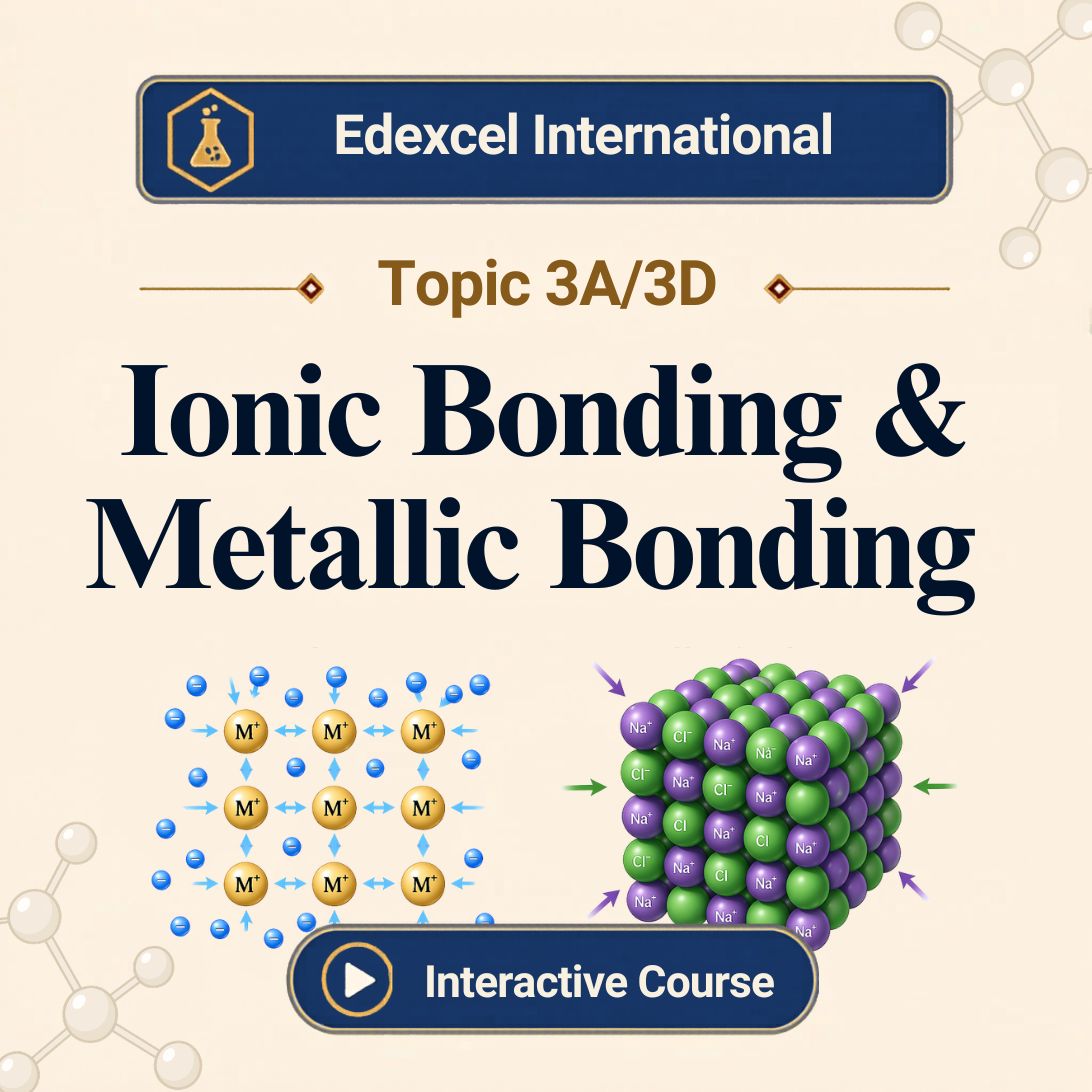
be able to describe ionic crystals as giant lattices of ions
3.5
know that ionic bonding is the result of strong net electrostatic attraction between ions
3.6
understand the effects of ionic radius and ionic charge on the strength of ionic bonding
3.7
understand reasons for the trends in ionic radii down a group in the Periodic Table, and for a set of isoelectronic ions, including N³⁻ to Al³⁺
3.8
understand the meaning of the term ‘polarisation’ as applied to ions
3.9
understand that the polarising power of a cation depends on its radius and charge, and the polarisability of an anion also depends on its radius and charge
Practical
Further suggested practical: The migration of ions in a U-tube using copper(II) chromate solution or on a microscope slide using potassium manganate(VII) crystals
3.20
understand that metals consist of giant lattices of metal ions in a sea of delocalised electrons
3.21
know that metallic bonding is the strong electrostatic attraction between metal ions and the delocalised electrons
3.22
be able to use the models in 3.20 and 3.21 to interpret simple properties of metals, including electrical conductivity and high melting temperature
Specification Coverage
Students will be assessed on their ability to:
The following specification points outline the knowledge and skills students are expected to demonstrate.
3.1
know and be able to interpret evidence for the existence of ions, limited to physical properties of ionic compounds, electron density maps and the migration of ions
3.2
be able to describe the formation of ions in terms of loss or gain of electrons
3.3
be able to draw dot-and-cross diagrams to show electrons in cations and anions
3.4
be able to describe ionic crystals as giant lattices of ions
3.5
know that ionic bonding is the result of strong net electrostatic attraction between ions
3.6
understand the effects of ionic radius and ionic charge on the strength of ionic bonding
3.7
understand reasons for the trends in ionic radii down a group in the Periodic Table, and for a set of isoelectronic ions, including N3− to Al3+
3.8
understand the meaning of the term ‘polarisation’ as applied to ions
3.9
understand that the polarising power of a cation depends on its radius and charge, and the polarisability of an anion also depends on its radius and charge
3.20
understand that metals consist of giant lattices of metal ions in a sea of delocalised electrons
3.21
know that metallic bonding is the strong electrostatic attraction between metal ions and the delocalised electrons
3.22
be able to use the models in 3.20 and 3.21 to interpret simple properties of metals, including electrical conductivity and high melting temperature
Complete Topic Package
Learn the content, practise exam questions, and identify exactly where marks are being lost.
This course combines guided video teaching, diagnostic MCQs, teacher-marked written assessment, and detailed specification reporting for Edexcel International A Level Chemistry.
Exam-focused learning with clear performance feedback