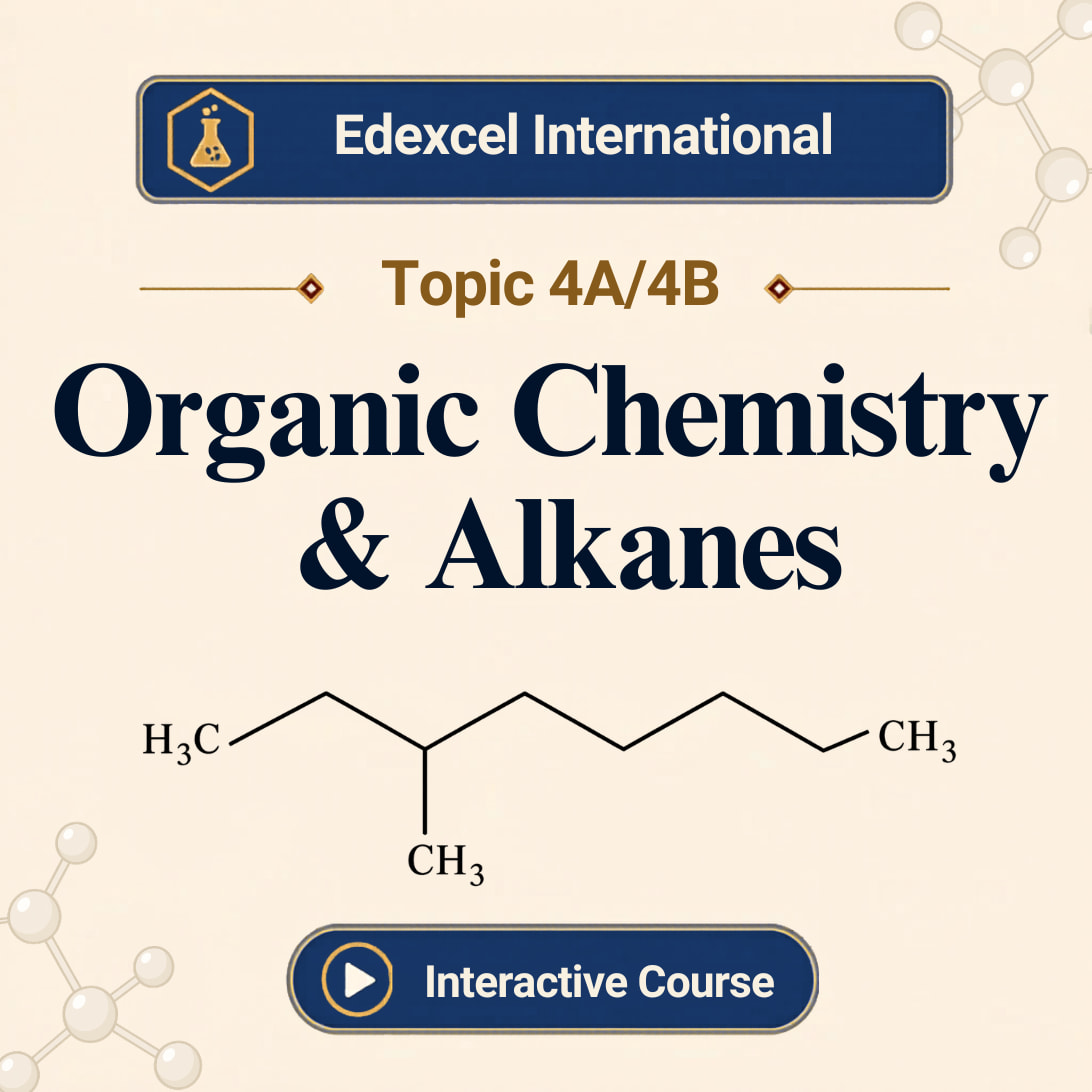
Organic Chemistry and Alkanes – Topic 4A/B
The Organic Chemistry and Alkanes Topic 4A/B Edexcel International A Level Chemistry course provides approximately 16 Hours of Guided Learning. Students work through guided video teaching, auto-marked MCQ practice, teacher-marked short-answer questions, and a specification assignment with a personalised progress report.
Guided Video Teaching
Virtual Lesson
The recorded lessons teach the key chemistry and the exam technique needed to apply it accurately.
Students pause during exam-practice sections, attempt questions independently, then review the worked explanations and mark scheme approach.
Specialist Marking
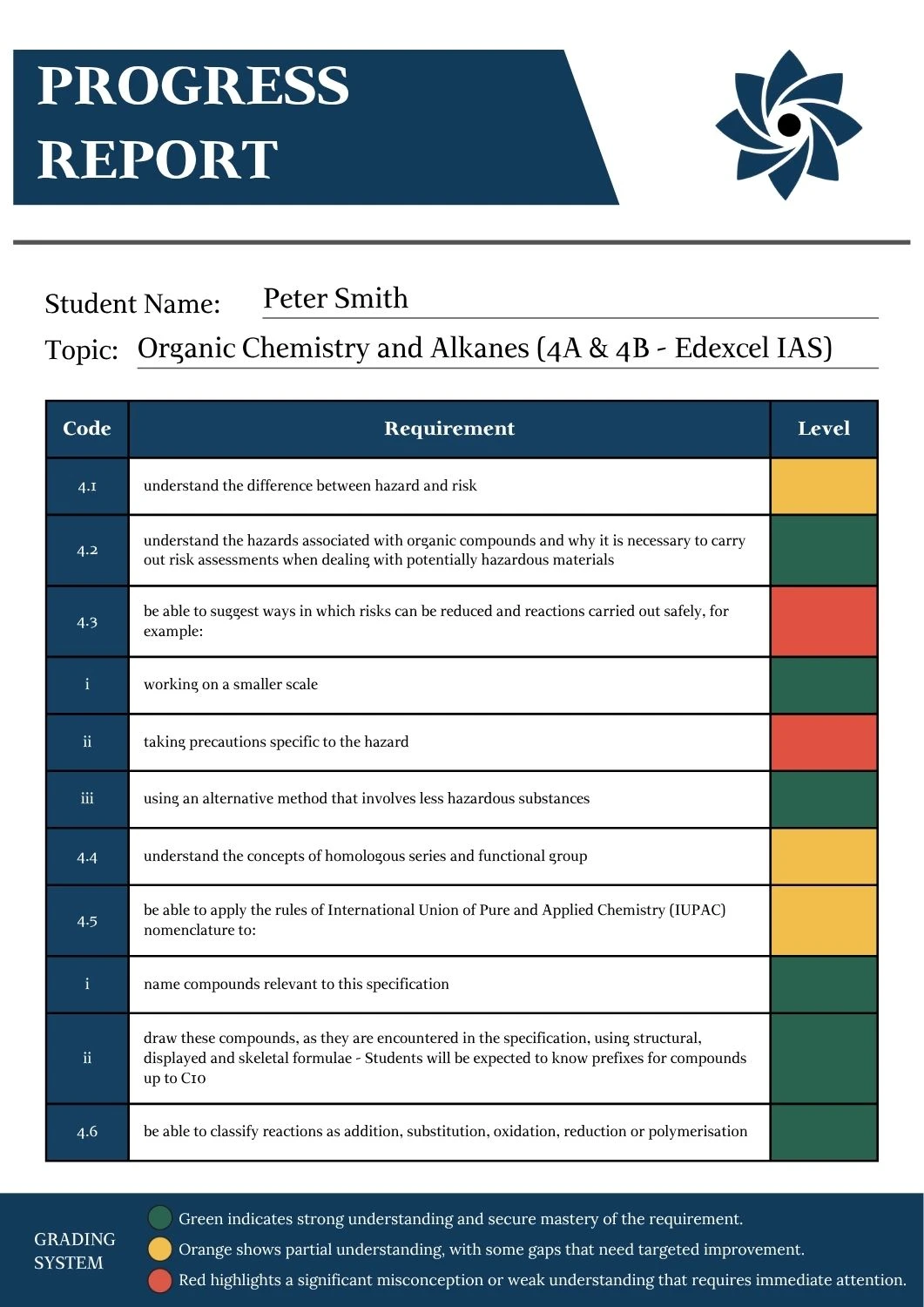
Assignment & Progress Report
The 29-mark assignment assesses the full Topic 4A/B specification, including organic safety, IUPAC naming, reaction classification, crude oil, fuels, alkanes, and free radical substitution.
After marking, students receive a colour-coded progress report showing secure areas, partial understanding, and specification points requiring further revision.

Instant Feedback
Multiple Choice Question Assessments
Four auto-marked MCQ quizzes provide 73 marks of targeted practice across Topic 4A/B.
Each option includes diagnostic feedback, so students can see why the correct answer is right and why each incorrect option loses marks.

Detailed Written Feedback
Short Answer Question Assessment
One teacher-marked short-answer quiz provides 30 marks of written exam practice across Topic 4A/B.
Students submit written responses, structures, mechanisms, or uploaded working where required. Each submission is marked by a real chemistry teacher within three working days.
Feedback identifies what was correct, what was missing, and how to improve exam-standard written responses.

Exam Board Alignment
This course covers the following Edexcel International A Level Chemistry specification points:
4.1
understand the difference between hazard and risk
4.2
understand the hazards associated with organic compounds and why it is necessary to carry out risk assessments when dealing with potentially hazardous materials
4.3
be able to suggest ways in which risks can be reduced and reactions carried out safely, for example:
i
working on a smaller scale
ii
taking precautions specific to the hazard
iii
using an alternative method that involves less hazardous substances
4.4
understand the concepts of homologous series and functional group
4.5
be able to apply the rules of International Union of Pure and Applied Chemistry (IUPAC) nomenclature to:
i
name compounds relevant to this specification
ii
draw these compounds, as they are encountered in the specification, using structural, displayed and skeletal formulae
iii
Students will be expected to know prefixes for compounds up to C10
4.6
be able to classify reactions as addition, substitution, oxidation, reduction or polymerisation
4.7
understand that bond breaking can be:
i
homolytic, to produce free radicals
ii
heterolytic, to produce ions
4.8
know definitions of the terms ‘free radical’ and ‘electrophile’
4.9
know the general formula of alkanes and cycloalkanes, and understand that they are hydrocarbons (compounds of carbon and hydrogen only) which are saturated (contain single bonds only)
4.10
understand the term ‘structural isomerism’ and be able to draw the structural isomers of organic molecules, given their molecular formula
4.11
be able to draw and name the structural isomers of alkanes and cycloalkanes with up to six carbon atoms
4.12
know that alkanes are used as fuels and obtained from the fractional distillation, cracking and reforming of crude oil, and be able to write equations for these reactions
4.13
know that pollutants, including carbon monoxide, oxides of nitrogen and sulfur, carbon particulates and unburned hydrocarbons, are emitted during the combustion of alkane fuels
4.14
understand the problems arising from pollutants from the combustion of alkane fuels, limited to the toxicity of carbon monoxide and why it is toxic, and the acidity of oxides of nitrogen and sulfur
4.15
be able to discuss the reasons for developing alternative fuels in terms of sustainability and reducing emissions, including the emission of CO2 and its relationship to climate change
4.16
be able to apply the concept of carbon neutrality to different fuels, such as petrol, bioethanol and hydrogen
4.17
understand the reactions of alkanes with:
i
oxygen in the air (combustion)
4.18
understand the mechanism of the free radical substitution reaction between an alkane and a halogen:
i
using free radicals, which are species with an unpaired electron, represented by a single dot
ii
showing the initiation step of the mechanism, with curly half-arrows for free radical formation
iii
showing the propagation and termination steps of the mechanism
iv
having limited use in synthesis because of further substitution reactions
Practical
Further suggested practical: Cracking alkanes by thermal decomposition, including liquid paraffin using aluminium oxide as a catalyst
Specification Coverage
Students will be assessed on their ability to:
The following specification points outline the knowledge and skills students are expected to demonstrate.
4.1
understand the difference between hazard and risk
4.2
understand the hazards associated with organic compounds and why it is necessary to carry out risk assessments when dealing with potentially hazardous materials
4.3
be able to suggest ways in which risks can be reduced and reactions carried out safely, for example:
i
working on a smaller scale
ii
taking precautions specific to the hazard
iii
using an alternative method that involves less hazardous substances
4.4
understand the concepts of homologous series and functional group
4.5
be able to apply the rules of International Union of Pure and Applied Chemistry (IUPAC) nomenclature to:
i
name compounds relevant to this specification
ii
draw these compounds, as they are encountered in the specification, using structural, displayed and skeletal formulae. Students will be expected to know prefixes for compounds up to C10
4.6
be able to classify reactions as addition, substitution, oxidation, reduction or polymerisation
4.7
understand that bond breaking can be:
i
homolytic, to produce free radicals
ii
heterolytic, to produce ions
4.8
know definitions of the terms ‘free radical’ and ‘electrophile’
4.9
know the general formula of alkanes and cycloalkanes, and understand that they are hydrocarbons (compounds of carbon and hydrogen only) which are saturated (contain single bonds only)
4.10
understand the term ‘structural isomerism’ and be able to draw the structural isomers of organic molecules, given their molecular formula
4.11
be able to draw and name the structural isomers of alkanes and cycloalkanes with up to six carbon atoms
4.12
know that alkanes are used as fuels and obtained from the fractional distillation, cracking and reforming of crude oil, and be able to write equations for these reactions
4.13
know that pollutants, including carbon monoxide, oxides of nitrogen and sulfur, carbon particulates and unburned hydrocarbons, are emitted during the combustion of alkane fuels
4.14
understand the problems arising from pollutants from the combustion of alkane fuels, limited to the toxicity of carbon monoxide and why it is toxic, and the acidity of oxides of nitrogen and sulfur
4.15
be able to discuss the reasons for developing alternative fuels in terms of sustainability and reducing emissions, including the emission of CO2 and its relationship to climate change
4.16
be able to apply the concept of carbon neutrality to different fuels, such as petrol, bioethanol and hydrogen
4.17
understand the reactions of alkanes with:
i
oxygen in the air (combustion) and halogens
4.18
understand the mechanism of the free radical substitution reaction between an alkane and a halogen:
i
using free radicals, which are species with an unpaired electron, represented by a single dot
ii
showing the initiation step of the mechanism, with curly half-arrows for free radical formation
iii
showing the propagation and termination steps of the mechanism
iv
having limited use in synthesis because of further substitution reactions
Complete Topic Package
Learn the content, practise exam questions, and identify exactly where marks are being lost.
This course combines guided video teaching, diagnostic MCQs, teacher-marked written assessment, and detailed specification reporting for Edexcel International A Level Chemistry.
Exam-focused learning with clear performance feedback