Periodicity
A concise revision guide to AQA 3.2.1 Periodicity: atomic radius and first ionisation energy trends across periods and down groups, melting and boiling point trends across Period 3, and how physical properties link to bonding and structure.
What Is Periodicity?
Periodicity refers to the repeating pattern of chemical and physical properties seen across different periods of the periodic table. The same pattern appears in Period 2 and Period 3 because electrons are added to the same types of subshells in the same sequence.
The AQA 7405 specification requires you to understand periodicity as a repeating pattern of physical and chemical properties, and to explain trends in atomic radius, first ionisation energy, and melting and boiling points using electronic structure, bonding and structure.
Key idea: periodic trends repeat because the electronic structure of each period follows the same pattern of subshell filling.
Atomic Radius Across a Period
Atomic radius generally decreases across a period. As proton number increases, nuclear charge increases. Electrons are added to the same main shell, so shielding remains similar. The stronger nuclear attraction pulls the electron cloud closer to the nucleus.
Nuclear charge increases
More protons in the nucleus attract the outer electrons more strongly, pulling them closer.
Shielding stays similar
Electrons enter the same main shell, so no significant extra inner-shell shielding is added.
Atomic radius decreases
The stronger attraction reduces the distance between the nucleus and the outer electrons.
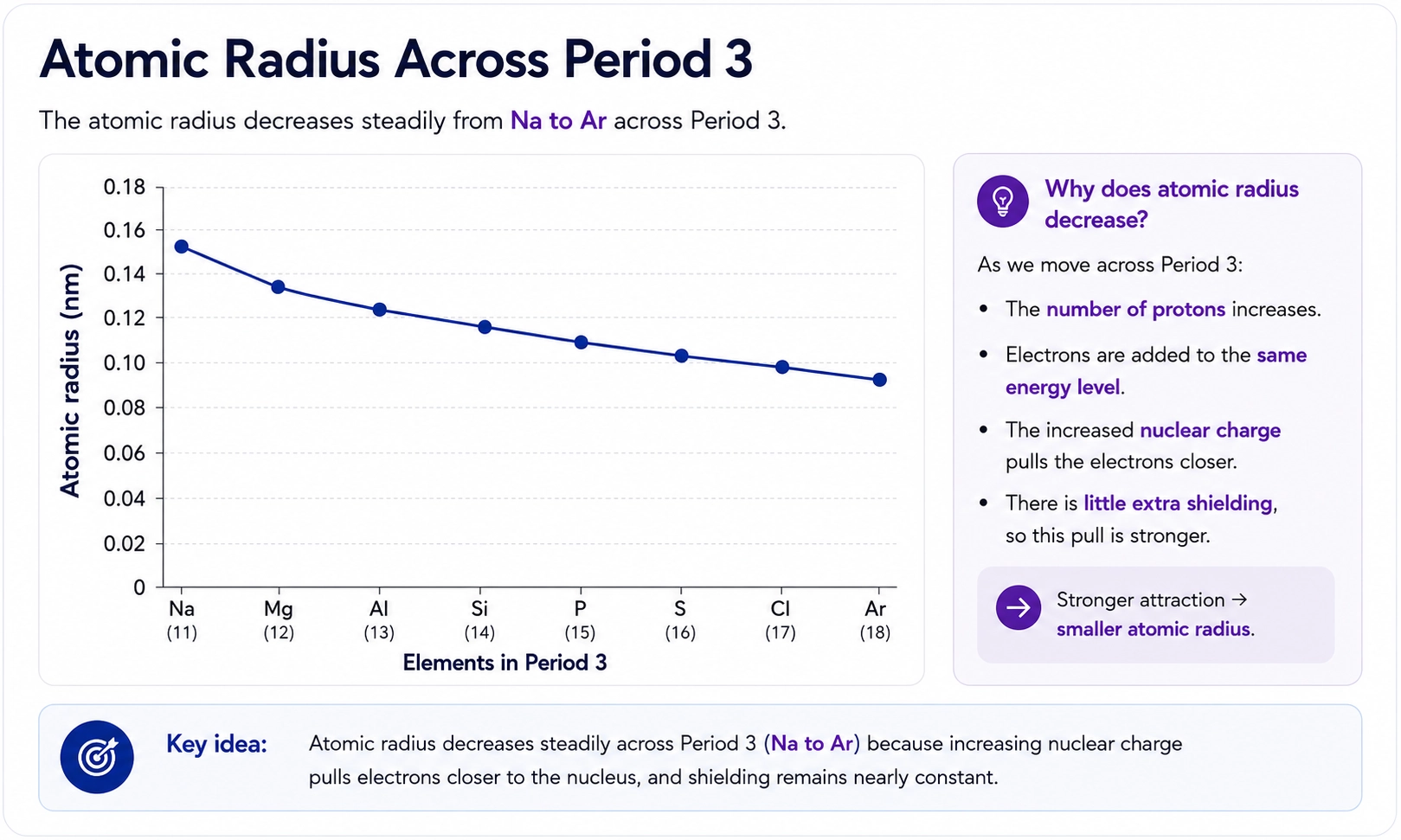
Across a period, atomic radius decreases because nuclear charge increases while shielding remains similar.
Ionisation Energy Compared Across a Period and Down a Group
It is useful to separate the two directions clearly. Across a period, electrons are added to the same main shell, so shielding remains similar and atomic radius decreases. First ionisation energy generally increases.
Down a group, electrons are added to new shells. This gives a larger atomic radius and more shielding, so first ionisation energy decreases.
| Direction | Atomic radius | Shielding | First ionisation energy |
|---|---|---|---|
| Across a period (left to right) | Decreases | Similar | Generally increases |
| Down a group | Increases | Increases | Decreases |
Melting and Boiling Point Trends Across Period 3
Across Period 3, melting and boiling points do not follow the same pattern as ionisation energy. This is because melting and boiling points depend on bonding and structure, not on how tightly electrons are held.
Sodium, magnesium and aluminium are metallic solids with giant metallic structures. Silicon has a giant covalent structure with very strong bonds throughout. Phosphorus, sulfur, chlorine and argon are simple molecular or monatomic, so their melting and boiling points are low and depend on weak intermolecular forces.
Exam focus: do not explain melting point trends using ionisation energy arguments. Melting point depends on the type of bonding and structure, not on the energy needed to remove an electron.
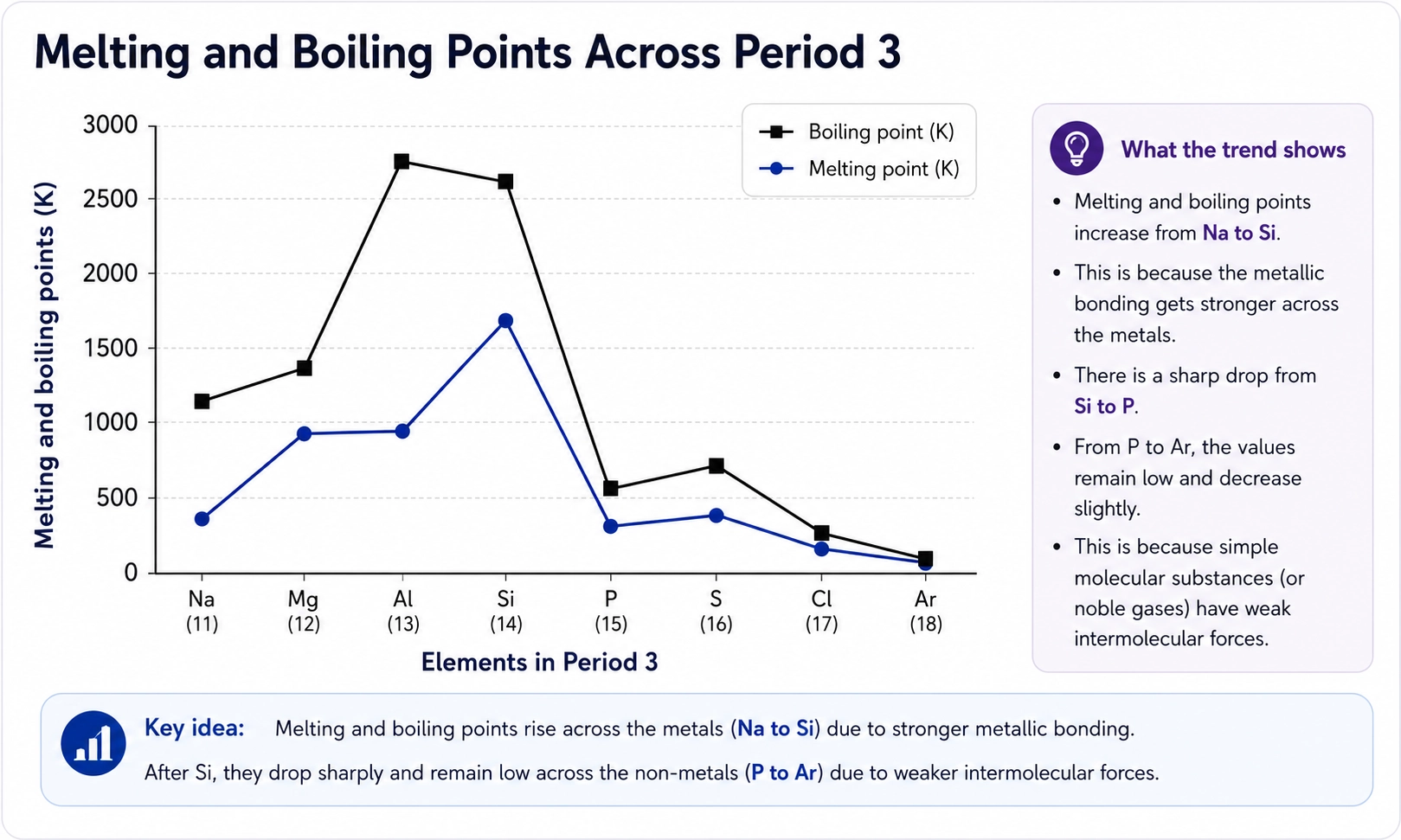
Physical property trends depend on bonding and structure, so they should not be explained using ionisation energy arguments alone.
Using Data to Illustrate Periodicity
AQA 3.2.1 Periodicity requires you to use data to illustrate periodic trends, including electronic configurations, atomic radii, first ionisation energies and melting or boiling points.
When answering these questions, state the trend clearly, identify the direction (across a period or down a group) and explain the cause using nuclear charge, shielding, atomic radius and the type of bonding or structure.
Electronic configuration
Repeating pattern of subshell filling from s to p explains why properties repeat across periods.
Atomic radius
Decreases across a period (nuclear charge dominates), increases down a group (extra shells).
Melting and boiling temperatures
Determined by structure: metallic, giant covalent, or simple molecular/monatomic.
First ionisation energies
Generally increase across a period; decrease down a group. Small exceptions occur between Group 2 and Group 3, and between Group 5 and Group 6.
Atomic Radius Across Period 3
AQA wants the trend in atomic radius stated and explained in its own right, not only as a step in the ionisation energy argument. From sodium to argon the atomic radius decreases.
| Element | Na | Mg | Al | Si | P | S | Cl |
|---|---|---|---|---|---|---|---|
| Atomic radius / nm | 0.191 | 0.160 | 0.143 | 0.118 | 0.110 | 0.104 | 0.099 |
| Nuclear charge | +11 | +12 | +13 | +14 | +15 | +16 | +17 |
Explanation. Across the period each element has one more proton in the nucleus, so the nuclear charge increases. The added electron goes into the same shell (the third), so the shielding by the inner 1s, 2s and 2p electrons is almost the same for every element. The outer electrons are therefore attracted more strongly and pulled closer to the nucleus.
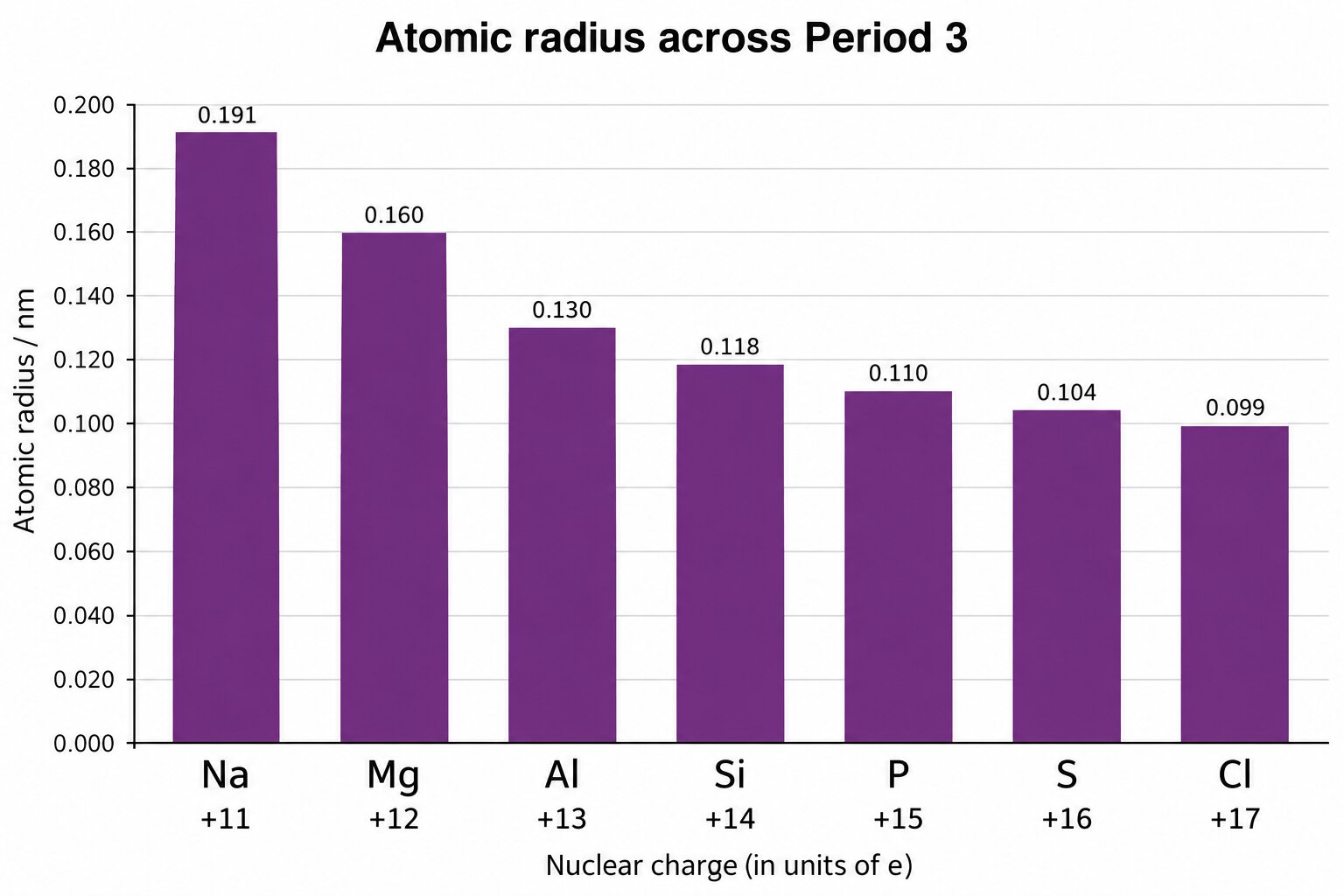
Atomic radius falls across Period 3 as the nuclear charge rises while shielding stays almost constant.
Exam sentence: Atomic radius decreases across Period 3 because the nuclear charge increases while the outer electrons stay in the same shell with similar shielding, so they are attracted more strongly to the nucleus.
Check Your Understanding
Use these short activities to check the periodic trends on elements and comparisons that do not appear on this page.
FAQs: Periodic Trends
Use these questions to secure the key reasoning for periodic trend exam answers.
What is periodicity?
Periodicity is the repeating pattern of physical and chemical properties seen across different periods of the periodic table, caused by the repeated pattern of subshell filling.
Why does atomic radius decrease across a period?
Nuclear charge increases while electrons are added to the same main shell, so shielding remains similar and the stronger nuclear attraction pulls the electron cloud closer to the nucleus.
Why do melting and boiling points not follow the same trend as ionisation energy across a period?
Melting and boiling points depend on bonding and structure. Metallic elements have giant metallic structures, silicon has a giant covalent structure, and the other Period 3 elements are simple molecular or monatomic with weak intermolecular forces.
Why does first ionisation energy generally increase across a period?
As proton number increases, nuclear charge increases but shielding remains similar because electrons enter the same main shell. The stronger attraction between the nucleus and the outer electron means more energy is needed to remove it.
Why does first ionisation energy decrease down a group?
Going down a group, atoms have more occupied electron shells. The outer electron is further from the nucleus and shielded more strongly by inner shells, so less energy is needed to remove it.

Master Atomic Structure and the Periodic Table for AQA A Level Chemistry
Continue from these free revision notes into the full 3.1.1 and 3.2.1 Atomic Structure and the Periodic Table course. The five guided video lessons are ready now; the AQA MCQ bank, teacher-marked short-answer questions, supplementary lessons and KASP spec-point mapping are being completed.
Guided video teaching
Learn the chemistry and exam technique through structured video lessons with worked examples and walkthroughs.
Instant MCQ feedback
Auto-marked MCQ quizzes provide immediate diagnostic feedback for every answer choice.
Teacher-marked SAQs
Submit written exam responses and receive chemistry specialist feedback with improvement guidance.
Progress tracking
Identify strengths and weaknesses across the full 3.1.1 and 3.2.1 specification with targeted reporting.
See how the course works
Click play to start the course preview animation.
Some ionic radii are shown.
| Ion | Ionic radius / nm |
|---|---|
| Na+ | 0.102 |
| K+ | 0.138 |
| F− | 0.133 |
| Cl− | 0.180 |
Which compound has the strongest ionic bonding?
Explain why the metallic bonding in magnesium is much stronger than that in sodium.
Copyright notice: This OLS revision content, including the explanations, layout, diagrams, tables and embedded learning structure, is authored for Online Learning System by Dr. Mohammed Al-Fatah. It may not be copied, reproduced, redistributed or adapted without written permission.
Keep this note — free
Save your progress across every AQA topic. A free account remembers which topics you have covered, saves your question scores, and syncs across your phone and laptop.
- Track every topic you have finished
- Keep your practice-question scores
- No payment, no card, free forever
Already registered? Log in