Alkanes and sp3 Carbon
A concise Cambridge International AS Level Chemistry revision guide to sp3 hybridised carbon (13.3.2 and 13.3.3): how the four sp3 orbitals form, the tetrahedral shape and 109.5° bond angle, the σ bonds of alkanes with free rotation, and straight-chain, branched and cyclic molecules (13.3.1).
GCSE Recap: The Alkane Family and Shared Pairs
Before you start, check the alkane general formula, what saturated means and what a single covalent bond is.
Why Carbon Hybridises
A carbon atom has the electron configuration 1s2 2s2 2p2, which suggests only two unpaired electrons and two bonds. In practice carbon always forms four bonds. Cambridge explains this using hybridisation: the 2s orbital and the three 2p orbitals mix to form new orbitals of equal energy, each holding one electron. In an alkane all four are mixed, giving four sp3 hybrid orbitals.
| Orbitals mixed | Hybrid orbitals formed | Shape of the set | Bond angle | Found in |
|---|---|---|---|---|
| One 2s + three 2p | Four sp3 | Tetrahedral | 109.5° | Alkanes, and any carbon with four single bonds |
| One 2s + two 2p | Three sp2 (one p left over) | Trigonal planar | 120° | Alkenes, carbonyl carbon |
| One 2s + one 2p | Two sp (two p left over) | Linear | 180° | Alkynes, nitriles |
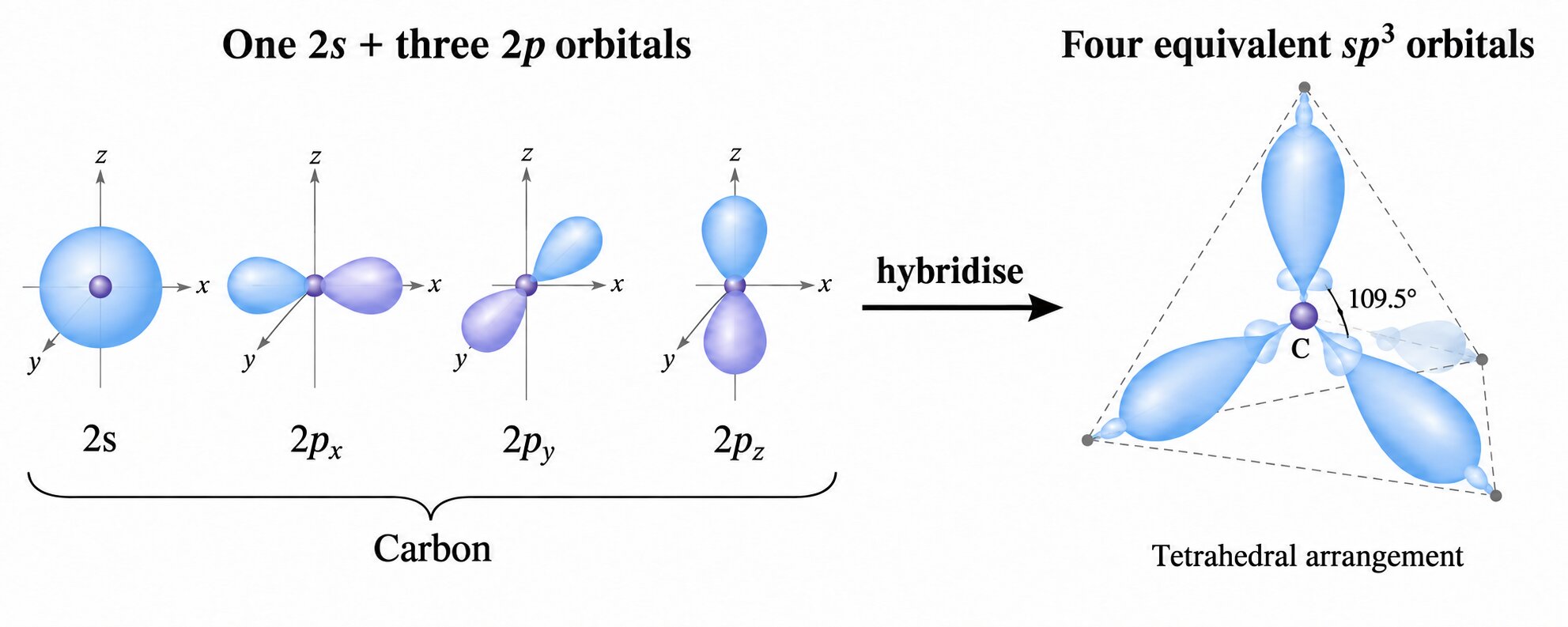
Mixing one 2s and three 2p orbitals gives four sp3 hybrid orbitals pointing to the corners of a tetrahedron.
Hybridisation of Carbon: sp³, sp² and sp Orbitals
Drag to rotate, scroll or pinch to zoom. Switch between the three states to see how mixing the 2s and 2p orbitals changes the shape around the carbon nucleus, and which 2p orbitals are left unhybridised.
sp³ hybridisation
© Dr. Mohammed Al-Fatah – onlinelearningsystem.net
Key idea: The number of hybrid orbitals equals the number of atomic orbitals mixed. Four orbitals mixed gives four sp3 orbitals, so the carbon makes four σ bonds.
Quick Check: Name the Hybridisation
Five quick questions on carbon atoms in molecules the page does not use.
The Tetrahedral Carbon of Alkanes
Each sp3 orbital overlaps head-on with an orbital on another atom to form a σ bond: with a 1s orbital of hydrogen for a C-H bond, or with an sp3 orbital of another carbon for a C-C bond. Because the electron density of a σ bond lies along the line between the nuclei, the two ends can rotate freely about the bond.
The four σ bonds repel each other equally and point to the corners of a tetrahedron, so every carbon atom in an alkane is tetrahedral with bond angles of 109.5°. In propane, for example, both the end carbons and the middle carbon are tetrahedral, which is why the carbon chain zig-zags rather than lying in a straight line.
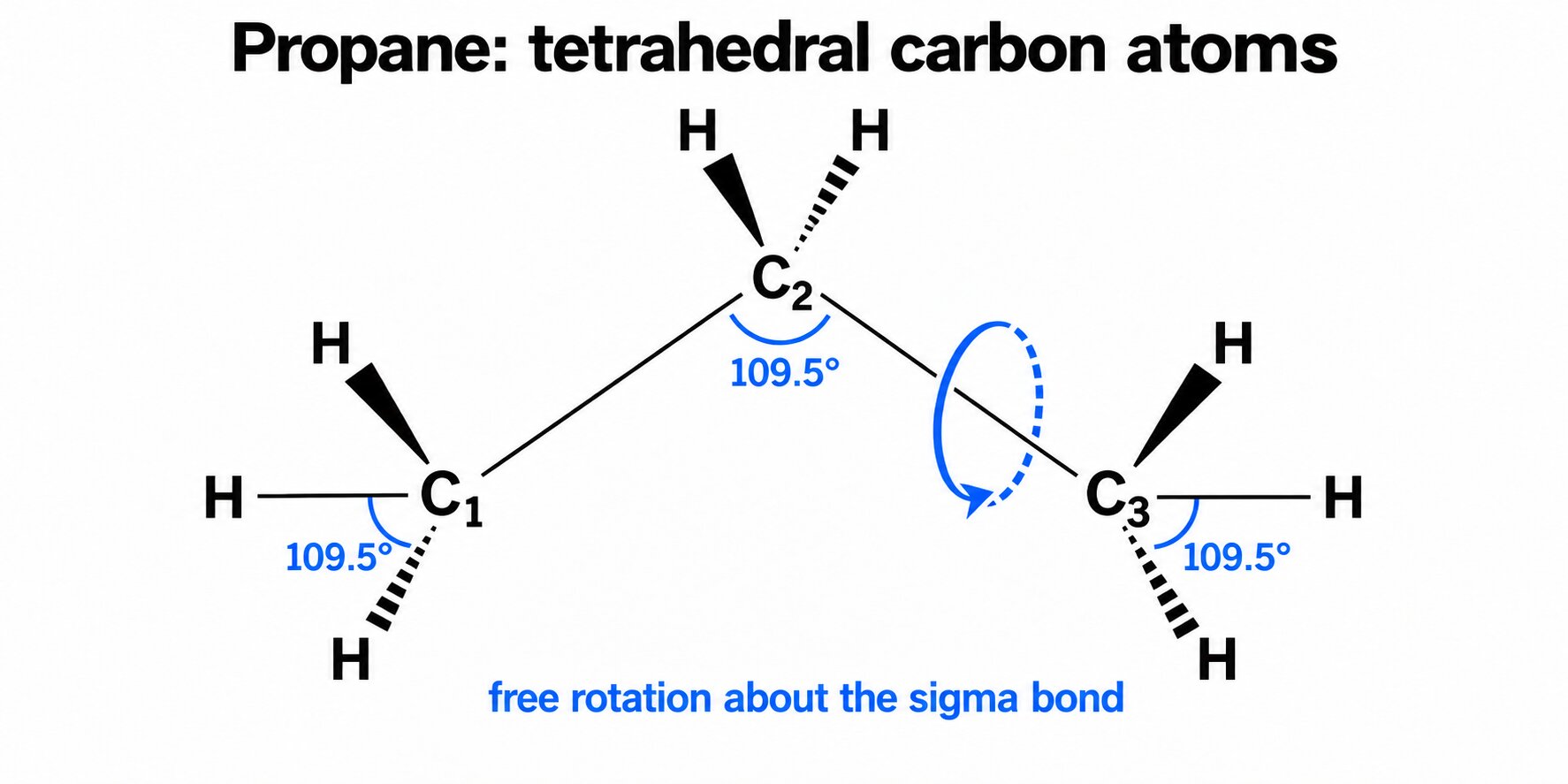
Every carbon in propane is sp3 hybridised and tetrahedral, and the C-C σ bonds allow free rotation.
Exam sentence: In an alkane each carbon atom is sp3 hybridised; its four sp3 orbitals form four σ bonds arranged tetrahedrally with bond angles of 109.5°, and there is free rotation about each C-C σ bond.
Quick Check: Counting Sigma Bonds
Type a number in each gap; count carbon to carbon and carbon to hydrogen bonds separately.
Quick Check: Two Drawings of Butane
Decide whether the two drawings show one compound or two, and why.
Straight-Chain, Branched and Cyclic Molecules
Cambridge 13.3.1 asks you to describe organic molecules as straight-chained, branched or cyclic. All three are built from sp3 carbons in alkanes; the difference is how the tetrahedral carbons are joined.
| Description | Meaning | Example | General formula (alkanes) |
|---|---|---|---|
| Straight-chain | Every carbon is bonded to at most two other carbons, forming one continuous chain | Hexane | CnH2n+2 |
| Branched | At least one carbon is bonded to three or four other carbons, so side chains come off the main chain | 2-Methylpentane, 2,2-dimethylbutane | CnH2n+2 |
| Cyclic | The carbon atoms form a ring | Cyclohexane | CnH2n |
A “straight” chain is not geometrically straight: the tetrahedral angles make it zig-zag. In cyclohexane the ring is not flat either; it puckers into a chair shape so that every carbon keeps its 109.5° angles.
Exam focus: Straight-chain and branched isomers share a molecular formula; the cyclic alkane with the same number of carbons has two fewer hydrogen atoms because two C-H bonds are replaced by the extra C-C bond that closes the ring.
Quick Check: Pick the Accurate Statement
In each round, choose the one statement that is accurate.
Common Exam Mistakes
- Saying carbon has four sp3 orbitals because it “needs four bonds”. Give the mechanism: one 2s and three 2p orbitals mix.
- Describing C-C bonds in alkanes as π bonds. All bonds in an alkane are σ bonds.
- Drawing the carbon chain as a straight line and quoting 180°. The chain zig-zags with 109.5° angles.
- Giving cyclohexane the alkane formula C6H14. The ring formula is C6H12.
Exam sentence: sp3 carbon: four hybrid orbitals, four σ bonds, tetrahedral, 109.5°, free rotation.
Master Introduction to Organic Chemistry and Alkanes for Cambridge International AS & A Level Chemistry
Continue from these free revision notes into the full Topics 13 and 14.1 Introduction to Organic Chemistry and Alkanes course. The guided video lessons are ready now; the Cambridge International MCQ bank, teacher-marked short-answer questions and KASP spec-point report are being written, and the course opens for enrolment as soon as they are complete.
Guided video teaching
Learn the chemistry and exam technique through structured video lessons with worked examples and walkthroughs.
Instant MCQ feedback
Auto-marked MCQ quizzes provide immediate diagnostic feedback for every answer choice.
Teacher-marked SAQs
Submit written exam responses and receive chemistry specialist feedback with improvement guidance.
Progress tracking
Identify strengths and weaknesses across the full Topics 13 and 14.1 specification with targeted reporting.
See how the course works
Click play to start the course preview animation.
Some ionic radii are shown.
| Ion | Ionic radius / nm |
|---|---|
| Na+ | 0.102 |
| K+ | 0.138 |
| F− | 0.133 |
| Cl− | 0.180 |
Which compound has the strongest ionic bonding?
Explain why the metallic bonding in magnesium is much stronger than that in sodium.
Free Radical Substitution FAQs
These questions summarise the core exam points on alkane substitution and free radicals.
Why are alkanes usually unreactive?
Alkanes are usually unreactive because they contain strong C-C and C-H bonds. These bonds require a large amount of energy to break.
What condition is needed for alkanes to react with chlorine?
Ultraviolet light is needed. UV light provides enough energy to break the Cl-Cl bond by homolytic fission, forming chlorine radicals.
What is a free radical?
A free radical is a species with an unpaired electron. The unpaired electron is usually represented using a dot, such as Cl•.
Why is the reaction called substitution?
It is called substitution because a hydrogen atom in the alkane is replaced by a halogen atom.
Why can a mixture of products form?
After the first substitution, the haloalkane product can undergo further substitution. This can replace more hydrogen atoms and produce a mixture of chlorinated products.
Copyright notice: This OLS revision content, including the explanations, layout, diagrams, tables and embedded learning structure, is authored for Online Learning System by Dr. Mohammed Al-Fatah. It may not be copied, reproduced, redistributed or adapted without written permission.
Keep this note — free
Save your progress across every Cambridge topic. A free account remembers which topics you have covered, saves your question scores, and syncs across your phone and laptop.
- Track every topic you have finished
- Keep your practice-question scores
- No payment, no card, free forever
Already registered? Log in