Polymer Waste
A concise revision guide to methods of disposing of waste polymers, including incineration, recycling, biodegradable polymers and cracking waste plastics back into useful chemical feedstock.
GCSE Recap: Polymers, Burning and Neutralising
Three quick questions on GCSE ideas that this page builds on.
What Cambridge Expects
The Cambridge AS syllabus asks you to recognise the difficulty of the disposal of poly(alkene)s, covering two ideas: their non-biodegradability and the harmful combustion products formed when they are burned. At A Level, Topic 35 adds degradable polymers and the hydrolysis of polyesters and polyamides.
Key idea: Poly(alkene)s are chemically inert because they are saturated, like alkanes, so they are not broken down by micro-organisms, and burning halogenated polymers such as PVC releases toxic hydrogen chloride.
Why Polymer Waste Is a Problem
Many polymers are useful because they are chemically stable, lightweight and durable. The same properties also mean that waste polymers can persist in the environment for long periods of time.
Most polymers are manufactured from compounds originally obtained from crude oil. This makes polymer waste an issue linked to both pollution and the use of a finite raw material.
The main strategies for dealing with waste polymers are incineration, recycling, using biodegradable or compostable polymers, and cracking long polymer chains into smaller molecules.
Key idea: Polymer disposal questions usually ask you to balance the advantage of reducing waste against disadvantages such as toxic gases, greenhouse gas emissions, sorting costs and limited recyclability.
Incineration
When waste polymers are incinerated, the energy released during combustion can be used to generate electricity.
A major advantage of incineration is that the volume of waste is greatly reduced. This reduces pressure on landfill sites.
However, incineration can release toxic substances. Burning halogenated plastics such as PVC may produce toxic, acidic gases including hydrogen chloride, HCl.
Modern incinerators are fitted with pollution-control systems. Hot waste gases can be passed through scrubbers, where acidic pollutants are reacted with a base or a carbonate before release into the atmosphere.
CaO + 2HCl → CaCl2 + H2O
In this example, calcium oxide neutralises hydrogen chloride, converting it into a salt and water. Despite pollution-control systems, greenhouse gases such as carbon dioxide may still be emitted during incineration.
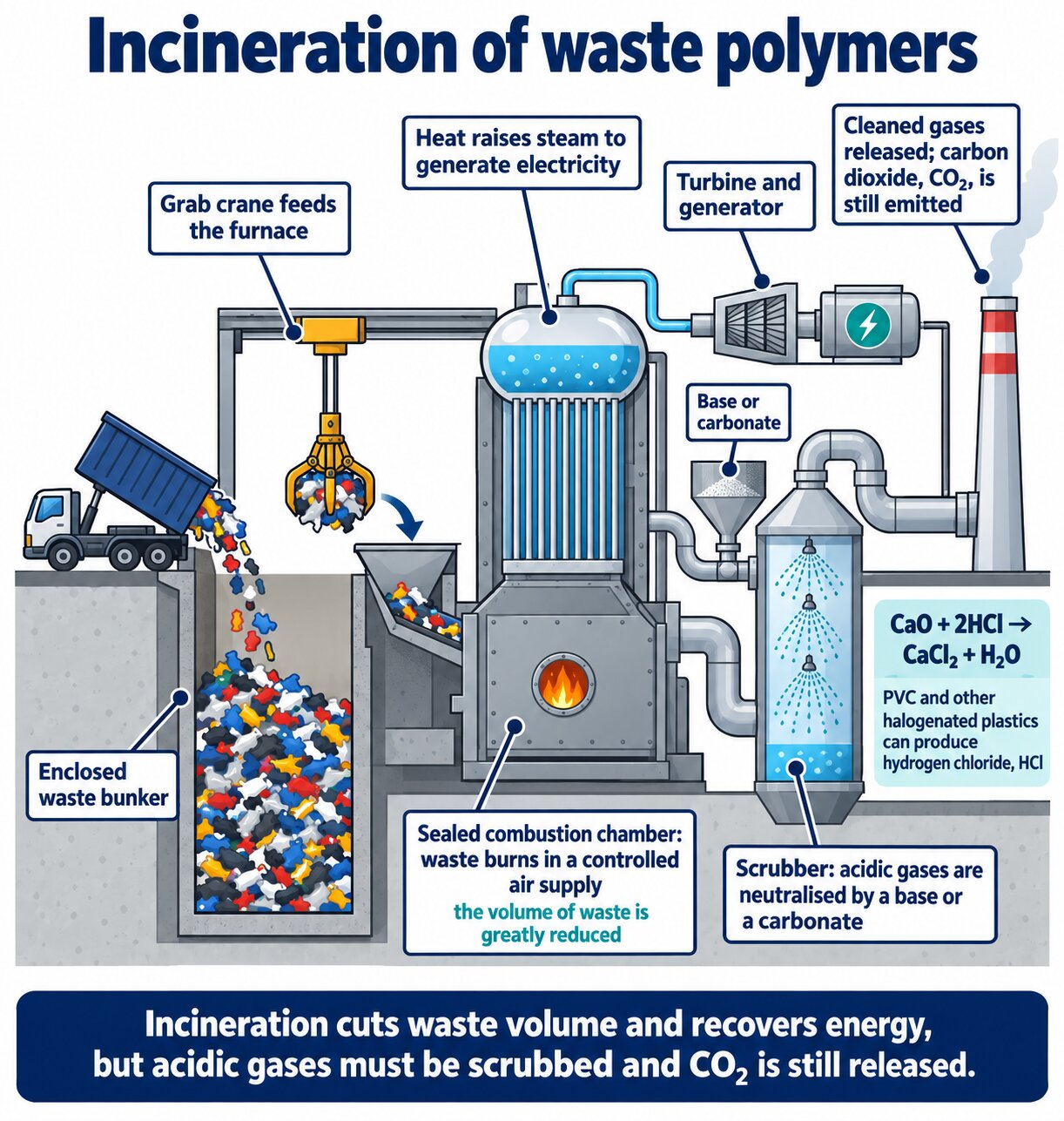
Incineration can reduce waste volume and recover energy, but acidic gases and greenhouse gas emissions must be controlled.
Quick Check: Scrubber Chemistry
Balance two new scrubber equations, then work out the mass of calcium oxide needed.
Recycling and Biodegradable Polymers
Recycling helps to conserve raw materials because many polymers are made from crude oil, a finite and valuable resource.
However, polymers must be collected and carefully sorted before recycling. This makes the process both energy-intensive and labour-intensive.
Plastics can usually only be recycled into the same type of polymer, so accurate separation is essential to maintain material quality.
Only thermoplastic polymers are suitable for recycling by melting because they can be heated, reshaped and reformed without undergoing chemical change.
Chemists have also developed biodegradable and compostable polymers, which are designed to break down more easily in the environment. Many biodegradable polymers are produced from renewable biological sources, such as maize and starch.
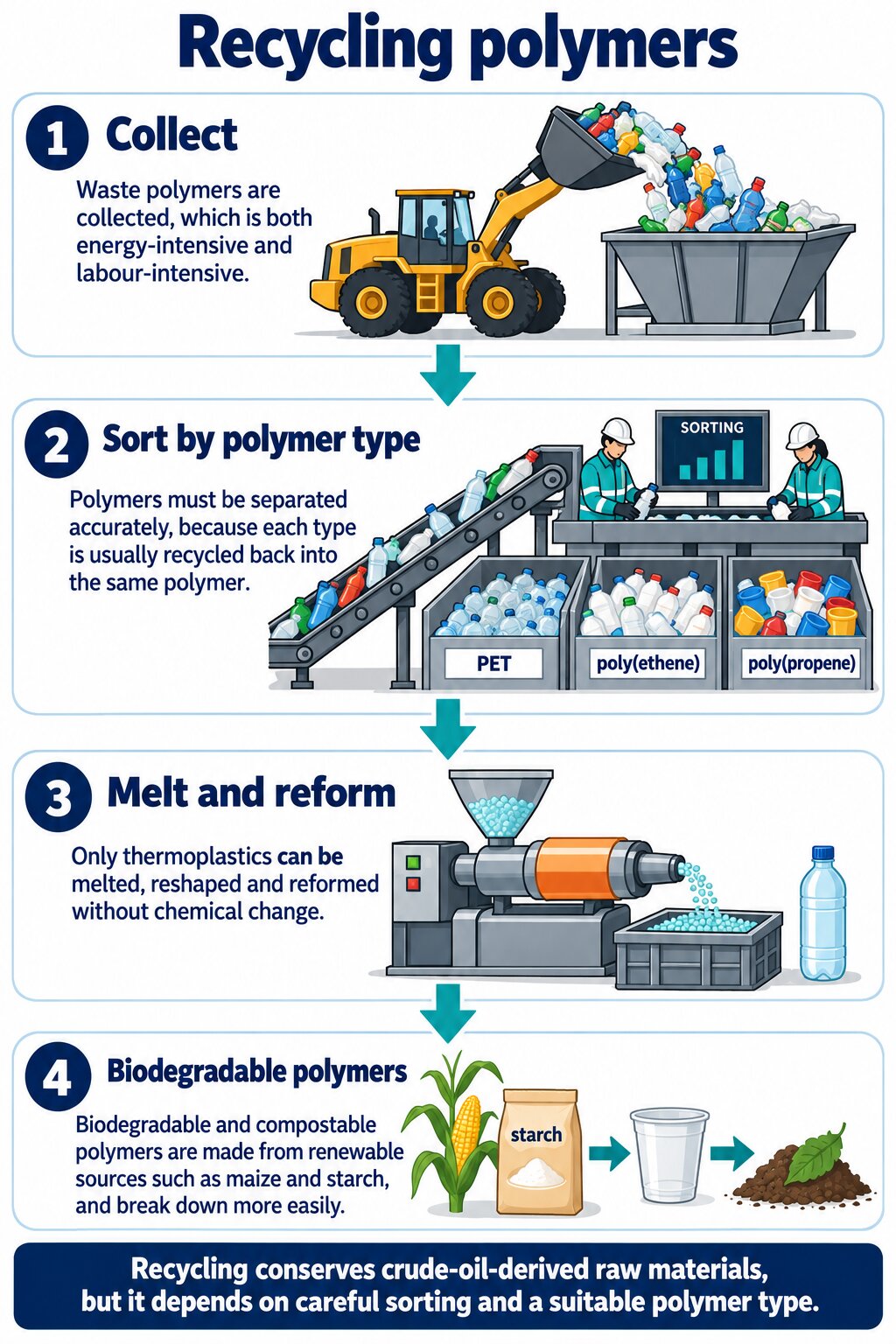
Recycling conserves crude-oil-derived resources, but effective recycling depends on careful sorting and suitable polymer type.
Quick Check: What Must Be Sorted Out?
Decide which item cannot go into the melt at a recycling plant.
Cracking Waste Polymers
Waste polymers can be broken down by cracking into smaller hydrocarbon molecules.
These smaller molecules can then be reused as feedstock to manufacture new chemicals and polymers.
By converting long polymer chains back into useful small molecules, cracking helps to recover value from plastic waste and reduce reliance on fresh supplies derived from crude oil.
Exam focus: Cracking is useful because it turns large, less useful polymer chains into smaller molecules that can be used again in the chemical industry.
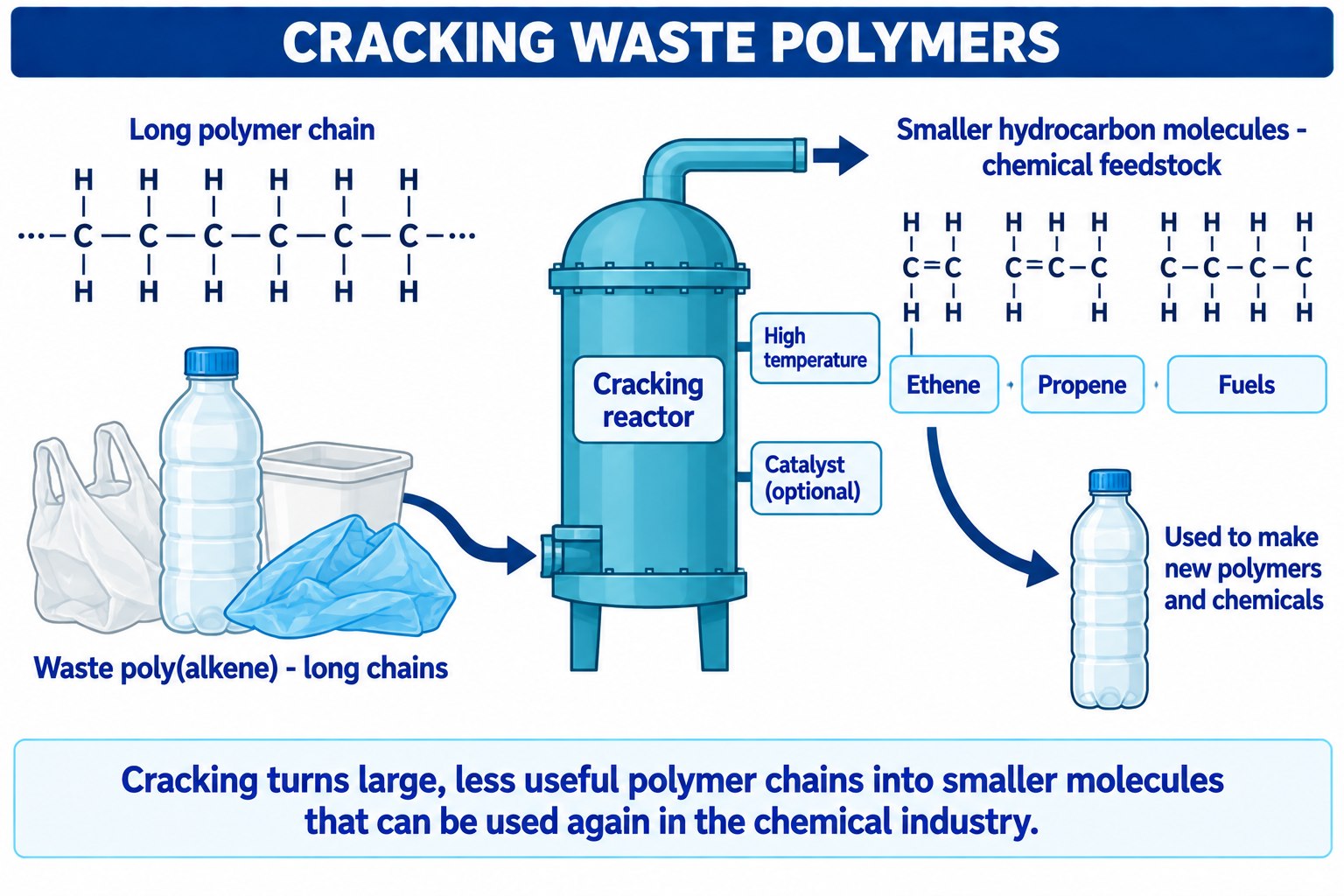
Industrial cracking of waste polymers into smaller hydrocarbon feedstock.
Cracking converts long polymer chains into smaller hydrocarbons that can be reused as chemical feedstock.
Quick Check: Order the Feedstock Route
Put the stages of feedstock recycling into the correct order.
Comparing Polymer Waste Disposal Methods
Exam questions often ask for advantages and disadvantages of different polymer waste disposal methods. The strongest answers are comparative and include both the chemical process and the environmental consequence.
| Method | Main advantage | Main disadvantage | Exam detail |
|---|---|---|---|
| Incineration | Generates energy and greatly reduces waste volume. | Can release toxic gases and greenhouse gases. | Acidic HCl from halogenated polymers can be neutralised in scrubbers. |
| Recycling | Conserves crude-oil-derived raw materials. | Requires collection, sorting and energy input. | Thermoplastics can be melted and reshaped without chemical change. |
| Biodegradable polymers | Can reduce long-term plastic pollution under suitable conditions. | May still need correct disposal conditions to decompose effectively. | Often made from renewable biological sources such as maize and starch. |
| Cracking | Produces smaller hydrocarbons that can be reused as feedstock. | Requires industrial processing and energy input. | Useful because it recovers chemical value from waste polymer chains. |
Do not just say “burn it”
Use the word incineration and link it to energy release, waste-volume reduction and possible toxic gases.
Sorting matters
Recycling depends on separating polymer types because plastics are usually recycled into the same type of polymer.
Use chemical examples
For incineration of PVC, mention acidic HCl gas and its neutralisation by a base such as CaO.
Quick Check: Evaluate the Method
In each round, pick the one evaluation that is chemically accurate.
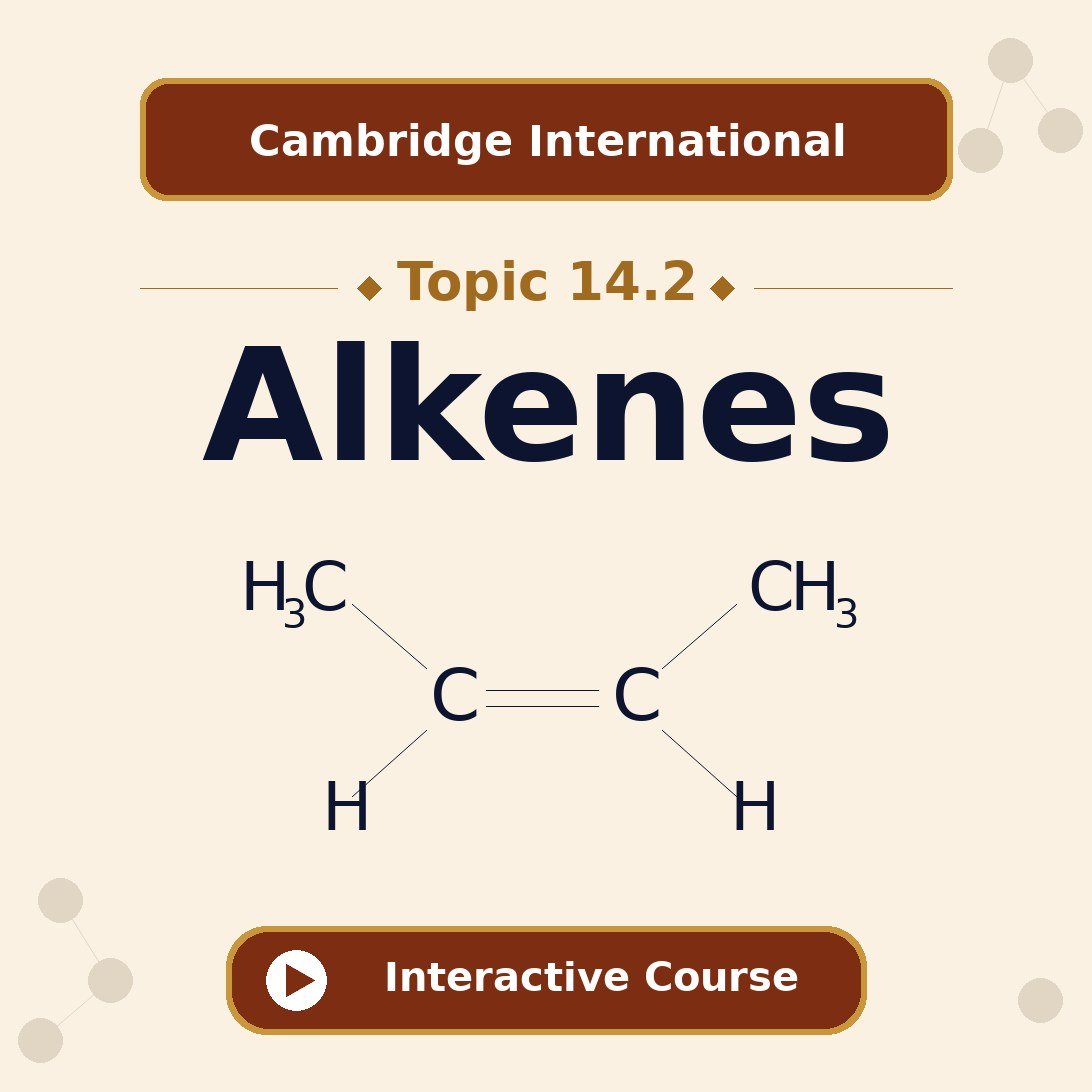
Master Alkenes for Cambridge International AS & A Level Chemistry
Continue from these free revision notes into the full Topic 14.2 Alkenes course. The guided video lessons are ready now; the Cambridge International MCQ bank, teacher-marked short-answer questions and KASP spec-point report are being written, and the course opens for enrolment as soon as they are complete.
Guided video teaching
Learn the chemistry and exam technique through structured video lessons with worked examples and walkthroughs.
Instant MCQ feedback
Auto-marked MCQ quizzes provide immediate diagnostic feedback for every answer choice.
Teacher-marked SAQs
Submit written exam responses and receive chemistry specialist feedback with improvement guidance.
Progress tracking
Identify strengths and weaknesses across the full Topic 14.2 specification with targeted reporting.
See how the course works
Click play to start the course preview animation.
Some ionic radii are shown.
| Ion | Ionic radius / nm |
|---|---|
| Na+ | 0.102 |
| K+ | 0.138 |
| F− | 0.133 |
| Cl− | 0.180 |
Which compound has the strongest ionic bonding?
Explain why the metallic bonding in magnesium is much stronger than that in sodium.
Copyright notice: This OLS revision content, including the explanations, layout, diagrams, tables and embedded learning structure, is authored for Online Learning System by Dr. Mohammed Al-Fatah. It may not be copied, reproduced, redistributed or adapted without written permission.
Keep this note — free
Save your progress across every Cambridge topic. A free account remembers which topics you have covered, saves your question scores, and syncs across your phone and laptop.
- Track every topic you have finished
- Keep your practice-question scores
- No payment, no card, free forever
Already registered? Log in