Heterogeneous and Homogeneous Catalysis
A concise revision guide to the two kinds of catalyst: a solid heterogeneous catalyst providing a surface for a gas-phase reaction (adsorption, bond weakening, reaction and desorption, as in the Haber process and the catalytic converter) and a homogeneous catalyst used in one step and regenerated in a later one, with the Fe²⁺/Fe³⁺ and NO₂ examples.
- 26.2.1
- 26.2.2-a
- 26.2.2-b
- 26.2.2-c
- 26.2.2(a)
- 26.2.2(b)
- 26.2.3
- 26.2.3(a)
- 26.2.3(b)
What these spec points say
- 26.2.1 explain that catalysts can be homogeneous or heterogeneous
- 26.2.2-a describe the mode of action of a heterogeneous catalyst to include adsorption of reactants
- 26.2.2-b describe the mode of action of a heterogeneous catalyst to include bond weakening
- 26.2.2-c describe the mode of action of a heterogeneous catalyst to include desorption of products
- 26.2.2(a) describe the mode of action of a heterogeneous catalyst, for example iron in the Haber process
- 26.2.2(b) describe the mode of action of a heterogeneous catalyst, for example palladium, platinum and rhodium in the catalytic removal of oxides of nitrogen from the exhaust gases of car engines
- 26.2.3 describe the mode of action of a homogeneous catalyst by being used in one step and reformed in a later step
- 26.2.3(a) describe the mode of action of a homogeneous catalyst, for example atmospheric oxides of nitrogen in the oxidation of atmospheric sulfur dioxide
- 26.2.3(b) describe the mode of action of a homogeneous catalyst, for example Fe2+ or Fe3+ in the I–/S2O82– reaction
Two Kinds of Catalyst
A catalyst increases the rate of a reaction by providing an alternative route with a lower activation energy. It is chemically unchanged at the end because it is regenerated.
With a lower Eₐ a larger fraction of collisions have enough energy to react, so the rate constant is larger at the same temperature. Catalysts are sorted by their phase relative to the reactants.
| Type | Phase | Examples | How it works |
|---|---|---|---|
| Homogeneous catalyst | It is in the same phase as the reactants. | An acid catalysing a reaction in aqueous solution, or a gas catalysing a reaction between gases. | It works by reacting with a reactant to form an intermediate, which then breaks down to give the product and release the catalyst. |
| Heterogeneous catalyst | It is in a different phase from the reactants. | Almost always a solid catalysing a reaction between gases or in solution. | It works by providing a surface on which the reaction takes place. |
Definition: Homogeneous catalyst: in the same phase as the reactants. Heterogeneous catalyst: in a different phase from the reactants, usually a solid with gaseous or dissolved reactants.
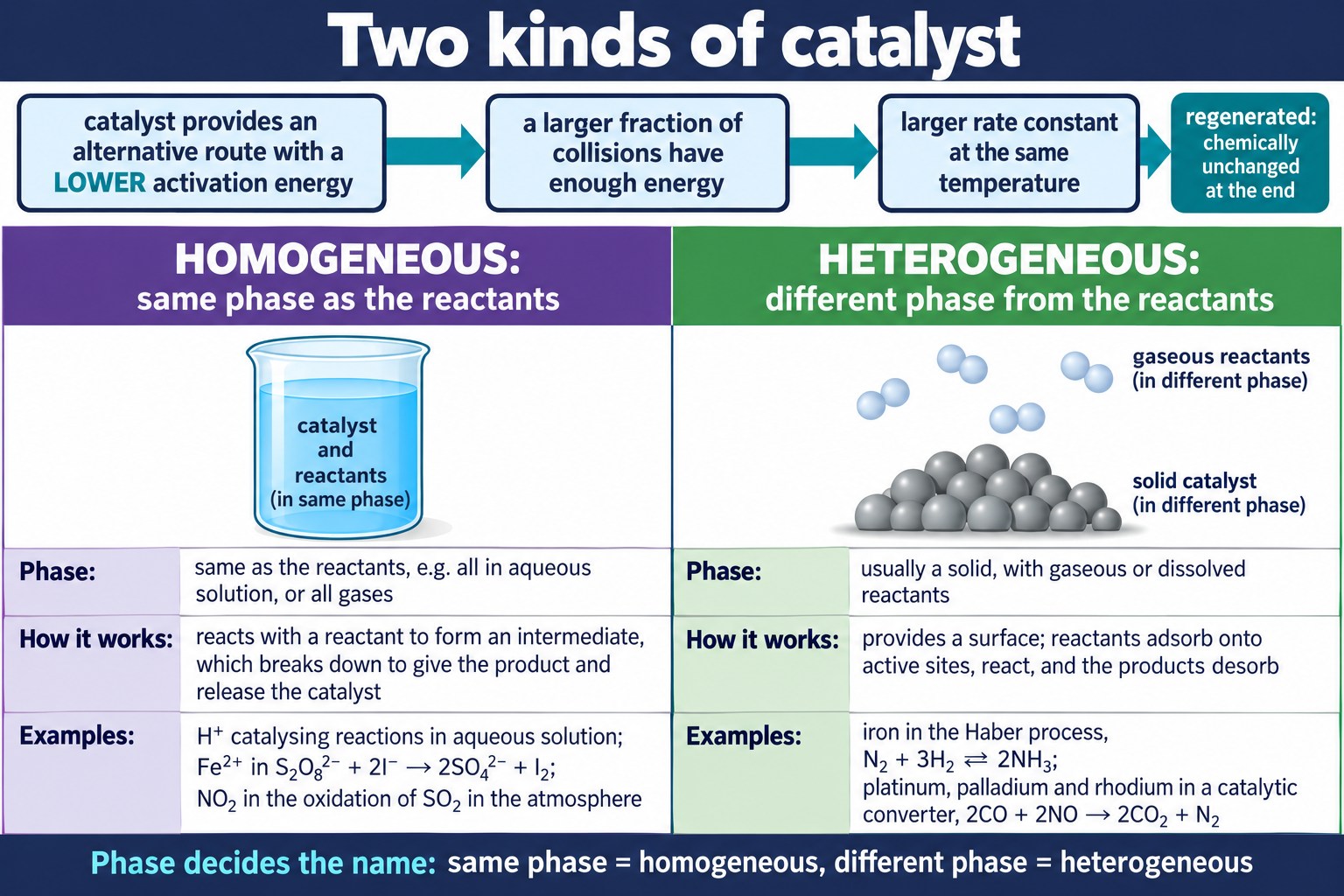
A homogeneous catalyst is in the same phase as the reactants and a heterogeneous catalyst is in a different phase, but both provide a route with a lower activation energy and are regenerated.
How a Solid Catalyst Works
The reaction takes place on the surface of the solid, at particular positions called active sites. Four things happen in turn:
- Adsorption: reactant molecules from the gas phase form weak bonds to the atoms of the surface. This holds them close together in a favourable orientation, and it concentrates them at the surface.
- Bond weakening: the bonds within the adsorbed molecules are stretched and weakened, and can break, because the electrons in them are partly shared with the surface. The activation energy for reaction is lower than in the gas phase.
- Reaction: the adsorbed atoms or fragments move across the surface and form new bonds with each other.
- Desorption: the product molecule breaks away from the surface, freeing the active site for the next reactants.
The classic example is iron in the Haber process. Nitrogen and hydrogen adsorb on the iron, the strong N≡N and H–H bonds are weakened and broken, hydrogen atoms add to nitrogen atoms one at a time, and the ammonia formed desorbs.
In a car’s catalytic converter, a thin layer of platinum, palladium and rhodium on a ceramic honeycomb catalyses the reaction between the two main pollutants, 2CO + 2NO → 2CO₂ + N₂, so that harmful carbon monoxide and nitrogen monoxide leave as carbon dioxide and nitrogen.
The honeycomb gives a very large surface area for a small mass of expensive metal.
The strength of adsorption has to be right. If the bonds to the surface are too strong, as with tungsten, the products cannot desorb and the active sites are blocked.
If they are too weak, as with silver, the reactants do not stay long enough for their bonds to be weakened. Nickel, platinum and the other metals in the middle of the d block adsorb strongly enough to activate reactants but weakly enough to release products.
A catalyst is poisoned when an impurity such as sulfur or lead adsorbs so strongly that it blocks the active sites permanently.
This is why leaded petrol destroys catalytic converters and why the feed gases for the Haber process are cleaned of sulfur compounds first.
Heterogeneous Catalysis on an Iron Surface
Follow nitrogen and hydrogen through the Haber process on iron: adsorption, bond breaking, reaction on the surface and desorption of ammonia.
© Dr. Mohammed Al-Fatah – onlinelearningsystem.net
Exam wording: “Reactants adsorb onto active sites on the surface; bonds in the reactants are weakened, lowering the activation energy; the atoms react on the surface; the products desorb.”
Check: Reaction at a Surface
Put the steps at a catalyst surface in order and explain them for reactions not used on this page.
How a Homogeneous Catalyst Works
A homogeneous catalyst takes part in the mechanism: it is used up in one step and regenerated in a later step.
Because it comes out unchanged, it does not appear in the overall equation, and a small amount can catalyse a large amount of reaction.
The route through the catalyst has a lower activation energy than the direct route. Its reaction profile shows two smaller humps with the intermediate in the dip between them.
Fe²⁺ and the peroxodisulfate–iodide reaction. Peroxodisulfate ions oxidise iodide ions: S₂O₈²⁻ + 2I⁻ → 2SO₄²⁻ + I₂.
The uncatalysed reaction is slow because it needs a collision between two negative ions, which repel each other, so the activation energy is high.
Adding Fe²⁺ replaces it with two fast steps, each between a positive ion and a negative ion:
stage 1: S₂O₈²⁻ + 2Fe²⁺ → 2SO₄²⁻ + 2Fe³⁺
stage 2: 2Fe³⁺ + 2I⁻ → 2Fe²⁺ + I₂
The Fe²⁺ used in stage 1 is re-formed in stage 2. Adding the stages cancels the iron ions and gives the overall equation.
Fe³⁺ works just as well, because the stages simply run in the other order: Fe³⁺ oxidises iodide first, and the Fe²⁺ formed is then re-oxidised by peroxodisulfate.
This is why transition-metal ions with two accessible oxidation states make good homogeneous catalysts.
Oxides of nitrogen and sulfur dioxide. In the atmosphere, sulfur dioxide from burning fossil fuels is oxidised only slowly by oxygen, but nitrogen dioxide from car engines catalyses it in two steps:
step 1: SO₂ + NO₂ → SO₃ + NO
step 2: NO + ½O₂ → NO₂
The NO₂ consumed in the first step is regenerated in the second, and the sum is the overall reaction SO₂ + ½O₂ → SO₃.
The sulfur trioxide dissolves in water droplets to give sulfuric acid, so a little NO₂ produces a great deal of acid rain: it is a catalyst, not a reactant.
Exam focus: for each example you should be able to write the two steps, show that they add up to the overall equation, and say which species is the catalyst and why: it is used in the first step and re-formed in the second.
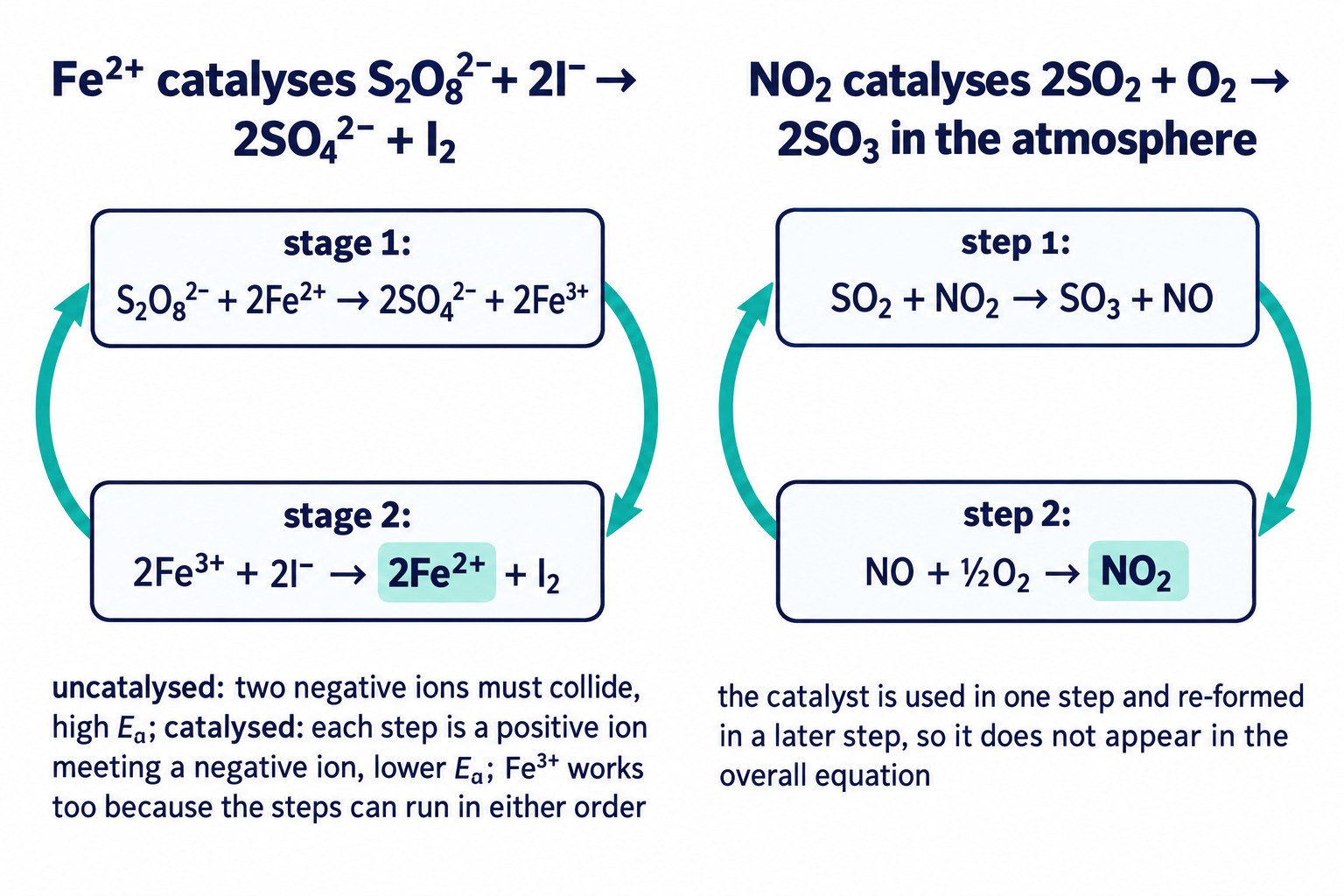
Two homogeneous catalytic cycles: Fe²⁺/Fe³⁺ in the peroxodisulfate–iodide reaction and NO₂/NO in the oxidation of sulfur dioxide, the catalyst regenerated in each.
Key idea: Homogeneous catalyst: used in one step, regenerated in a later step, so it is absent from the overall equation. Look for the species that is a reactant in one step and a product in another.
Check: Catalytic Cycles
Identify the catalyst and the intermediate in two-step mechanisms not shown on this page, and explain why the catalysed route is faster.
Common Exam Points
Say
“A heterogeneous catalyst is in a different phase from the reactants and provides a surface: adsorption, bond weakening, reaction, desorption.” “A homogeneous catalyst is used in one step and regenerated in a later step.” “The catalyst provides an alternative route with a lower activation energy.”
Do not say
“The catalyst lowers the activation energy of the reaction” (it provides a different route with a lower Eₐ). “Absorbed” for adsorbed. “The catalyst is used up.”
Watch for
Being asked why the uncatalysed peroxodisulfate–iodide reaction is slow (two negative ions must collide) or why Fe³⁺ also catalyses it (the two stages run in the other order). Being asked to add two steps and show that the catalyst cancels.
FAQs
Use these quick answers to check the catalysis ideas.
What is the difference between adsorption and absorption?
Adsorption is bonding to a surface: the reactant molecules attach to the outside of the solid catalyst. Absorption would mean being taken into the bulk of the solid. Heterogeneous catalysis is a surface process, so the word is adsorption.
Why does adsorption speed up the reaction?
Bonding to the surface weakens the bonds within the adsorbed molecules, holds them close together in a favourable orientation, and so lowers the activation energy of the reaction. The products are then desorbed, freeing the surface.
Why is a catalyst that adsorbs too strongly no good?
If the products stay bound to the surface they block the active sites and nothing else can be adsorbed, so the catalyst is poisoned. Too weak an adsorption is also useless, because the reactants do not stay on the surface long enough to react.
How can a homogeneous catalyst appear in the mechanism but not in the overall equation?
It is used up in one step and regenerated in a later one, so it cancels when the steps are added. The catalysed route usually has two steps with a lower activation energy each, in place of one slow uncatalysed step.
Why can Fe²⁺ or Fe³⁺ catalyse the reaction between I⁻ and S₂O₈²⁻?
The uncatalysed reaction is between two negative ions, which repel each other, so the activation energy is high. Fe³⁺ oxidises I⁻ to I₂ and is reduced to Fe²⁺, which then reduces S₂O₈²⁻ and is turned back into Fe³⁺; each step is between oppositely charged ions and is fast.
Copyright and author footprint: This OLS revision page was written for Online Learning System by Dr. Mohammed Al-Fatah. It is designed for A Level Chemistry revision and should not be copied or redistributed without permission.
Keep this note — free
Save your progress across every Cambridge topic. A free account remembers which topics you have covered, saves your question scores, and syncs across your phone and laptop.
- Track every topic you have finished
- Keep your practice-question scores
- No payment, no card, free forever
Already registered? Log in