Boiling Point Trends
A concise revision guide to boiling point trends explained by intermolecular forces: alkanes with chain length and branching, alcohols compared with alkanes, and the hydrogen halides HF to HI, for Cambridge International A Level Chemistry.
GCSE Recap: Size, State and Crude Oil
Before you start, check what you already know about molecule size and the temperature at which a substance boils.
How Intermolecular Forces Set the Boiling point
A substance boils when its molecules gain enough energy to overcome the intermolecular forces between them, so the stronger the forces, the higher the boiling point. Every trend on this page is explained by asking which forces act between the molecules and what changes their strength: the number of electrons, the shape of the molecule, the presence of a permanent dipole and the presence of hydrogen bonds.
Students should always name the force, state what has changed and finish with the energy statement: “more energy is needed to separate the molecules”. A trend described without a force earns nothing.
Exam answer model: Identify the force → say why it is stronger or weaker → “so more (or less) energy is needed to overcome the forces between the molecules” → higher (or lower) boiling point.
Alkanes: Increasing Chain Length
Alkanes are non-polar, so the only force between their molecules is id–id forces. As the chain lengthens, each molecule has more electrons and a larger surface area of contact with its neighbours, so the id–id forces strengthen and the boiling point rises steadily. Methane, ethane, propane and butane are gases at room temperature; pentane to heptadecane are liquids; longer alkanes are waxy solids.
| Alkane | Formula | Electrons | boiling point / °C |
|---|---|---|---|
| Methane | CH₄ | 10 | -162 |
| Ethane | C₂H₆ | 18 | -89 |
| Propane | C₃H₈ | 26 | -42 |
| Butane | C₄H₁₀ | 34 | -1 |
| Pentane | C₅H₁₂ | 42 | 36 |
| Hexane | C₆H₁₄ | 50 | 69 |
| Heptane | C₇H₁₆ | 58 | 98 |
| Octane | C₈H₁₈ | 66 | 126 |
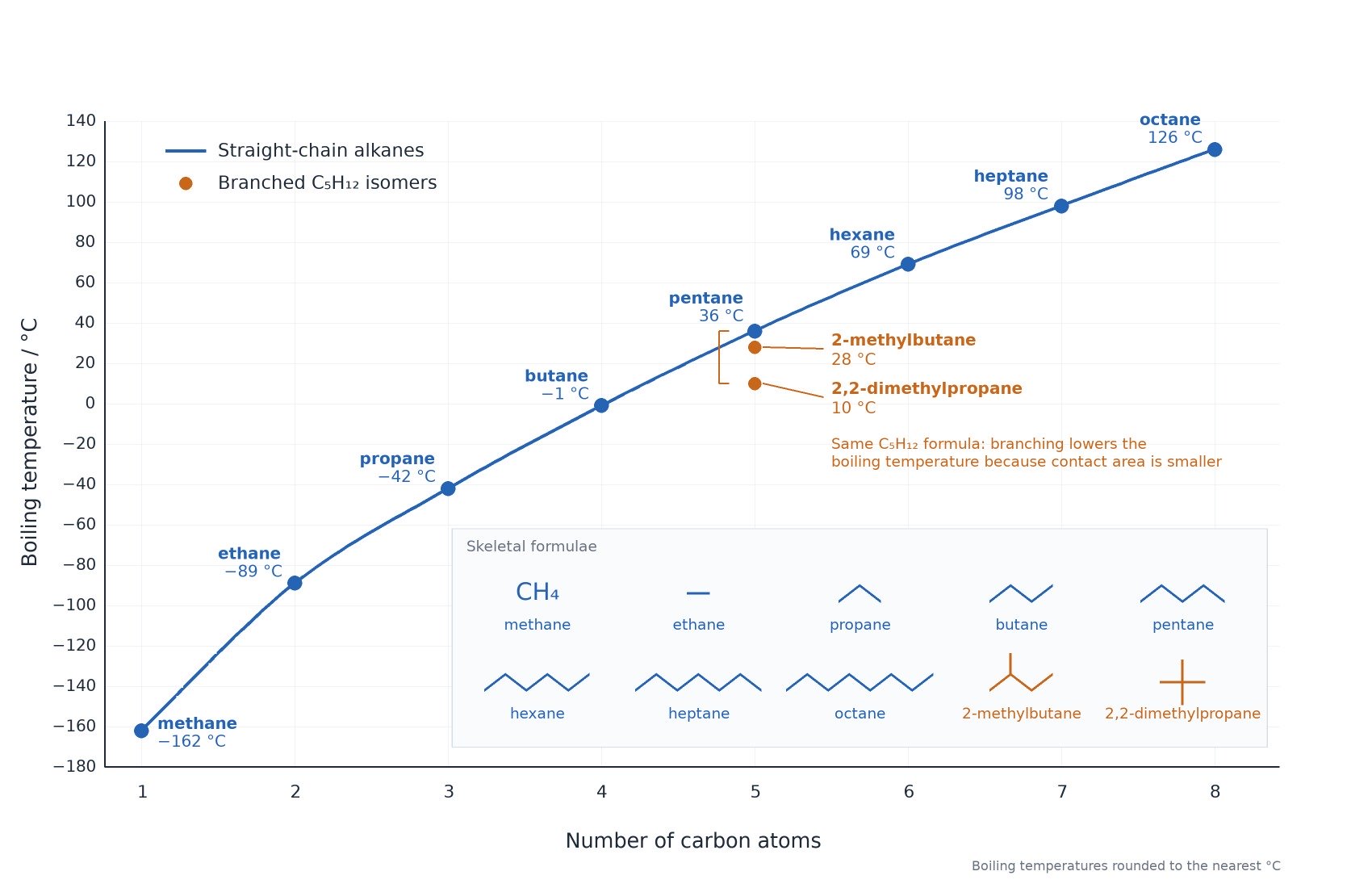
The boiling point of the alkanes rises with chain length because id–id forces strengthen; at a fixed formula, branching lowers it.
The rise is steepest at the start of the series, because adding one CH₂ group to methane increases its electron count by 80%, while adding one to heptane increases it by 14%. This is why the curve flattens as the chain lengthens.
Exam sentence: Hexane has a higher boiling point than butane because hexane molecules have more electrons and a larger surface area of contact, so the id–id forces between the molecules are stronger and more energy is needed to overcome them.
Quick Check: Two Alkanes You Have Not Met
Drag the words and numbers into place to build the comparison.
Alkanes: The Effect of Branching
Isomers have the same number of electrons, so any difference in their boiling points must come from shape. Branched alkanes are more compact and nearly spherical, so neighbouring molecules cannot approach each other as closely or over as large an area, the id–id forces are weaker and the boiling point is lower.
| C₅H₁₂ isomer | Shape | boiling point / °C |
|---|---|---|
| Pentane | straight chain | 36 |
| 2-Methylbutane | one branch | 28 |
| 2,2-Dimethylpropane | four groups on one carbon, almost spherical | 10 |
Straight chains can lie side by side along their whole length, like pencils in a box, giving a large area over which instantaneous dipoles can induce dipoles in the neighbour. A ball-shaped molecule touches its neighbours only at a few points.
Common mistake: Saying branched isomers have “fewer electrons” or “weaker bonds”. They have the same electrons and the same C-C and C-H bonds; only the contact area between molecules differs.
Quick Check: Pick the Accurate Statement
In each round, choose the one statement about the pair of isomers that is accurate.
Alcohols Compared With Alkanes
Alcohols have much higher boiling points, and so a much lower volatility, than alkanes with a similar number of electrons, because the O-H group lets alcohol molecules form hydrogen bonds with each other, which alkanes cannot do. The fair comparison is between molecules of similar size, so that their id–id forces are similar and the difference can be attributed to the hydrogen bonds.
| Compound | Formula | Electrons | Hydrogen bonding? | boiling point / °C |
|---|---|---|---|---|
| Propane | C₃H₈ | 26 | no | -42 |
| Ethanol | C₂H₅OH | 26 | yes | 78 |
| Butane | C₄H₁₀ | 34 | no | -1 |
| Propan-1-ol | C₃H₇OH | 34 | yes | 97 |
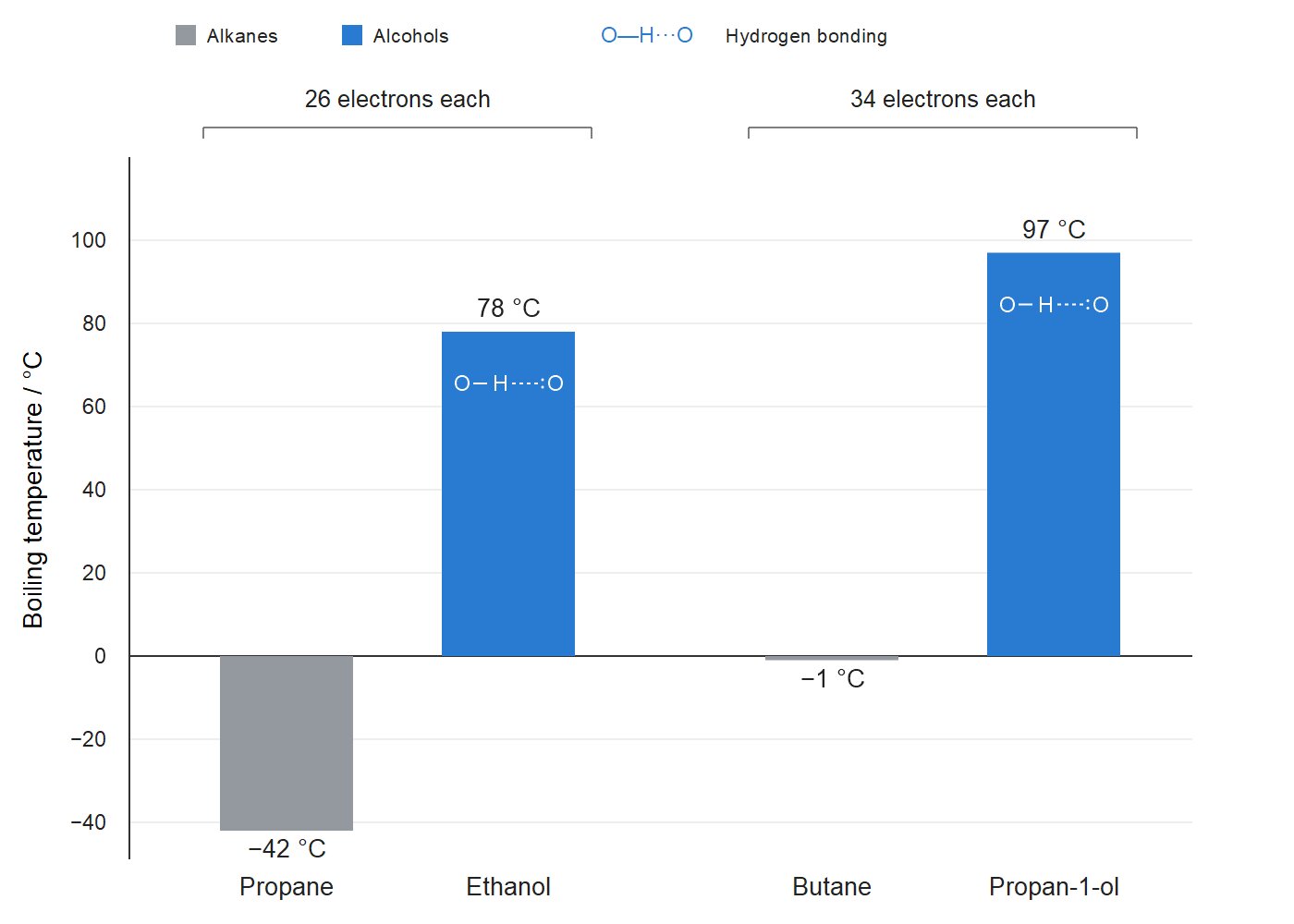
Alcohols boil about 100 °C higher than alkanes with the same number of electrons because hydrogen bonds act between alcohol molecules in addition to id–id forces.
The 120 °C gap between propane and ethanol is larger still than the 103 °C gap that a permanent dipole produced between F₂ and HCl, which is one way to remember that hydrogen bonds are stronger than permanent dipole–permanent dipole (pd–pd) forces. Alcohols also have permanent dipole–permanent dipole (pd–pd) forces from the polar C-O and O-H bonds, but these are minor next to the hydrogen bonds, which are several times stronger.
Exam sentence: Ethanol has a higher boiling point than propane because ethanol molecules form hydrogen bonds between the O-H groups, which are stronger than the id–id forces between propane molecules, so more energy is needed to separate ethanol molecules.
Quick Check: Same Electrons, Very Different Liquids
Two molecules with 18 electrons each, and 154 °C between them.
The Hydrogen Halides HF to HI
The boiling points of the hydrogen halides do not fall smoothly down the group. HF is anomalously high because it forms hydrogen bonds; from HCl to HI the boiling point rises because the number of electrons increases and the id–id forces strengthen, even though the permanent dipole becomes smaller.
| Hydrogen halide | Electrons | Electronegativity of halogen | Hydrogen bonding? | boiling point / °C |
|---|---|---|---|---|
| HF | 10 | 4.0 | yes | 20 |
| HCl | 18 | 3.0 | no | -85 |
| HBr | 36 | 2.8 | no | -67 |
| HI | 54 | 2.5 | no | -35 |
The HCl to HI trend is a useful test of understanding, because the dipole and the id–id forces pull in opposite directions. HCl has the largest permanent dipole of the three, yet it has the lowest boiling point, because the extra electrons in HBr and HI produce id–id forces that outweigh the shrinking permanent dipole–permanent dipole (pd–pd) forces. For molecules with a large number of electrons, id–id forces usually dominate.
The Group 14 to 17 hydride graph on the Anomalous Properties of Water page shows the HF anomaly alongside those of water and ammonia; the same drawing serves both pages.
Exam sentence: HF has a much higher boiling point than HCl because HF molecules form hydrogen bonds; HI has a higher boiling point than HCl because HI molecules have more electrons, so the id–id forces between them are stronger.
Quick Check: Explain a Trend That Fights Itself
Write a short explanation, then compare it with the mark points and the model answer.
Putting the Trends Together
When two substances are compared, work through the forces in order of strength and stop at the first difference.
| Question to ask | If the answer differs | Example |
|---|---|---|
| Does one form hydrogen bonds and the other not? | The hydrogen-bonded one boils much higher, provided the two molecules are of similar size | ethanol 78 °C versus propane -42 °C |
| Does one have a permanent dipole and the other not? | The polar one boils higher | HCl -85 °C versus F₂ -188 °C |
| Which has more electrons? | The one with more electrons boils higher | HI -35 °C versus HCl -85 °C |
| Which is less branched? | The straighter molecule boils higher | pentane 36 °C versus 2,2-dimethylpropane 10 °C |
The first question settles the order only when the two molecules are of a similar size. A long non-polar chain has so many more electrons that it can boil above a short hydrogen-bonded molecule, so check the sizes before you trust the hydrogen bonding step.
Worked example. Put propane, pentane and ethanol in order. Ethanol is the only one with an O-H group, so it forms hydrogen bonds and boils highest. Neither propane nor pentane has a permanent dipole, so compare electrons: pentane has 42 and propane 26, so pentane boils above propane. The order is propane (-42 °C), pentane (36 °C), ethanol (78 °C).
Key idea: Hydrogen bonds outweigh dipoles, dipoles outweigh id–id forces for molecules of similar size, and id–id forces grow with electrons and contact area.
Quick Check: Put Six Liquids in Order
Drag the six substances into order, lowest first, using the four questions from this card.
Common Exam Points
Explain the trend in boiling point of the alkanes
More electrons and larger surface contact, stronger id–id forces, more energy to separate molecules.
Explain why 2,2-dimethylpropane boils lower than pentane
Same electrons; more compact shape; smaller area of contact; weaker id–id forces.
Explain why alcohols are less volatile than alkanes
Hydrogen bonds between O-H groups, absent in alkanes, need more energy to overcome.
Explain the order HF > HI > HBr > HCl
HF: hydrogen bonds; HCl to HI: increasing electrons, stronger id–id forces, outweighing the falling dipole.
FAQs
Use these quick answers to check the boiling point comparisons that Cambridge International questions set.
Why does boiling point rise along the alkane series?
Each extra carbon adds electrons and surface area, so the id–id forces between molecules get stronger and more energy is needed to separate them. The rise flattens along the series because each extra CH₂ group is a smaller fraction of the total.
Why do branched alkanes boil lower than straight-chain isomers?
Isomers have the same number of electrons, so the difference is shape. A branched molecule is compact and touches its neighbours over a smaller area, so the id–id forces are weaker: pentane boils at 36 °C and 2,2-dimethylpropane at 10 °C.
Why are alcohols less volatile than alkanes?
The O-H group lets alcohol molecules hydrogen bond with each other, which alkanes cannot do. Ethanol and propane both have 26 electrons, yet ethanol boils 120 °C higher.
Why does HF boil higher than HCl, HBr and HI?
HF molecules form hydrogen bonds, which the other hydrogen halides cannot. From HCl to HI the trend then rises again as the number of electrons increases.
Which factor wins when they disagree?
Hydrogen bonding outweighs a permanent dipole, and a permanent dipole outweighs id–id forces for molecules of similar size. Once the electron count differs a great deal, id–id forces dominate, which is why HI boils higher than HCl.
Copyright and author footprint: This OLS revision page was written for Online Learning System by Dr. Mohammed Al-Fatah. It is designed for A Level Chemistry revision and should not be copied or redistributed without permission.
Keep this note — free
Save your progress across every Cambridge topic. A free account remembers which topics you have covered, saves your question scores, and syncs across your phone and laptop.
- Track every topic you have finished
- Keep your practice-question scores
- No payment, no card, free forever
Already registered? Log in