Concentrations in PPM
A focused revision guide to expressing and calculating concentrations in parts per million (ppm) for Edexcel International A Level Chemistry. This page covers the meaning of ppm, the formulae for solutions and for gases in air, and full worked examples for both contexts.
What Does Parts Per Million (ppm) Mean?
Concentrations of solutions can also be compared using the term parts per million, or ppm. This unit is often used for very low concentrations, such as pollutants in water or trace gases in the atmosphere.
The logic is simple. Think of the word “percent”; the “cent” part refers to 100, so 50% means 50 out of 100. Parts per million means out of a million. So 50 ppm means 50 parts out of 1 000 000 parts.
The “parts” usually refer to mass for solutions, or volume for gases. The parts can be measured in any unit of mass (or volume), but the unit must be the same on the top and the bottom of the fraction.
Definition: ppm tells you how many parts of solute are present in one million parts of the total sample. For very dilute concentrations, ppm is more convenient than mol dm−3.
Useful equivalents: a concentration of 1 ppm means 1 g of solute in 1 000 000 g of solvent, or 1 mg in 1 000 000 mg. Grams and milligrams are the most commonly used units for solutions.
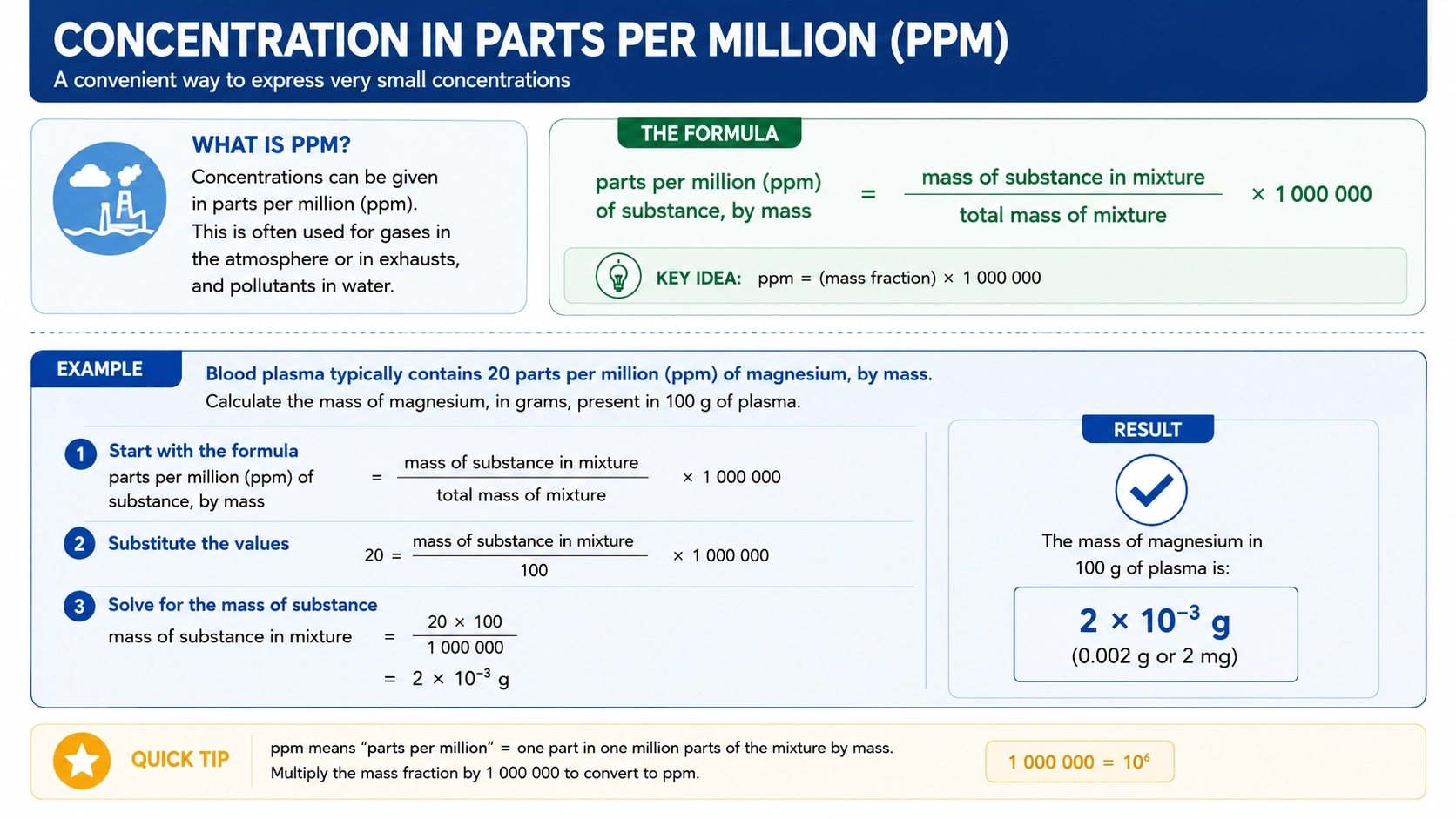
Because the units cancel inside the fraction, ppm is dimensionless; the value itself carries the meaning regardless of whether the masses are in g or mg.
Calculations for Solutions in ppm
For a solute dissolved in a solvent, the ppm formula uses masses:
The masses can be in any units, but they must be the same units on the top and the bottom. If they are given in different units, convert one of them before substituting.
Example A — Solute in solvent
A solution contains 0.176 g of solute dissolved in 750 g of solvent. What is the concentration in ppm?
The units of solute and solvent are already the same (both in grams), so the values can be directly inserted into the expression.
Watch the units: if the question gives the solute in mg and the solvent in g, convert one of them so they match. Either change the solute to g (divide by 1000) or the solvent to mg (multiply by 1000) before substituting.
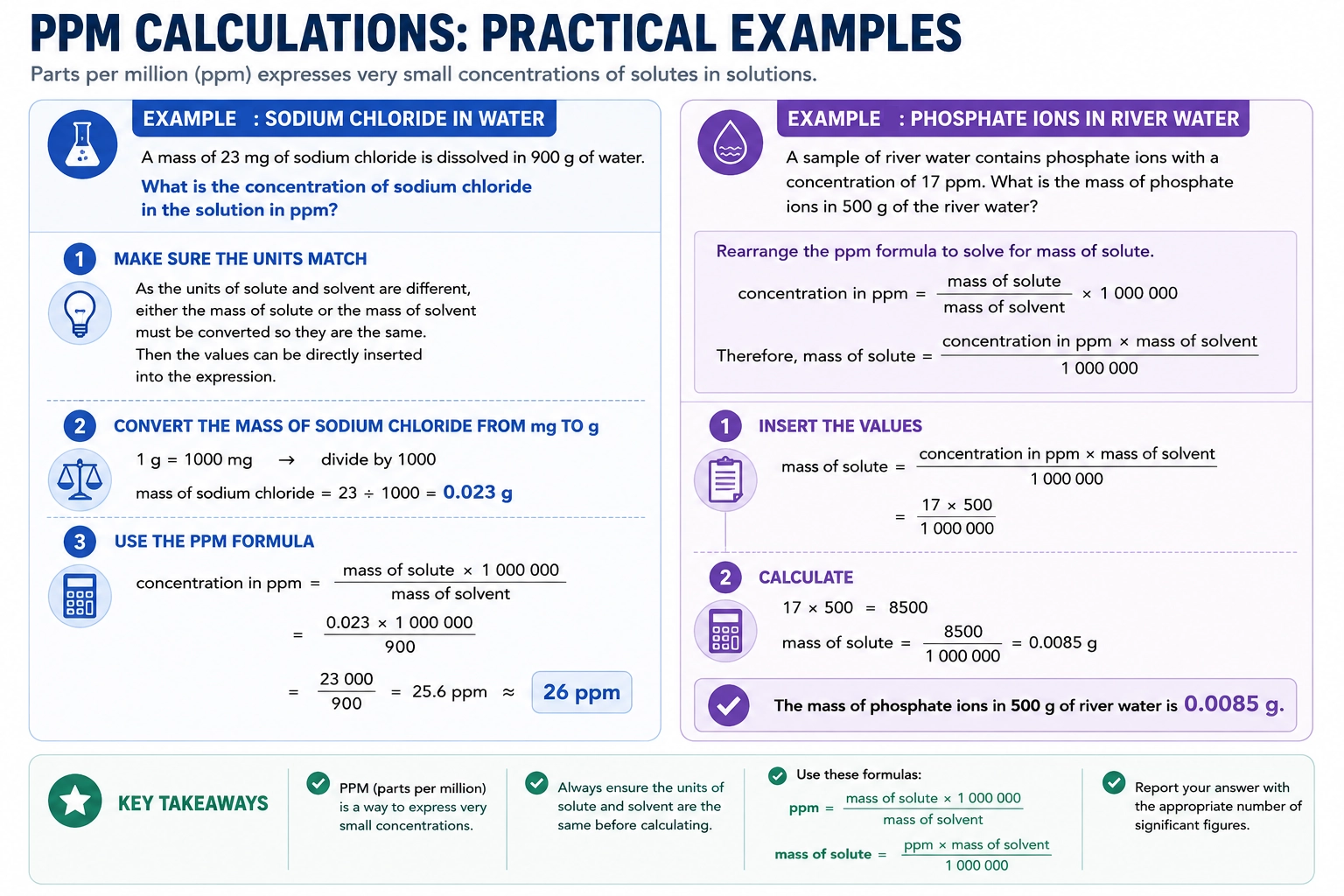
The multiplication by 1 000 000 is what shifts a tiny mass ratio into a value that can be quoted as a whole number, which is why ppm is the standard way to report trace pollutants.
Calculations for Gases in ppm
For gases in air, the ppm formula uses volumes rather than masses, because gas concentrations are most easily measured by volume.
The volumes can be in any unit (dm3, cm3, m3), but they must be the same on the top and the bottom of the fraction.
Example B — Finding the volume of a trace gas
5000 dm3 of air is found to contain ozone with a concentration of 87 ppm. What volume of ozone is in this sample of air?
Rearrange the expression to make the volume of gas the subject:
Volume of gas = (concentration in ppm × volume of air) ÷ 1 000 000
Learning tip: for ppm calculations with solutions, use the expression involving masses. For ppm calculations with gases, use the expression involving volumes. Mixing the two is a common error.
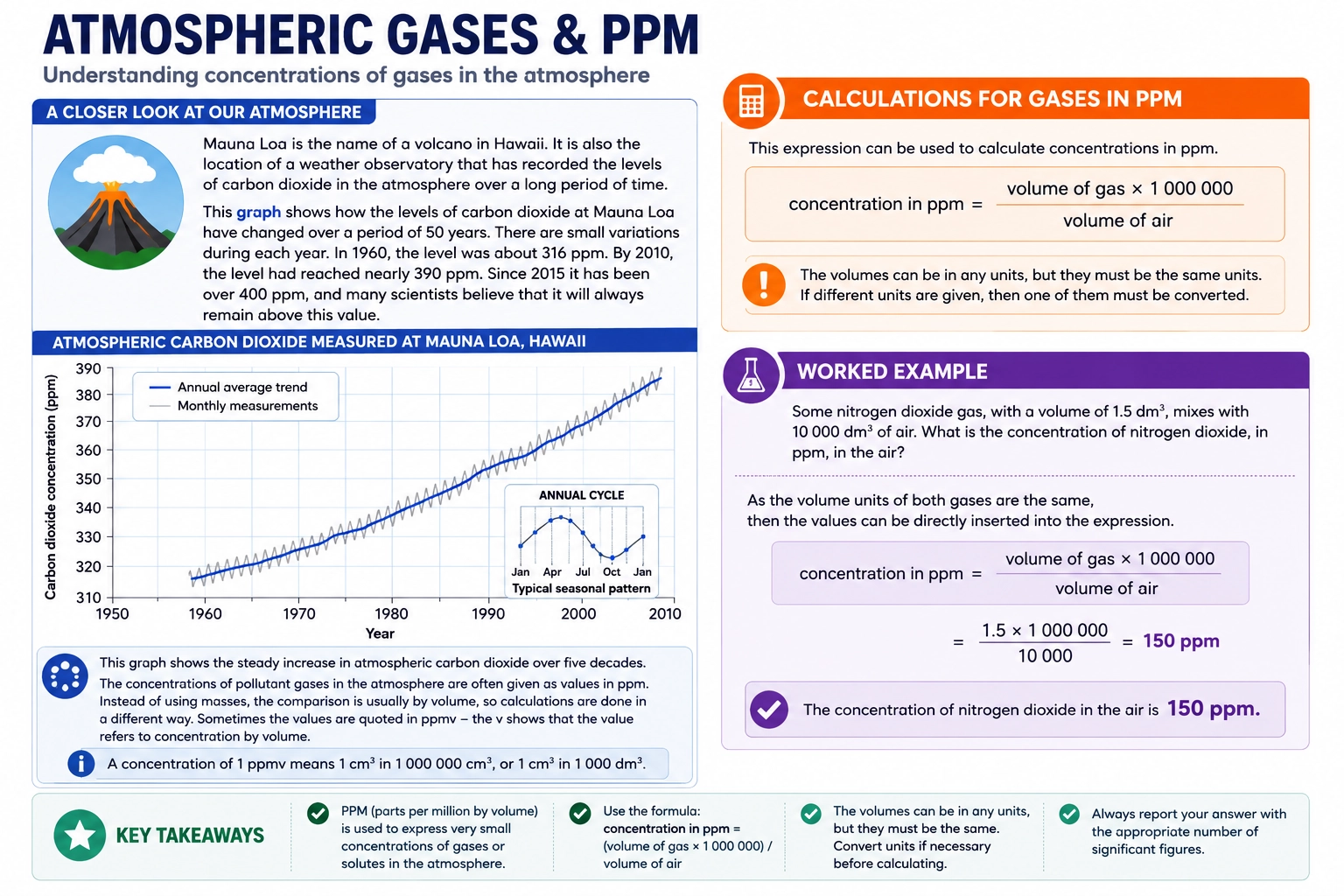
Atmospheric carbon dioxide is reported in ppm precisely because its concentration in air is far too small to make mol dm−3 a practical unit.
Comparing Two ppm Concentrations
A common exam question asks you to compare two air samples and decide which has the higher concentration of a pollutant. The strategy is to calculate the ppm value for each sample using the same formula, then compare directly.
Example C — Comparing two air samples for SO2
Two samples of air containing sulfur dioxide were analysed.
- Sample 1: 500 dm3 of air contained 37 cm3 of sulfur dioxide.
- Sample 2: 4000 dm3 of air contained 1.4 dm3 of sulfur dioxide.
Show, by calculation, which sample has the higher concentration of SO2 in ppm.
Sample 1: the volume of gas is in cm3 and the volume of air is in dm3, so first convert 37 cm3 to 0.037 dm3 (or convert 500 dm3 to 500 000 cm3; either works).
Exam tip: always state the comparison conclusion in words after the calculation. If the question says “show, by calculation, which sample…”, you must do both the maths and the verbal statement to gain full marks.
Common Exam Points
- ppm stands for parts per million; it is a way of expressing very dilute concentrations as a whole number.
- 1 ppm means 1 part of solute in 1 000 000 parts of sample (for example, 1 g in 1 000 000 g, or 1 mg in 1 000 000 mg).
- ppm is dimensionless: the units cancel inside the fraction, leaving a pure number.
- For solutions: ppm = (mass of solute × 1 000 000) ÷ mass of solvent. Masses must be in the same unit.
- For gases in air: ppm = (volume of gas × 1 000 000) ÷ volume of air. Volumes must be in the same unit.
- When the units do not match, convert one of them before substituting (1 dm3 = 1000 cm3; 1 g = 1000 mg).
- The formula can be rearranged to find the volume (or mass) of solute when the ppm value is given.
- For “show by calculation” questions, write both the working and a written comparison or conclusion.
- Common real-world applications include atmospheric CO2, ozone, sulfur dioxide and trace metal pollutants in drinking water.
Check Your Understanding
Use this activity to practise ppm calculations for both solutions and gases, including comparing sample concentrations.
QuickSnap
This text summary condenses the page into the essential exam ideas.
- ppm: parts per million; how many parts of solute are present in 1 000 000 parts of sample.
- Solutions formula: ppm = (mass of solute × 1 000 000) ÷ mass of solvent.
- Gases formula: ppm = (volume of gas × 1 000 000) ÷ volume of air.
- Unit rule: mass units must match on the top and bottom for solutions; volume units must match for gases.
- Equivalents: 1 ppm = 1 g in 1 000 000 g = 1 mg in 1 000 000 mg.
- Rearranging: volume of gas = (ppm × volume of air) ÷ 1 000 000.
- Use case: ppm is preferred over mol dm−3 for very dilute pollutants and atmospheric gases.
- Comparison questions: calculate ppm for each sample and state the conclusion in words.
Master Formulae, Equations and Amount of Substance for Edexcel International A Level Chemistry
Continue from these free revision notes into the full Topic 1 Formulae, Equations and Amount of Substance course, with guided video teaching, diagnostic MCQ practice, teacher-marked short-answer questions and a specification assignment with a personalised progress report.
Guided video teaching
Learn ppm calculations, concentrations of solutions, dilutions, molar volume calculations, the ideal gas equation, empirical formulae, mole calculations, percentage yield and atom economy through structured video lessons with worked examples and walkthroughs.
Instant MCQ feedback
Auto-marked MCQ quizzes provide immediate diagnostic feedback for every answer choice.
Teacher-marked SAQs
Submit written exam responses and receive chemistry specialist feedback with improvement guidance.
Progress tracking
Identify strengths and weaknesses across formulae, equations, mole calculations, concentrations, gas volumes, percentage yield and atom economy with targeted reporting.
FAQs
These questions address the most common points of confusion students encounter when working with ppm.
What does ppm actually mean?
ppm stands for “parts per million”. It tells you how many parts of solute (or gas) are present in 1 000 000 parts of the total sample. So 50 ppm means 50 parts in 1 000 000 parts. The word works in the same way as “percent”, which means out of 100.
When should I use ppm instead of mol dm−3?
ppm is used for very dilute concentrations, particularly trace pollutants in water and trace gases in air. For these, mol dm−3 values would be tiny decimals that are awkward to write, so ppm gives a more readable whole number.
Does it matter what units I use for the masses or volumes?
No, as long as the units are the same on the top and the bottom of the fraction. The units cancel inside the formula, leaving ppm as a dimensionless number. If the question gives different units, convert one of them first.
What is the difference between ppm for solutions and ppm for gases?
The structure of the formula is identical, but the quantities differ. For solutions, use masses (mass of solute over mass of solvent). For gases in air, use volumes (volume of gas over volume of air). Choosing the wrong one is a common mistake.
Is ppm the same as mg/L for dilute aqueous solutions?
For very dilute aqueous solutions, 1 ppm is approximately equal to 1 mg per dm3 (1 mg/L) because the density of dilute water is close to 1 g cm−3. This is a useful approximation but is not strictly part of the formula.
How do I rearrange the ppm formula to find the mass or volume of solute?
Multiply both sides of the formula by the mass (or volume) of the sample, then divide by 1 000 000. For gases this gives: volume of gas = (ppm × volume of air) ÷ 1 000 000.
Copyright notice: This OLS revision content, including the explanations, layout, diagrams, tables and embedded learning structure, is authored for Online Learning System by Dr. Mohammed Al-Fatah. It may not be copied, reproduced, redistributed or adapted without written permission.