Catalysts and Reaction Profiles
A concise revision guide to catalysts: alternative routes of lower activation energy, reaction profiles for uncatalysed and catalysed reactions including the intermediate, homogeneous and heterogeneous catalysts, and why industry uses them.
- 9.5
- 9.6-a
- 9.6-b
- 9.8
- 9.9
What these spec points say
- 9.5 understand the role of catalysts in providing alternative reaction routes of lower activation energy
- 9.6-a be able to draw reaction profiles for uncatalysed reactions
- 9.6-b be able to draw reaction profiles for catalysed reactions
- 9.8 understand the use of a solid (heterogeneous) catalyst for industrial reactions, in the gas phase, in terms of providing a surface for the reaction
- 9.9 understand the economic benefits of the use of catalysts in industrial reactions
What a Catalyst Does
A catalyst is a substance that increases the rate of a reaction without being used up.
It takes part in the reaction, but it is regenerated by the end, so a small amount of catalyst can convert a very large amount of reactant.
The catalyst works by providing an alternative reaction route (a different mechanism) with a lower activation energy, so that a greater proportion of collisions have enough energy to react.
A catalyst does not change the products, the amount of product, or the enthalpy change of the reaction, and it does not make an impossible reaction possible.
It only changes how quickly the reaction reaches its end point. In a reversible reaction it speeds up the forward and reverse reactions equally, which matters for equilibria later in this topic.
Definition: A catalyst increases the rate of a reaction by providing an alternative route with a lower activation energy, and is chemically unchanged at the end of the reaction.
Reaction profiles for Catalysed Reactions
A reaction profile plots energy against the progress of the reaction. The reactants sit at one level, the products at another (lower for an exothermic reaction, higher for an endothermic one), and the curve between them rises over an energy barrier whose height above the reactants is the activation energy.
The catalysed route is drawn on the same axes as a second curve with a lower barrier.
Because the catalyst takes part in the reaction, the catalysed route usually has two smaller humps with a dip between them. The dip is the energy level of the intermediate formed between the catalyst and a reactant.
The activation energy of the catalysed route is measured to the higher of the two small peaks. The start and finish levels, and therefore ΔH, are exactly the same on both routes.
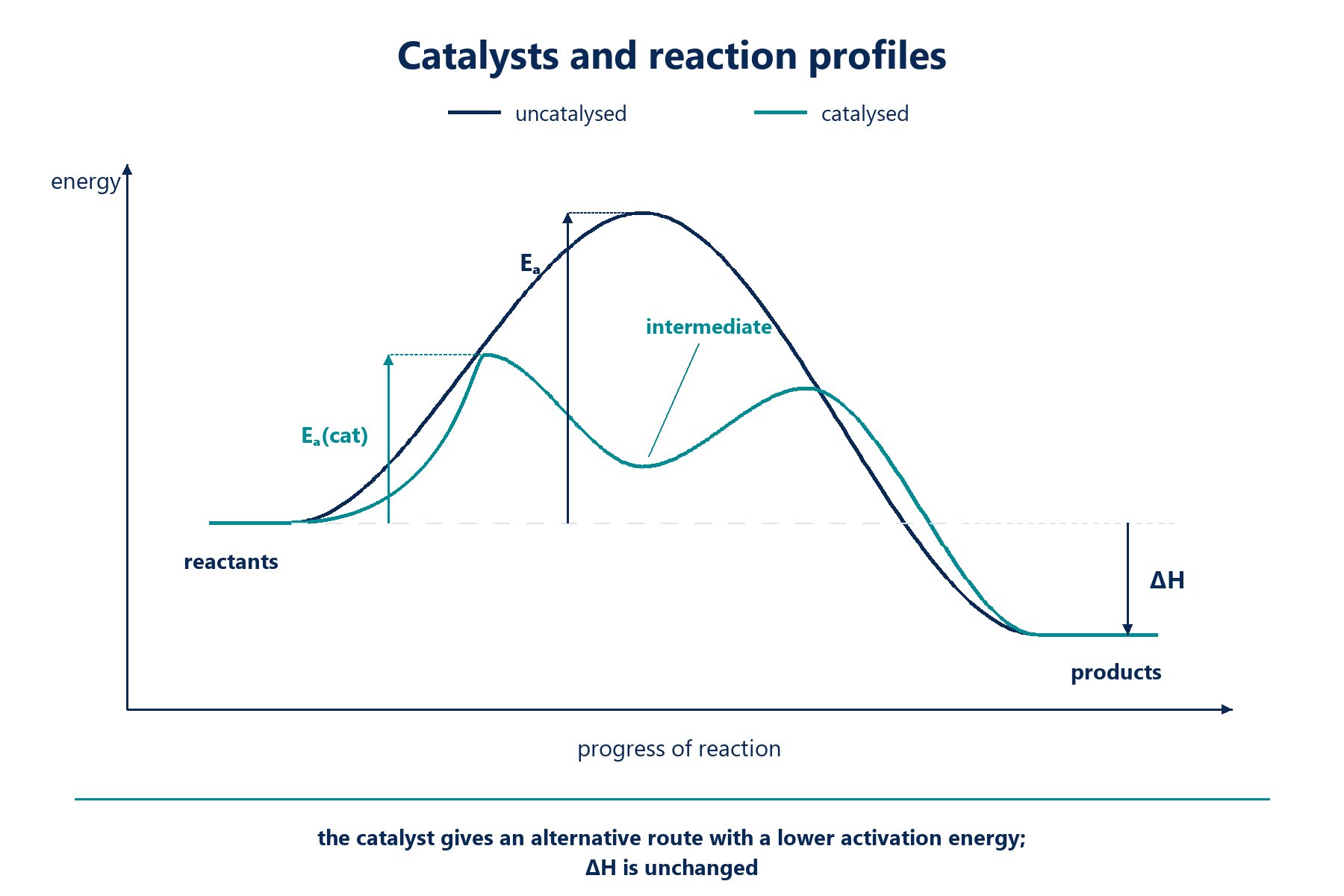
A reaction profile for an exothermic reaction showing the uncatalysed route and the lower catalysed route with its intermediate.
Exam focus: Draw the catalysed route starting and finishing at the same levels as the uncatalysed one, with a lower peak. If asked to show the intermediate, put a dip between two humps and label it.
Check: Reading a Profile
Interpret reaction profiles for reactions not drawn on this page.
Homogeneous and Heterogeneous Catalysts
A homogeneous catalyst is in the same phase as the reactants, usually all in solution or all gases.
It reacts with a reactant to form an intermediate, which then breaks down to give the product and regenerate the catalyst.
Sulfuric acid catalysing the formation of an ester from an alcohol and a carboxylic acid is a homogeneous catalyst.
A heterogeneous catalyst is in a different phase from the reactants, most often a solid catalysing a reaction between gases.
The reactant molecules are adsorbed onto active sites on the surface, where their bonds are weakened. The atoms react on the surface and the product then leaves it (desorption).
Iron in the Haber process, vanadium(V) oxide in the Contact process and the platinum–rhodium in a car’s catalytic converter all work this way.
A solid catalyst is easy to separate from the products and can be used in a continuous process, but its surface can be poisoned by impurities that block the active sites.
Heterogeneous Catalysis on an Iron Surface
Follow nitrogen and hydrogen through the Haber process on iron: adsorption, bond breaking, reaction on the surface and desorption of ammonia.
© Dr. Mohammed Al-Fatah – onlinelearningsystem.net
Key idea: Homogeneous: same phase, works through an intermediate. Heterogeneous: different phase, works at surface active sites by adsorption.
Check: Sorting Catalysts
Classify catalysts and describe how a solid catalyst works, using examples not given above.
Why Industry Uses Catalysts
Catalysts make industrial processes cheaper and more sustainable.
Because they lower the activation energy, a reaction can run at an acceptable rate at a lower temperature, so less energy is needed, less fossil fuel is burned to supply it and less carbon dioxide is released.
Lower temperatures and pressures also mean cheaper, safer plant.
A catalyst can also make a process more atom economical by steering the reaction to the wanted product and away from by-products. More of the starting material ends up in the product and less waste is made.
Because the catalyst is not used up it does not need constant replacing, although in practice catalysts are replaced when they become poisoned or lose their surface area.
The economic benefits are lower fuel bills, higher output from the same plant, less expensive equipment and less waste to dispose of; the environmental benefits are lower carbon dioxide emissions and less pollution from by-products.
Exam wording: Link each benefit to the cause: “lower activation energy → lower temperature → less energy → less fossil fuel burned → less CO₂”. “Higher atom economy → less waste.”
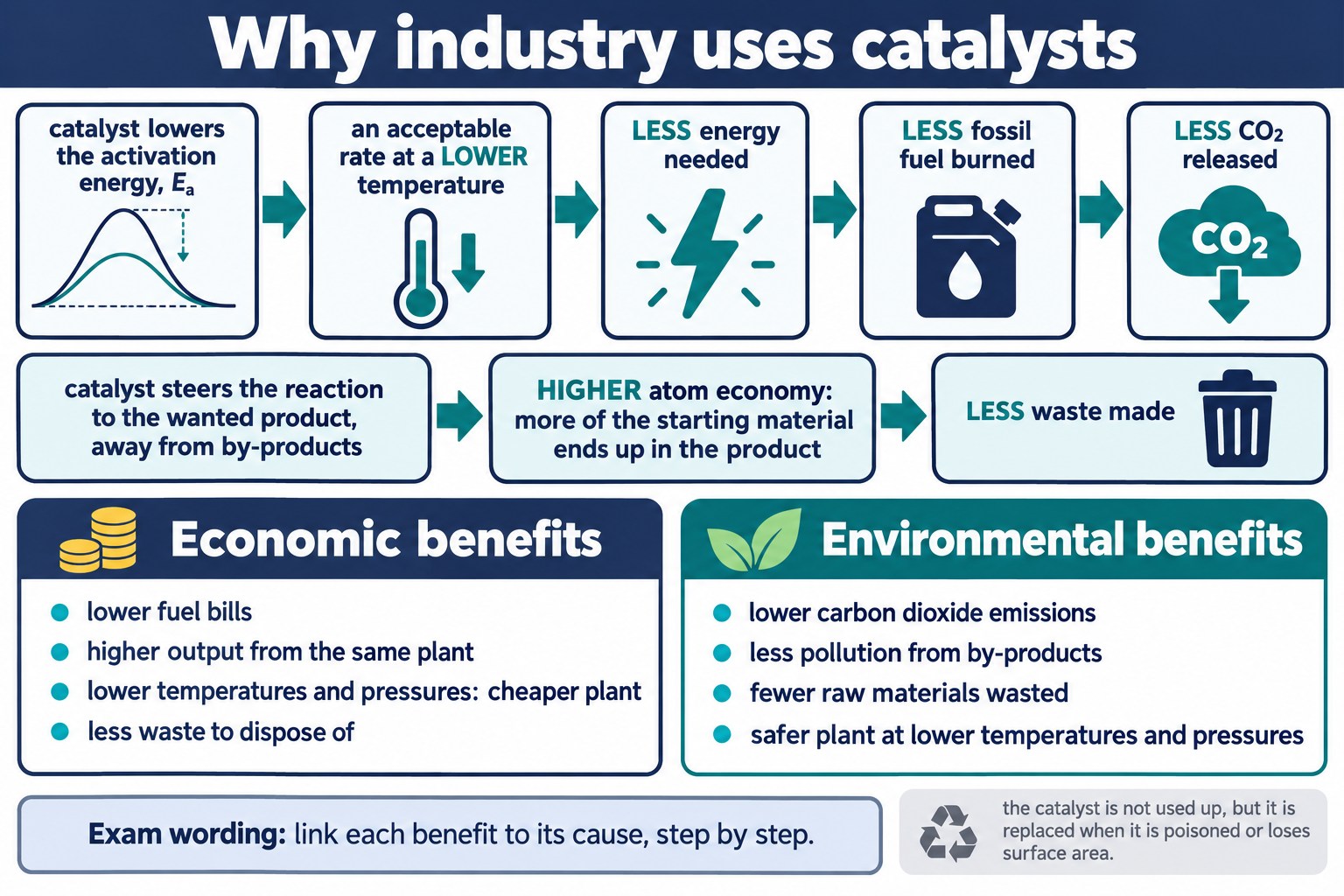
A catalyst lets a process run at a lower temperature with less energy and less carbon dioxide, and by favouring the wanted product it raises the atom economy and cuts waste.
Check: Catalysts in Industry
Explain the benefits of catalysts for a process not described above.
FAQs
Use these quick answers to check the catalyst ideas.
Is a catalyst used up?
No. It takes part in the reaction but is regenerated, so it is chemically unchanged at the end and the same amount is present.
Does a catalyst change ΔH?
No. The reactants and products are the same, so the enthalpy change is the same. Only the activation energy is lower.
Why does the catalysed route on a reaction profile have two humps?
Because the catalyst forms an intermediate with a reactant, which then breaks down to give the product. The dip between the humps is the energy of the intermediate.
What is the difference between a homogeneous and a heterogeneous catalyst?
A homogeneous catalyst is in the same phase as the reactants, such as an acid in solution; a heterogeneous catalyst is in a different phase, such as a solid catalysing a gas reaction at its surface.
How does a catalyst reduce carbon dioxide emissions?
It lets the reaction run at an acceptable rate at a lower temperature, so less fuel is burned to heat the plant and less carbon dioxide is produced.
Copyright and author footprint: This OLS revision page was written for Online Learning System by Dr. Mohammed Al-Fatah. It is designed for A Level Chemistry revision and should not be copied or redistributed without permission.
Keep this note — free
Save your progress across every Edexcel topic. A free account remembers which topics you have covered, saves your question scores, and syncs across your phone and laptop.
- Track every topic you have finished
- Keep your practice-question scores
- No payment, no card, free forever
Already registered? Log in