Le Chatelier’s Principle
A concise revision guide to Le Chatelier’s principle: predicting and justifying the effect of temperature, pressure and concentration changes on the position of a homogeneous equilibrium, and why a catalyst has no effect.
- 3.2.3(b)-i
- 3.2.3(b)-ii
- 3.2.3(b)-iii
- 3.2.3(b)-iv
- 3.2.3(c)
What these spec points say
- 3.2.3(b)-i le Chatelier's principle
- 3.2.3(b)-ii application of le Chatelier's principle for homogeneous equilibria to deduce qualitatively the effect of a change in temperature on the position of equilibrium
- 3.2.3(b)-iii application of le Chatelier's principle for homogeneous equilibria to deduce qualitatively the effect of a change in pressure on the position of equilibrium
- 3.2.3(b)-iv application of le Chatelier's principle for homogeneous equilibria to deduce qualitatively the effect of a change in concentration on the position of equilibrium
- 3.2.3(c) explanation that a catalyst increases the rate of both forward and reverse reactions in an equilibrium by the same amount resulting in an unchanged position of equilibrium
Le Chatelier’s Principle
Le Chatelier’s principle states that if a change is made to a system at dynamic equilibrium, the position of equilibrium moves in the direction that reduces the effect of the change.
It predicts which way an equilibrium shifts when the temperature, pressure or a concentration is altered.
Remember: the principle is a tool for prediction only. The reason a shift happens is always the change in the forward and reverse rates.
The principle applies to homogeneous equilibria, where every substance is in the same phase, such as gases reacting to give gases or ions reacting in solution.
The examples below use the ammonia equilibrium, N₂(g) + 3H₂(g) ⇌ 2NH₃(g), ΔH = −92 kJ mol⁻¹, because every kind of change can be shown on it.
Definition: If a change is made to a system at equilibrium, the position of equilibrium moves to minimise (oppose) the effect of that change.
Changing the Temperature
Raising the temperature favours the endothermic direction, because that direction absorbs heat and so reduces the temperature rise.
For the ammonia equilibrium the forward reaction is exothermic, so the reverse reaction is endothermic. Raising the temperature moves the position of equilibrium to the left, and the equilibrium yield of ammonia falls.
Lowering the temperature favours the exothermic forward reaction and the yield rises, but the rate falls, which is the industrial dilemma on the next page.
The justification must name the direction and its sign. “The equilibrium moves in the endothermic direction, which is the reverse reaction, to absorb the extra heat” earns the marks; “it moves to the left” alone does not.
Rule: Increase temperature → shift in the endothermic direction. Decrease temperature → shift in the exothermic direction. Temperature is the only change that also changes the value of the equilibrium constant.
Check: Temperature Changes
Predict and justify the effect of temperature on equilibria not used above.
Changing the Pressure
Pressure only affects equilibria that involve gases, and only when the number of gas molecules is different on the two sides.
Increasing the pressure moves the position of equilibrium towards the side with fewer moles of gas, because fewer molecules in the same volume exert a lower pressure, which reduces the effect of the increase.
In the ammonia equilibrium there are four moles of gas on the left and two on the right, so a higher pressure moves the equilibrium to the right and raises the yield of ammonia.
If the number of gas molecules is the same on both sides, as in H₂(g) + I₂(g) ⇌ 2HI(g), changing the pressure has no effect on the position of equilibrium, although it still increases the rate of both reactions.
Adding an inert gas at constant volume changes the total pressure but not the concentrations of the reacting gases, so it has no effect either.
Exam wording: Count the gas moles on each side and say so: “there are 4 moles of gas on the left and 2 on the right, so increasing the pressure moves the equilibrium to the right, the side with fewer gas molecules, to reduce the pressure”.
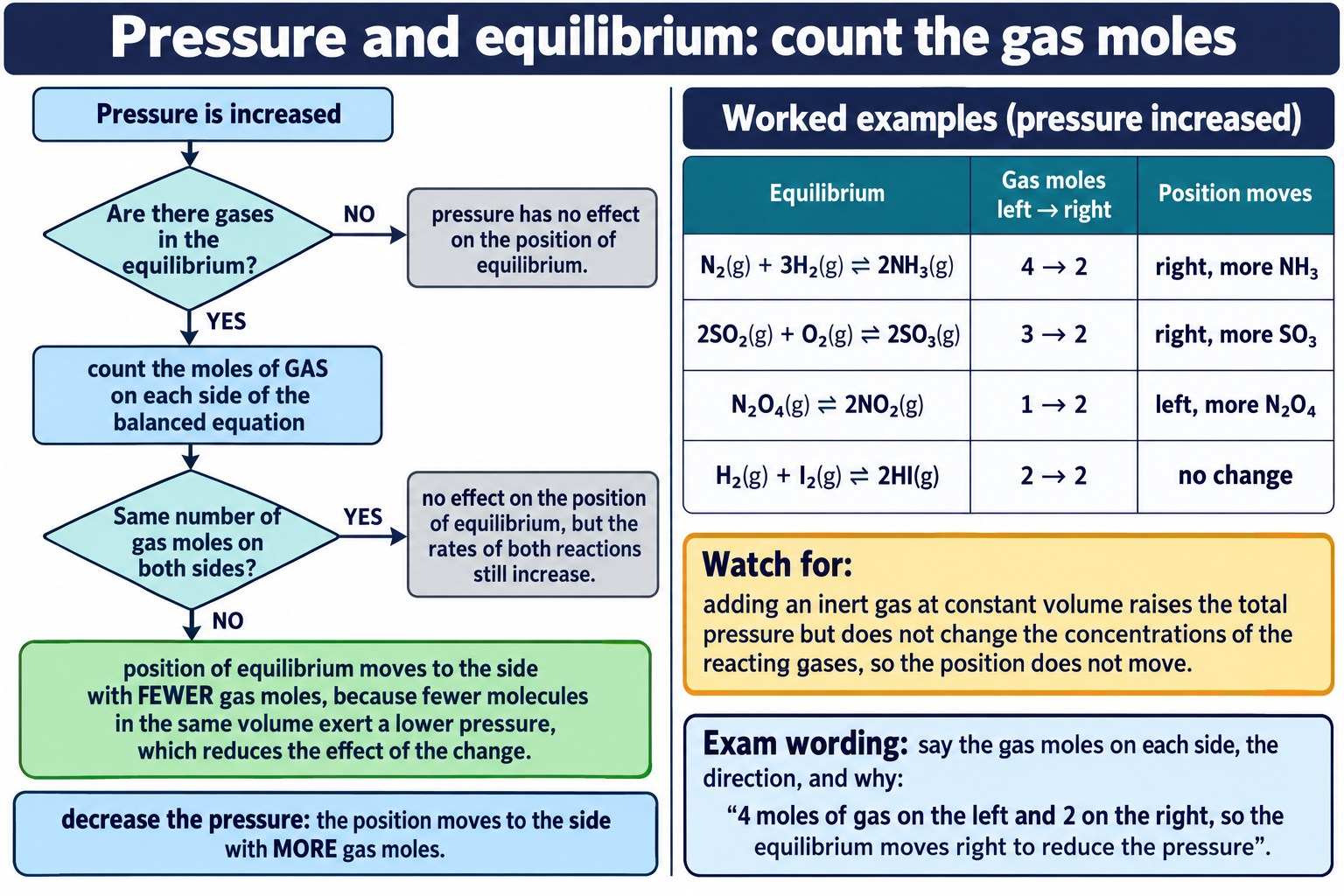
Increasing the pressure moves the position of equilibrium towards the side with fewer moles of gas, and has no effect when both sides have the same number.
Changing a Concentration
Adding more of a substance moves the position of equilibrium away from it, so that some of the extra is used up. Removing a substance moves the equilibrium towards it, so that some is replaced.
Adding more nitrogen to the ammonia equilibrium moves it to the right.
Removing ammonia as it forms, which is what happens in the industrial plant when the ammonia is condensed out, also moves it to the right and keeps the forward reaction going.
In solution the classic demonstration is the chromate(VI)–dichromate(VI) equilibrium, 2CrO₄²⁻(aq) + 2H⁺(aq) ⇌ Cr₂O₇²⁻(aq) + H₂O(l), yellow ⇌ orange.
Adding acid raises [H⁺] and the solution turns orange as the equilibrium moves right; adding alkali removes H⁺ and it turns yellow again.
Colour changes like this are how concentration and temperature effects are investigated in the laboratory: the mixture is prepared, the change is made, and the new colour is compared with the original.
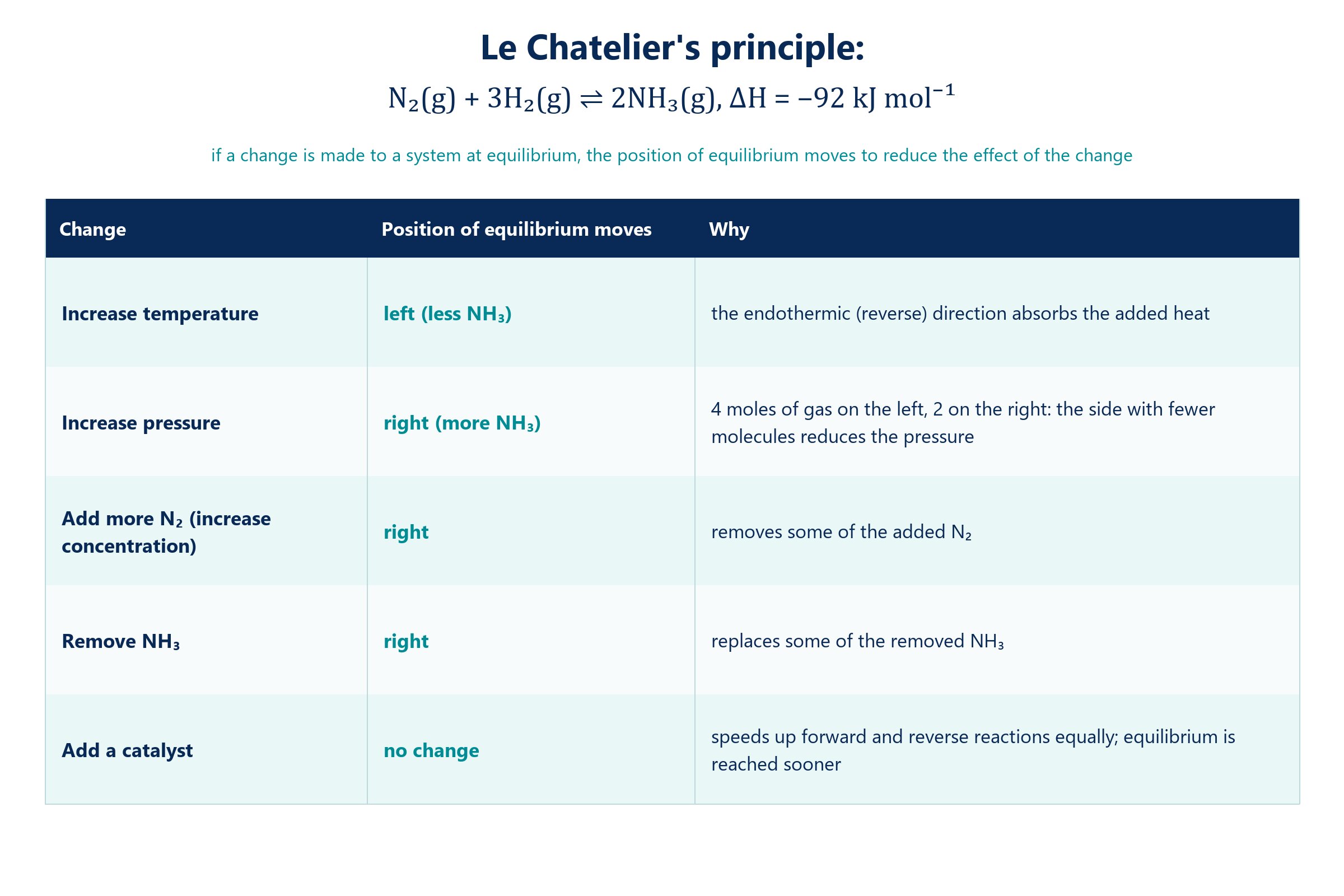
Le Chatelier applied to the ammonia equilibrium: each change, the direction of the shift and the reason.
Key idea: Add a substance → equilibrium moves away from it. Remove a substance → equilibrium moves towards it.
Check: Pressure and Concentration
Predict the shift for equilibria with different gas-mole counts and concentration changes.
Catalysts and Equilibrium
A catalyst has no effect on the position of equilibrium and no effect on the equilibrium yield. It lowers the activation energy of the forward and reverse reactions by the same amount, so it speeds up both reactions equally.
What it does change is the time taken: equilibrium is reached much sooner.
In industry this is exactly what is wanted, because it allows an acceptable rate at a lower temperature, where the yield of an exothermic reaction is higher.
Exam wording: “A catalyst increases the rates of the forward and reverse reactions equally, so the position of equilibrium is unchanged but equilibrium is reached faster.”
Check: Putting It Together
Combine temperature, pressure, concentration and catalyst effects for an unfamiliar equilibrium.
FAQs
Use these quick answers to check Le Chatelier’s principle.
Which way does the equilibrium move when I heat it?
In the endothermic direction, because that absorbs some of the added heat. For an exothermic forward reaction that means to the left.
What if the number of gas moles is the same on both sides?
Then changing the pressure has no effect on the position of equilibrium, although both rates increase.
Why does removing a product move the equilibrium to the right?
The system responds by making more of the removed product to replace some of what was lost, so more reactant is converted.
Does a catalyst increase the yield?
No. It speeds up the forward and reverse reactions equally, so the position of equilibrium and the yield are unchanged; equilibrium is just reached sooner.
Does Le Chatelier explain why the equilibrium moves?
It predicts the direction. The explanation is that the change alters the forward and reverse rates unequally until they become equal again at a new position.
Copyright and author footprint: This OLS revision page was written for Online Learning System by Dr. Mohammed Al-Fatah. It is designed for A Level Chemistry revision and should not be copied or redistributed without permission.
Keep this note — free
Save your progress across every OCR A topic. A free account remembers which topics you have covered, saves your question scores, and syncs across your phone and laptop.
- Track every topic you have finished
- Keep your practice-question scores
- No payment, no card, free forever
Already registered? Log in