Calculating Entropy Changes
A concise revision guide to calculating the entropy change of a reaction from standard entropies, with the units, the signs and the common slips.
- 5.2.2(c)
- 5.2.2(e)-ii
What these spec points say
- 5.2.2(c) calculation of the entropy change of a system, ΔS, and related quantities for a reaction given the entropies of the reactants and products
- 5.2.2(e)-ii calculations related to the free energy change, ΔG, using ΔG = ΔH – TΔS
ΔS of the System From Standard Entropies
The entropy change of the system, ΔS, is the difference between the entropies of the products and the reactants.
It is found from tabulated standard entropies, in the same way that an enthalpy change is found from enthalpies of formation:
ΔS = ΣS⦵(products) − ΣS⦵(reactants)
- Each entropy is multiplied by the number of moles of that substance in the equation.
- The answer has the same units as the data, J K⁻¹ mol⁻¹.
- There is one difference from enthalpy calculations: elements have non-zero entropies, so an element in the equation must be included with its tabulated value, not treated as zero.
Worked example 1: a gas is made
The thermal decomposition of calcium carbonate is CaCO₃(s) → CaO(s) + CO₂(g).
| Substance | S⦵ / J K⁻¹ mol⁻¹ |
|---|---|
| CaCO₃(s) | 92.9 |
| CaO(s) | 39.7 |
| CO₂(g) | 213.6 |
Step 1. Add the entropies of the products: 39.7 + 213.6 = 253.3 J K⁻¹ mol⁻¹.
Step 2. Subtract the entropy of the reactant: ΔS = (39.7 + 213.6) − 92.9.
Answer. ΔS = +160.4 J K⁻¹ mol⁻¹.
- The sign is positive, as page 1 predicted for a reaction that makes a gas from a solid.
- The size is typical of a reaction that produces one mole of gas: roughly 150 to 200 J K⁻¹ mol⁻¹ per mole of gas gained.
Worked example 2: gas moles fall
For N₂(g) + 3H₂(g) → 2NH₃(g), S⦵ = 192 (N₂), 131 (H₂) and 193 (NH₃) J K⁻¹ mol⁻¹.
Step 1. Products: 2 × 193 = 386 J K⁻¹ mol⁻¹.
Step 2. Reactants: 192 + (3 × 131) = 585 J K⁻¹ mol⁻¹.
Answer. ΔS = 386 − 585 = −199 J K⁻¹ mol⁻¹. Four moles of gas become two, so the entropy of the system falls.
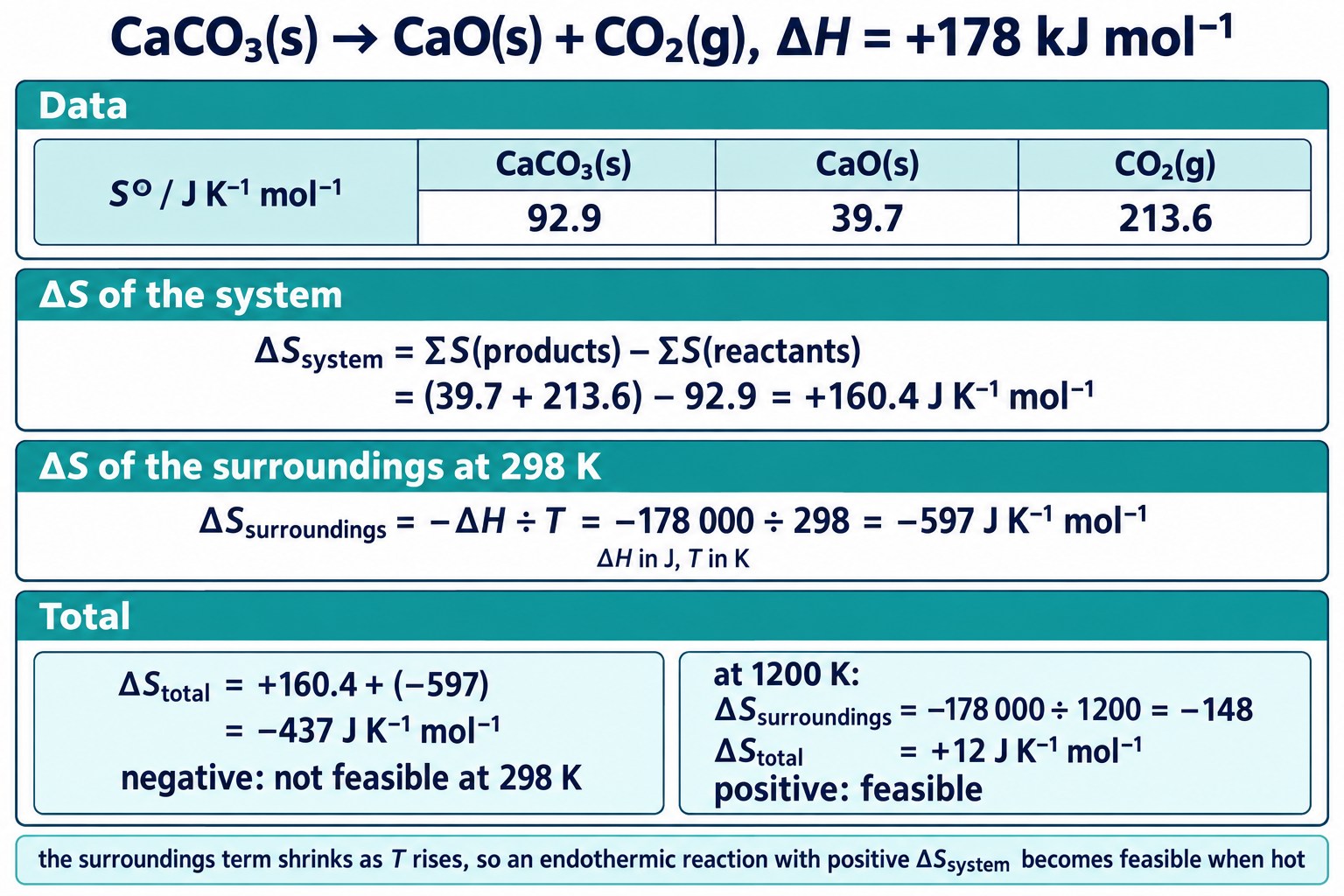
The calcium carbonate calculation laid out in full: standard entropies, ΔS of the system, then the surroundings and total entropy at 298 K and at 1200 K.
Worked example: CaCO₃(s) → CaO(s) + CO₂(g): ΔS = ΣS(products) − ΣS(reactants) = (39.7 + 213.6) − 92.9 = +160.4 J K⁻¹ mol⁻¹. Multiply each S by its balancing number, and include the elements.
Check: ΔS From Standard Entropies
Calculate the entropy change of the system with its sign and units for reactions not used on this page.
Why the Surroundings Matter
A reaction does not only change the entropy of the substances taking part.
- An exothermic reaction gives out heat to its surroundings. That heat spreads among the surrounding particles, and their entropy rises.
- An endothermic reaction takes heat in and lowers the entropy of the surroundings.
- The size of that change is the heat transferred divided by the temperature.
- So an exothermic reaction with enthalpy change ΔH raises the entropy of the surroundings by −ΔH ÷ T, with T in kelvin.
- Because T is in the denominator, the effect is large at low temperatures and shrinks as the temperature rises.
Where the Gibbs equation comes from
A change is feasible when the total entropy, the ΔS of the system plus this surroundings term, is positive.
Multiplying that condition through by −T gives ΔH − TΔS < 0, which is the Gibbs equation that page 3 uses.
- The −TΔS term is the entropy change of the system in energy units.
- ΔH stands for the entropy change of the surroundings.
- The calculation is done in kJ mol⁻¹ rather than J K⁻¹ mol⁻¹.
You do not need to calculate the entropy change of the surroundings separately. Knowing where the equation comes from explains why exothermic reactions with a negative ΔS can still be feasible.
Key idea: Heat given out to the surroundings raises their entropy by −ΔH/T. That is why ΔH appears in the Gibbs equation alongside −TΔS: together they measure the total entropy change in energy units.
Check: Units and Signs
Convert between J and kJ, use kelvin temperatures and keep the signs straight in entropy calculations not used on this page.
Putting ΔS and ΔH Together
For the decomposition of calcium carbonate ΔH = +178 kJ mol⁻¹ and ΔS = +160.4 J K⁻¹ mol⁻¹.
The enthalpy change is unfavourable and the entropy change favourable, so whether the reaction is feasible depends on the temperature.
The Gibbs energy change, ΔG = ΔH − TΔS, weighs the two against each other. The reaction is feasible when ΔG is negative.
Worked example: calcium carbonate at two temperatures
Step 1. Convert the entropy term to kJ first: 160.4 J K⁻¹ mol⁻¹ = 0.1604 kJ K⁻¹ mol⁻¹.
Step 2. At 298 K: ΔG = 178 − (298 × 0.1604) = 178 − 47.8 = +130 kJ mol⁻¹.
Step 3. At 1200 K: ΔG = 178 − (1200 × 0.1604) = 178 − 192.5 = −15 kJ mol⁻¹.
Answer. ΔG is positive at 298 K, so limestone does not decompose at room temperature. ΔG is negative at 1200 K, so in a lime kiln the reaction goes.
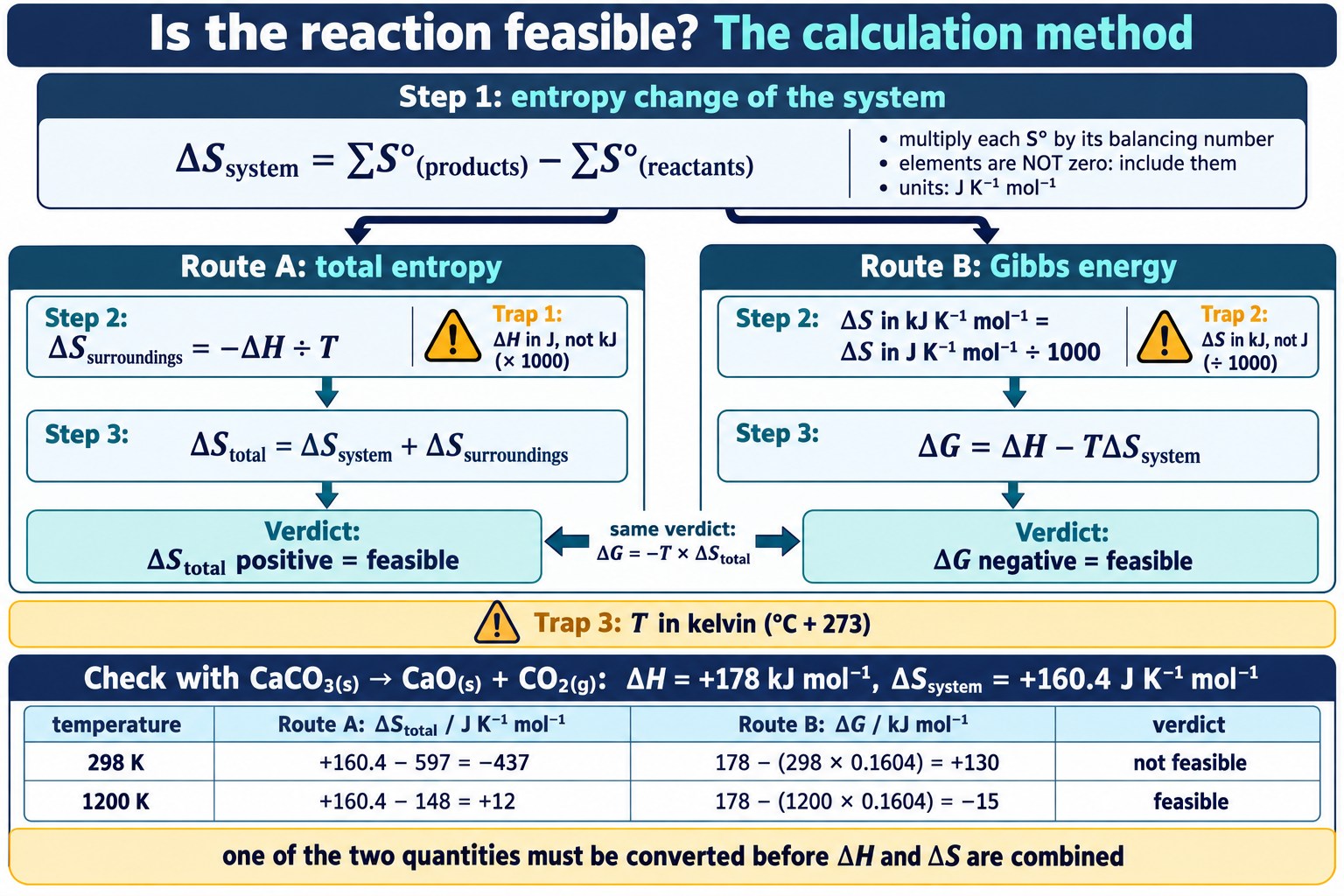
The method as a flow chart: ΔS of the system first, then the total entropy route or the Gibbs energy route, with the unit traps marked and both routes giving the same verdict for calcium carbonate.
- The TΔS term grows with temperature until it outweighs ΔH.
- This is the reason an endothermic reaction with a positive entropy change becomes feasible when hot.
- Page 3 deals with the full equation, its sign combinations and the temperature at which ΔG changes sign.
Worked example: CaCO₃(s) → CaO(s) + CO₂(g) at 298 K: ΔG = ΔH − TΔS = 178 − (298 × 0.1604) = +130 kJ mol⁻¹, not feasible. At 1200 K: 178 − (1200 × 0.1604) = −15 kJ mol⁻¹, feasible.
Common Exam Points
Say
- “ΔS = ΣS(products) − ΣS(reactants), including the elements.”
- “Convert ΔS to kJ K⁻¹ mol⁻¹ before using ΔG = ΔH − TΔS.”
- “ΔG is negative, so the reaction is feasible.”
Do not say
- “Elements have an entropy of zero” (only their enthalpy of formation is zero).
- “T = 25” (use kelvin: 298 K).
- “ΔG = 178 − 298 × 160.4” (units mixed: use 0.1604 kJ K⁻¹ mol⁻¹).
Watch for
- The most common slip in this topic is units: entropies are in J K⁻¹ mol⁻¹ and enthalpies in kJ mol⁻¹, so one of them must be converted before they are combined.
- Check that the sign of ΔS matches the change in moles of gas.
- Check that a temperature given in °C has had 273 added.
Check: A Full Calculation
Carry out a complete calculation of ΔS and then ΔG and decide whether a reaction not used on this page is feasible.
FAQs
Use these quick answers to check the entropy calculations.
Why must I convert J to kJ?
Because standard entropies are tabulated in J K⁻¹ mol⁻¹ while enthalpy changes are in kJ mol⁻¹. Whenever the two meet in one equation they must share a unit, so either divide the entropy term by 1000 or multiply ΔH by 1000. Mixing them is the most common reason for an answer that is out by a factor of a thousand.
Why do I have to multiply each standard entropy by the balancing number?
Because standard entropy is quoted per mole of substance, and the equation may involve two or three moles. In 2H₂(g) + O₂(g) → 2H₂O(l) the hydrogen contributes 2 × 131 J K⁻¹ mol⁻¹ and the water 2 × 70 J K⁻¹ mol⁻¹. Forgetting the multiplier changes both the size and, sometimes, the sign of ΔS.
Where does the −TΔS term come from?
Heat given out by the reaction raises the entropy of the surroundings by −ΔH/T. Adding that to the entropy change of the system and multiplying the whole thing through by −T turns the total entropy change into a quantity in kJ mol⁻¹, which is ΔG = ΔH − TΔS. The −TΔS term is therefore the entropy change of the system written in energy units.
Can ΔS for a reaction be negative and the reaction still happen?
Yes, provided the reaction is exothermic enough. The condensation of steam and the combustion of hydrogen both lower the entropy of the system, but the heat they release raises the entropy of the surroundings by more, so overall the change is still feasible.
What temperature do I use if the question does not say?
Standard conditions, which means 298 K. Always convert Celsius to kelvin by adding 273 before substituting; an entropy calculation at 25 K instead of 298 K gives nonsense. If the question sets a different temperature, use that one throughout.
Copyright and author footprint: This OLS revision page was written for Online Learning System by Dr. Mohammed Al-Fatah. It is designed for A Level Chemistry revision and should not be copied or redistributed without permission.
Keep this note — free
Save your progress across every OCR A topic. A free account remembers which topics you have covered, saves your question scores, and syncs across your phone and laptop.
- Track every topic you have finished
- Keep your practice-question scores
- No payment, no card, free forever
Already registered? Log in