Oxides of Nitrogen and the Environment
A concise revision guide to the oxides of nitrogen: how NO and NO₂ form naturally in lightning and in car engines, how catalytic converters remove them, how they react with unburnt hydrocarbons to form peroxyacetyl nitrate in photochemical smog, and their direct and catalytic roles in acid rain, with every equation.
Catalytic Converter Surface
Choose a step to watch CO and NO adsorb on the metal, rearrange into CO₂ and N₂, leave the surface, and see the honeycomb that holds it all. Drag to rotate.
© Dr. Mohammed Al-Fatah – onlinelearningsystem.net
Before You Start
Oxides of nitrogen, written together as NOₓ, are nitrogen monoxide NO and nitrogen dioxide NO₂. This page follows them from the engine to the rain cloud.
- Why nitrogen needs a very high temperature to react at all: the triple bond and the lack of polarity in Nitrogen and Ammonia.
- How a catalyst lowers the activation energy, and the difference between a heterogeneous and a homogeneous catalyst: Catalysts and Reaction Profiles.
- The sulfur dioxide that NO₂ helps to oxidise has its own page: Sulfur Dioxide: Acid Rain and Food Preservation.
- Every equation on this page carries state symbols: all the oxides and the gases they react with are (g); the acids formed in rain are (aq).
GCSE Recap: Fuels, Pollutants and Acidity
Three quick questions on the GCSE ideas this page builds on.
How Oxides of Nitrogen Form
Nitrogen and oxygen only combine when something supplies enough energy to break the N≡N bond. Nature does it with lightning; people do it inside engines and furnaces.
Natural sources
- Lightning: N₂(g) + O₂(g) → 2NO(g). The reaction is endothermic (ΔH = +180 kJ mol⁻¹) and happens only in the extreme temperature of the lightning channel.
- Soil bacteria: denitrifying bacteria release NO and N₂O as they break down nitrates. Volcanoes add a little more.
Man-made sources
- Car engines: the spark and burning fuel heat the cylinder above 1000 °C, so the nitrogen and oxygen drawn in with the air react: N₂(g) + O₂(g) → 2NO(g).
- In the exhaust and the air: the colourless NO is oxidised to the brown, toxic gas NO₂: 2NO(g) + O₂(g) → 2NO₂(g).
- Power stations and furnaces burning any fuel in air at high temperature produce NOₓ in the same way.
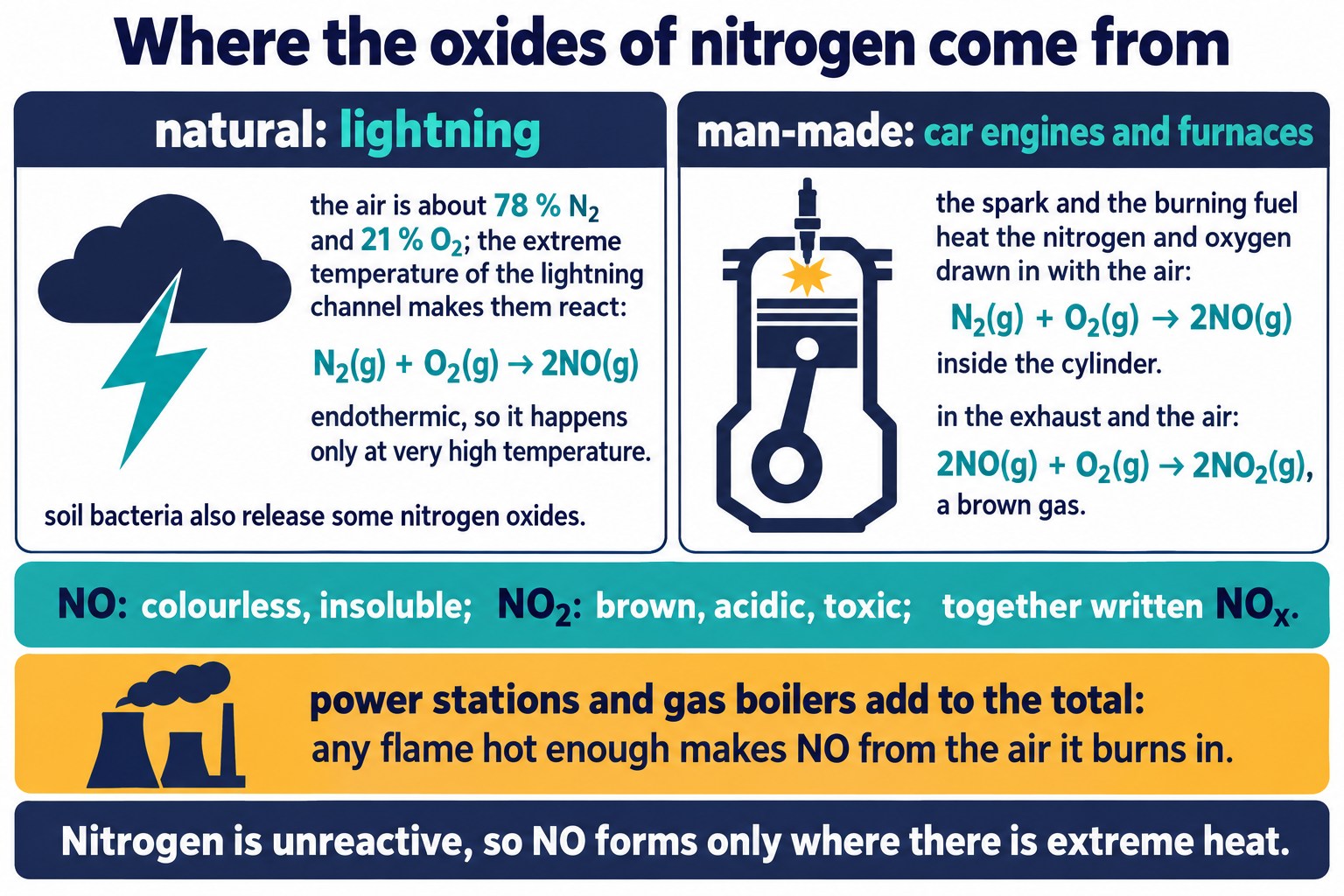
Lightning and a car engine side by side, each with its equation, the temperature that makes the reaction possible and the brown colour of NO₂.
Exam focus: The oxide forms from the nitrogen in the air, not from the fuel. Say “the high temperature of the engine provides the energy to break the N≡N bond”.
Check: Where Oxides of Nitrogen Come From
Write the equations for NO and NO₂ formation, explain why lightning and engines are needed, and name the natural and man-made sources.
The Catalytic Converter
A catalytic converter in the exhaust removes three pollutants at once: oxides of nitrogen, carbon monoxide and unburnt hydrocarbons. It converts them to nitrogen, carbon dioxide and water.
- The catalyst is a thin coating of platinum, palladium and rhodium on a ceramic honeycomb: a huge surface area from a tiny mass of expensive metal.
- Carbon monoxide reduces the nitrogen oxides: 2NO(g) + 2CO(g) → N₂(g) + 2CO₂(g) and 2NO₂(g) + 4CO(g) → N₂(g) + 4CO₂(g).
- Unburnt hydrocarbons are oxidised by NO as well: 2C₈H₁₈(g) + 50NO(g) → 16CO₂(g) + 18H₂O(g) + 25N₂(g).
- Remaining carbon monoxide is oxidised by oxygen in the exhaust: 2CO(g) + O₂(g) → 2CO₂(g).
- It is a heterogeneous catalyst: the gases adsorb onto the metal surface, their bonds weaken, new bonds form between neighbours, and the products desorb.
- Lead compounds poison the surface by bonding to it permanently, which is why converters need unleaded fuel.
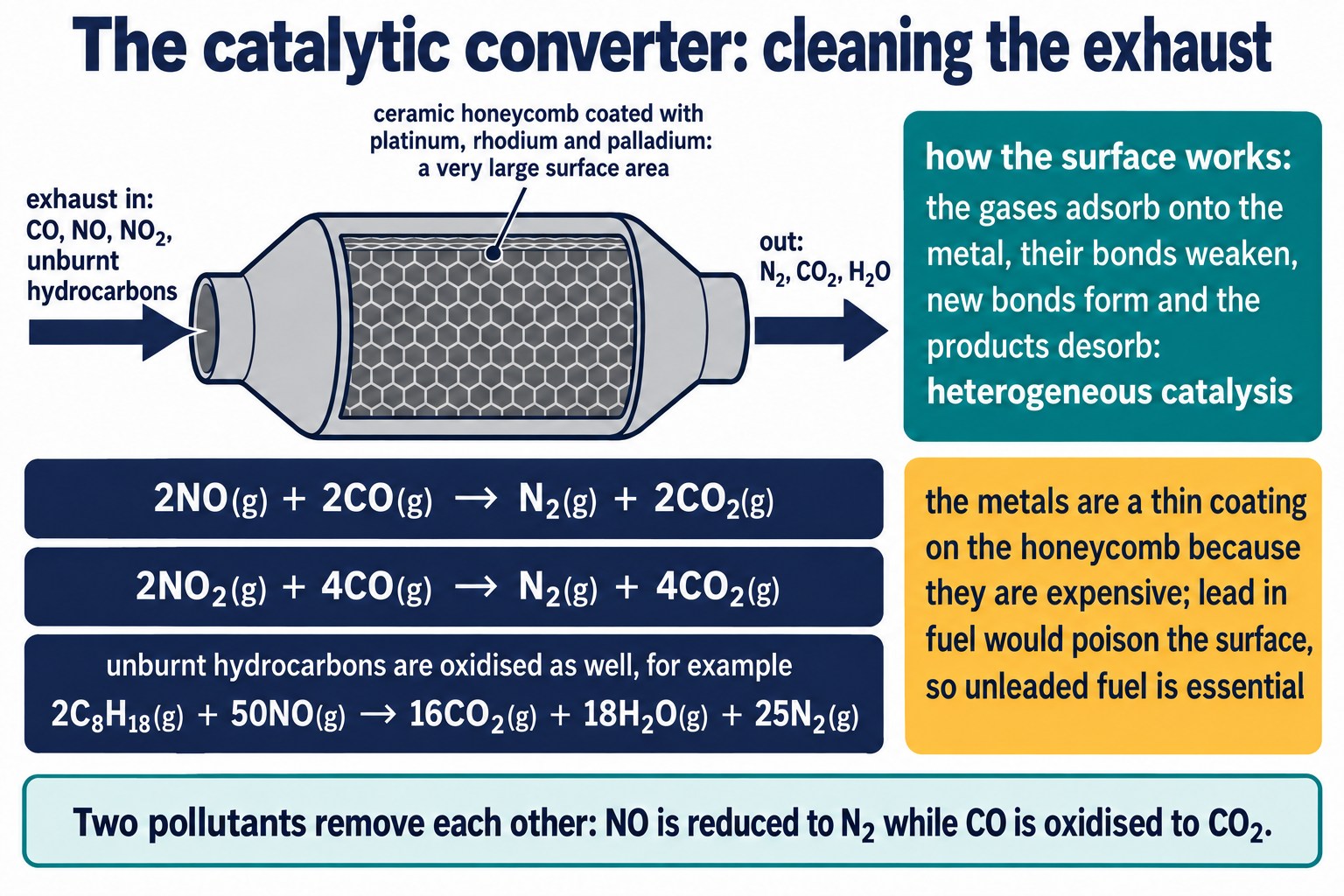
A cut-away honeycomb with the three pollutants going in, the three harmless gases coming out and the four equations written beside it.
Remember: One reaction removes two pollutants: NO is reduced to N₂ while CO is oxidised to CO₂. Say which species is oxidised and which is reduced.
Quick Check: Balancing New Converter Reactions
Balance equations for two new fuels, then track the electrons in a new reaction.
Photochemical Smog and PAN
On a still, sunny day over a city, NO₂ and unburnt hydrocarbons from traffic react in sunlight. The brown haze that results is photochemical smog.
- Sunlight splits NO₂ into NO and oxygen atoms, which make ozone and attack the hydrocarbons to form reactive radicals.
- The radicals are oxidised to peroxy radicals such as CH₃COOO•, which combine with NO₂: CH₃COOO•(g) + NO₂(g) → CH₃COOONO₂(g).
- The product is peroxyacetyl nitrate, PAN, CH₃COOONO₂: a component of photochemical smog along with ozone and aldehydes.
- PAN is a powerful irritant to the eyes and lungs, damages the leaves of plants and is stable enough to be carried far from the city that made it.
- Converters cut the smog at source by removing both ingredients, NOₓ and the unburnt hydrocarbons, before they leave the exhaust.
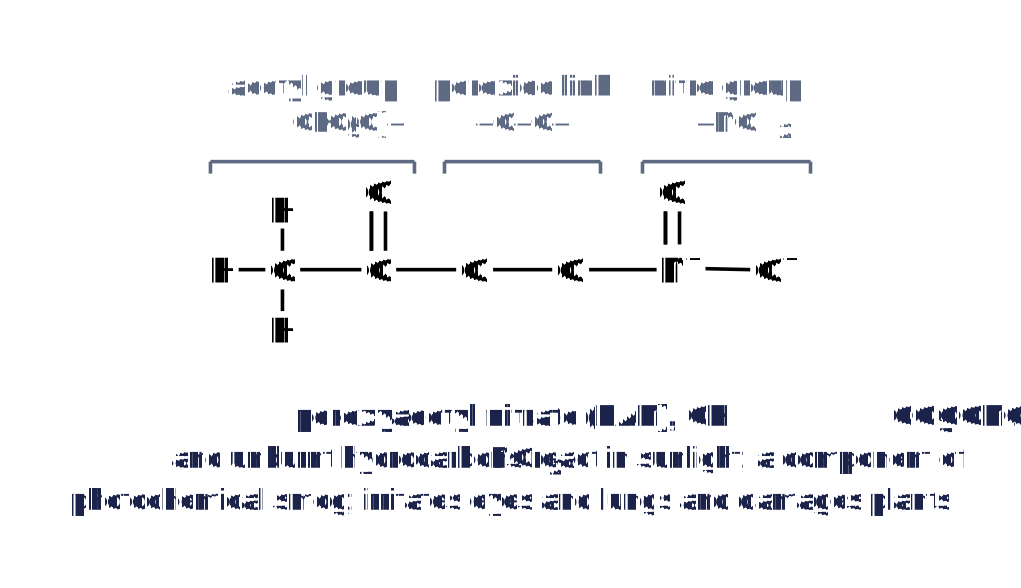
Peroxyacetyl nitrate, CH₃COOONO₂: the ethanoyl group bonded through two oxygens to the nitrate group.
Exam focus: Learn the sentence: “NO₂ reacts with unburnt hydrocarbons in sunlight to form peroxyacetyl nitrate, PAN, a component of photochemical smog”.
Check: Converters and Photochemical Smog
Balance converter equations, identify what is oxidised and reduced, describe the catalyst surface, and recall how PAN forms and why it matters.
Acid Rain: The Direct Route
Nitrogen dioxide is an acidic oxide. Dissolving in the water droplets of clouds it forms nitric acid, so NO₂ makes acid rain directly without any help.
- With water alone: 2NO₂(g) + H₂O(l) → HNO₃(aq) + HNO₂(aq), nitric and nitrous acids.
- With water and the oxygen of the air: 4NO₂(g) + 2H₂O(l) + O₂(g) → 4HNO₃(aq), so all the nitrogen ends up as nitric acid.
- NO must first be oxidised: 2NO(g) + O₂(g) → 2NO₂(g). NO itself is a neutral oxide and does not dissolve to give an acid.
- Nitric acid is a strong acid, so even small amounts take rainwater well below its natural pH of about 5.6.
- Nitric acid in rain adds nitrate to soils and lakes, which fertilises algae: acid rain and eutrophication go together.
Remember: Natural rain is already slightly acidic (pH about 5.6) from dissolved carbon dioxide. Acid rain means a pH below about 5.
Acid Rain: NO₂ as a Catalyst for Oxidising SO₂
Sulfur dioxide from burning coal and oil is oxidised to sulfur trioxide only slowly on its own. NO₂ speeds the oxidation up and is itself regenerated: it acts as a catalyst.
Step 1. NO₂ gives an oxygen atom to sulfur dioxide: NO₂(g) + SO₂(g) → NO(g) + SO₃(g).
Step 2. The NO formed is oxidised back to NO₂ by the oxygen in the air: 2NO(g) + O₂(g) → 2NO₂(g).
Overall. Add the steps (with step 1 doubled): 2SO₂(g) + O₂(g) → 2SO₃(g). NO₂ appears in neither side of the overall equation.
Then. Sulfur trioxide dissolves in water droplets: SO₃(g) + H₂O(l) → H₂SO₄(aq), sulfuric acid, a strong acid.
- NO₂ is a homogeneous catalyst here: the catalyst and the reactants are all gases in the same phase.
- The two-step route has a lower activation energy than the direct reaction of SO₂ with O₂, so the rain forms faster.
- Both oxides of nitrogen take part: NO₂ is used in step 1 and NO is turned back into NO₂ in step 2, so the pair is recycled.
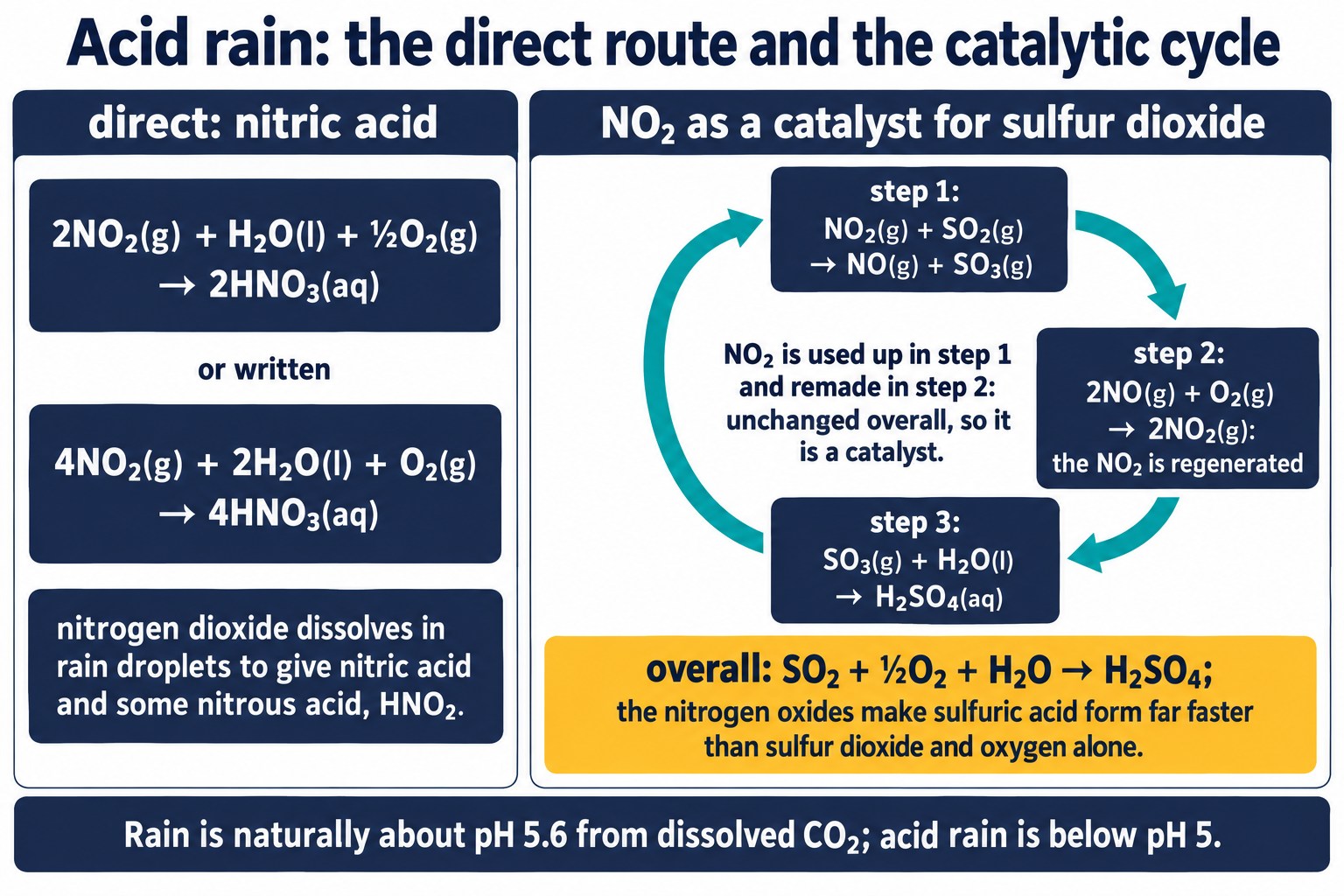
The catalytic cycle as a loop: NO₂ oxidises SO₂ to SO₃, NO is oxidised back to NO₂ by O₂, and SO₃ leaves the loop to form H₂SO₄.
Exam focus: Catalyst means used in one step and regenerated in a later step. Write both steps, then show that they add up to 2SO₂ + O₂ → 2SO₃ (Catalysts and Reaction Profiles).
Check: Oxides of Nitrogen and Acid Rain
Write the direct acid rain equations, show how NO₂ catalyses the oxidation of SO₂ in two steps, and explain why it counts as a catalyst.
Common Exam Points
- NO forms wherever nitrogen and oxygen are hot enough: lightning naturally, car engines and furnaces artificially. N₂(g) + O₂(g) → 2NO(g), then 2NO(g) + O₂(g) → 2NO₂(g).
- Catalytic converters use platinum, palladium and rhodium on a honeycomb: 2NO(g) + 2CO(g) → N₂(g) + 2CO₂(g). NO is reduced, CO is oxidised.
- Unburnt hydrocarbons are oxidised by NO in the converter too; be ready to balance an equation such as octane with NO.
- PAN, peroxyacetyl nitrate, forms when NO₂ reacts with unburnt hydrocarbons in sunlight; it is a component of photochemical smog.
- Direct acid rain: 4NO₂(g) + 2H₂O(l) + O₂(g) → 4HNO₃(aq), or 2NO₂(g) + H₂O(l) → HNO₃(aq) + HNO₂(aq).
- Catalytic acid rain: NO₂(g) + SO₂(g) → NO(g) + SO₃(g) then 2NO(g) + O₂(g) → 2NO₂(g); the NO₂ is regenerated, so it is a catalyst.
- SO₃(g) + H₂O(l) → H₂SO₄(aq) completes the story: NOₓ makes the rain more acidic through sulfuric acid as well as nitric acid.
- Use the words “homogeneous” (NO₂ in the air) and “heterogeneous” (the converter surface) correctly when asked about catalysis.
FAQs
Use these quick answers to check how the oxides of nitrogen form in lightning and engines, how catalytic converters remove them, how PAN forms in photochemical smog and the direct and catalytic roles of NO and NO₂ in acid rain.
How do oxides of nitrogen form in a car engine?
Air in the cylinder contains nitrogen and oxygen, and the very high temperature of the burning fuel drives the endothermic reaction N₂(g) + O₂(g) → 2NO(g). In the exhaust the nitrogen monoxide is oxidised further, 2NO(g) + O₂(g) → 2NO₂(g), a brown gas.
How does a catalytic converter remove the oxides of nitrogen?
Platinum, rhodium and palladium on a ceramic honeycomb let the pollutants react together on the metal surface: 2NO(g) + 2CO(g) → N₂(g) + 2CO₂(g) and 2NO₂(g) + 4CO(g) → N₂(g) + 4CO₂(g). The oxides of nitrogen are reduced while carbon monoxide is oxidised.
What is PAN and why does it matter?
Peroxyacetyl nitrate, CH₃COOONO₂, forms when nitrogen dioxide reacts with unburnt hydrocarbons in sunlight. It is a component of photochemical smog, irritates the eyes and lungs and damages plant leaves, which is why cities with heavy traffic and strong sunshine suffer most.
How does nitrogen dioxide act as a catalyst in the formation of acid rain?
It oxidises sulfur dioxide and is then regenerated: NO₂(g) + SO₂(g) → NO(g) + SO₃(g), then 2NO(g) + O₂(g) → 2NO₂(g).
The SO₃ dissolves in water to give sulfuric acid, SO₃(g) + H₂O(l) → H₂SO₄(aq), while NO₂ is used up and remade in each cycle.
How do the oxides of nitrogen contribute directly to acid rain?
Nitrogen dioxide dissolves in rainwater with oxygen to give nitric acid: 4NO₂(g) + 2H₂O(l) + O₂(g) → 4HNO₃(aq).
Without oxygen a mixture of nitric and nitrous acids forms. Nitric acid is strong, so small amounts lower the pH of rain well below its natural 5.6.

Copyright notice: This OLS revision content, including the explanations, layout, diagrams, tables and embedded learning structure, is authored for Online Learning System by Dr. Mohammed Al-Fatah. It may not be copied, reproduced, redistributed or adapted without written permission.
Keep this note — free
Save your progress across every Cambridge topic. A free account remembers which topics you have covered, saves your question scores, and syncs across your phone and laptop.
- Track every topic you have finished
- Keep your practice-question scores
- No payment, no card, free forever
Already registered? Log in