Sulfur Dioxide: Acid Rain and Food Preservation
A concise revision guide to sulfur dioxide: how it forms when fossil fuels burn and from volcanoes, how it dissolves and is oxidised to give acid rain, the damage acid rain causes and how flue-gas desulfurisation and low-sulfur fuels reduce it, and why sulfur dioxide is used as a food preservative.
Before You Start
Sulfur dioxide is the acidic oxide of sulfur in its +4 oxidation state. Everything on this page follows from two facts: it is an acidic gas and it is a reducing agent.
- Sulfur burns with a blue flame to give SO₂, which dissolves to an acidic solution: Period 3 elements with oxygen and water and Period 3 oxides with water.
- The oxidation of SO₂ to SO₃ in the air is catalysed by NO₂: the two-step cycle is on Oxides of Nitrogen and the Environment.
- An acidic oxide reacts with bases such as calcium oxide and calcium carbonate: the basis of flue-gas desulfurisation.
- Sulfur in SO₂ is +4 and can be oxidised to +6 (SO₃, sulfate), which is why sulfur dioxide and sulfites act as reducing agents.
GCSE Recap: Oxides, Acids and Carbonates
Three quick questions on the GCSE ideas this page builds on.
Where Sulfur Dioxide Comes From
Fossil fuels formed from living things, and living things contain sulfur. When the fuel burns, so does the sulfur.
- Coal contains up to 3 % sulfur as pyrite and organic compounds: S(s) + O₂(g) → SO₂(g). Coal-fired power stations are the largest man-made source.
- Crude oil fractions contain thiols and sulfides: CH₃SH(g) + 3O₂(g) → SO₂(g) + CO₂(g) + 2H₂O(g) when petrol or diesel burns.
- Smelting sulfide ores to extract metals: 2ZnS(s) + 3O₂(g) → 2ZnO(s) + 2SO₂(g).
- Volcanoes are the main natural source, releasing SO₂ and hydrogen sulfide which is oxidised to SO₂ in the air.
- The gas is colourless with a sharp, choking smell, very soluble in water and a respiratory irritant that triggers asthma.
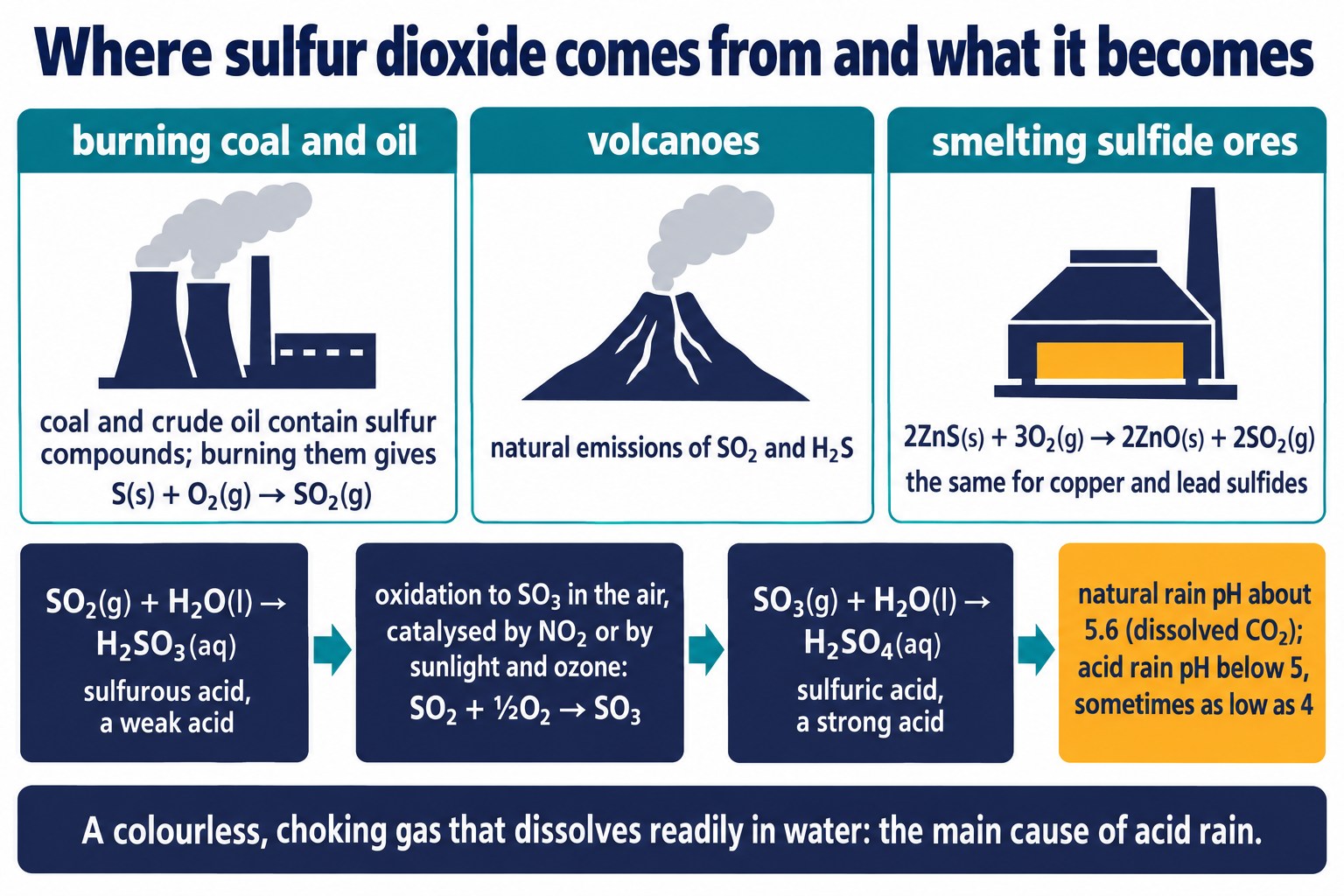
The sources of sulfur dioxide as four tiles: a power station, a vehicle, a smelter and a volcano, each with its equation.
Remember: Sulfur dioxide comes from the sulfur in the fuel; nitrogen oxides come from the nitrogen in the air. Different origins, the same acid rain.
How Sulfur Dioxide Makes Acid Rain
Sulfur dioxide reaches the rain in two ways: dissolving directly as a weak acid, or being oxidised first to sulfur trioxide and then forming the strong acid.
Step 3. Sulfur trioxide dissolves: SO₃(g) + H₂O(l) → H₂SO₄(aq), sulfuric acid, a strong acid fully ionised in the droplet.
Result. Natural rain has a pH of about 5.6 from dissolved CO₂. Rain with sulfuric and nitric acids falls below pH 5, and pH 4 has been recorded downwind of industry.
- The catalytic step with NO₂ (NO₂(g) + SO₂(g) → NO(g) + SO₃(g), then 2NO(g) + O₂(g) → 2NO₂(g)) is explained on Oxides of Nitrogen and the Environment.
- Dissolved sulfurous acid is also oxidised in the droplets: H₂SO₃(aq) is converted to H₂SO₄(aq), so almost all the sulfur ends up as sulfate.
- Winds carry the gases hundreds of kilometres, so the rain falls on countries that did not burn the fuel.
Exam focus: Two acids, two strengths: H₂SO₃ is weak, H₂SO₄ is strong. State which forms in each step and give state symbols: (g) for the oxides, (aq) for the acids.
Check: Sources and Acid Rain Chemistry
Write equations for sulfur dioxide forming from fuels and ores, follow it to sulfurous and sulfuric acid, and compare the pH of natural and acid rain.
The Damage Acid Rain Does
Acid rain harms living things directly and also indirectly, by changing the chemistry of soils and water. Buildings and metals suffer too.
| Where | What happens | Chemistry |
|---|---|---|
| lakes and rivers | fish eggs fail to hatch and fish die as the pH falls; the water looks clear because plankton die | acid leaches Al³⁺ from clay soils; aluminium ions damage fish gills |
| soils | nutrients are washed away and trees weaken | H⁺ displaces Mg²⁺, Ca²⁺ and K⁺ from the soil particles |
| forests | needles and leaves yellow and drop; forest dieback in Scandinavia and Germany | acid dissolves the waxy coating of leaves and lets disease in |
| limestone and marble buildings | carvings blur and surfaces crumble | CaCO₃(s) + H₂SO₄(aq) → CaSO₄(s) + H₂O(l) + CO₂(g) |
| metal structures | steel bridges and railings rust faster | Fe(s) + H₂SO₄(aq) → FeSO₄(aq) + H₂(g) |
| people | sulfur dioxide itself irritates the lungs | asthma and bronchitis worsen on days of high SO₂ |
Remember: The limestone equation is the one examiners set: acid plus carbonate gives a salt, water and carbon dioxide. Calcium sulfate is washed away, so the stone wears.
Reducing Sulfur Dioxide Emissions
Power stations remove most of their sulfur dioxide by flue-gas desulfurisation: an acidic oxide is neutralised by a cheap base, calcium carbonate or calcium oxide.
- The flue gases pass through a spray of limestone slurry: CaCO₃(s) + SO₂(g) → CaSO₃(s) + CO₂(g).
- With lime (made by heating limestone): CaO(s) + SO₂(g) → CaSO₃(s). Both are acid–base reactions of an acidic oxide with a basic oxide or carbonate.
- Air blown through the slurry oxidises the calcium sulfite: 2CaSO₃(s) + O₂(g) → 2CaSO₄(s). The product, hydrated as gypsum (CaSO₄·2H₂O), is sold for plasterboard.
- About 90 % of the sulfur dioxide is removed. The cost is the energy to quarry and heat the limestone, and the carbon dioxide released.
- Low-sulfur fuels: refineries remove sulfur from petrol and diesel by hydrodesulfurisation, turning the sulfur compounds into H₂S which is converted to sulfur.
- Switching to natural gas, nuclear or renewable sources removes the sulfur dioxide altogether.
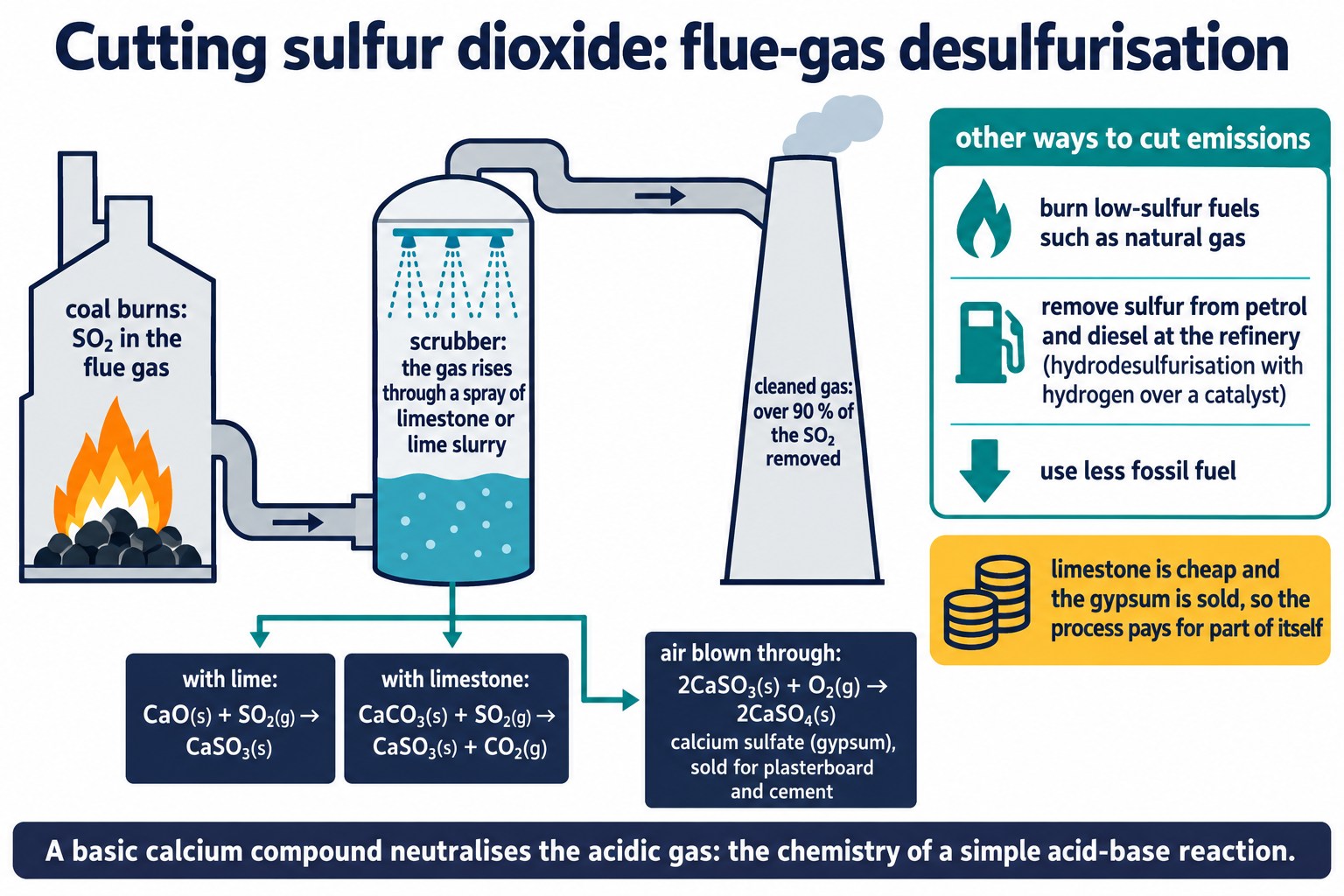
Flue-gas desulfurisation as a flow: dirty gas in, limestone slurry spray, the two neutralisation equations, oxidation to gypsum, clean gas out.
Exam focus: Explain why calcium carbonate works: SO₂ is an acidic oxide and CaCO₃ is a base, so they react to form a salt. Then write the equation with state symbols.
Quick Check: Limestone or Lime?
Follow the carbon through two routes to the same product.
Sulfur Dioxide as a Food Preservative
Sulfur dioxide and the sulfites are additives E220 to E228, used in dried fruit, wine, fruit juice, sausages and pickles. They preserve food in three ways.
- Antimicrobial: sulfur dioxide passes into bacteria, yeasts and moulds and disrupts their enzymes, so the food does not spoil or ferment.
- Antioxidant: SO₂ and sulfite are reducing agents, oxidised in preference to the food: 2SO₃²⁻(aq) + O₂(g) → 2SO₄²⁻(aq). Cut fruit does not brown; wine keeps its colour.
- Acidic: dissolved SO₂ lowers the pH, SO₂(aq) + H₂O(l) ⇌ H⁺(aq) + HSO₃⁻(aq), and most microbes grow badly in acid.
- The additives are added as sodium sulfite Na₂SO₃, sodium metabisulfite Na₂S₂O₅ or potassium hydrogensulfite, which release SO₂ in the acidic food.
- Drawbacks: some people react with asthma or allergic symptoms, so the label must declare sulfites; SO₂ also destroys vitamin B1 (thiamine).
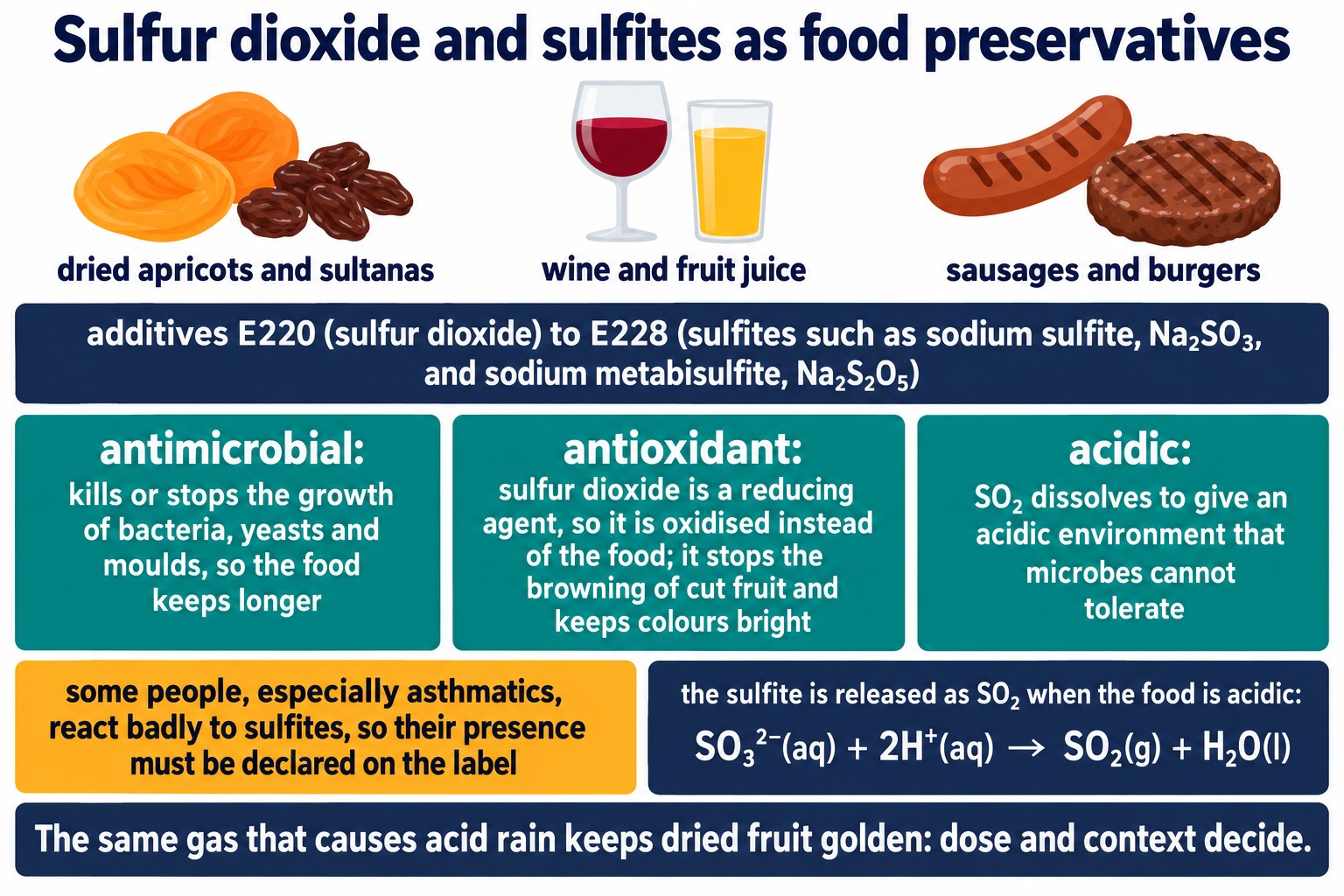
A poster of dried apricots, a wine bottle and a sausage with the three modes of preservation written beside them and the E numbers.
Remember: Preservative means two jobs: stopping microbes (antimicrobial) and stopping oxidation (antioxidant). Give both when asked why SO₂ is added to food.
Check: Damage, Desulfurisation and Preservation
Match the effects of acid rain to their chemistry, write the flue-gas desulfurisation equations and explain how sulfur dioxide preserves food.
Quick Check: What Is Sulfur Dioxide Doing?
Use the change in oxidation state of sulfur to decide the role of SO₂ in each new reaction.
Common Exam Points
- Sulfur dioxide comes from the sulfur in coal and oil, from smelting sulfide ores and from volcanoes: S(s) + O₂(g) → SO₂(g).
- SO₂(g) + H₂O(l) → H₂SO₃(aq) is a weak acid; oxidation to SO₃ (catalysed by NO₂) then SO₃(g) + H₂O(l) → H₂SO₄(aq) gives the strong acid.
- Natural rain is pH about 5.6 because of dissolved CO₂; acid rain is below pH 5.
- Effects: fish deaths through leached aluminium, nutrient loss from soils, forest dieback, corrosion of limestone (CaCO₃ + H₂SO₄) and metals.
- Flue-gas desulfurisation: CaCO₃(s) + SO₂(g) → CaSO₃(s) + CO₂(g) or CaO(s) + SO₂(g) → CaSO₃(s); then oxidation to CaSO₄, gypsum.
- Explain FGD as an acid–base reaction: an acidic oxide neutralised by a basic oxide or carbonate.
- Preservative: SO₂ and sulfites kill bacteria, yeasts and moulds and act as antioxidants (reducing agents oxidised to sulfate instead of the food).
- Sulfur is +4 in SO₂ and sulfite, +6 in SO₃ and sulfate; the +4 to +6 change is why they are reducing agents.
FAQs
Use these quick answers to check where atmospheric sulfur dioxide comes from, how it forms acid rain and what damage follows, how flue-gas desulfurisation removes it and why sulfur dioxide and sulfites are used to preserve food.
Where does the sulfur dioxide in the atmosphere come from?
Mainly from burning coal and oil that contain sulfur compounds, S(s) + O₂(g) → SO₂(g), in power stations, factories and engines. Smelting sulfide ores releases more, 2ZnS(s) + 3O₂(g) → 2ZnO(s) + 2SO₂(g), and volcanoes are the main natural source.
How does sulfur dioxide end up as sulfuric acid in rain?
It dissolves to give weak sulfurous acid, SO₂(g) + H₂O(l) → H₂SO₃(aq).
In the air it is also oxidised to sulfur trioxide, catalysed by nitrogen dioxide or sunlight and ozone, and SO₃(g) + H₂O(l) → H₂SO₄(aq) gives the strong acid in rain below pH 5.
What damage does acid rain actually do?
It acidifies lakes so fish die and leaches aluminium ions from soils, damages forests, corrodes steel and dissolves limestone and marble buildings: CaCO₃(s) + H₂SO₄(aq) → CaSO₄(s) + H₂O(l) + CO₂(g). The soluble calcium sulfate washes away, so carved stonework slowly disappears.
How does flue-gas desulfurisation remove sulfur dioxide from power station gases?
The acidic gas is passed through a slurry of limestone or lime, which neutralises it: CaCO₃(s) + SO₂(g) → CaSO₃(s) + CO₂(g) or CaO(s) + SO₂(g) → CaSO₃(s). The calcium sulfite is oxidised to calcium sulfate, gypsum, which is sold for plasterboard.
Why is sulfur dioxide added to dried fruit, wine and sausages?
Sulfur dioxide and sulfites (E220 to E228) are antimicrobial, killing bacteria, yeasts and moulds, and act as antioxidants because sulfur dioxide is a reducing agent, stopping the browning that oxidation causes. The acidic environment also slows spoilage, although some people react badly to sulfites.

Copyright notice: This OLS revision content, including the explanations, layout, diagrams, tables and embedded learning structure, is authored for Online Learning System by Dr. Mohammed Al-Fatah. It may not be copied, reproduced, redistributed or adapted without written permission.
Keep this note — free
Save your progress across every Cambridge topic. A free account remembers which topics you have covered, saves your question scores, and syncs across your phone and laptop.
- Track every topic you have finished
- Keep your practice-question scores
- No payment, no card, free forever
Already registered? Log in