Nitrogen and Ammonia
A concise revision guide to nitrogen and ammonia: why the nitrogen molecule is so unreactive, ammonia as a Brønsted–Lowry base, the structure and formation of the ammonium ion by a dative bond, the displacement of ammonia from ammonium salts by a stronger base, and the uses that follow from this chemistry.
Making the Ammonium Ion
Choose a step to watch the lone pair on ammonia accept a proton and the new ion settle into a regular tetrahedron.
© Dr. Mohammed Al-Fatah – onlinelearningsystem.net
Recap: Covalent Bonds, Dative Bonds and Brønsted–Lowry
Five quick questions on the groundwork: the triple bond in N₂, the lone pair in NH₃, the dative bond (Dative Covalent Bonding), bond enthalpy (Bond Energy and Bond Length) and the Brønsted–Lowry definitions (Acids, Bases and pH Curves).
Why Nitrogen Is So Unreactive
Nitrogen is 78 % of the air by volume, yet at room temperature it takes part in almost no reactions. Two features of the N₂ molecule explain this.
- Triple bond strength: the N≡N bond enthalpy is +944 kJ mol⁻¹, one of the strongest bonds known. Any reaction that breaks it has a very high activation energy.
- Short bond: three shared pairs pull the two nuclei to 0.110 nm, so the bonding electrons are held very tightly.
- No polarity: the two atoms are identical, so the electron cloud is symmetrical. No δ+ atom invites a nucleophile and no δ− atom attracts an electrophile.
- Tightly held lone pairs: each nitrogen has one lone pair in a low-energy orbital pointing away from the bond, so N₂ is a very poor electron-pair donor.
The consequences follow directly. Nitrogen is used as an inert atmosphere in food packaging and in chemical plants, and the Haber process needs 450 °C, 200 atm and an iron catalyst to make N₂ react at all.
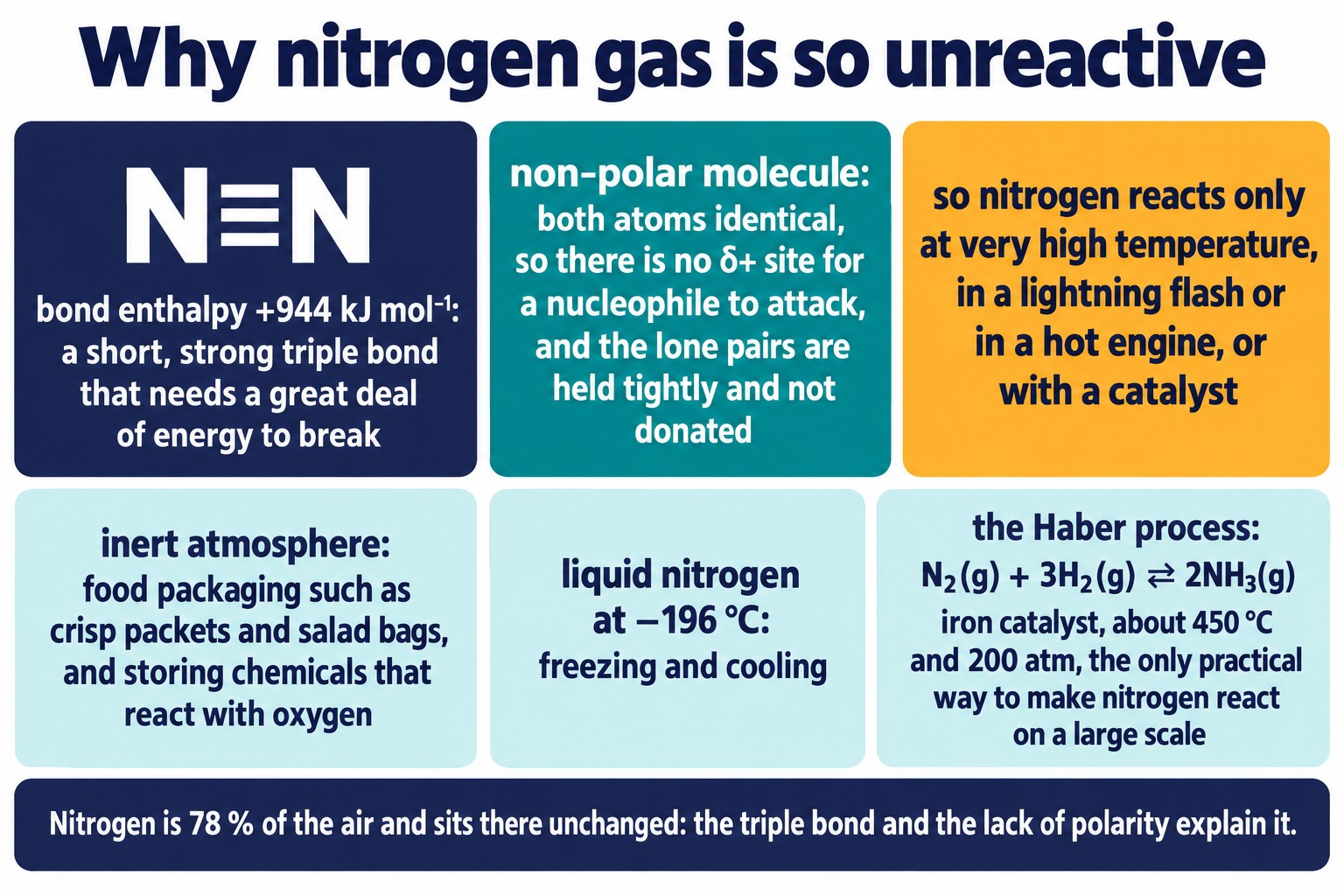
The two reasons for the unreactivity of nitrogen, the bond data and the uses that depend on an unreactive gas.
Exam focus: Give both reasons: the very strong triple bond (+944 kJ mol⁻¹) and the lack of polarity. One reason on its own is usually one mark out of two.
Ammonia as a Brønsted–Lowry Base
Ammonia is trigonal pyramidal with an H–N–H angle of 107°: three bonding pairs and one lone pair on nitrogen. The lone pair is the basic site.
- A Brønsted–Lowry base is a proton acceptor. The lone pair on nitrogen forms a bond to H⁺.
- In water: NH₃(aq) + H₂O(l) ⇌ NH₄⁺(aq) + OH⁻(aq). Water acts as the acid; ammonia accepts its proton and hydroxide ions make the solution alkaline.
- Ammonia is a weak base: the equilibrium lies well to the left. A 0.1 mol dm⁻³ solution has pH about 11; sodium hydroxide at the same concentration reaches 13.
- With hydrogen chloride gas: NH₃(g) + HCl(g) → NH₄Cl(s). Dense white smoke of solid ammonium chloride forms where the two gases meet.
- With acids in solution ammonia forms ammonium salts: 2NH₃(aq) + H₂SO₄(aq) → (NH₄)₂SO₄(aq) and NH₃(aq) + HNO₃(aq) → NH₄NO₃(aq).
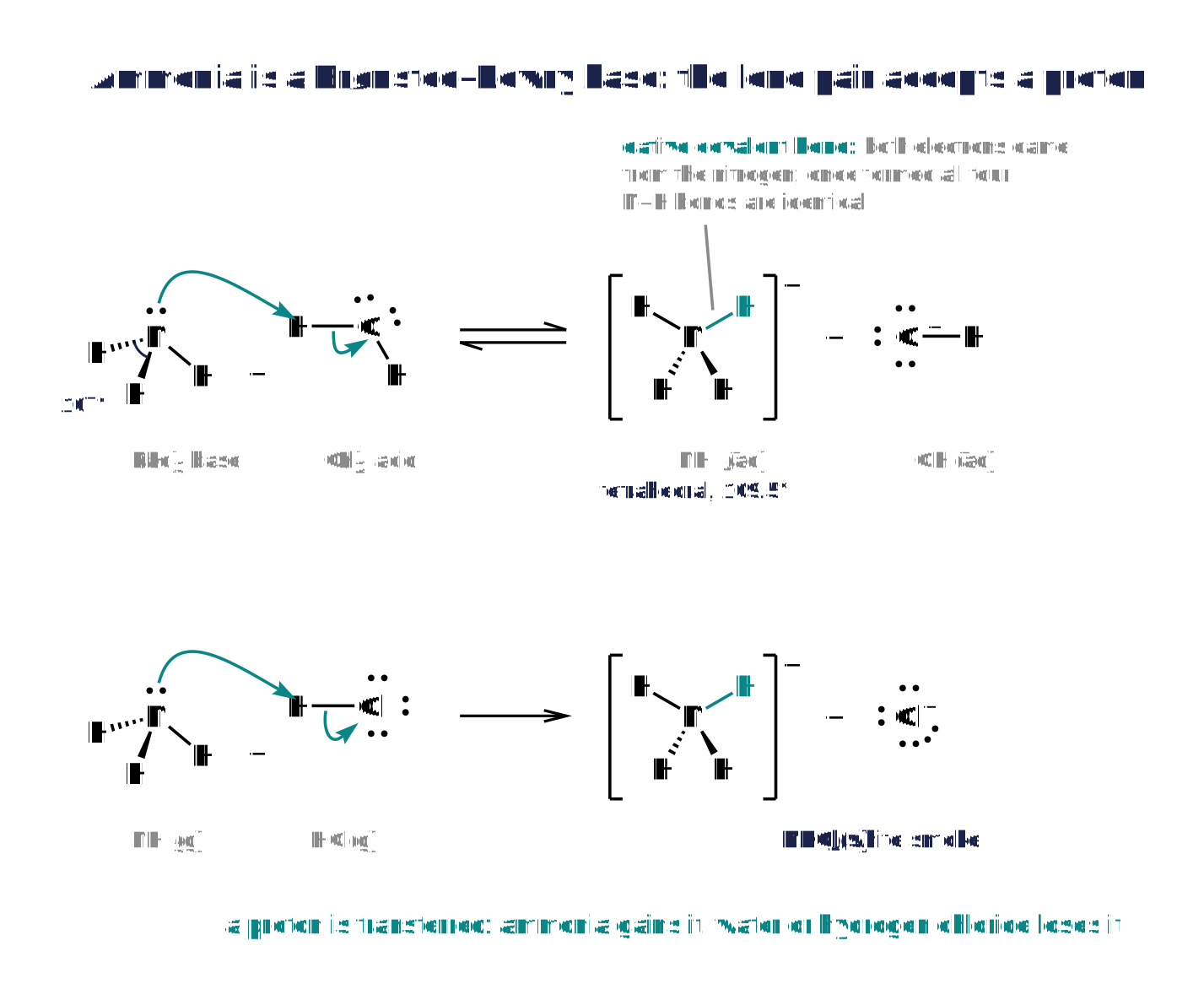
Ammonia accepting a proton from water and from hydrogen chloride: the lone pair becomes the new N–H bond and the equilibrium arrow shows the weak base.
Remember: It is the lone pair, not the N–H bonds, that makes ammonia a base. The proton donor (water or HCl) is the acid in each equation: Acids, Bases and pH Curves.
The Ammonium Ion
When the lone pair of ammonia bonds to a proton, a dative covalent bond forms. H⁺ has no electrons of its own, so both electrons of the new bond come from nitrogen.
- The formation is an acid–base reaction: NH₃ is the base (proton acceptor) and HCl or H₂O is the acid (proton donor).
- Once formed, the dative bond is identical to the other three N–H bonds: the same length, the same strength, the same electron pair shared between N and H.
- Four bonding pairs and no lone pairs repel equally, so NH₄⁺ is tetrahedral with H–N–H angles of 109.5°, wider than the 107° of ammonia.
- The ion carries one positive charge because nitrogen now shares its lone pair, and the charge is written outside square brackets in a dot-and-cross diagram.
- Ammonium salts such as NH₄Cl and (NH₄)₂SO₄ are ionic solids: an NH₄⁺ cation with the anion of the acid. More on the bond itself: Dative Covalent Bonding.
Common mistake: Drawing NH₄⁺ with a lone pair on nitrogen, or calling the dative bond weaker than the others. All four bonds are the same once the ion exists.
Check: Nitrogen and the Basicity of Ammonia
Explain the unreactivity of nitrogen, pick out the acid and the base in equations involving ammonia, and describe the bonding and shape of the ammonium ion.
Displacing Ammonia from Ammonium Salts
An ammonium salt holds the ammonium ion, the conjugate acid of ammonia. A stronger base than ammonia takes the proton from NH₄⁺ and releases ammonia gas.
- With sodium hydroxide on warming: NH₄Cl(s) + NaOH(aq) → NaCl(aq) + NH₃(g) + H₂O(l).
- The ionic equation shows the acid–base step: NH₄⁺(aq) + OH⁻(aq) → NH₃(g) + H₂O(l). Hydroxide is the stronger base, so it wins the proton.
- Why warm: ammonia is very soluble in water, so gentle heating is needed to drive the gas out of the solution.
- With calcium hydroxide (the laboratory preparation of ammonia): 2NH₄Cl(s) + Ca(OH)₂(s) → CaCl₂(s) + 2NH₃(g) + 2H₂O(l) on heating the dry solids.
- The same chemistry explains why farmers never spread lime and an ammonium fertiliser together: the alkaline lime releases the nitrogen as ammonia gas.
The test for an ammonium salt
Step 1. Add sodium hydroxide solution to the solid or solution and warm gently.
Step 3. Confirm with a glass rod dipped in concentrated hydrochloric acid: dense white smoke of ammonium chloride forms, NH₃(g) + HCl(g) → NH₄Cl(s).
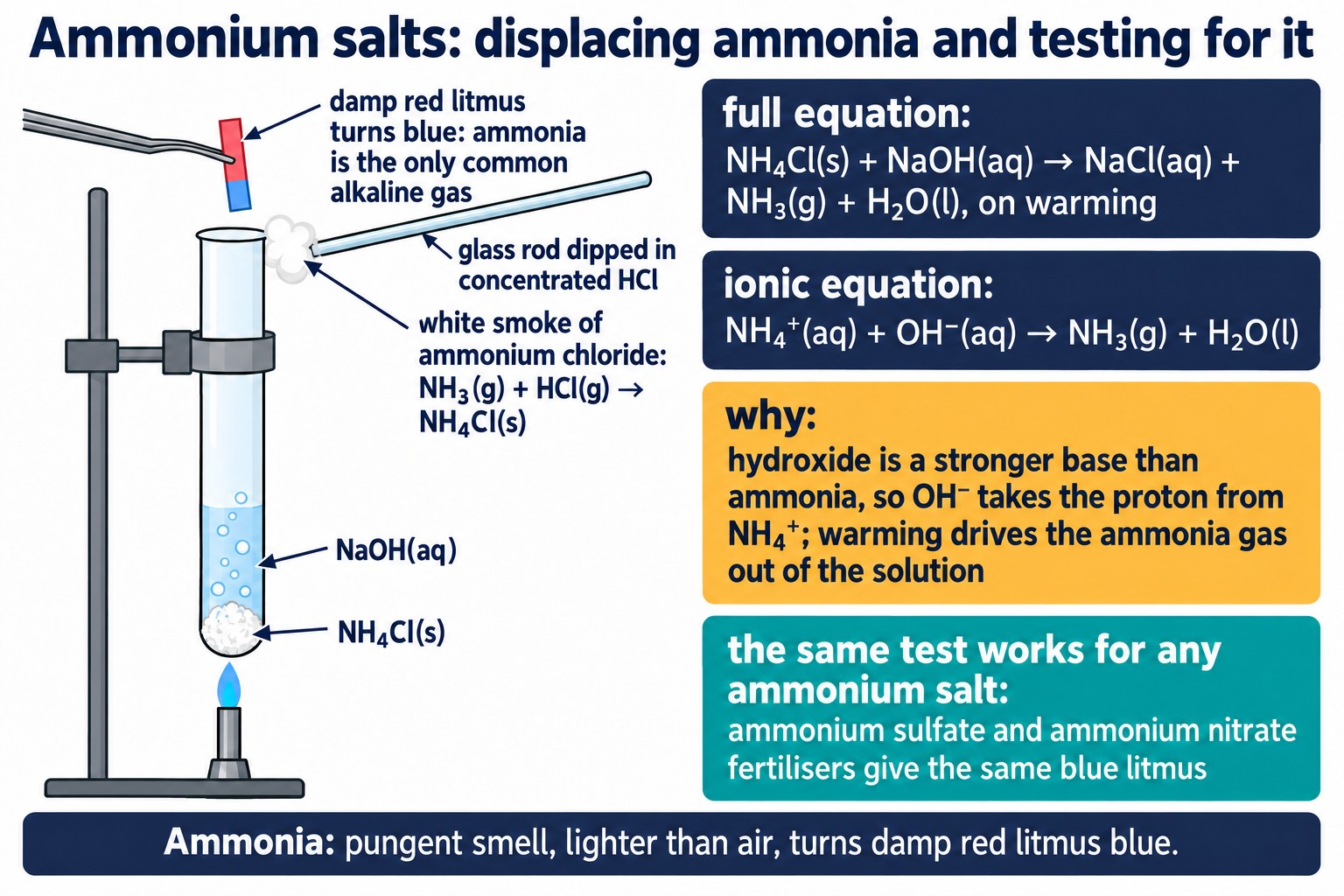
The displacement test as a scene: ammonium salt and sodium hydroxide warmed, damp red litmus turning blue and the white smoke with hydrogen chloride.
Exam focus: A test answer needs the reagent, the condition and the observation: “add NaOH(aq), warm, damp red litmus paper turns blue”. The equation earns the explaining mark.
Quick Check: Tracking the Ammonia from a New Salt
Work out each step on paper with this new salt, then flip the card to compare.
Uses of Ammonia and Its Salts
About 150 million tonnes of ammonia are made each year by the Haber process. Most of it feeds the uses below, and all of them follow from the basicity of the lone pair.
| Use | The chemistry | Note |
|---|---|---|
| nitrogen fertilisers | ammonia neutralised by an acid: (NH₄)₂SO₄, NH₄NO₃ and ammonium phosphate | soluble salts that plants take up as NH₄⁺ and NO₃⁻ |
| nitric acid | ammonia oxidised over platinum: 4NH₃(g) + 5O₂(g) → 4NO(g) + 6H₂O(g), then NO to NO₂ to HNO₃ | the acid is used for fertilisers, explosives and dyes |
| household cleaners | dilute aqueous ammonia dissolves grease as a weak alkali | evaporates without leaving a residue |
| nylon and other polymers | ammonia is the nitrogen source for amines and amides | an industrial feedstock |
| refrigeration | liquid ammonia absorbs heat as it evaporates | used in large cold stores |
- Nitrate fertilisers are very soluble, so rain washes them into rivers where they feed algae: eutrophication.
- The oxides of nitrogen made alongside nitric acid, and in car engines, are the subject of Oxides of Nitrogen and the Environment.
Remember: Every use in the table starts with the lone pair on nitrogen: it accepts a proton in the fertiliser salts and donates electrons to form amines and amides.
Check: Ammonium Salts and Displacement
Write the equation for displacing ammonia with a stronger base, describe the test for an ammonium salt and link the uses of ammonia to its chemistry.
Common Exam Points
- Nitrogen is unreactive for two reasons: the N≡N bond enthalpy of +944 kJ mol⁻¹ and the lack of polarity in the molecule. Give both.
- Ammonia is a Brønsted–Lowry base because the lone pair on nitrogen accepts a proton: NH₃(aq) + H₂O(l) ⇌ NH₄⁺(aq) + OH⁻(aq), a weak base.
- The ammonium ion forms by a dative covalent bond; all four N–H bonds are then identical and the ion is tetrahedral, 109.5°.
- Displacement: NH₄⁺(aq) + OH⁻(aq) → NH₃(g) + H₂O(l) on warming, because hydroxide is the stronger base.
- Test for ammonium ions: warm with NaOH(aq), damp red litmus paper turns blue; white smoke with a rod dipped in concentrated HCl.
- White smoke of NH₄Cl forms when ammonia and hydrogen chloride gases meet: NH₃(g) + HCl(g) → NH₄Cl(s).
- Uses follow from the chemistry: ammonium salts as fertilisers, oxidation to nitric acid, a weak alkali in cleaners.
- Give state symbols on every equation and name the acid and the base when an equation is an acid–base reaction.
FAQs
Use these quick answers to check why nitrogen is so unreactive, why ammonia is a Brønsted–Lowry base, how the ammonium ion forms by a dative bond, and how ammonia is displaced from its salts and tested for.
Why is the nitrogen molecule so unreactive?
The N≡N triple bond is short and very strong, with a bond enthalpy of +944 kJ mol⁻¹, so breaking it needs a great deal of energy. The molecule is also non-polar, with no δ+ site for nucleophiles, so reactions need high temperatures and a catalyst.
Why is ammonia described as a Brønsted–Lowry base?
A Brønsted–Lowry base accepts a proton, and ammonia uses the lone pair on nitrogen to do that: NH₃(aq) + H₂O(l) ⇌ NH₄⁺(aq) + OH⁻(aq). The equilibrium lies to the left, so ammonia is a weak base; 0.1 mol dm⁻³ has pH about 11.
What type of bond forms when ammonia becomes the ammonium ion, and why are all four bonds identical?
The nitrogen lone pair is donated to H⁺, which has no electrons, forming a dative (coordinate) covalent bond. Once formed it is just a shared pair like the other three, so NH₄⁺ is a regular tetrahedron with four identical N–H bonds and angles of 109.5°.
How do I test for an ammonium salt?
Warm the salt with aqueous sodium hydroxide and hold damp red litmus paper in the gas released: it turns blue as ammonia is driven off, NH₄Cl(s) + NaOH(aq) → NaCl(aq) + NH₃(g) + H₂O(l).
Ammonia also gives white smoke of NH₄Cl with hydrogen chloride gas.
Why does sodium hydroxide displace ammonia from an ammonium salt?
Hydroxide is a stronger base than ammonia, so it takes the proton from the ammonium ion: NH₄⁺ + OH⁻ → NH₃ + H₂O. The stronger base wins the proton and the weaker base, ammonia, escapes as a gas on warming, driving the reaction to completion.

Copyright notice: This OLS revision content, including the explanations, layout, diagrams, tables and embedded learning structure, is authored for Online Learning System by Dr. Mohammed Al-Fatah. It may not be copied, reproduced, redistributed or adapted without written permission.
Keep this note — free
Save your progress across every Cambridge topic. A free account remembers which topics you have covered, saves your question scores, and syncs across your phone and laptop.
- Track every topic you have finished
- Keep your practice-question scores
- No payment, no card, free forever
Already registered? Log in