The Electrochemical Series and Feasibility of Reactions
A concise revision guide to using E⦵ values: the electrochemical series, the strongest oxidising and reducing agents, predicting whether a reaction is feasible.
- 24.2.5(b)
- 24.2.6-a
- 24.2.6-b
- 24.2.8
What these spec points say
- 24.2.5(b) use standard cell potentials to predict the feasibility of a reaction
- 24.2.6-a deduce from E⦵ values the relative reactivity of elements, compounds and ions as oxidising agents
- 24.2.6-b deduce from E⦵ values the relative reactivity of elements, compounds and ions as reducing agents
- 24.2.8 predict qualitatively how the value of an electrode potential, E, varies with the concentrations of the aqueous ions
Before You Start
This page uses the E⦵ values from Standard Electrode Potentials and the Hydrogen Electrode and the cell calculation from Electrochemical Cells and Cell Potentials.
- Every half-equation is written as a reduction: oxidised form + electrons ⇌ reduced form.
- The half-cell with the more negative E⦵ releases electrons and is oxidised.
- E⦵cell = E⦵(positive electrode) − E⦵(negative electrode).
- From GCSE: a more reactive metal displaces a less reactive metal from a solution of its ions.
GCSE Recap: Metal Reactivity and Displacement
Three quick questions on the GCSE ideas this page builds on.
The Electrochemical (Redox) Series
The redox series is a list of half-equations arranged in order of their E⦵ values. It is also called the electrochemical series. This table runs from the most negative value to the most positive.
| Half-equation (reduction) | E⦵ / V |
|---|---|
| Li⁺(aq) + e⁻ ⇌ Li(s) | −3.04 |
| Mg²⁺(aq) + 2e⁻ ⇌ Mg(s) | −2.37 |
| Zn²⁺(aq) + 2e⁻ ⇌ Zn(s) | −0.76 |
| Fe²⁺(aq) + 2e⁻ ⇌ Fe(s) | −0.44 |
| 2H⁺(aq) + 2e⁻ ⇌ H₂(g) | 0.00 |
| Cu²⁺(aq) + 2e⁻ ⇌ Cu(s) | +0.34 |
| I₂(aq) + 2e⁻ ⇌ 2I⁻(aq) | +0.54 |
| Fe³⁺(aq) + e⁻ ⇌ Fe²⁺(aq) | +0.77 |
| Ag⁺(aq) + e⁻ ⇌ Ag(s) | +0.80 |
| Br₂(aq) + 2e⁻ ⇌ 2Br⁻(aq) | +1.07 |
| Cr₂O₇²⁻(aq) + 14H⁺(aq) + 6e⁻ ⇌ 2Cr³⁺(aq) + 7H₂O(l) | +1.33 |
| Cl₂(g) + 2e⁻ ⇌ 2Cl⁻(aq) | +1.36 |
| MnO₄⁻(aq) + 8H⁺(aq) + 5e⁻ ⇌ Mn²⁺(aq) + 4H₂O(l) | +1.51 |
| F₂(g) + 2e⁻ ⇌ 2F⁻(aq) | +2.87 |
- Some data tables run the other way, with the most positive value at the top. Always read the signs, not the position.
- You are given the values in the exam. They do not need to be memorised.
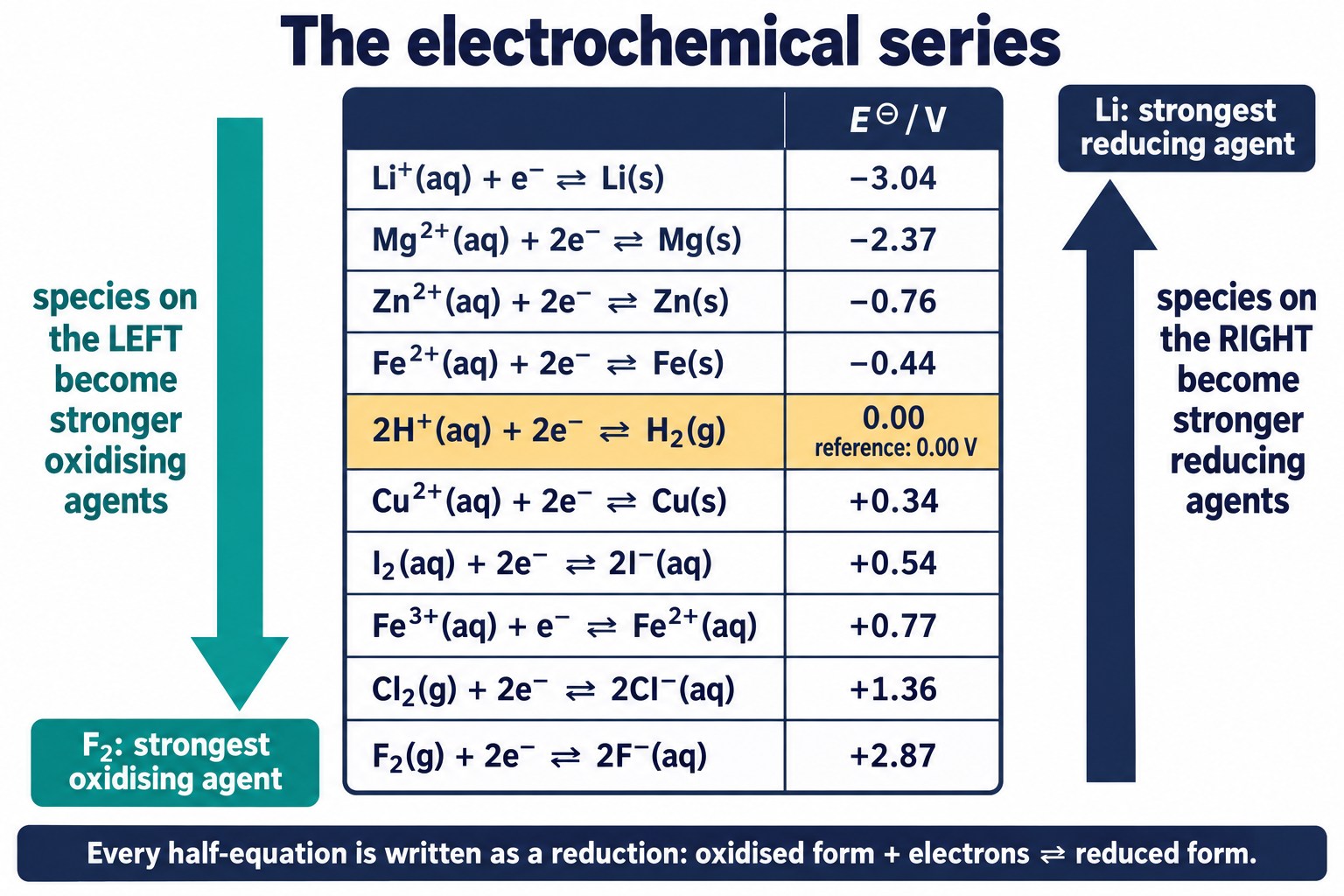
The redox series as a ladder from lithium to fluorine, with the strongest reducing agent at the negative end and the strongest oxidising agent at the positive end.
Oxidising Agents and Reducing Agents in the Series
Each half-equation has an oxidising agent on its left-hand side and a reducing agent on its right-hand side.
| E⦵ value | Equilibrium tends to go | What this means |
|---|---|---|
| very positive | forwards: the left-hand species gains electrons | the species on the left is a strong oxidising agent |
| very negative | backwards: the right-hand species loses electrons | the species on the right is a strong reducing agent |
- The strongest oxidising agent is on the left of the most positive half-equation: F₂, at +2.87 V.
- The strongest reducing agent is on the right of the most negative half-equation: Li, at −3.04 V.
- Li⁺ is a very weak oxidising agent, and F⁻ is a very weak reducing agent.
- Oxidising power on the left increases as E⦵ becomes more positive: I₂, then Br₂, then Cl₂, then F₂.
- Reducing power on the right increases as E⦵ becomes more negative: Cu, then Fe, then Zn, then Mg.
Remember: Compare species on the same side. Oxidising agents are on the left with the electrons; reducing agents are on the right. A metal ion such as Zn²⁺ is not a reducing agent.
Check: Reading the Electrochemical Series
Rank oxidising agents and reducing agents from E⦵ values, using half-equations given in the questions.
Predicting Whether a Reaction Is Feasible
Two half-cells with different E⦵ values will drive a reaction in one direction only. A reaction is feasible if its E⦵cell is positive.
Method
- Write the two half-equations as reductions, with their E⦵ values.
- The half-equation with the more positive E⦵ goes forwards, as a reduction.
- The half-equation with the more negative E⦵ is reversed, as an oxidation.
- Find E⦵cell = E⦵(reduction half-cell) − E⦵(oxidation half-cell).
- Multiply the half-equations so the electrons match, then add them to get the overall equation.
- If the reaction asked about matches this direction, E⦵cell is positive and the reaction is feasible.
- If it is the opposite direction, E⦵cell is negative and the reaction does not happen under standard conditions.
- With the more negative half-equation written on top, the feasible changes run anticlockwise: the top one backwards, the bottom one forwards.
- In a longer data table, first pick out the two half-equations that contain the species actually present in the mixture.
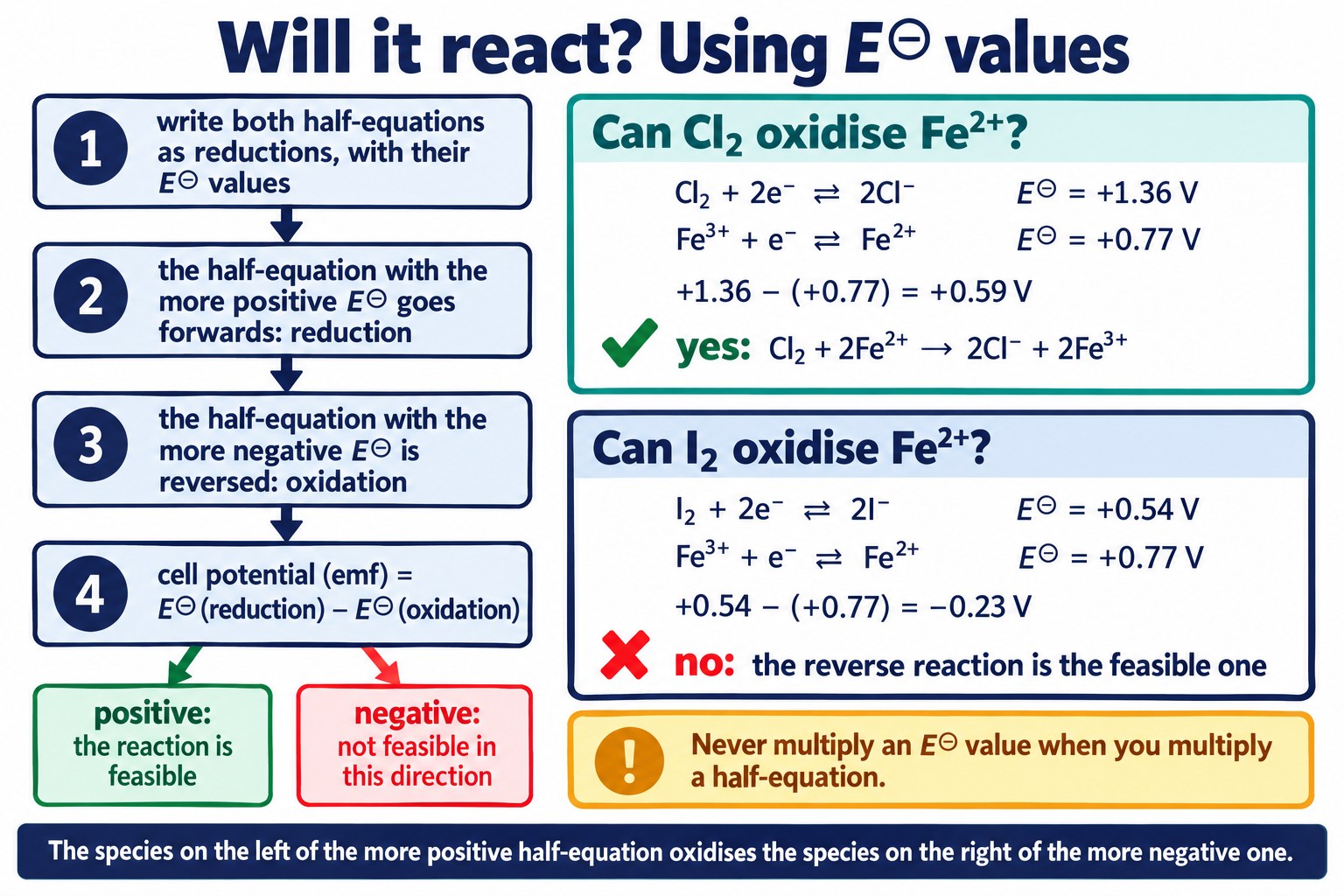
A four-step route from two E⦵ values to a prediction, worked for chlorine with iron(II) ions and for iodine with iron(II) ions.
Exam focus: State the comparison in words: “E⦵ for Cl₂/Cl⁻ is more positive than E⦵ for Fe³⁺/Fe²⁺, so Cl₂ oxidises Fe²⁺.” Then give the value of E⦵cell with its sign.
Worked Examples
Worked example 1: can chlorine oxidise iron(II) ions?
Data: Cl₂ + 2e⁻ ⇌ 2Cl⁻, E⦵ = +1.36 V. Fe³⁺ + e⁻ ⇌ Fe²⁺, E⦵ = +0.77 V.
Step 1. The reaction asked about needs Cl₂ reduced and Fe²⁺ oxidised.
Step 3. E⦵cell = +1.36 − (+0.77) = +0.59 V.
Worked example 2: can iodine oxidise iron(II) ions?
Data: I₂ + 2e⁻ ⇌ 2I⁻, E⦵ = +0.54 V. Fe³⁺ + e⁻ ⇌ Fe²⁺, E⦵ = +0.77 V.
Step 1. The reaction asked about needs I₂ reduced and Fe²⁺ oxidised.
Step 2. E⦵cell = +0.54 − (+0.77) = −0.23 V.
Worked example 3: does copper react with dilute acid?
Data: 2H⁺ + 2e⁻ ⇌ H₂, E⦵ = 0.00 V. Cu²⁺ + 2e⁻ ⇌ Cu, E⦵ = +0.34 V.
Step 1. The reaction asked about needs H⁺ reduced and Cu oxidised.
Step 2. E⦵cell = 0.00 − (+0.34) = −0.34 V.
A species that reacts with itself
Data: H₂O₂ + 2H⁺ + 2e⁻ ⇌ 2H₂O, E⦵ = +1.77 V. O₂ + 2H⁺ + 2e⁻ ⇌ H₂O₂, E⦵ = +0.68 V.
- H₂O₂ is on the left of the more positive half-equation, so one molecule is reduced to water.
- H₂O₂ is on the right of the less positive half-equation, so another molecule is oxidised to oxygen.
- E⦵cell = +1.77 − (+0.68) = +1.09 V, so 2H₂O₂ → 2H₂O + O₂ is feasible.
- Oxygen changes from −1 to −2 and to 0. Oxidation and reduction of the same element in one reaction is called disproportionation.
Check: Predicting Feasibility
Use E⦵ values to decide whether reactions happen and to calculate the standard cell potential, with pairs of half-equations not used on this page.
Quick Check: Will It React with Itself?
Work out each answer on paper, then flip the card to compare.
How Concentration Changes an Electrode Potential
E⦵ values apply only under standard conditions. Each half-cell is an equilibrium, so a change in concentration shifts its position and changes the potential, E.
- Increasing the concentration of the oxidised form (on the left) shifts the equilibrium to the right. Electrons are removed from the electrode, and E becomes more positive.
- Decreasing that concentration shifts the equilibrium to the left. Electrons are released onto the electrode, and E becomes more negative.
Example: the zinc–copper cell
| Change | Effect on the half-cell | Effect on the cell potential |
|---|---|---|
| dilute the Zn²⁺(aq) | Zn²⁺ + 2e⁻ ⇌ Zn shifts left; E more negative than −0.76 V | greater than 1.10 V |
| dilute the Cu²⁺(aq) | Cu²⁺ + 2e⁻ ⇌ Cu shifts left; E less positive than +0.34 V | less than 1.10 V |
- The cell potential is the gap between the two E values. It grows when they move apart and shrinks when they move together.
- Short cut: treat the overall cell reaction as an equilibrium. More concentrated reactant ions raise the cell potential; more concentrated product ions lower it.
- The size of the change is calculated with the Nernst equation: see The Nernst Equation and Gibbs Free Energy.
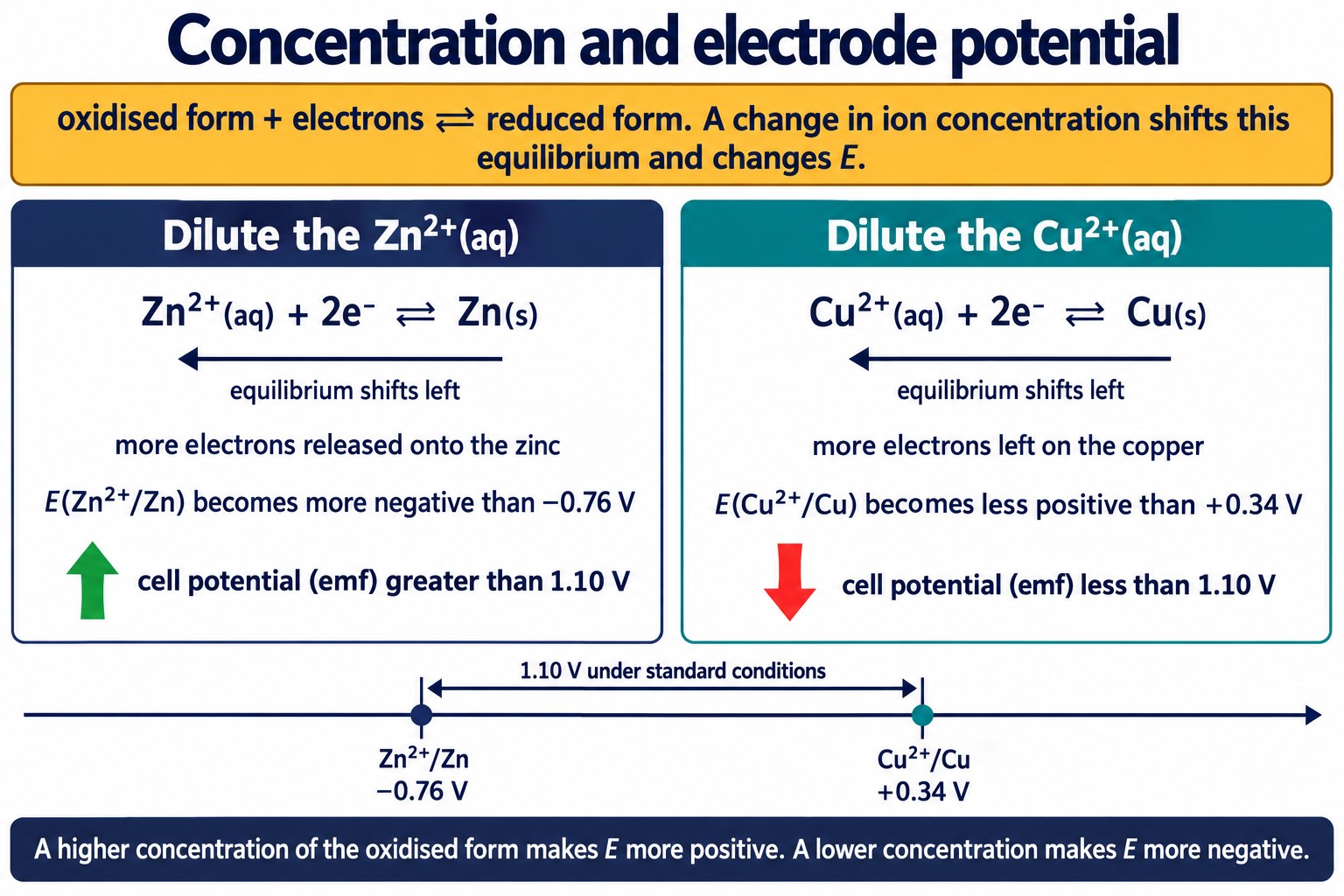
Diluting the zinc ions makes the zinc potential more negative and the cell potential larger; diluting the copper(II) ions has the opposite effect.
Exam focus: Explain in three steps: which way the half-cell equilibrium shifts, whether electrons are released or removed, and so whether E becomes more negative or more positive.
Quick Check: Changing the Concentrations
A cell is made from Mg²⁺ + 2e⁻ ⇌ Mg (E⦵ = −2.37 V) and Ni²⁺ + 2e⁻ ⇌ Ni (E⦵ = −0.25 V), with a standard cell potential of 2.12 V.
Common Exam Points
Say
- “E⦵cell is positive, so the reaction is feasible.”
- “The more positive half-equation goes forwards as a reduction.”
- “F₂ is the strongest oxidising agent because its half-equation has the most positive E⦵.”
Do not say
- “Zinc has a higher E⦵” for a negative value: say more negative or more positive.
- “Zn²⁺ is a strong reducing agent” (the reducing agent is Zn, on the right).
- “The reaction is feasible, so it is fast” (E⦵ values say nothing about rate).
Watch for
- Reversing the sign of E⦵ and then subtracting as well: use the table values as given.
- E⦵ values multiplied by the number of electrons: never multiply them.
- Overall equations in the wrong direction: the more negative half-equation is the one reversed.
- Non-standard conditions, such as concentrated acid: the E⦵ prediction may not hold.
Check: Feasibility and Its Limits
Apply E⦵ values to new reactions and explain how a change in concentration alters an electrode potential.
FAQs
Use these quick answers to check the electrochemical series and predicting whether a reaction is feasible.
How do I find the strongest oxidising agent in a list of E⦵ values?
Find the most positive E⦵: the species on the left of that half-equation gains electrons most readily, so F₂ (+2.87 V) is the strongest oxidising agent. The strongest reducing agent is on the right of the most negative, Li (−3.04 V).
How do I predict whether a redox reaction will happen?
Calculate the standard cell potential for the reaction as written: E⦵ of the half-cell being reduced minus E⦵ of the half-cell being oxidised. A positive value means the reaction is feasible. For Cl₂ with Fe²⁺: +1.36 − (+0.77) = +0.59 V.
Can iodine oxidise iron(II) ions?
No. E⦵ for I₂/I⁻ is +0.54 V and for Fe³⁺/Fe²⁺ it is +0.77 V, so the value is +0.54 − (+0.77) = −0.23 V. The reverse reaction is the one that goes: 2Fe³⁺ + 2I⁻ → 2Fe²⁺ + I₂.
Why does copper not react with dilute acids?
For Cu + 2H⁺ → Cu²⁺ + H₂ the value is 0.00 − (+0.34) = −0.34 V, so H⁺ ions are not a strong enough oxidising agent. Metals with a negative E⦵, such as zinc and iron, do release hydrogen.
How does concentration change an electrode potential?
Apply Le Chatelier to the half-cell equilibrium. Diluting Zn²⁺(aq) shifts Zn²⁺ + 2e⁻ ⇌ Zn to the left, releasing electrons, so E becomes more negative. In a zinc-copper cell this raises the cell voltage above 1.10 V.

Copyright notice: This OLS revision content, including the explanations, layout, diagrams, tables and embedded learning structure, is authored for Online Learning System by Dr. Mohammed Al-Fatah. It may not be copied, reproduced, redistributed or adapted without written permission.
Keep this note — free
Save your progress across every Cambridge topic. A free account remembers which topics you have covered, saves your question scores, and syncs across your phone and laptop.
- Track every topic you have finished
- Keep your practice-question scores
- No payment, no card, free forever
Already registered? Log in