The Nernst Equation and Gibbs Free Energy
A concise revision guide to non-standard electrode potentials: how E changes with the concentrations of the aqueous ions, calculations with the Nernst equation, and using ΔG⦵ = −nE⦵cellF to link cell potential to Gibbs free energy.
- 24.2.8
- 24.2.9
- 24.2.10
What these spec points say
- 24.2.8 predict qualitatively how the value of an electrode potential, E, varies with the concentrations of the aqueous ions
- 24.2.9 use the Nernst equation, e.g. E = E⦵ + (0.059/z) log([oxidised species]/[reduced species]), to predict quantitatively how the value of an electrode potential varies with the concentrations of the aqueous ions; examples include Cu2+(aq) + 2e– ⇌ Cu(s), Fe3+(aq) + e– ⇌ Fe2+(aq)
- 24.2.10 understand and use the equation ΔG⦵ = –nE⦵cell F
Before You Start
This page builds on Standard Electrode Potentials, Electrochemical Cells and Cell Potentials and The Electrochemical Series and Feasibility of Reactions. The free energy ideas come from Topic 23 Chemical energetics.
What you need to remember
- The standard electrode (reduction) potential, E⦵, is measured under standard conditions: 298 K, 101 kPa and solutions of 1.00 mol dm⁻³.
- Half-equations are written as reductions: oxidised species + electrons ⇌ reduced species.
- The standard cell potential is E⦵cell = E⦵(positive electrode) − E⦵(negative electrode).
- A reaction is feasible when E⦵cell is positive.
- A reaction is feasible when the Gibbs free energy change, ΔG, is negative.
Electrode Potentials When Conditions Are Not Standard
Away from standard conditions the electrode potential is written E, without the ⦵ sign. Its value depends on the concentrations of the aqueous ions in the half-cell.
A metal and its ions
Cu²⁺(aq) + 2e⁻ ⇌ Cu(s)
- Increasing the concentration of Cu²⁺ shifts the equilibrium to the right (Le Chatelier).
- Electrons are removed from the copper electrode, so its potential becomes more positive.
- Diluting the Cu²⁺ shifts the equilibrium to the left, electrons build up on the electrode, and E becomes less positive.
Two ions of the same element
Fe³⁺(aq) + e⁻ ⇌ Fe²⁺(aq)
| Change | Shift in the equilibrium | Effect on E |
|---|---|---|
| increase the concentration of Fe³⁺ | to the right | more positive |
| decrease the concentration of Fe³⁺ | to the left | less positive |
| increase the concentration of Fe²⁺ | to the left | less positive |
| decrease the concentration of Fe²⁺ | to the right | more positive |
Key idea: More of the oxidised species (the left-hand side of the half-equation) makes E more positive. More of the reduced species makes E less positive.
Quick Check: Which Way Does E Move?
Each change is made to a half-cell at 298 K that is new to this page, so use the half-equation to decide.
The Nernst Equation
The Nernst equation gives the size of the change. At 298 K:
E = E⦵ + (0.059) / (z) log ([oxidised species]) / ([reduced species])
| Term | Meaning |
|---|---|
| E | electrode potential under the actual conditions, in V |
| E⦵ | standard electrode potential of the half-cell, in V |
| 0.059 | a constant, in V, that applies at 298 K |
| z | number of electrons transferred in the half-equation |
| log | logarithm to base 10 (the log key, not ln) |
| [oxidised species] | concentration of the species on the electron side of the half-equation, in mol dm⁻³ |
| [reduced species] | concentration of the species on the other side, in mol dm⁻³ |
A metal in a solution of its ions
The reduced species is the solid metal. A solid has no concentration term, so the equation becomes simpler.
E = E⦵ + (0.059) / (z) log [Mⁿ⁺]
Three quick checks
- If every concentration is 1.00 mol dm⁻³, the log term is log 1 = 0 and E = E⦵.
- A concentration ratio below 1 has a negative log, so E is less positive than E⦵.
- Each tenfold change in the ratio changes E by (0.059) / (z) volts.
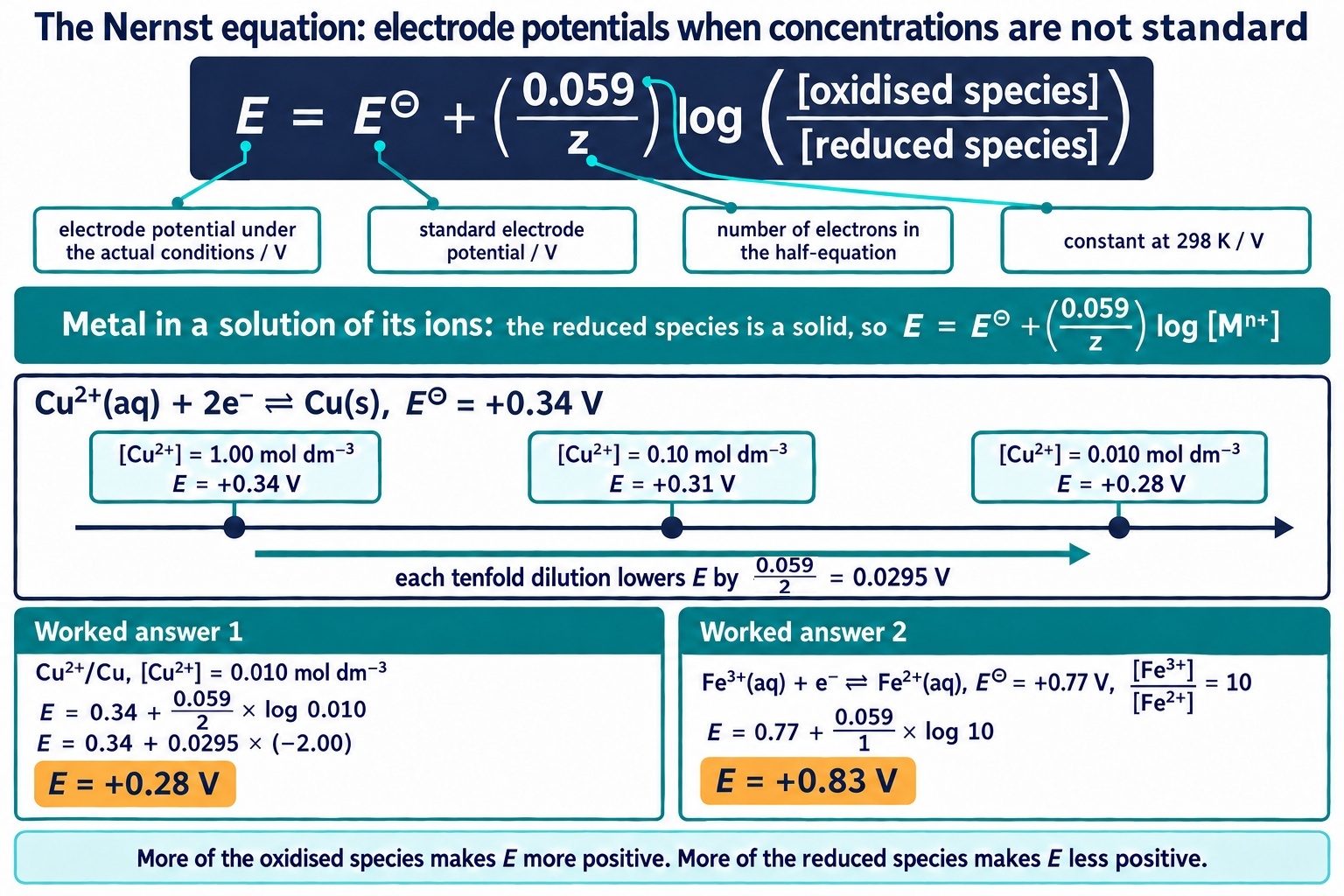
The Nernst equation with its terms, the simpler form for a metal and its ions, and the copper half-cell potential falling as the solution is diluted.
Nernst Equation Calculations
Worked example 1: a metal and its ions
Calculate E for a copper half-cell in which [Cu²⁺] = 0.010 mol dm⁻³. E⦵Cu²⁺/Cu = +0.34 V.
Step 2. E = 0.34 + ((0.059) / (2)) × log 0.010 = 0.34 + (0.0295 × −2.00)
Worked example 2: two aqueous ions
Calculate E for an Fe³⁺/Fe²⁺ half-cell in which the concentration of Fe³⁺ is ten times that of Fe²⁺. E⦵ = +0.77 V.
Step 2. E = 0.77 + ((0.059) / (1)) × log 10 = 0.77 + (0.059 × 1.00)
Worked example 3: a negative electrode potential
Calculate E for a zinc half-cell in which [Zn²⁺] = 0.10 mol dm⁻³. E⦵Zn²⁺/Zn = −0.76 V.
Step 1. Zn²⁺ + 2e⁻ ⇌ Zn, so z = 2.
Step 2. E = −0.76 + ((0.059) / (2)) × log 0.10 = −0.76 + (0.0295 × −1.00)
Worked example 4: the effect on a cell
A zinc–copper cell has [Zn²⁺] = 1.00 mol dm⁻³ and [Cu²⁺] = 0.010 mol dm⁻³. Calculate the cell potential.
Step 2. Ecell = E(positive electrode) − E(negative electrode) = (+0.28) − (−0.76)
Answer. Ecell = 1.04 V, which is smaller than the standard value of 1.10 V.
Exam focus: Write the half-equation as a reduction first. It gives z, and it shows which species is oxidised (with the electrons) and which is reduced.
Check: Concentration and the Nernst Equation
Predict how an electrode potential changes with concentration and use the Nernst equation for half-cells and concentrations not used on this page.
Cell Potential and Gibbs Free Energy
The standard cell potential of a reaction is linked to its standard Gibbs free energy change.
ΔG⦵ = −nE⦵cellF
| Term | Meaning | Unit |
|---|---|---|
| ΔG⦵ | standard Gibbs free energy change | J mol⁻¹ |
| n | number of electrons transferred in the overall equation | none |
| E⦵cell | standard cell potential | V |
| F | Faraday constant, 96 500 | C mol⁻¹ |
- One volt is one joule per coulomb, so V × C mol⁻¹ gives J mol⁻¹.
- Divide by 1000 to convert the answer to kJ mol⁻¹.
- Find n by balancing the electrons in the two half-equations before they cancel.
The sign
| E⦵cell | ΔG⦵ | Reaction as written |
|---|---|---|
| positive | negative | feasible |
| zero | zero | at equilibrium |
| negative | positive | not feasible: the reverse reaction is feasible |
The minus sign in the equation means that E⦵cell and ΔG⦵ always have opposite signs. The two tests of feasibility therefore always agree.
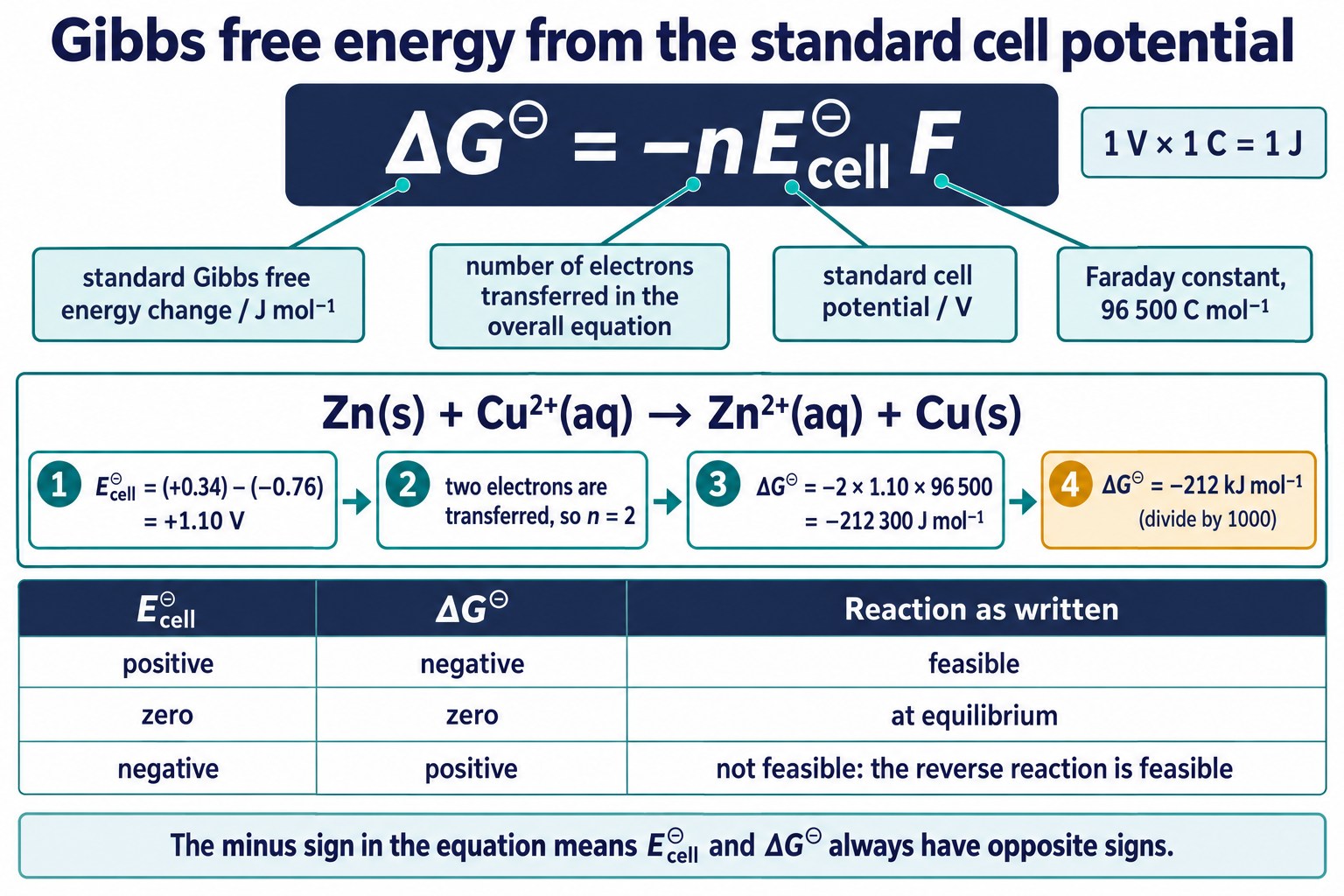
The equation ΔG⦵ = −nE⦵cellF with its terms and units, applied to the zinc–copper cell.
Gibbs Free Energy Calculations
Worked example 1
Calculate ΔG⦵ for Zn(s) + Cu²⁺(aq) → Zn²⁺(aq) + Cu(s). E⦵ values: Zn²⁺/Zn −0.76 V, Cu²⁺/Cu +0.34 V.
Step 1. E⦵cell = (+0.34) − (−0.76) = +1.10 V.
Step 2. Zn → Zn²⁺ + 2e⁻ and Cu²⁺ + 2e⁻ → Cu, so n = 2.
Step 3. ΔG⦵ = −2 × 1.10 × 96 500 = −212 300 J mol⁻¹
Worked example 2
Calculate ΔG⦵ for Cl₂(aq) + 2Fe²⁺(aq) → 2Cl⁻(aq) + 2Fe³⁺(aq). E⦵ values: Cl₂/Cl⁻ +1.36 V, Fe³⁺/Fe²⁺ +0.77 V.
Step 1. Chlorine is reduced, so E⦵cell = (+1.36) − (+0.77) = +0.59 V.
Step 2. Cl₂ + 2e⁻ → 2Cl⁻, and two Fe²⁺ ions lose one electron each, so n = 2.
Answer. ΔG⦵ = −2 × 0.59 × 96 500 = −113 870 J mol⁻¹ = −114 kJ mol⁻¹
Worked example 3: finding n
Calculate ΔG⦵ for MnO₄⁻ + 8H⁺ + 5Fe²⁺ → Mn²⁺ + 4H₂O + 5Fe³⁺. E⦵ values: MnO₄⁻/Mn²⁺ +1.51 V, Fe³⁺/Fe²⁺ +0.77 V.
Step 1. E⦵cell = (+1.51) − (+0.77) = +0.74 V.
Answer. ΔG⦵ = −5 × 0.74 × 96 500 = −357 050 J mol⁻¹ = −357 kJ mol⁻¹
Worked example 4: a reaction that is not feasible
Calculate ΔG⦵ for Cu(s) + 2H⁺(aq) → Cu²⁺(aq) + H₂(g).
Step 1. E⦵cell = 0.00 − (+0.34) = −0.34 V, and n = 2.
Step 2. ΔG⦵ = −2 × (−0.34) × 96 500 = +65 620 J mol⁻¹
Remember: Do not multiply E⦵ values when a half-equation is multiplied. The number of electrons enters the calculation once only, as n.
Quick Check: Non-Standard Cells
Work out each answer on paper, then flip the card to compare.
Common Exam Points
Say
- “Increasing the concentration of the oxidised species shifts the equilibrium to the right, so E becomes more positive.”
- “z is the number of electrons in the half-equation.”
- “E⦵cell is positive, so ΔG⦵ is negative and the reaction is feasible.”
Do not say
- “E⦵ changes with concentration” (E⦵ is fixed: it is E that changes).
- “Use ln in the Nernst equation” (the 0.059 form uses log to base 10).
- “ΔG⦵ = −212 300 kJ mol⁻¹” (the equation gives joules: divide by 1000).
Watch for
- The solid metal is left out of the log term.
- The ratio is oxidised over reduced, never the other way up.
- Signs: a negative E⦵ and a negative log term are both easy to drop.
- F is written 96 500 C mol⁻¹, and n has no unit.
Check: ΔG⦵ = −nE⦵cellF
Find n, calculate ΔG⦵ from standard cell potentials and decide feasibility for reactions not used on this page.
FAQs
Use these quick answers to check the Nernst equation and the link between cell potential and Gibbs free energy.
What happens to E if the concentration of the oxidised species increases?
The half-cell equilibrium, such as Cu²⁺ + 2e⁻ ⇌ Cu, shifts to the right to remove the added ions. Electrons are taken from the electrode, so E becomes more positive. Diluting the ions has the opposite effect.
What is the Nernst equation?
At 298 K, E = E⦵ + (0.059) / (z) log(([oxidised species]) / ([reduced species])), where z is the number of electrons in the half-equation. For a metal in a solution of its ions the metal is a solid, so E = E⦵ + (0.059) / (z) log[Mⁿ⁺].
How do I calculate E for a copper half-cell with 0.010 mol dm⁻³ Cu²⁺?
Here z = 2 and log 0.010 = −2, so E = +0.34 + ((0.059) / (2)) × (−2) = +0.34 − 0.059 = +0.28 V. Each tenfold dilution lowers E by about 0.03 V for a two-electron half-cell.
How do I calculate ΔG⦵ from a cell potential?
Use ΔG⦵ = −nE⦵cellF, with F = 96 500 C mol⁻¹. For Zn + Cu²⁺ → Zn²⁺ + Cu, n = 2 and E⦵cell = +1.10 V, so ΔG⦵ = −2 × 1.10 × 96 500 = −212 300 J mol⁻¹, or −212 kJ mol⁻¹.
Why does a positive E⦵cell mean a reaction is feasible?
In ΔG⦵ = −nE⦵cellF, both n and F are always positive. A positive E⦵cell therefore gives a negative ΔG⦵, which is the condition for a feasible reaction. A negative E⦵cell gives a positive ΔG⦵, so the reaction is not feasible.

Copyright notice: This OLS revision content, including the explanations, layout, diagrams, tables and embedded learning structure, is authored for Online Learning System by Dr. Mohammed Al-Fatah. It may not be copied, reproduced, redistributed or adapted without written permission.
Keep this note — free
Save your progress across every Cambridge topic. A free account remembers which topics you have covered, saves your question scores, and syncs across your phone and laptop.
- Track every topic you have finished
- Keep your practice-question scores
- No payment, no card, free forever
Already registered? Log in