Electrolysis: Predicting the Products
A concise revision guide to electrolysis: what happens at the anode and the cathode, and predicting the substances liberated from the state of the electrolyte, the position in the redox series and the concentration.
- 24.1.1-a
- 24.1.1-b
- 24.1.1-c
What these spec points say
- 24.1.1-a predict the identities of substances liberated during electrolysis from the state of electrolyte (molten or aqueous)
- 24.1.1-b predict the identities of substances liberated during electrolysis from the position in the redox series (electrode potential)
- 24.1.1-c predict the identities of substances liberated during electrolysis from the concentration
Before You Start
Electrolysis was first met before A Level. This page uses E⦵ values from the redox series to explain which product forms. Oxidation and reduction are covered in Topic 6 Electrochemistry.
- Electrolysis is the decomposition of an ionic compound, molten or in aqueous solution, by an electric current.
- An ionic solid does not conduct, because its ions are not free to move.
- Oxidation is loss of electrons. Reduction is gain of electrons.
- A more positive E⦵ means that the species on the left of the half-equation is more easily reduced.
GCSE Recap: Ions at the Electrodes
Three quick questions on the GCSE ideas this page builds on.
The Electrolysis Cell
| Term | Meaning |
|---|---|
| Electrolyte | the molten or dissolved ionic compound that conducts and is decomposed |
| Electrodes | the rods that carry the current into and out of the electrolyte |
| Anode | the positive electrode: anions move to it and are oxidised |
| Cathode | the negative electrode: cations move to it and are reduced |
| Inert electrode | an electrode that does not react, such as graphite or platinum |
- The d.c. power supply pulls electrons away from the anode and pushes them onto the cathode.
- At the anode, ions lose electrons: oxidation.
- At the cathode, ions gain electrons: reduction.
- Ions carry the current through the electrolyte. Electrons carry it through the wires.
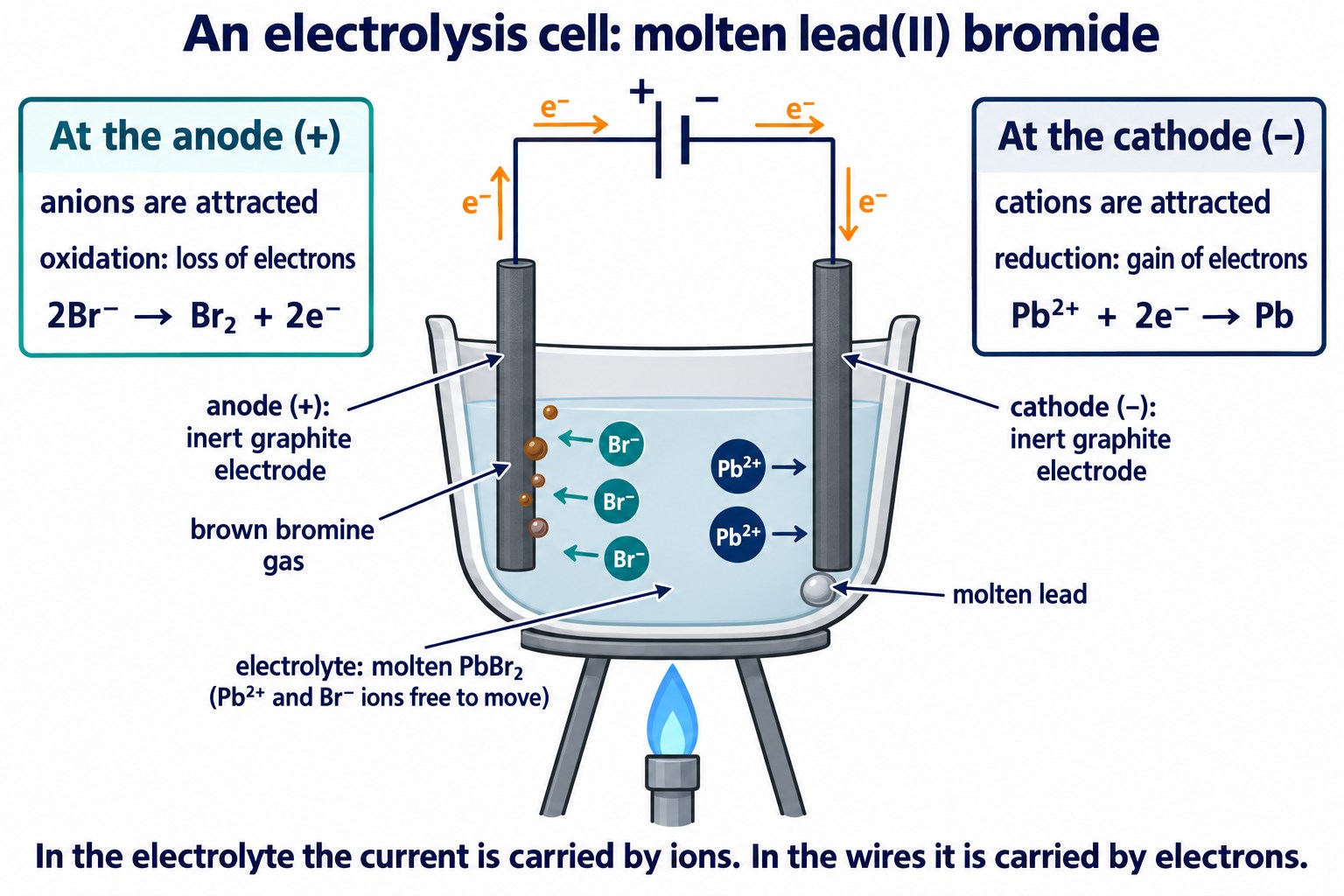
Electrolysis of molten lead(II) bromide with inert electrodes: Br⁻ ions are oxidised to bromine at the anode and Pb²⁺ ions are reduced to lead at the cathode.
Remember: In electrolysis the anode is positive and the cathode is negative. Oxidation always happens at the anode and reduction at the cathode.
Molten Electrolytes
A molten binary compound contains only two types of ion. There is no choice to make: the cation is reduced and the anion is oxidised.
| Molten electrolyte | At the cathode (−) | At the anode (+) |
|---|---|---|
| Lead(II) bromide, PbBr₂ | Pb²⁺ + 2e⁻ → Pb | 2Br⁻ → Br₂ + 2e⁻ |
| Sodium chloride, NaCl | Na⁺ + e⁻ → Na | 2Cl⁻ → Cl₂ + 2e⁻ |
| Aluminium oxide, Al₂O₃ | Al³⁺ + 3e⁻ → Al | 2O²⁻ → O₂ + 4e⁻ |
- The metal forms at the cathode and the non-metal forms at the anode.
- Aluminium oxide is dissolved in molten cryolite to lower the working temperature.
- In aluminium extraction the hot graphite anodes react with the oxygen to form carbon dioxide.
- Very reactive metals, such as sodium and aluminium, can only be made by electrolysis of a molten compound.
Check: Cells and Molten Electrolytes
Identify the electrodes, the direction of ion movement and the half-equations for molten electrolytes that are not used on this page.
Aqueous Electrolytes: Water Competes
An aqueous solution contains the ions of the compound and also water. Water can be reduced at the cathode or oxidised at the anode. So at each electrode there is a competition.
| Electrode | Possible reactions | Product from water |
|---|---|---|
| Cathode (−) | the metal ion is reduced, or water (or H⁺) is reduced | hydrogen |
| Anode (+) | the anion is oxidised, or water (or OH⁻) is oxidised | oxygen |
Equations for water
| Electrode | Solution | Half-equation |
|---|---|---|
| Cathode | neutral or alkaline | 2H₂O + 2e⁻ → H₂ + 2OH⁻ |
| Cathode | acidic | 2H⁺ + 2e⁻ → H₂ |
| Anode | neutral or alkaline | 4OH⁻ → O₂ + 2H₂O + 4e⁻ |
| Anode | acidic | 2H₂O → O₂ + 4H⁺ + 4e⁻ |
Key idea: Three things decide what is liberated: the state of the electrolyte (molten or aqueous), the position in the redox series (the E⦵ value) and the concentration.
At the Cathode: Using E⦵ Values
Reduction happens at the cathode. The species that is most easily reduced is discharged: the one with the more positive E⦵.
| Half-equation | E⦵ / V | At the cathode in aqueous solution |
|---|---|---|
| Ag⁺ + e⁻ ⇌ Ag | +0.80 | silver is deposited |
| Cu²⁺ + 2e⁻ ⇌ Cu | +0.34 | copper is deposited |
| 2H⁺ + 2e⁻ ⇌ H₂ | 0.00 | hydrogen is given off |
| Al³⁺ + 3e⁻ ⇌ Al | −1.66 | hydrogen, not aluminium |
| Mg²⁺ + 2e⁻ ⇌ Mg | −2.37 | hydrogen, not magnesium |
| Na⁺ + e⁻ ⇌ Na | −2.71 | hydrogen, not sodium |
- Cu²⁺ and Ag⁺ have positive E⦵ values. They are reduced more easily than H⁺ or water, so the metal is deposited.
- Na⁺, Mg²⁺ and Al³⁺ have very negative E⦵ values. They are very hard to reduce, so hydrogen forms.
- When hydrogen forms from a neutral solution, OH⁻ ions are left behind and the solution becomes alkaline.
At the Anode: E⦵ and Concentration
Oxidation happens at the anode. The species that is most easily oxidised is discharged: the one on the right of the half-equation with the less positive E⦵.
| Half-equation | E⦵ / V |
|---|---|
| I₂ + 2e⁻ ⇌ 2I⁻ | +0.54 |
| Br₂ + 2e⁻ ⇌ 2Br⁻ | +1.07 |
| O₂ + 4H⁺ + 4e⁻ ⇌ 2H₂O | +1.23 |
| Cl₂ + 2e⁻ ⇌ 2Cl⁻ | +1.36 |
- I⁻ and Br⁻ are oxidised more easily than water, so iodine or bromine forms.
- Sulfate and nitrate ions are not oxidised. Water is oxidised and oxygen forms.
- For Cl⁻ the two E⦵ values are close: +1.36 V and +1.23 V. Here the concentration decides.
The effect of concentration
| Solution | Anode product | Reason |
|---|---|---|
| Concentrated NaCl(aq) | chlorine | the high concentration of Cl⁻ makes Cl⁻ easier to oxidise, and Cl⁻ ions are discharged |
| Dilute NaCl(aq) | mainly oxygen | few Cl⁻ ions are present, so water is oxidised, as E⦵ predicts |
A higher concentration of Cl⁻ moves the equilibrium Cl₂ + 2e⁻ ⇌ 2Cl⁻ to the left. The electrode potential becomes less positive, so Cl⁻ is oxidised more readily. The Nernst equation puts numbers on this.
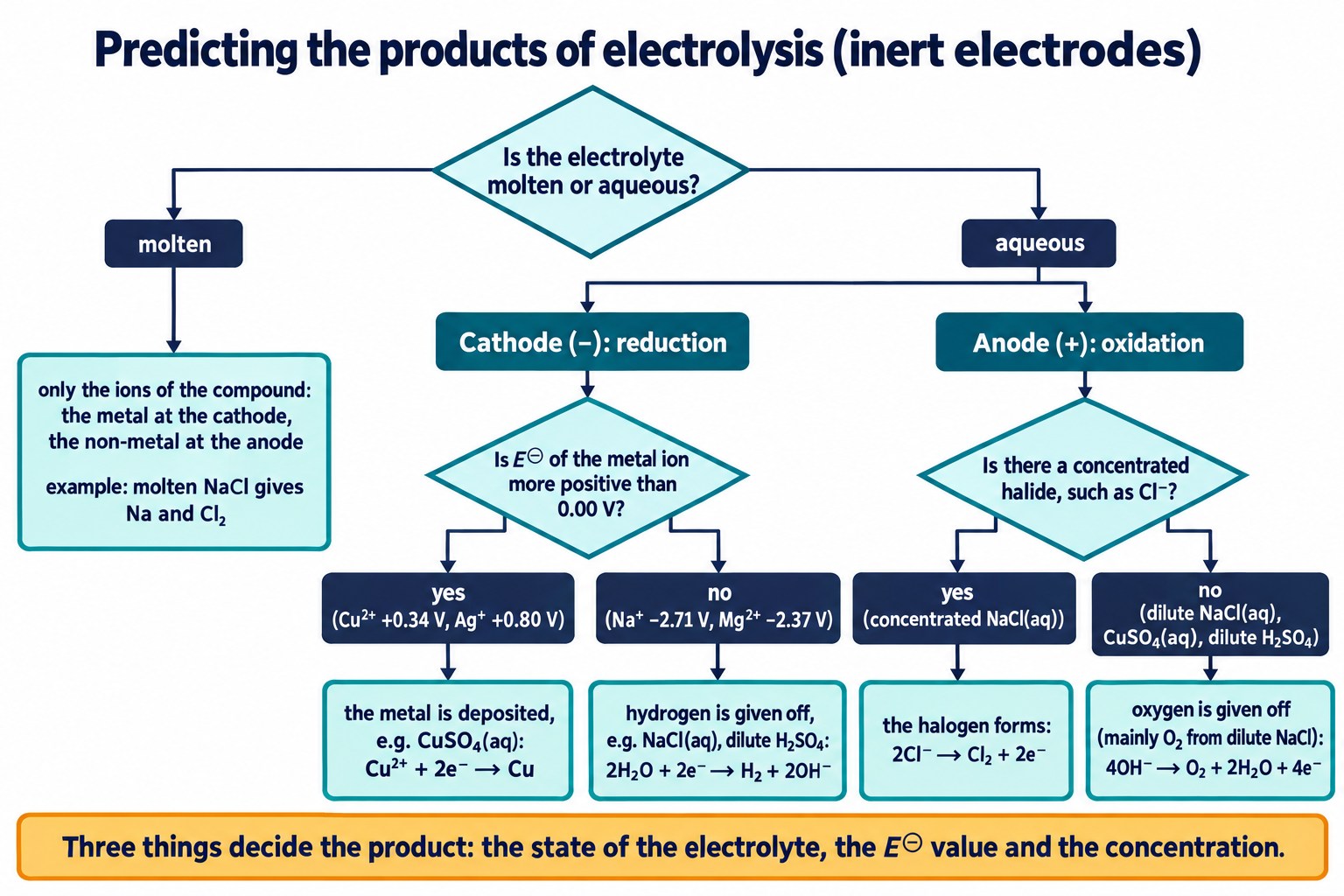
A decision chart for the products of electrolysis with inert electrodes: molten or aqueous, the E⦵ value of the metal ion at the cathode, and the halide concentration at the anode.
Quick Check: Two Conditions at Once
Use the data to decide the product at both electrodes for each new salt.
Products to Know
| Electrolyte (inert electrodes) | At the cathode (−) | At the anode (+) | What is left |
|---|---|---|---|
| Molten NaCl | sodium | chlorine | nothing else |
| Molten Al₂O₃ | aluminium | oxygen | nothing else |
| Concentrated NaCl(aq) | hydrogen | chlorine | NaOH(aq) |
| Dilute NaCl(aq) | hydrogen | mainly oxygen | more concentrated NaCl(aq) |
| CuSO₄(aq) | copper | oxygen | H₂SO₄(aq): the blue colour fades |
| Dilute H₂SO₄ | hydrogen | oxygen | more concentrated H₂SO₄ |
Worked example: concentrated sodium chloride solution
Step 1. Ions and molecules present: Na⁺, Cl⁻ and H₂O.
Dilute sulfuric acid
- Cathode: 2H⁺ + 2e⁻ → H₂. Anode: 2H₂O → O₂ + 4H⁺ + 4e⁻.
- The same charge gives 2 mol of H₂ for every 1 mol of O₂, so the volume of hydrogen is twice the volume of oxygen.
- Overall, only water is decomposed: 2H₂O → 2H₂ + O₂.
Electrodes that are not inert
With copper electrodes in CuSO₄(aq), the anode itself is oxidised: Cu → Cu²⁺ + 2e⁻. The anode loses mass, the cathode gains the same mass and the solution stays blue. Electrolysis calculations uses this cell.
Quick Check: What Forms and What Is Left?
Pick the one accurate statement in each set, using electrolytes that are new to this page.
Common Exam Points
Say
- “Na⁺ ions are not discharged because E⦵ for Na⁺/Na is much more negative than that for water, so water is reduced to hydrogen.”
- “In concentrated solution the chloride ions are discharged in preference to water, forming chlorine.”
- “Oxidation occurs at the anode: 2Cl⁻ → Cl₂ + 2e⁻.”
Do not say
- “Sodium forms at the cathode” for an aqueous solution (hydrogen forms).
- “Sulfate ions are discharged at the anode” (oxygen forms from water).
- “The anode is negative” (in electrolysis the anode is positive).
Watch for
- The state: molten or aqueous. Read the state symbols carefully.
- The words “dilute” and “concentrated” for halide solutions.
- Half-equations that balance for both atoms and charge.
- Questions about what remains in solution after electrolysis.
Check: Predicting the Products
Predict the substances liberated at each electrode from the state of the electrolyte, E⦵ values and concentration, for electrolytes not used on this page.
FAQs
Use these quick answers to check how to predict the products of electrolysis.
Which electrode is the anode and which is the cathode?
The anode is the positive electrode: anions are attracted to it and oxidation happens there. The cathode is the negative electrode: cations are attracted to it and reduction happens there. Inert electrodes of platinum or graphite do not take part.
Why do molten and aqueous sodium chloride give different products?
A molten salt contains only its own ions, so molten NaCl gives sodium and chlorine. In solution, water is also present and can be reduced or oxidised instead, so NaCl(aq) gives hydrogen at the cathode, not sodium.
How do I predict the product at the cathode of an aqueous solution?
The species with the more positive E⦵ is reduced. Cu²⁺ (+0.34 V) and Ag⁺ (+0.80 V) are discharged as the metal. For a reactive metal such as sodium (−2.71 V), water is reduced instead: 2H₂O + 2e⁻ → H₂ + 2OH⁻.
Why does concentrated NaCl(aq) give chlorine but dilute NaCl(aq) gives oxygen?
The E⦵ values for forming O₂ (+1.23 V) and Cl₂ (+1.36 V) are close together. A high concentration of chloride ions favours 2Cl⁻ → Cl₂ + 2e⁻. In dilute solution, water or OH⁻ is oxidised instead, giving mainly oxygen.
What are the products from copper(II) sulfate solution with inert electrodes?
Copper is deposited at the cathode: Cu²⁺ + 2e⁻ → Cu. Sulfate ions are not oxidised, so oxygen forms at the anode: 4OH⁻ → O₂ + 2H₂O + 4e⁻. The blue colour fades and the solution becomes acidic.

Copyright notice: This OLS revision content, including the explanations, layout, diagrams, tables and embedded learning structure, is authored for Online Learning System by Dr. Mohammed Al-Fatah. It may not be copied, reproduced, redistributed or adapted without written permission.
Keep this note — free
Save your progress across every Cambridge topic. A free account remembers which topics you have covered, saves your question scores, and syncs across your phone and laptop.
- Track every topic you have finished
- Keep your practice-question scores
- No payment, no card, free forever
Already registered? Log in