Electrolysis Calculations and the Faraday Constant
A concise revision guide to quantitative electrolysis: Q = It, the Faraday constant and F = Le, calculating the mass or volume of substance liberated, and finding the Avogadro constant by an electrolytic method.
- 24.1.2
- 24.1.3(a)
- 24.1.3(b)-i
- 24.1.3(b)-ii
- 24.1.4
What these spec points say
- 24.1.2 state and apply the relationship F = Le between the Faraday constant, F, the Avogadro constant, L, and the charge on the electron, e
- 24.1.3(a) calculate the quantity of charge passed during electrolysis, using Q = It
- 24.1.3(b)-i calculate the mass of substance liberated during electrolysis
- 24.1.3(b)-ii calculate the volume of substance liberated during electrolysis
- 24.1.4 describe the determination of a value of the Avogadro constant by an electrolytic method
Before You Start
This page follows Electrolysis: Predicting the Products, which gives the half-equation at each electrode. Here those half-equations are used to calculate how much product forms.
- Moles = (mass) / (Ar) for an element.
- One mole of any gas occupies 24.0 dm³ at room conditions.
- Current is measured in amperes, A. Time must be in seconds, s.
- A half-equation shows how many moles of electrons are needed for each mole of product.
GCSE Recap: Electrodes, Moles and Gas Volumes
Three quick questions on the GCSE ideas this page builds on.
Charge and the Faraday Constant
The amount of substance liberated in electrolysis depends on the charge that passes through the cell.
Q = I × t
| Symbol | Quantity | Unit |
|---|---|---|
| Q | charge | coulomb, C |
| I | current | ampere, A |
| t | time | second, s |
Definition: The Faraday constant, F, is the charge carried by one mole of electrons. F = 96 500 C mol⁻¹.
F = Le
One mole of electrons contains L electrons, where L is the Avogadro constant. Each electron carries a charge e. So the charge on one mole of electrons is L × e.
F = L × e = 6.02 × 10²³ × 1.60 × 10⁻¹⁹ = 9.63 × 10⁴ C mol⁻¹
- L = 6.02 × 10²³ mol⁻¹ and e = 1.60 × 10⁻¹⁹ C.
- The product is within 0.2% of 96 500 C mol⁻¹. The small difference comes from rounding L and e.
- Rearranged: L = (F) / (e) and e = (F) / (L).
From Charge to Moles of Product
moles of electrons = (Q) / (F)
The half-equation then gives the mole ratio of electrons to product.
| Product | Half-equation | Moles of electrons for 1 mol of product |
|---|---|---|
| Silver | Ag⁺ + e⁻ → Ag | 1 |
| Copper | Cu²⁺ + 2e⁻ → Cu | 2 |
| Aluminium | Al³⁺ + 3e⁻ → Al | 3 |
| Hydrogen | 2H⁺ + 2e⁻ → H₂ | 2 |
| Chlorine | 2Cl⁻ → Cl₂ + 2e⁻ | 2 |
| Oxygen | 4OH⁻ → O₂ + 2H₂O + 4e⁻ | 4 |
The route for every calculation
- Convert the time to seconds and calculate the charge: Q = It.
- Moles of electrons = (Q) / (F).
- Use the half-equation to find the moles of product.
- Mass = moles × Ar. For a gas at room conditions, volume = moles × 24.0 dm³.
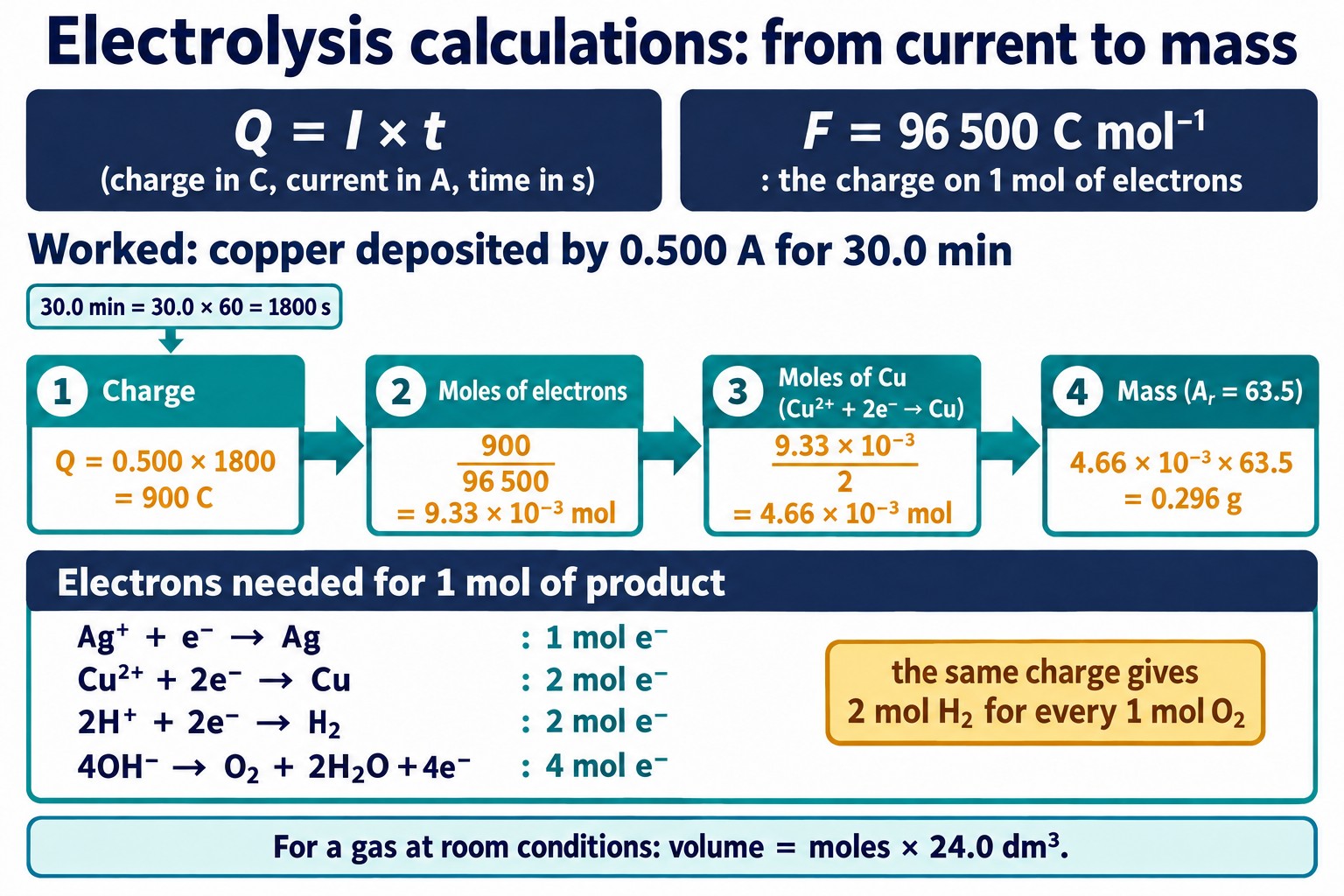
The four steps of an electrolysis calculation, worked for copper deposited by 0.500 A in 30.0 minutes, with the electrons needed for one mole of common products.
Key idea: The same charge deposits different amounts of different elements. One mole of electrons gives 1 mol of Ag, but only ½ mol of Cu and ⅓ mol of Al.
Check: Charge, F and Moles of Electrons
Use Q = It, the Faraday constant and F = Le, and link moles of electrons to moles of product, with values not used on this page.
Calculating a Mass
Worked example 1
A current of 0.500 A is passed through copper(II) sulfate solution for 30.0 minutes. Calculate the mass of copper deposited at the cathode. (Ar of Cu = 63.5)
Step 2. Moles of electrons = (900) / (96 500) = 9.33 × 10⁻³ mol.
Answer. Mass of copper = 4.66 × 10⁻³ × 63.5 = 0.296 g
Exam focus: The most common error is leaving the time in minutes. Convert to seconds before using Q = It.
Calculating a Volume of Gas
Worked example 2
A current of 2.00 A is passed through dilute sulfuric acid for 965 s. Calculate the volume of each gas formed, measured at room conditions.
Step 1. Charge, Q = 2.00 × 965 = 1930 C.
Step 2. Moles of electrons = (1930) / (96 500) = 0.0200 mol.
- The volumes are in the ratio 2 : 1, because O₂ needs twice as many electrons per mole as H₂.
- The same charge passes through both electrodes, so the moles of electrons are the same at each.
Calculating a Time or a Current
Work through the same route in reverse: mass, then moles of product, then moles of electrons, then charge.
Worked example 3
How long must a current of 0.500 A flow to deposit 2.16 g of silver from silver nitrate solution? (Ar of Ag = 107.9)
Step 1. Moles of Ag = (2.16) / (107.9) = 0.0200 mol.
Step 3. Charge, Q = 0.0200 × 96 500 = 1930 C.
Answer. Time = (Q) / (I) = (1930) / (0.500) = 3860 s, which is about 64 minutes.
- To find a current, use I = (Q) / (t).
- To identify a metal, find its moles from the charge and then Ar = (mass) / (moles).
- To find the charge on a metal ion, divide the moles of electrons by the moles of metal deposited.
Check: Masses, Volumes and Times
Calculate the mass of metal or the volume of gas liberated, and the time or current needed, with data not used on this page.
Quick Check: Identify the Metal, Link the Products
Work out each answer on paper, then flip the card to compare.
Finding the Avogadro Constant by Electrolysis
Electrolysis gives a way to measure L. The cell has two copper electrodes in copper(II) sulfate solution.
| Electrode | Half-equation | Change in mass |
|---|---|---|
| Anode (+) | Cu(s) → Cu²⁺(aq) + 2e⁻ | decreases |
| Cathode (−) | Cu²⁺(aq) + 2e⁻ → Cu(s) | increases by the same amount |
Method
- Clean both copper electrodes and weigh the anode.
- Connect a d.c. supply, an ammeter and a variable resistor in series with the cell.
- Switch on and start a timer. Use the variable resistor to keep the current constant.
- After a measured time, such as 40 minutes, switch off.
- Rinse the anode with distilled water and then with propanone. Let it dry and reweigh it.
- Propanone evaporates quickly, so the electrode dries without heating.
- The gain in mass of the cathode can be used instead.
- The anode is often preferred, because copper deposited on the cathode may not stick and can be lost during rinsing.
- A gas can be used instead: the volume collected gives the moles of gas, and its half-equation gives the moles of electrons.
Worked example
A current of 0.200 A flows for 40.0 minutes. The anode loses 0.158 g. Calculate a value for L. (Ar of Cu = 63.5; e = 1.60 × 10⁻¹⁹ C)
Step 1. Charge, Q = 0.200 × (40.0 × 60) = 0.200 × 2400 = 480 C.
Step 2. Number of electrons = (Q) / (e) = (480) / (1.60 × 10⁻¹⁹) = 3.00 × 10²¹.
Step 3. Moles of Cu = (0.158) / (63.5) = 2.488 × 10⁻³ mol.
Answer. L = (number of electrons) / (moles of electrons) = (3.00 × 10²¹) / (4.976 × 10⁻³) = 6.03 × 10²³ mol⁻¹
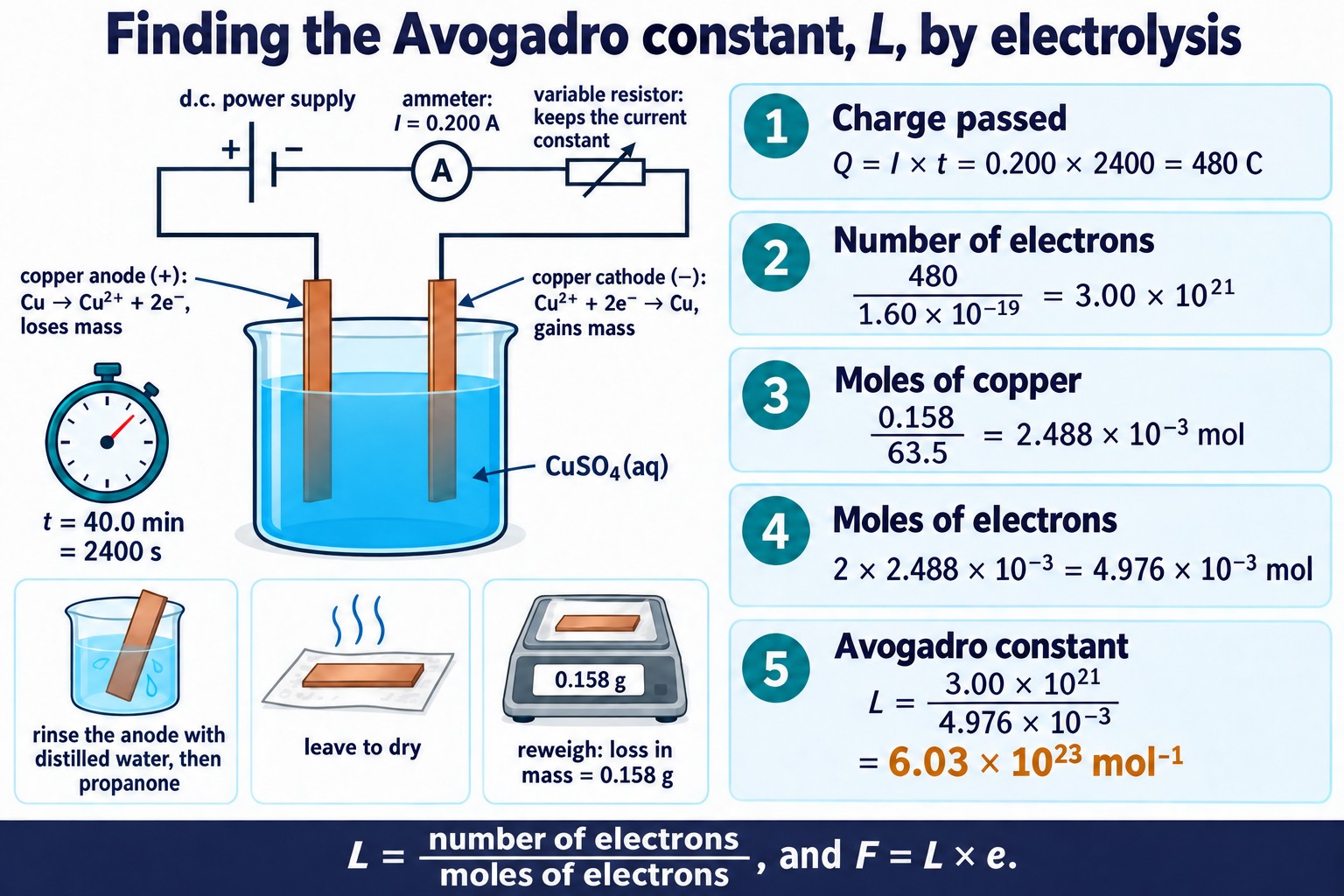
Finding the Avogadro constant: the circuit with copper electrodes in copper(II) sulfate solution, and the five calculation steps from 480 C and a 0.158 g loss in mass to L = 6.03 × 10²³ mol⁻¹.
Key idea: The charge passed gives the number of electrons. The change in mass gives the moles of electrons. Dividing one by the other gives L.
Common Exam Points
Say
- “The Faraday constant is the charge on one mole of electrons.”
- “Moles of electrons = (It) / (F).”
- “Two moles of electrons are needed to deposit one mole of copper.”
Do not say
- “Q = (I) / (t)” (charge is current multiplied by time).
- “Moles of copper = moles of electrons” (divide by 2 for Cu²⁺).
- “The volume of oxygen equals the volume of hydrogen” (oxygen needs 4 electrons per molecule).
Watch for
- Time in minutes or hours: always convert to seconds.
- The charge on the ion: Ag⁺ needs 1 electron, Cu²⁺ needs 2, Al³⁺ and Cr³⁺ need 3.
- Gas volumes asked for in cm³: 1 dm³ = 1000 cm³.
- In the Avogadro experiment, the reason for rinsing with propanone and for keeping the current constant.
Check: Electrolysis Calculations
Bring the whole page together: Q = It, F = Le, masses and volumes liberated and the determination of the Avogadro constant, with data not used on this page.
FAQs
Use these quick answers to check electrolysis calculations, the Faraday constant and the Avogadro constant.
What is the Faraday constant?
F is the charge carried by one mole of electrons, 96 500 C mol⁻¹. It equals the Avogadro constant multiplied by the charge on one electron: F = Le = 6.02 × 10²³ × 1.60 × 10⁻¹⁹ = 9.63 × 10⁴ C mol⁻¹.
How do I calculate the charge passed?
Use Q = It, with Q in coulombs, I in amperes and t in seconds. Always convert minutes to seconds first: a current of 0.500 A for 30.0 minutes is 0.500 × 1800 = 900 C.
How do I find the mass of metal deposited?
Moles of electrons = (Q) / (F), then use the half-equation: Cu²⁺ + 2e⁻ → Cu needs 2 mol of electrons per mole of copper. So 900 C is 9.33 × 10⁻³ mol of electrons, 4.66 × 10⁻³ mol of Cu and 0.296 g.
Why does dilute sulfuric acid give twice as much hydrogen as oxygen?
The same charge passes at both electrodes. Forming 1 mol of H₂ needs 2 mol of electrons, but forming 1 mol of O₂ releases 4 mol. So 1930 C gives 0.0100 mol of H₂ (240 cm³) and 0.00500 mol of O₂ (120 cm³).
How is the Avogadro constant found by electrolysis?
Electrolyse CuSO₄(aq) with copper electrodes, measuring the current, the time and the change in mass of an electrode. Number of electrons = (It) / (e). Moles of electrons = 2 × moles of copper. L = (number of electrons) / (moles of electrons).

Copyright notice: This OLS revision content, including the explanations, layout, diagrams, tables and embedded learning structure, is authored for Online Learning System by Dr. Mohammed Al-Fatah. It may not be copied, reproduced, redistributed or adapted without written permission.
Keep this note — free
Save your progress across every Cambridge topic. A free account remembers which topics you have covered, saves your question scores, and syncs across your phone and laptop.
- Track every topic you have finished
- Keep your practice-question scores
- No payment, no card, free forever
Already registered? Log in