Why Halogenoarenes Resist Substitution: Chlorobenzene versus Chloroethane
A concise revision guide to the difference in reactivity between a halogenoalkane and a halogenoarene: why chloroethane is hydrolysed by warm aqueous hydroxide while chlorobenzene is not, in terms of the delocalisation of the chlorine lone pair into the ring, the stronger and shorter C–Cl bond, the repulsion of nucleophiles by the ring and the geometry that blocks attack, with the harsh conditions that do convert chlorobenzene.
Why Chlorobenzene Resists Nucleophiles
Choose a step to compare the C–Cl bond in chlorobenzene and in chloroethane, and to see which one hydroxide can substitute.
© Dr. Mohammed Al-Fatah – onlinelearningsystem.net
Before You Start
Chloroethane and chlorobenzene both contain a C–Cl bond, but only one of them is hydrolysed by warm aqueous hydroxide. This page explains the difference.
- Nucleophilic substitution of a halogenoalkane: the Sₙ2 and Sₙ1 mechanisms, with OH⁻ attacking the δ+ carbon: Nucleophilic Substitution Reactions.
- Bond energy and the rate of hydrolysis down the halogens: Rates of Hydrolysis and Bond Enthalpy; bond energy and bond length: Bond Energy and Bond Length.
- The delocalised ring of benzene and how halogenoarenes are made: Making Halogenoarenes by Electrophilic Substitution.
- The whole halogenoalkane topic for reference: Topic 15 Halogen Compounds.
Two Compounds Compared
Put the numbers side by side first. Every difference in reactivity on this page can be traced back to one of these rows.
| Property | Chloroethane, CH₃CH₂Cl | Chlorobenzene, C₆H₅Cl |
|---|---|---|
| carbon bonded to Cl | saturated (sp³), tetrahedral, four single bonds | part of the planar ring (sp²), one bond into the π system |
| C–Cl bond length | 0.177 nm | 0.170 nm: shorter |
| C–Cl bond energy | about 340 kJ mol⁻¹ | more than 340 kJ mol⁻¹: stronger |
| polarity of C–Cl | polar, an exposed δ+ carbon | polar, but the δ+ carbon is shielded by the ring |
| warm NaOH(aq) | hydrolysed to ethanol | no reaction |
| AgNO₃(aq) after hydrolysis | white precipitate of AgCl | no precipitate |
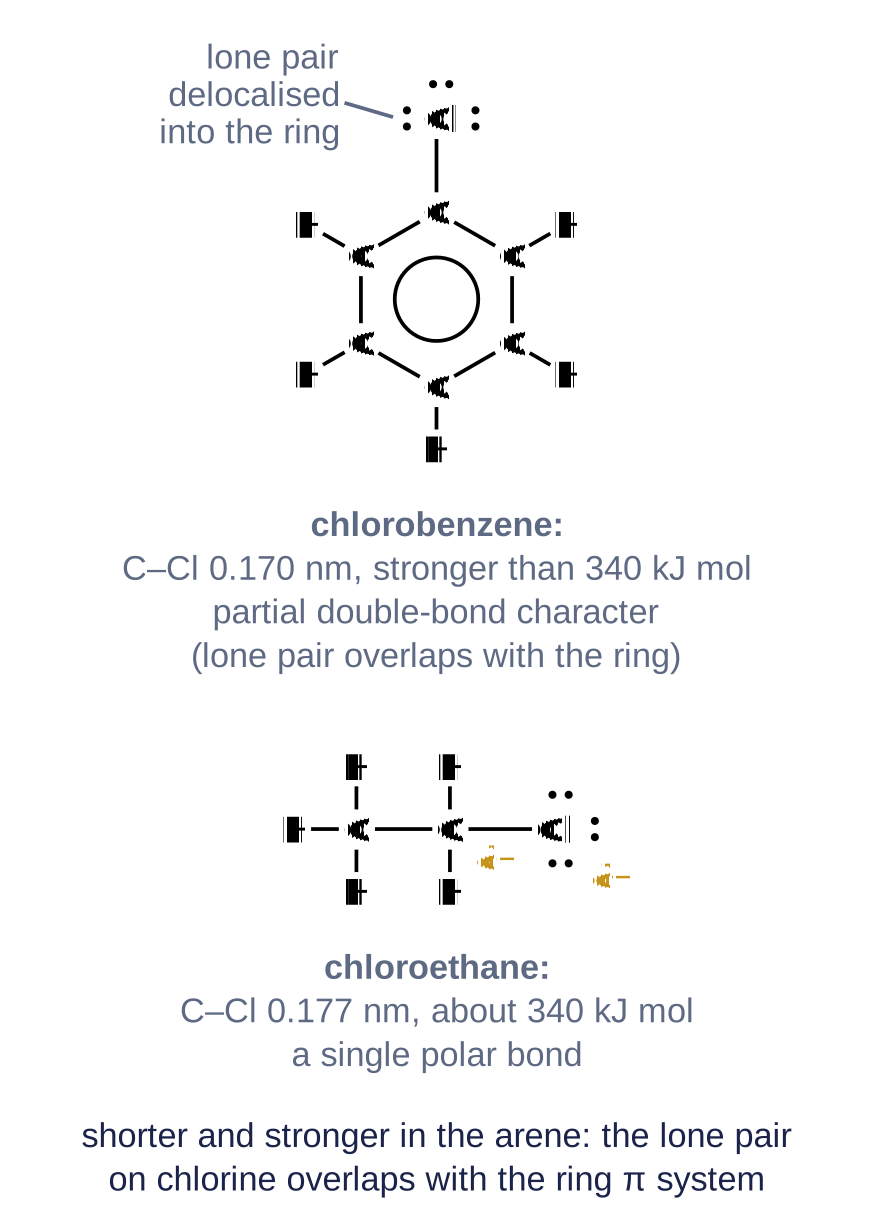
Chlorobenzene and chloroethane drawn side by side with the C–Cl bond lengths 0.170 nm and 0.177 nm written on the bonds.
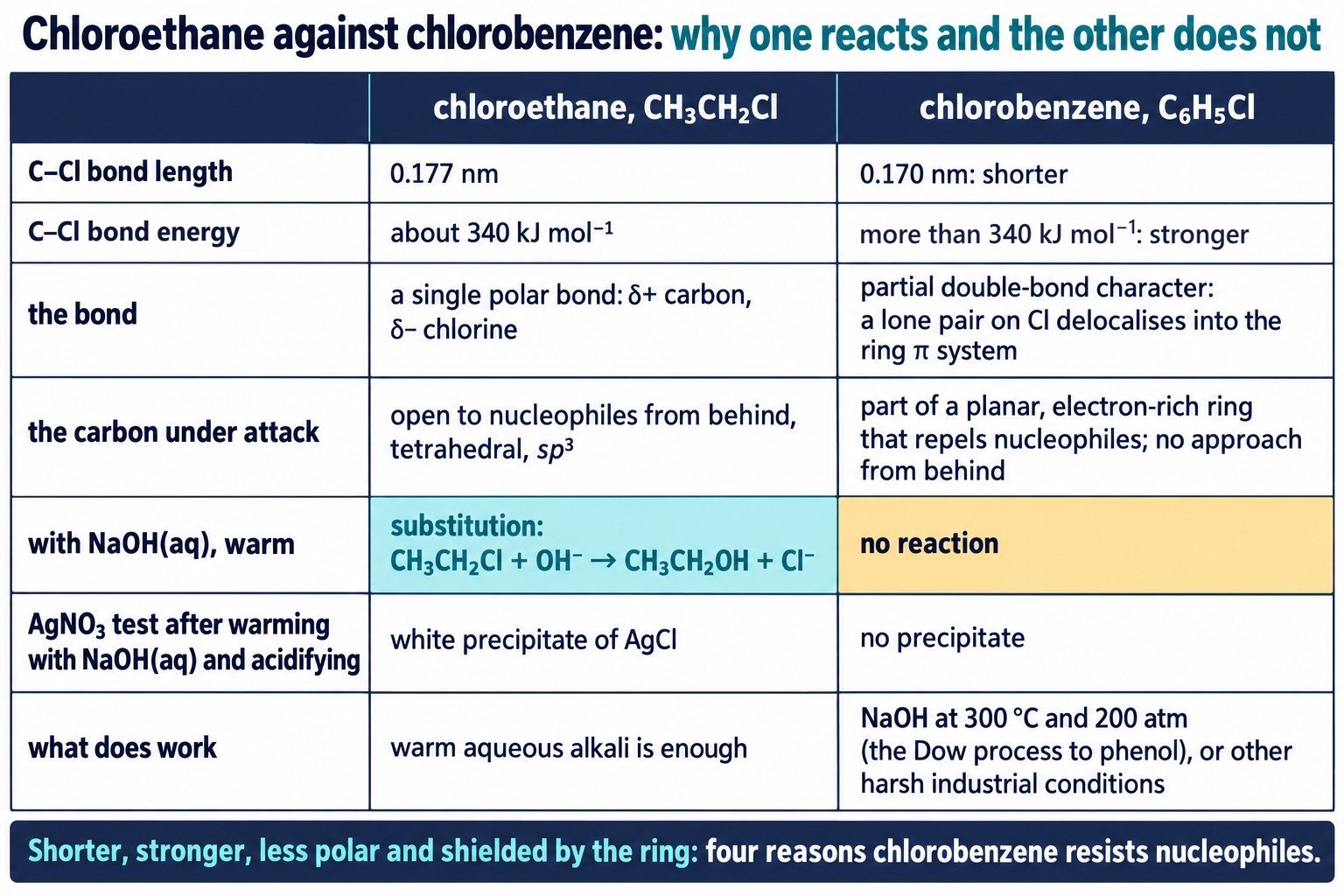
The comparison table as a poster, with the bond lengths, bond energies and test results written out and a verdict row at the bottom.
Remember: Shorter means stronger here: the two numbers point the same way. A stronger bond and a carbon that cannot be reached make substitution very slow.
Delocalisation of the Chlorine Lone Pair
Chlorine has three lone pairs. In chlorobenzene one of them sits in a p orbital that is parallel to the p orbitals of the ring carbons, so it overlaps with the π system.
Step 1. The lone pair is partly delocalised into the ring: electron density spreads from chlorine onto the six carbons.
- In chloroethane the chlorine lone pairs have nothing to overlap with: the C–Cl bond is a plain single bond, 0.177 nm, about 340 kJ mol⁻¹.
- Delocalisation is also why the chlorine in chlorobenzene is 2,4-directing in further electrophilic substitution: the extra density goes to those positions.
- The same lone-pair delocalisation explains why phenol and phenylamine behave differently from alcohols and alkylamines.
Exam focus: Write “a lone pair on chlorine is delocalised into the ring, giving the C–Cl bond partial double-bond character, so it is stronger and harder to break”. That sentence carries two marks.
Check: Bond Strength and Delocalisation
Compare the two C–Cl bonds in length and enthalpy, explain the partial double-bond character of chlorobenzene, and predict which compound reacts with warm aqueous hydroxide.
The Ring Repels and the Geometry Blocks
Even if the C–Cl bond could be broken, hydroxide cannot get to the carbon. Two further reasons make nucleophilic substitution on the ring almost impossible.
- Electron repulsion: the ring carries high electron density above and below its plane. A negative nucleophile such as OH⁻ is repelled before it reaches the carbon.
- No Sₙ2 route: Sₙ2 needs attack from the side opposite the leaving group. In chlorobenzene that side is the inside of the flat ring: physically blocked.
- No Sₙ1 route: loss of Cl⁻ would leave a phenyl cation with its positive charge in the plane of the ring, where the π system cannot stabilise it.
- The phenyl cation is therefore far too unstable to form under laboratory conditions.
- Chloroethane has none of these problems: the δ+ carbon is open on the side away from chlorine and is attached to electron-poor hydrogens.
Common mistake: Saying chlorobenzene “has no δ+ carbon”. It does, but the δ+ is reduced, shielded by the ring and repelled from nucleophiles. Say all three.
Quick Check: Why Does the Ring Resist?
Pick the one accurate statement in each set, using compounds that are new to this page.
Chloroethane: Why Substitution Happens
For comparison, warm chloroethane with aqueous sodium hydroxide and it is hydrolysed to ethanol within minutes. Everything the ring prevents is open here.
Equation. CH₃CH₂Cl(l) + NaOH(aq) → CH₃CH₂OH(aq) + NaCl(aq); ionic: CH₃CH₂Cl + OH⁻ → CH₃CH₂OH + Cl⁻.
Mechanism. Sₙ2: the lone pair on OH⁻ attacks the δ+ carbon from behind, the C–Cl bond breaks heterolytically and Cl⁻ leaves: Nucleophilic Substitution Reactions.
Conditions. Warm with NaOH(aq); a little ethanol helps the two reagents mix. Water alone hydrolyses chloroethane too, only more slowly.
- Chlorine is more electronegative than carbon, so the carbon is δ+ and attracts the nucleophile.
- The C–Cl bond, at about 340 kJ mol⁻¹, breaks readily on warming; the C–Br and C–I bonds break faster still.
- Elimination competes when hot ethanolic KOH is used instead: Elimination Reactions of Halogenoalkanes.
Remember: Same functional group name on paper, different chemistry in the tube: the halogen on a saturated carbon is substituted; the halogen on the ring stays put.
The Hydrolysis Test
The difference is easy to show. Hydrolysis releases chloride ions, and chloride ions give a white precipitate with silver nitrate.
- Warm each compound with aqueous sodium hydroxide for a few minutes (or heat with water and a little ethanol).
- Acidify with dilute nitric acid to remove the excess hydroxide, which would otherwise give a brown precipitate of Ag₂O.
- Add aqueous silver nitrate. Ag⁺(aq) + Cl⁻(aq) → AgCl(s).
- Chloroethane: a white precipitate of silver chloride. Chlorobenzene: no precipitate, even after prolonged warming.
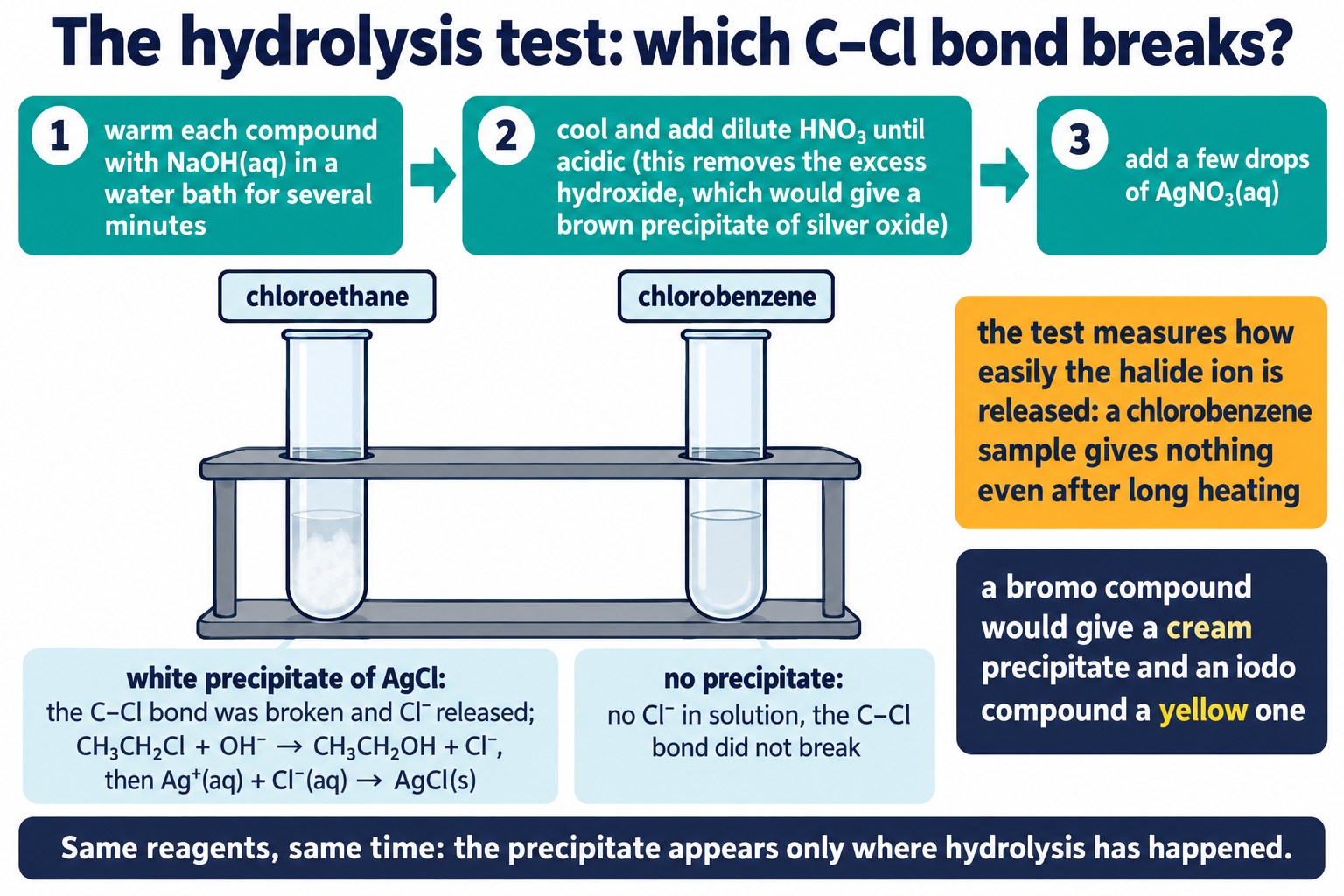
Two test tubes after the silver nitrate step: a white precipitate in the chloroethane tube and a clear colourless solution in the chlorobenzene tube, with the three steps listed.
- The precipitate dissolves in dilute ammonia, confirming chloride rather than bromide or iodide.
- (Chloromethyl)benzene, with chlorine on the side chain, gives the white precipitate: it is a halogenoalkane and the test tells the two kinds of chlorine apart.
- Never heat the mixture to dryness; the test only needs a few minutes of gentle warming.
Exam focus: A question that gives “no precipitate with silver nitrate after warming with NaOH(aq)” is pointing at a halogen on a benzene ring. Say so, and say why.
Quick Check: Predict the Precipitate
Each new compound is warmed with NaOH(aq), acidified with dilute nitric acid and tested with AgNO₃(aq).
Harsh Conditions That Do Work
Chlorobenzene is resistant, not inert. Industry forces the substitution with conditions far beyond a test tube.
Dow process. C₆H₅Cl(l) + 2NaOH(aq) → C₆H₅O⁻Na⁺(aq) + NaCl(aq) + H₂O(l) at about 300 °C and 200 atm, then acidification gives phenol, C₆H₅OH.
- The high temperature supplies the energy to break the strong C–Cl bond; the pressure keeps the water liquid.
- The route was once the main source of phenol; the cumene process has largely replaced it.
- Fluorobenzene and chlorobenzene do react with nucleophiles when the ring also carries strongly electron-withdrawing groups such as NO₂, which make the ring electron-poor.
Remember: For the examination the answer is simple: under the conditions that hydrolyse chloroethane, chlorobenzene does not react. Quote the industrial conditions only to show you know it is possible.
Check: Repulsion, Geometry and the Test
Explain why the ring repels nucleophiles and blocks both substitution mechanisms, predict the result of the silver nitrate test for new pairs of compounds, and recall the conditions that do convert chlorobenzene.
Common Exam Points
- C–Cl in chlorobenzene is shorter (0.170 nm) and stronger than in chloroethane (0.177 nm, about 340 kJ mol⁻¹).
- Reason: a chlorine lone pair in a p orbital is delocalised into the ring π system, giving the C–Cl bond partial double-bond character.
- The electron-rich ring repels nucleophiles, and the reduced δ+ on the ring carbon attracts them less.
- No Sₙ2: attack from behind the C–Cl bond is blocked by the flat ring. No Sₙ1: the phenyl cation is far too unstable.
- Chloroethane: CH₃CH₂Cl(l) + NaOH(aq) → CH₃CH₂OH(aq) + NaCl(aq) on warming, by nucleophilic substitution.
- Test: warm with NaOH(aq), acidify with HNO₃, add AgNO₃(aq). Chloroethane gives white AgCl(s); chlorobenzene gives nothing.
- A halogen on a side chain, as in (chloromethyl)benzene, behaves as a halogenoalkane and does give the precipitate.
- Chlorobenzene is converted only under harsh conditions: NaOH at about 300 °C and 200 atm gives phenol (the Dow process).
FAQs
Use these quick answers to check why chloroethane is hydrolysed by warm aqueous hydroxide but chlorobenzene is not: the delocalised lone pair, the shorter and stronger C–Cl bond, the electron-rich ring and the geometry that blocks attack.
Why is the C–Cl bond in chlorobenzene stronger than the one in chloroethane?
One chlorine lone pair sits in a p orbital overlapping the ring π system, so it is delocalised. The C–Cl bond gains partial double-bond character: it shortens from 0.177 to 0.170 nm, and the C–Cl bond is stronger in chlorobenzene than the 340 kJ mol⁻¹ in chloroalkanes.
Why does the ring repel nucleophiles?
The benzene ring holds a cloud of delocalised electrons above and below the plane, and the delocalised chlorine lone pair adds more. A nucleophile such as OH⁻ is negative, so it is repelled as it approaches. In chloroethane the open δ+ carbon attracts the nucleophile.
Why can a nucleophile not attack the carbon bearing chlorine from behind, as in a halogenoalkane?
In a nucleophilic substitution the nucleophile attacks the carbon from the side opposite the leaving group. In chlorobenzene that carbon is part of a flat ring, so the ring itself blocks the back. Losing Cl⁻ first would give a phenyl cation, far too unstable.
How can I show the difference by a simple test?
Warm each compound with aqueous sodium hydroxide, acidify with dilute nitric acid and add silver nitrate solution. Chloroethane has been hydrolysed, so chloride ions give a white precipitate of silver chloride. Chlorobenzene gives no precipitate because no chloride has been released.
Can chlorobenzene ever be made to react with hydroxide?
Yes, but only under forcing conditions: sodium hydroxide at about 300 °C and 200 atm converts chlorobenzene to phenol in the Dow process. The extreme temperature and pressure show how much more energy is needed than the gentle warming that hydrolyses a halogenoalkane.

Copyright notice: This OLS revision content, including the explanations, layout, diagrams, tables and embedded learning structure, is authored for Online Learning System by Dr. Mohammed Al-Fatah. It may not be copied, reproduced, redistributed or adapted without written permission.
Keep this note — free
Save your progress across every Cambridge topic. A free account remembers which topics you have covered, saves your question scores, and syncs across your phone and laptop.
- Track every topic you have finished
- Keep your practice-question scores
- No payment, no card, free forever
Already registered? Log in