Making Halogenoarenes by Electrophilic Substitution
A concise revision guide to halogenoarenes: how benzene reacts with chlorine or bromine in the presence of an aluminium halide catalyst to give chlorobenzene or bromobenzene, how methylbenzene gives the 2- and 4-chloro products because the methyl group directs substitution, the conditions, the electrophile and the contrast with side-chain substitution in light.
Recap: Benzene and Electrophilic Substitution
Five quick questions on what you already know: the delocalised ring (Topic 30 Hydrocarbons), why benzene substitutes rather than adds, and the general mechanism with its intermediate (Electrophilic Substitution in Benzene).
Benzene to Chlorobenzene
A halogenoarene has a halogen atom bonded directly to a benzene ring. Benzene does not react with chlorine on its own: the Cl₂ molecule is not a strong enough electrophile for the stable ring.
Equation. C₆H₆(l) + Cl₂(g) → C₆H₅Cl(l) + HCl(g).
Conditions. Anhydrous aluminium chloride (or iron(III) chloride) as the catalyst, room temperature, no water, kept out of bright light.
Bromine. C₆H₆(l) + Br₂(l) → C₆H₅Br(l) + HBr(g) with aluminium bromide or iron(III) bromide. Iron filings work too: they form FeBr₃ with the bromine.
- One hydrogen is substituted by chlorine; the ring and its delocalised electrons survive, so no addition takes place.
- The HCl is seen as misty fumes. The product chlorobenzene is a colourless liquid, insoluble in water, with an almond-like smell.
- The catalyst is called a halogen carrier because it makes the halogen into a stronger electrophile.
- Water destroys the catalyst (AlCl₃ hydrolyses violently), so every reagent must be dry.
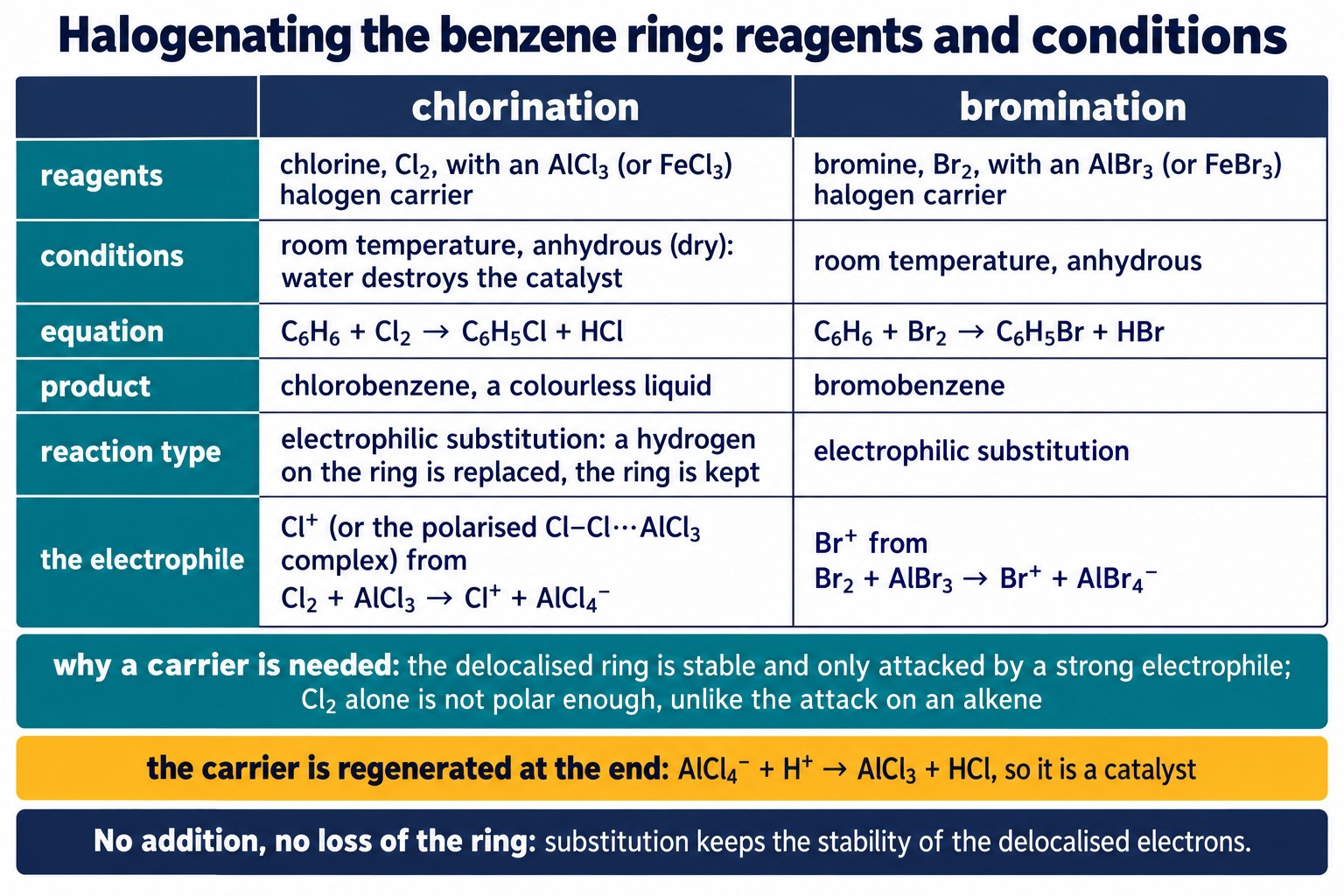
A conditions table as a poster: reagent, catalyst, temperature, dryness and product for the chlorination and bromination of benzene.
Exam focus: Three words earn three marks: substitution (not addition), electrophilic (the attacking species is Cl⁺), and the catalyst named with “anhydrous”.
The Electrophile and the Halogen Carrier
Aluminium chloride is electron-deficient: the aluminium has only six electrons in its outer shell. It accepts a lone pair from one chlorine atom of Cl₂.
Step 2. Cl⁺ (or the strongly polarised Cl–Cl···AlCl₃ complex) attacks the electron-rich ring, giving the positively charged intermediate in which delocalisation is partly broken.
Step 3. The intermediate loses H⁺ from the carbon that was attacked, restoring the full delocalised ring: chlorobenzene forms.
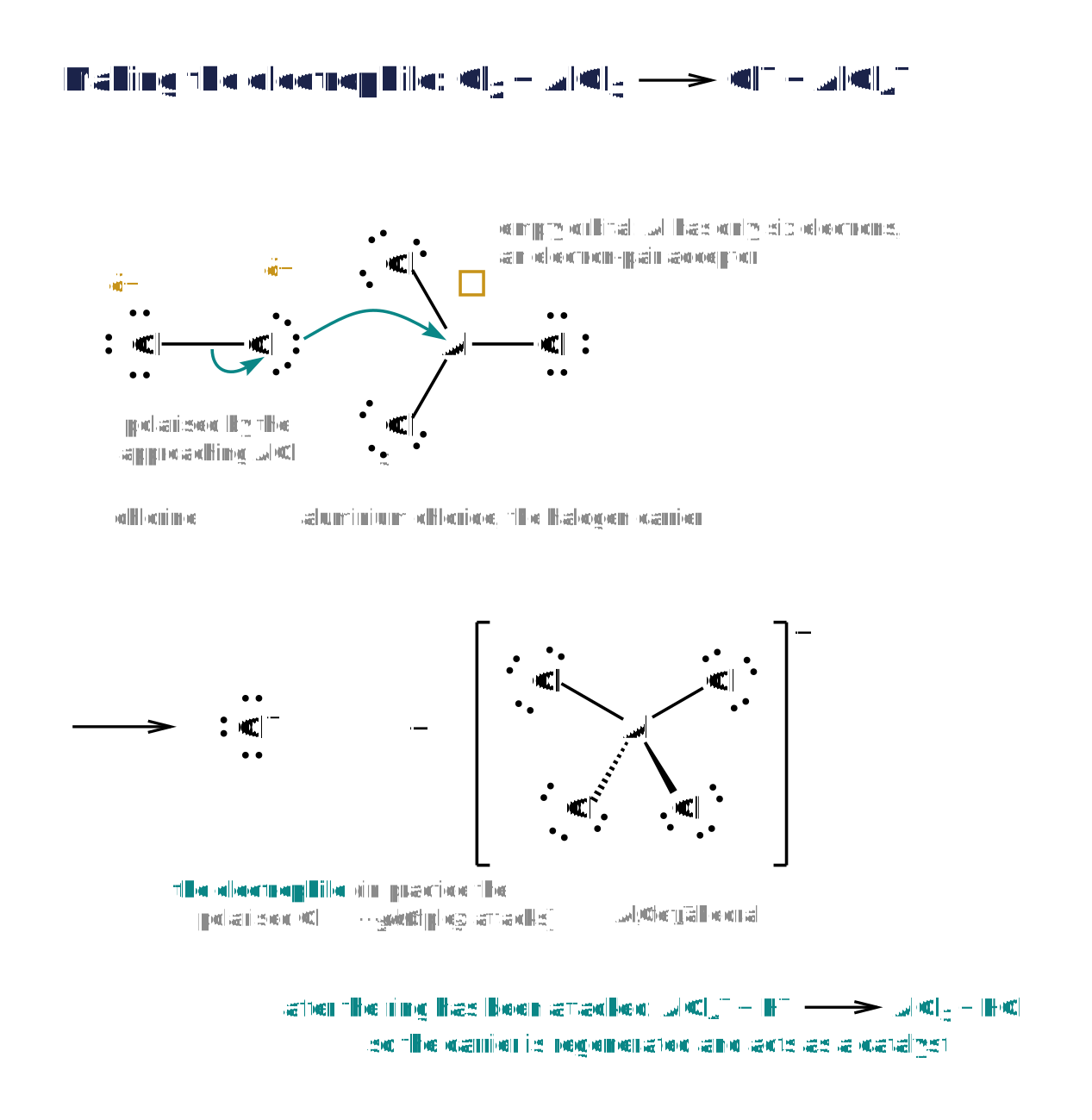
Chlorine donating a lone pair to the empty orbital of aluminium chloride, the Cl–Cl bond breaking and the Cl⁺ and AlCl₄⁻ ions that result.
- The full mechanism with the ring intermediate is drawn in Halogenation of Benzene: use it, and show the horseshoe-shaped partial ring with the positive charge.
- FeCl₃ and FeBr₃ work in the same way: the iron(III) centre accepts the lone pair.
- The polarised complex is an acceptable electrophile in an answer; what matters is that the attacking chlorine carries a positive charge.
Common mistake: Writing Cl⁻ as the electrophile. The species that attacks the ring is electron-poor, Cl⁺; the chloride stays on the aluminium as AlCl₄⁻ until the last step.
Check: Reaction and Electrophile
Write the equation and conditions for making a halogenoarene, show how the halogen carrier forms the electrophile and is regenerated, and name the mechanism.
Methylbenzene: the 2- and 4-Products
When the ring already carries a methyl group, chlorine goes to the positions next to and opposite the CH₃. Methylbenzene gives a mixture of two products.
Equation. C₆H₅CH₃(l) + Cl₂(g) → CH₃C₆H₄Cl(l) + HCl(g), with AlCl₃, cold and anhydrous.
Products. 2-chloromethylbenzene (also named 1-chloro-2-methylbenzene) and 4-chloromethylbenzene (1-chloro-4-methylbenzene). Very little of the 3-isomer forms.
Why. The methyl group releases electron density into the ring, raising it most at the 2- and 4-positions. CH₃ is activating and 2,4-directing: Directing Effects in Electrophilic Substitution.
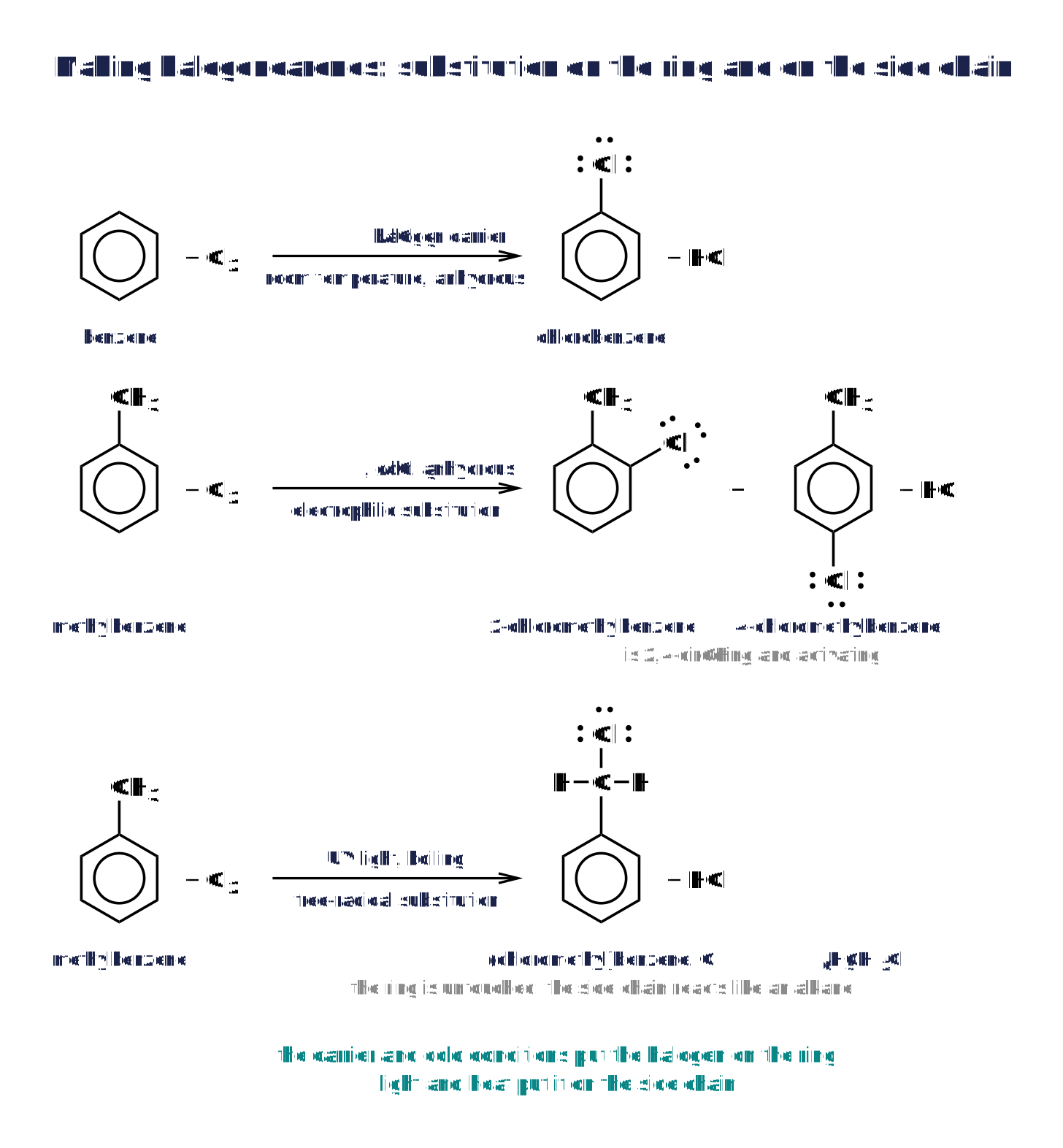
Benzene to chlorobenzene; methylbenzene to 2- and 4-chloromethylbenzene with AlCl₃; methylbenzene to (chloromethyl)benzene in light, reagents over the arrows.
- Methylbenzene reacts faster than benzene under the same conditions because the ring is richer in electrons.
- Excess chlorine substitutes again, so the halogen is limited to one equivalent to stop at the monochloro products.
- The same two positions are substituted by bromine with AlBr₃: 2-bromomethylbenzene and 4-bromomethylbenzene.
Remember: Number from the carbon bearing the first substituent when you name: 2- and 4- both count from the CH₃ carbon as position 1.
Ring or Side Chain?
Methylbenzene has two places a chlorine can go: the ring or the CH₃ side chain. The conditions decide which, so examiners test them together.
| Conditions | Where chlorine goes | Mechanism | Product |
|---|---|---|---|
| Cl₂, AlCl₃ catalyst, cold, dark, anhydrous | the ring, at the 2- and 4-positions | electrophilic substitution | 2- and 4-chloromethylbenzene |
| Cl₂, UV light or boiling, no catalyst | the side chain | free-radical substitution | (chloromethyl)benzene, C₆H₅CH₂Cl |
- In UV light the Cl–Cl bond splits homolytically into chlorine radicals, which abstract a hydrogen from the CH₃ group, as in the chlorination of an alkane.
- C₆H₅CH₃(l) + Cl₂(g) → C₆H₅CH₂Cl(l) + HCl(g); further substitution gives C₆H₅CHCl₂ and C₆H₅CCl₃.
- (Chloromethyl)benzene is not a halogenoarene: its chlorine is on a saturated carbon, so it reacts as a halogenoalkane (Chlorobenzene versus Chloroethane).
- More side-chain reactions of methylbenzene, including its oxidation to benzoic acid: Other Reactions of Benzene and Methylbenzene.
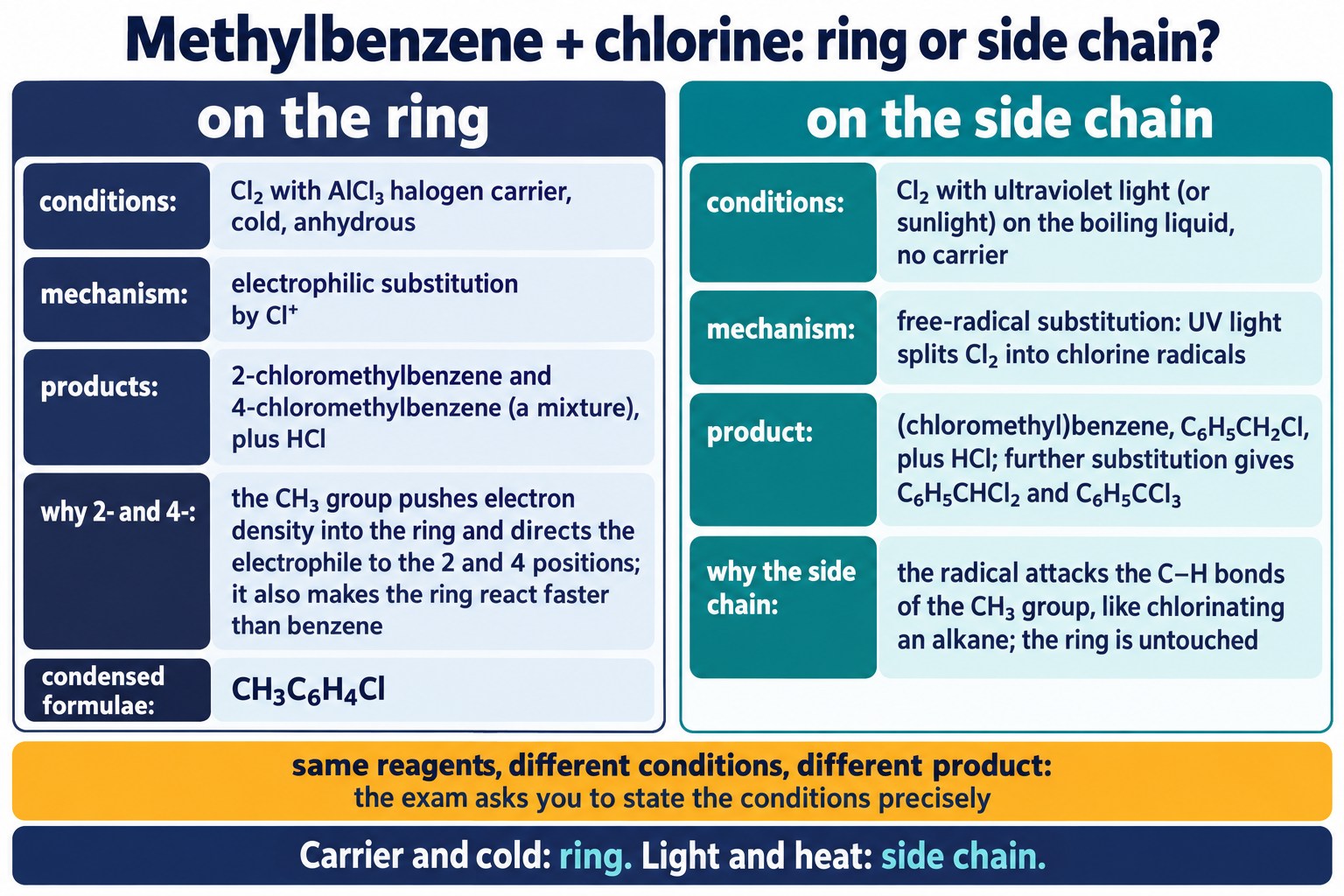
Two tiles comparing ring substitution with a catalyst and side-chain substitution in light: conditions, species that attacks, and product name.
Exam focus: If a question gives “Cl₂ and UV light” with methylbenzene, the answer is the side-chain product. “Cl₂ and AlCl₃” means the ring. Read the conditions before you draw.
Quick Check: Predict the Product
Read the conditions, decide where the halogen goes, and choose the product for each new compound.
Naming Halogenoarenes and Their Uses
Halogenoarenes are named as substituted benzenes. The halogen is a prefix, the ring carbons are numbered to give the lowest locants, and prefixes are listed alphabetically.
- Chlorobenzene C₆H₅Cl, bromobenzene C₆H₅Br: one halogen, no number needed.
- 1,2-Dichlorobenzene: two chlorines on neighbouring carbons; 1,3- and 1,4- for the other arrangements.
- 1-Bromo-4-methylbenzene: alphabetical order puts bromo before methyl, so the bromine carbon is position 1.
- The alternative name 4-chloromethylbenzene treats methylbenzene as the parent; both forms are accepted.
Uses
- Chlorobenzene was the starting material for phenol by the Dow process and for the insecticide DDT; it remains a solvent and an intermediate for dyes and pharmaceuticals.
- Bromobenzene is used to make organometallic reagents in synthesis.
- Halogenoarenes are far less reactive than halogenoalkanes towards nucleophiles, which is why they persist in the environment: Chlorobenzene versus Chloroethane.
Remember: A halogen on the ring is a halogenoarene; a halogen on a side chain is still a halogenoalkane. The name and the reactivity both follow from where the C–X bond is.
Check: Methylbenzene and Naming
Predict the products of ring and side-chain chlorination of methylbenzene from the conditions, explain why the 2- and 4-isomers form, and name substituted halogenoarenes.
Common Exam Points
- Benzene + Cl₂ with anhydrous AlCl₃ (or FeCl₃) at room temperature gives chlorobenzene + HCl; Br₂ with AlBr₃ (or FeBr₃) gives bromobenzene.
- Electrophile: Cl₂ + AlCl₃ → Cl⁺ + AlCl₄⁻; catalyst regenerated by H⁺ + AlCl₄⁻ → AlCl₃ + HCl.
- Mechanism: electrophilic substitution with a positively charged intermediate in which the delocalisation is partly broken.
- Methylbenzene + Cl₂/AlCl₃ gives 2-chloromethylbenzene and 4-chloromethylbenzene: the CH₃ group is activating and 2,4-directing.
- Methylbenzene + Cl₂ in UV light or boiling gives (chloromethyl)benzene by free-radical substitution on the side chain.
- Anhydrous conditions are essential: water destroys the aluminium halide catalyst.
- Name with the lowest locants and alphabetical prefixes: 1-bromo-4-methylbenzene, 1,2-dichlorobenzene.
- A halogen on the ring is a halogenoarene; a halogen on the side chain is a halogenoalkane and behaves like one.
FAQs
Use these quick answers to check how benzene and methylbenzene are chlorinated with an aluminium chloride catalyst, how the electrophile forms, why methylbenzene gives the 2- and 4-chloro products, and how ring substitution differs from side-chain substitution.
What conditions turn benzene into chlorobenzene?
Chlorine with anhydrous aluminium chloride (or iron(III) chloride) as the halogen carrier at room temperature: C₆H₆ + Cl₂ → C₆H₅Cl + HCl.
The conditions must be dry because water hydrolyses the catalyst. Bromine with aluminium bromide gives bromobenzene in the same way, by electrophilic substitution.
Why is a halogen carrier needed when alkenes react with chlorine without one?
The delocalised ring is stable and only attacked by a strong electrophile, and the non-polar Cl₂ molecule is too weak. Aluminium chloride accepts a lone pair from chlorine, Cl₂ + AlCl₃ → Cl⁺ + AlCl₄⁻, generating the Cl⁺ electrophile that the electron-rich ring can attack.
Why does methylbenzene give two chloro products rather than one?
The methyl group releases electrons into the ring, so it activates the ring and directs substitution to the 2- and 4-positions. Chlorination with AlCl₃ in the cold therefore gives a mixture of 2-chloromethylbenzene and 4-chloromethylbenzene, and the reaction is faster than with benzene.
What is the difference between ring substitution and side-chain substitution in methylbenzene?
With chlorine and aluminium chloride in the cold, Cl⁺ substitutes the ring by electrophilic substitution. With chlorine in ultraviolet light or at the boiling point and no catalyst, chlorine radicals attack the CH₃ group by free-radical substitution, giving (chloromethyl)benzene, C₆H₅CH₂Cl.
How do I name halogenoarenes correctly?
A halogen directly on the ring takes a prefix with a position number: chlorobenzene, 2-chloromethylbenzene, 4-bromomethylbenzene, 1,3-dichlorobenzene. A halogen on a side chain is shown with brackets, as in (chloromethyl)benzene, because the chlorine is on the CH₂ carbon and not on the ring.

Copyright notice: This OLS revision content, including the explanations, layout, diagrams, tables and embedded learning structure, is authored for Online Learning System by Dr. Mohammed Al-Fatah. It may not be copied, reproduced, redistributed or adapted without written permission.
Keep this note — free
Save your progress across every Cambridge topic. A free account remembers which topics you have covered, saves your question scores, and syncs across your phone and laptop.
- Track every topic you have finished
- Keep your practice-question scores
- No payment, no card, free forever
Already registered? Log in