Brønsted–Lowry Acids, Bases and Conjugate Pairs
A concise revision guide to Brønsted–Lowry acids and bases: acids as proton donors and bases as proton acceptors, acid-base reactions as proton transfer, the hydronium ion, conjugate acid-base pairs and water acting as both an acid and a base.
- 14.1-a
- 14.1-b
- 14.1-c
- 14.2
What these spec points say
- 14.1-a understand that a Brønsted-Lowry acid is a proton donor
- 14.1-b understand that a Brønsted-Lowry base is a proton acceptor
- 14.1-c understand that acid-base reactions involve proton transfer
- 14.2 be able to identify Brønsted–Lowry conjugate acid-base pairs
Brønsted–Lowry acids and bases: proton transfer
Follow one proton at a time: who gives it, who takes it, and the conjugate pairs that result.
© Dr. Mohammed Al-Fatah – onlinelearningsystem.net
GCSE Recap: Acids, Alkalis and pH
Three quick questions on what you already know: what acids and alkalis release in water, the neutralisation equation, and the pH scale.
From GCSE Acids to Proton Transfer
At GCSE an acid was a substance that releases hydrogen ions, H⁺(aq), in water, and an alkali released hydroxide ions, OH⁻(aq).
Neutralisation was the reaction between the two: H⁺(aq) + OH⁻(aq) → H₂O(l). Your AS notes (Typical Reactions of Acids) used the same idea in titrations.
That definition only works in water. The Brønsted–Lowry theory is wider: it looks at what happens to the hydrogen ion itself.
- A hydrogen atom is one proton and one electron. A hydrogen ion, H⁺, has lost its electron, so it is simply a proton.
- A Brønsted–Lowry acid is a proton donor.
- A Brønsted–Lowry base is a proton acceptor.
- An alkali is a base that dissolves in water to give OH⁻ ions.
| Idea | GCSE view | Brønsted–Lowry view |
|---|---|---|
| Acid | releases H⁺ ions in water | donates a proton to a base |
| Base | neutralises an acid; an alkali releases OH⁻ | accepts a proton from an acid |
| Reaction | H⁺ + OH⁻ → H₂O | any proton transfer, in water or not |
Definitions: A Brønsted–Lowry acid is a proton donor. A Brønsted–Lowry base is a proton acceptor. An acid can only donate a proton if a base is present to accept it.
Acid-Base Reactions Are Proton Transfers
Every Brønsted–Lowry reaction moves one proton from the acid to the base. The base needs a lone pair of electrons, which forms a dative covalent bond to the incoming proton.
An acid in water
HCl(aq) + H₂O(l) → H₃O⁺(aq) + Cl⁻(aq)
- Hydrogen chloride is the acid: it donates a proton.
- Water is the base: a lone pair on its oxygen accepts the proton.
- The product H₃O⁺ is the oxonium ion (also called the hydronium ion). H⁺(aq) is shorthand for it.
A base in water
NH₃(aq) + H₂O(l) ⇌ NH₄⁺(aq) + OH⁻(aq)
- Ammonia is the base: the lone pair on nitrogen accepts a proton.
- Water is now the acid: it donates a proton and is left as OH⁻.
- This is why a solution of ammonia is alkaline.
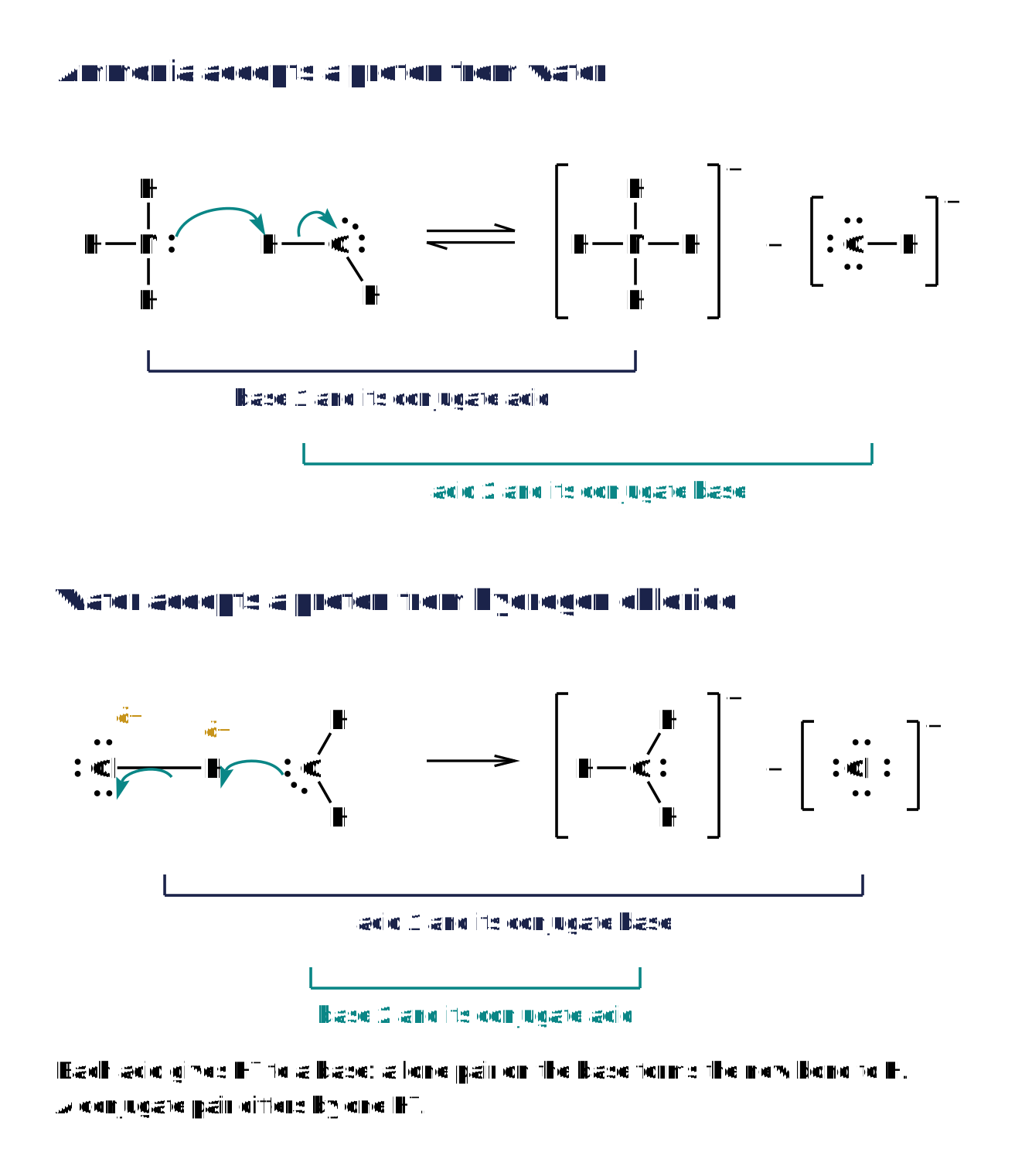
Proton transfer drawn with curly arrows: a lone pair on nitrogen takes a proton from water, and a lone pair on oxygen takes a proton from hydrogen chloride. The conjugate pairs are bracketed.
A reaction with no water
Hydrogen chloride gas and ammonia gas meet to form a white smoke of ammonium chloride:
HCl(g) + NH₃(g) → NH₄Cl(s)
No water and no OH⁻ ions are involved, so the GCSE definition cannot describe it. The Brønsted–Lowry theory can: HCl donates a proton directly to NH₃.
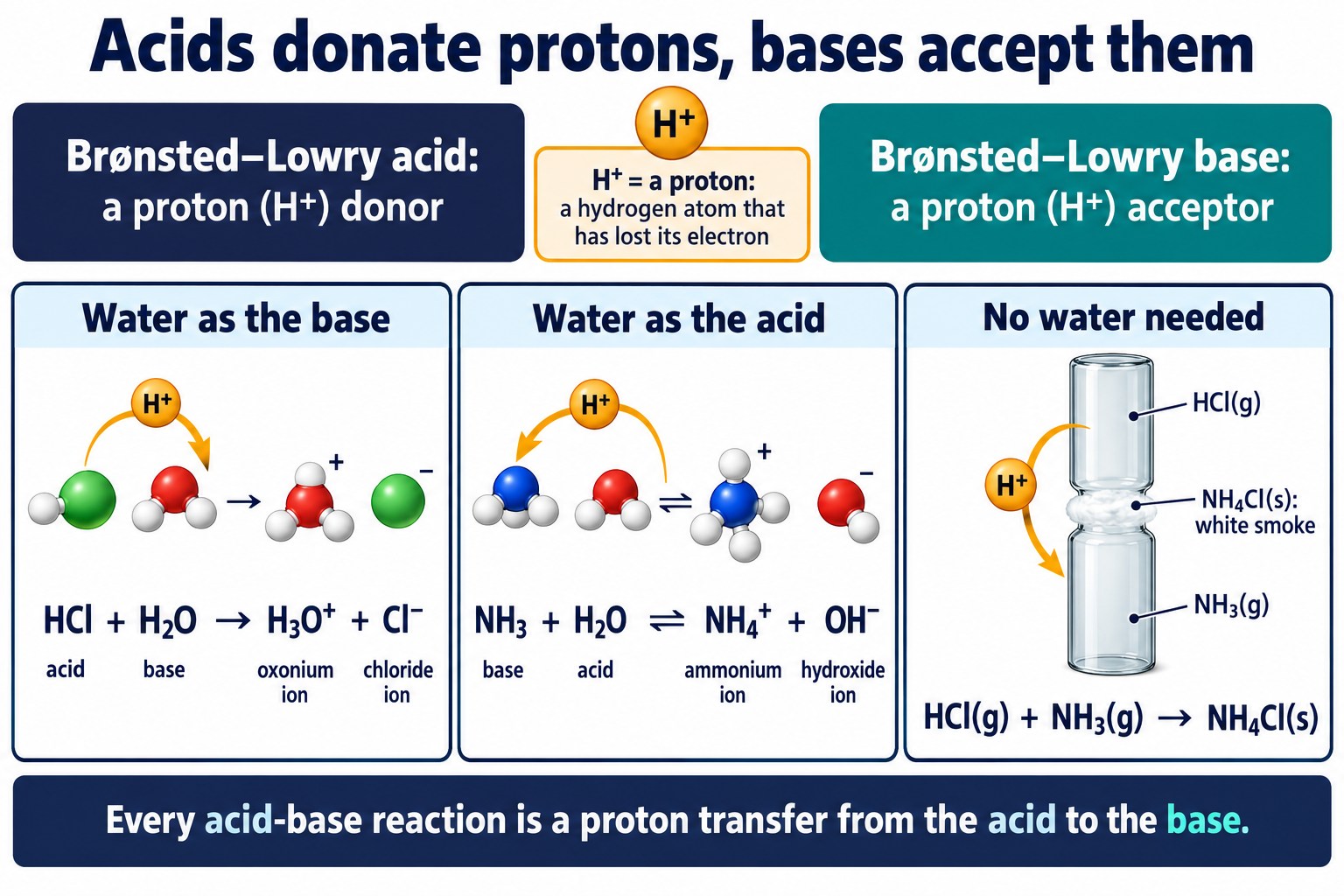
Acid-base reactions as proton transfer: hydrogen chloride and water, ammonia and water, and hydrogen chloride gas meeting ammonia gas to form a white smoke with no water present.
Exam focus: To identify the acid and the base, follow the proton. The species that loses an H⁺ is the acid; the species that gains it is the base. Its formula tells you: the acid ends with one H fewer.
Check: Proton Donors and Acceptors
Identify the acid and the base, and the proton transferred, in reactions not used on this page.
Conjugate Acid-Base Pairs
When an acid loses a proton, what is left can accept a proton back. It is the conjugate base of that acid. When a base gains a proton it becomes its conjugate acid.
- The two members of a conjugate acid-base pair differ by exactly one H⁺.
- Every acid-base equilibrium contains two pairs: acid 1 with base 1, and base 2 with acid 2.
- In the reverse reaction the conjugate acid donates the proton back to the conjugate base.
Worked example: ethanoic acid in water
CH₃COOH(aq) + H₂O(l) ⇌ CH₃COO⁻(aq) + H₃O⁺(aq)
Step 2. Pair each reactant with the product that differs from it by one H⁺.
Common conjugate pairs
| Acid | Conjugate base |
|---|---|
| HCl | Cl⁻ |
| H₃O⁺ | H₂O |
| H₂O | OH⁻ |
| NH₄⁺ | NH₃ |
| CH₃COOH | CH₃COO⁻ |
| H₂SO₄ | HSO₄⁻ |
| HSO₄⁻ | SO₄²⁻ |
| H₂CO₃ | HCO₃⁻ |
Acid or base depends on the partner
Nitric acid is usually an acid. Mixed with concentrated sulfuric acid, a stronger acid, it accepts a proton instead:
H₂SO₄ + HNO₃ ⇌ HSO₄⁻ + H₂NO₃⁺
- Pair 1: H₂SO₄ (acid 1) and HSO₄⁻ (conjugate base 1).
- Pair 2: HNO₃ (base 2) and H₂NO₃⁺ (conjugate acid 2).
- This step starts the formation of the nitronium ion, NO₂⁺, used to nitrate benzene.
The stronger an acid, the weaker its conjugate base. Cl⁻ has almost no tendency to take a proton back, so HCl reacts completely (→). CH₃COO⁻ takes protons back readily, so ethanoic acid reacts only partly (⇌).
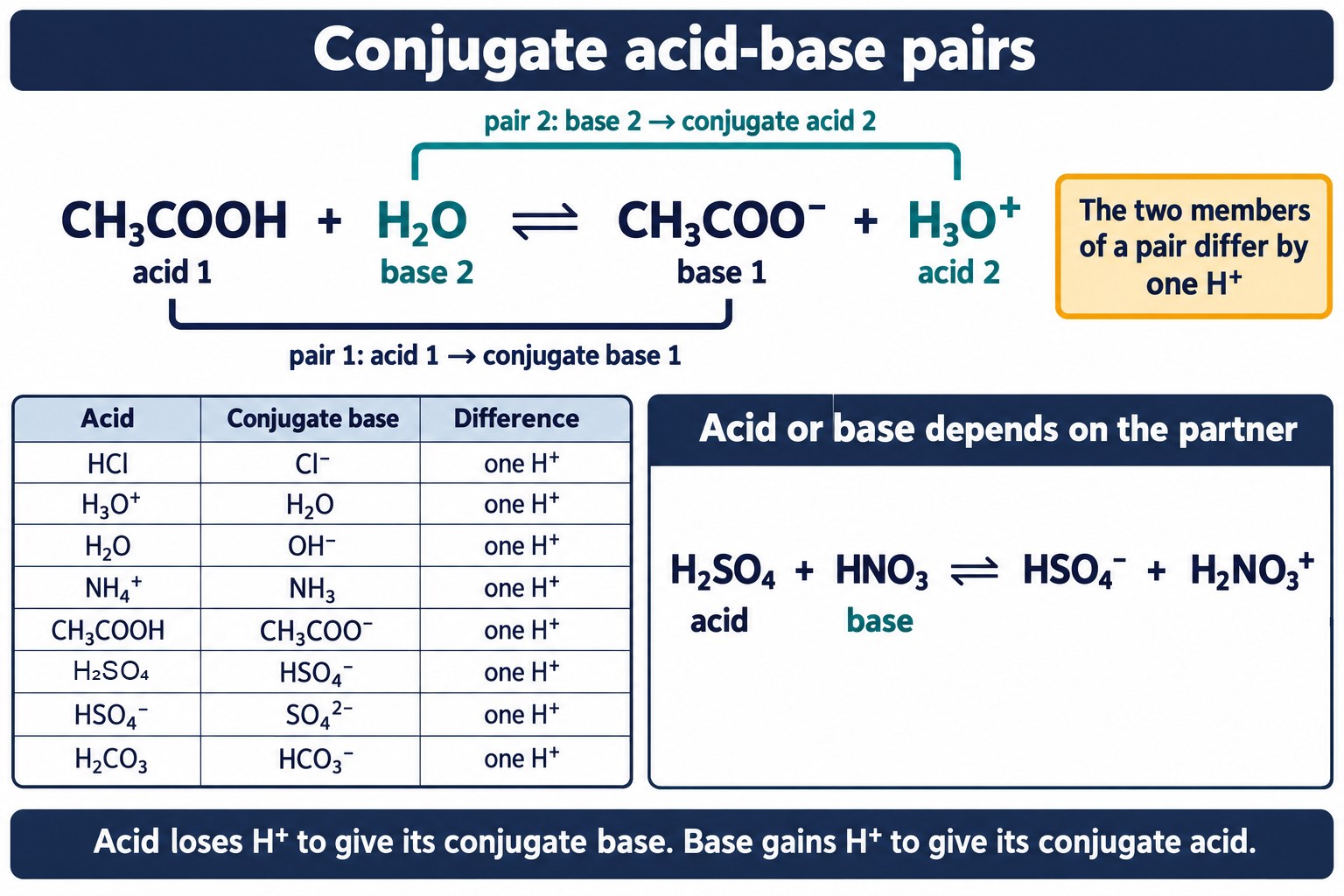
Conjugate acid-base pairs in the ethanoic acid equilibrium, each pair differing by one proton, with a table of common pairs and nitric acid acting as a base in sulfuric acid.
Exam focus: Label pairs with matching numbers: acid 1 / base 1 and base 2 / acid 2. Never pair the two reactants together. Each pair has one species on each side of the arrow.
Check: Conjugate Pairs
Write conjugate acids and bases, and identify both pairs in equilibria not used on this page.
Water: An Acid and a Base
Water appears on both sides of the story. It accepts a proton from hydrogen chloride but donates one to ammonia.
| Partner | Equation | Water acts as |
|---|---|---|
| HCl | HCl + H₂O → H₃O⁺ + Cl⁻ | a base: accepts H⁺ |
| NH₃ | NH₃ + H₂O ⇌ NH₄⁺ + OH⁻ | an acid: donates H⁺ |
| another H₂O | H₂O + H₂O ⇌ H₃O⁺ + OH⁻ | both at once |
- A species that can act as an acid or as a base is amphoteric.
- Water transfers protons between its own molecules only to a tiny extent. This equilibrium is the basis of Kw on page 3.
- Ions with both a lone pair and an acidic H can also act either way, for example HCO₃⁻ and HSO₄⁻.
The hydrogencarbonate ion
- As a base: HCO₃⁻ + H⁺ → H₂CO₃.
- As an acid: HCO₃⁻ + OH⁻ → CO₃²⁻ + H₂O.
- This two-way behaviour is used in the blood buffer on the buffers page.
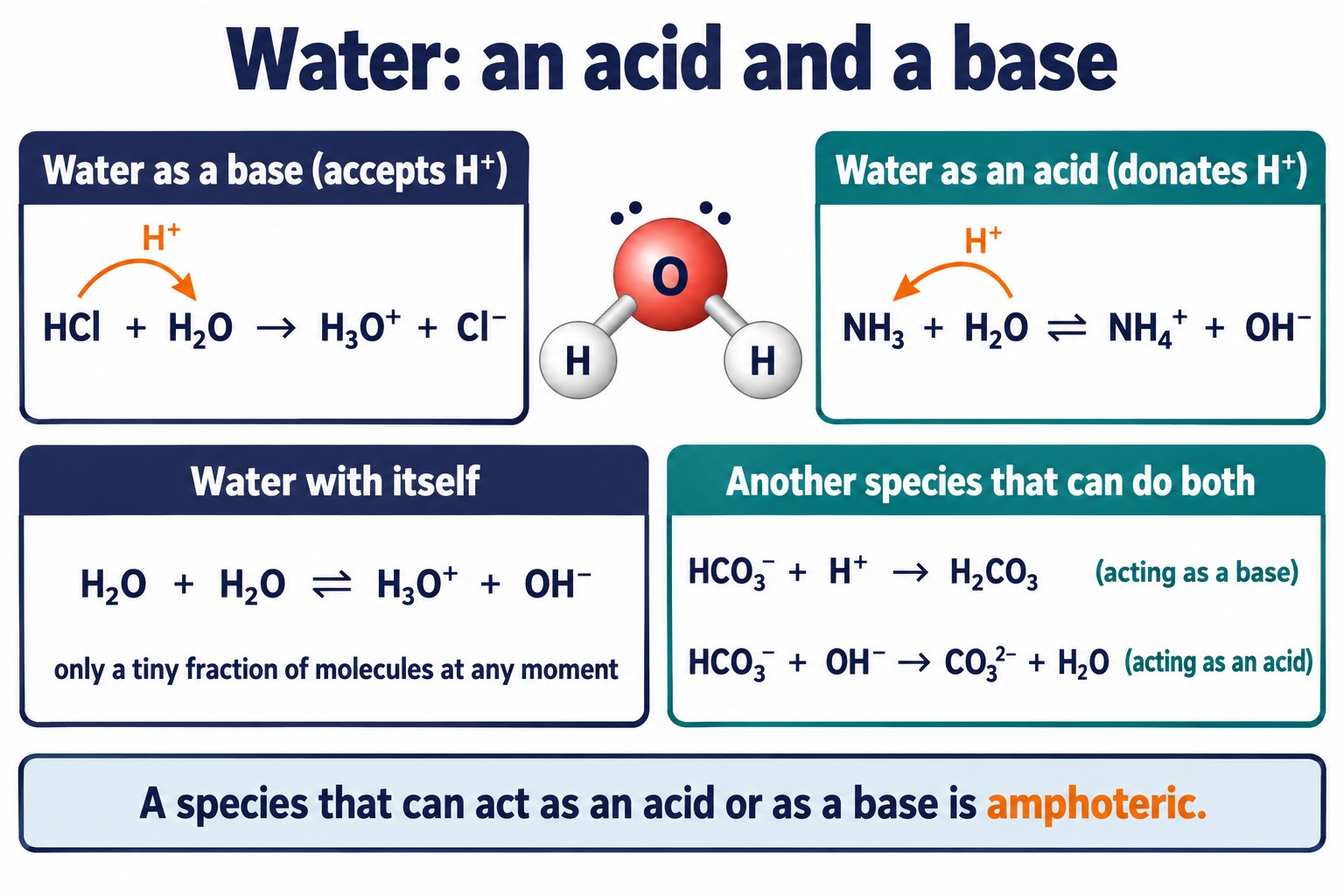
Water acting as a base with hydrogen chloride, as an acid with ammonia and as both with itself, with the hydrogencarbonate ion as a second species that can act either way.
Remember: Whether water is an acid or a base depends on its partner. With an acid it is a base; with a base it is an acid. The reaction partner decides.
Common Exam Points
Say
- “An acid is a proton donor; a base is a proton acceptor.”
- “H₂O accepts a proton from HCl, so water acts as a base.”
- “CH₃COO⁻ is the conjugate base of CH₃COOH: they differ by one H⁺.”
Do not say
- “An acid donates hydrogen” or “donates an H” (it donates a proton, H⁺).
- “HCl and H₂O are a conjugate pair” (a pair is one acid and the species it becomes).
- “A base is something that contains OH⁻” (NH₃ is a base with no OH⁻).
Watch for
- Reactions with no water, such as HCl(g) + NH₃(g): the Brønsted–Lowry definition still applies.
- The same species acting as an acid in one reaction and a base in another: water, HCO₃⁻ and HNO₃.
- Charges in conjugate pairs: removing H⁺ lowers the charge by one; adding H⁺ raises it by one.
Check: Water, Pairs and Proton Transfer Together
Combine conjugate pairs, amphoteric species and reactions without water in examples not used on this page.
FAQs
Use these quick answers to check Brønsted–Lowry acids, bases and conjugate pairs.
What is the difference between an acid and a base in Brønsted–Lowry theory?
An acid is a proton donor and a base is a proton acceptor. Every acid-base reaction is a proton transfer, so an acid can only lose its H⁺ when a base with a lone pair is present to accept it.
How do I find the conjugate base of an acid?
Remove one H⁺ and lower the charge by one. HCl gives Cl⁻, NH₄⁺ gives NH₃ and HSO₄⁻ gives SO₄²⁻. To find a conjugate acid, add one H⁺ and raise the charge by one instead.
Can water really be both an acid and a base?
Yes. Water accepts a proton from HCl, acting as a base, but donates a proton to NH₃, acting as an acid. A species that can do either is amphoteric. HCO₃⁻ and HSO₄⁻ behave in the same way.
Why is H₃O⁺ often written as H⁺(aq)?
A bare proton cannot exist in water. It bonds datively to a lone pair on a water molecule, forming the oxonium ion, H₃O⁺. Writing H⁺(aq) is accepted shorthand for this ion in equations and in pH work.
Why is HCl gas reacting with NH₃ gas an acid-base reaction?
HCl donates a proton directly to the lone pair on NH₃, forming NH₄Cl. No water and no OH⁻ ions are involved, so the GCSE definition fails, but it is still a proton transfer and so a Brønsted–Lowry acid-base reaction.

Copyright notice: This OLS revision content, including the explanations, layout, diagrams, tables and embedded learning structure, is authored for Online Learning System by Dr. Mohammed Al-Fatah. It may not be copied, reproduced, redistributed or adapted without written permission.
Keep this note — free
Save your progress across every Edexcel IAL topic. A free account remembers which topics you have covered, saves your question scores, and syncs across your phone and laptop.
- Track every topic you have finished
- Keep your practice-question scores
- No payment, no card, free forever
Already registered? Log in