Weak Acids: Ka and pKa
A concise revision guide to weak acids: the acid dissociation constant Ka and pKa, calculating the pH of a weak acid with the two standard assumptions, finding Ka from a pH measurement, and when those assumptions stop working.
- 14.8
- 14.9-a
- 14.9-b
- 14.9-c
- 14.12-a
- 14.14
What these spec points say
- 14.8 be able to deduce the expression for the acid dissociation constant, Ka, for a weak acid
- 14.9-a be able to calculate pH of a weak acid from Ka, making relevant assumptions
- 14.9-b be able to calculate pH of a weak acid from pKa, making relevant assumptions
- 14.9-c know that solving quadratic equations is not expected
- 14.12-a be able to define the term 'pKa'
- 14.14 be able to calculate Ka for a weak acid from experimental data given the pH of a solution containing a known mass of acid
Before You Start
This page uses page 2, pH and Strong Acids (strong and weak acids, pH = −log[H⁺]), and page 3, The Ionic Product of Water, Kw, and Strong Bases.
- Ka is another equilibrium constant, written by the same rules as Kc (Topic 13 Chemical Equilibria).
- A weak acid dissociates only partially: HA ⇌ H⁺ + A⁻ lies far to the left.
The Acid Dissociation Constant, Ka
For a weak acid HA in water the equilibrium is HA(aq) ⇌ H⁺(aq) + A⁻(aq). Its equilibrium constant is the acid dissociation constant, Ka.
Ka = ([H⁺][A⁻]) / ([HA])
- All three concentrations are equilibrium values in mol dm⁻³.
- Units: (mol dm⁻³ × mol dm⁻³) / (mol dm⁻³) = mol dm⁻³.
- Written with H₃O⁺, HA + H₂O ⇌ H₃O⁺ + A⁻ gives Ka = ([H₃O⁺][A⁻]) / ([HA]). Water is the solvent, so it is left out.
- Like Kc, Ka changes only with temperature.
Worked example: ethanoic acid
Step 1. CH₃COOH(aq) ⇌ CH₃COO⁻(aq) + H⁺(aq).
Answer. Ka = ([CH₃COO⁻][H⁺]) / ([CH₃COOH]) = 1.74 × 10⁻⁵ mol dm⁻³ at 298 K.
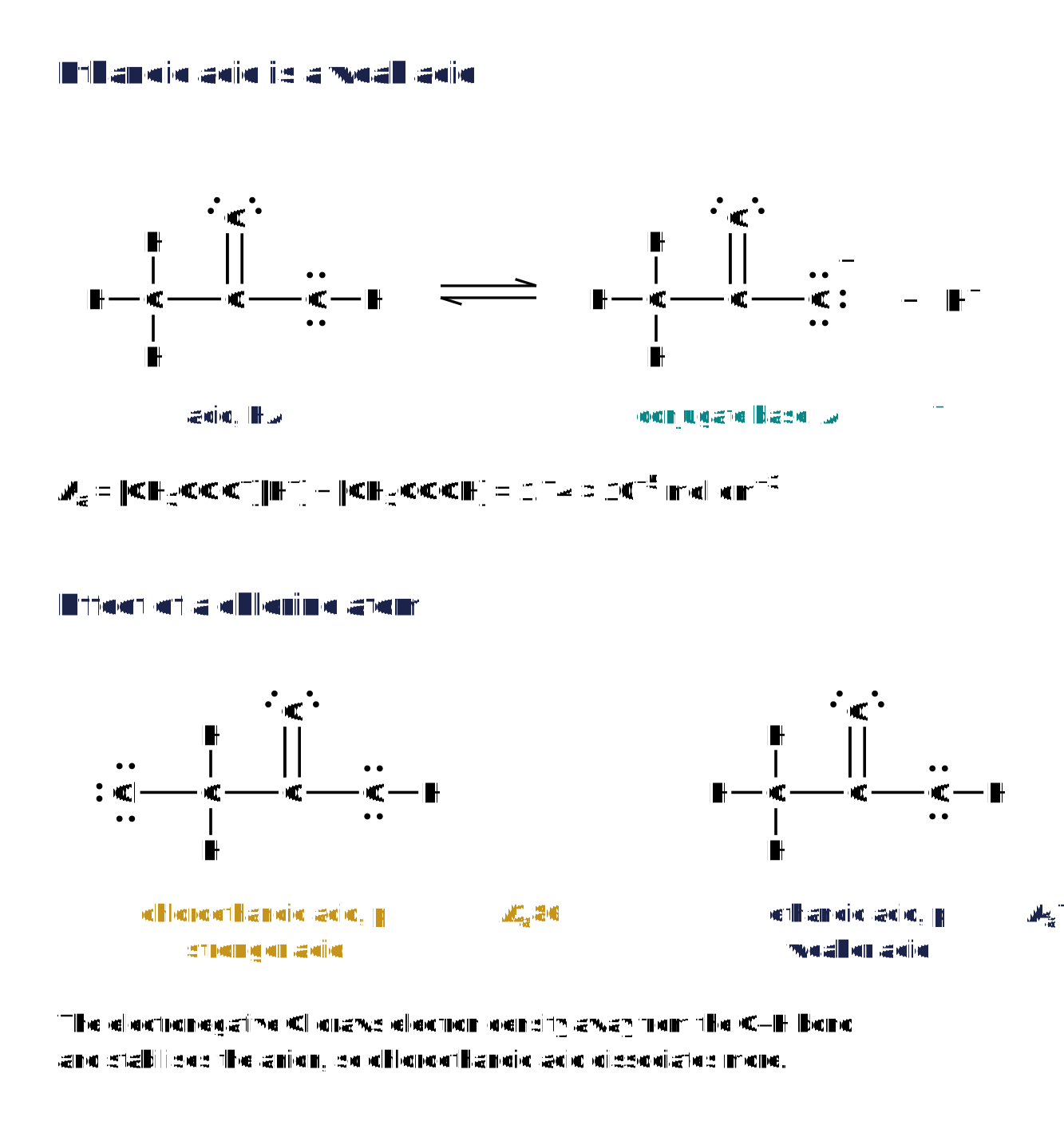
Ethanoic acid losing a proton to form the ethanoate ion, its conjugate base, beside chloroethanoic acid, which is a stronger acid with a smaller pKa.
A larger Ka means the equilibrium lies further to the right: more H⁺ at the same concentration, so a stronger acid.
Definition: Ka = ([H⁺][A⁻]) / ([HA]), the equilibrium constant for the dissociation of a weak acid. Units mol dm⁻³. A larger Ka means a stronger acid.
pKa
Ka values are small and awkward, so they are often turned into pKa, in the same way that [H⁺] is turned into pH.
pKa = −log Ka
Ka = 10⁻ᵖᴷᵃ
- A smaller pKa means a larger Ka, so a stronger acid.
- One pKa unit is a factor of ten in Ka.
- pKa has no units.
| Acid | Ka / mol dm⁻³ | pKa |
|---|---|---|
| chloroethanoic acid, ClCH₂COOH | 1.38 × 10⁻³ | 2.86 |
| methanoic acid, HCOOH | 1.78 × 10⁻⁴ | 3.75 |
| benzoic acid, C₆H₅COOH | 6.31 × 10⁻⁵ | 4.20 |
| ethanoic acid, CH₃COOH | 1.74 × 10⁻⁵ | 4.76 |
| propanoic acid, CH₃CH₂COOH | 1.35 × 10⁻⁵ | 4.87 |
| hydrocyanic acid, HCN | 6.17 × 10⁻¹⁰ | 9.21 |
Worked examples: converting
Example 1. Ka = 1.74 × 10⁻⁵ mol dm⁻³. pKa = −log(1.74 × 10⁻⁵) = 4.76.
Example 2. pKa = 4.87. Ka = 10⁻⁴·⁸⁷ = 1.35 × 10⁻⁵ mol dm⁻³.
The chlorine atom in chloroethanoic acid is electronegative. It draws electron density from the O–H bond and spreads the charge on the anion, so the acid dissociates more.
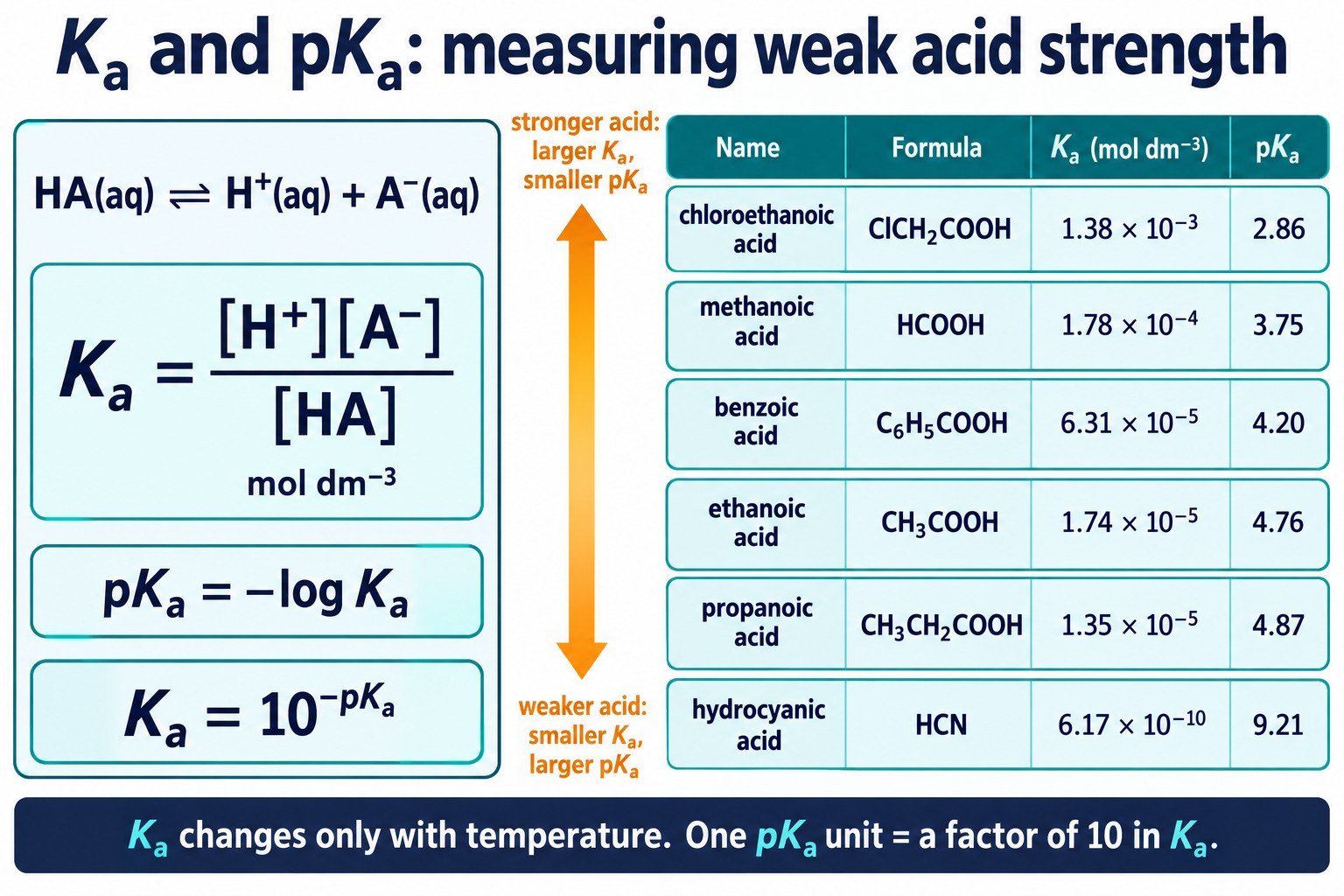
The Ka expression and pKa, with six weak acids ranked from chloroethanoic acid to hydrocyanic acid: a larger Ka and a smaller pKa mean a stronger acid.
Remember: Strongest acid: largest Ka, smallest pKa. The pattern is the reverse of what the numbers look like, so check the direction every time you rank acids.
Check: Ka and pKa
Write Ka expressions, convert between Ka and pKa, and rank weak acids by strength, for acids and values not used on this page.
pH of a Weak Acid
A weak acid does not dissociate completely, so [H⁺] is not the concentration of the acid. Ka links the two, with two assumptions.
- [H⁺] = [A⁻]: each HA that dissociates gives one H⁺ and one A⁻, and the H⁺ from water is negligible.
- [HA] at equilibrium ≈ [HA] at the start: so little dissociates that the concentration of HA hardly changes.
With both assumptions, Ka = ([H⁺]²) / ([HA]), so [H⁺] = √(Ka × [HA]).
Worked example 1: from Ka
Find the pH of 0.100 mol dm⁻³ ethanoic acid. Ka = 1.74 × 10⁻⁵ mol dm⁻³.
Step 1. Ka = ([H⁺]²) / ([CH₃COOH]), so [H⁺]² = 1.74 × 10⁻⁵ × 0.100 = 1.74 × 10⁻⁶.
Step 2. [H⁺] = √(1.74 × 10⁻⁶) = 1.32 × 10⁻³ mol dm⁻³.
Answer. pH = −log(1.32 × 10⁻³) = 2.88.
Check assumption 2: (1.32 × 10⁻³) / (0.100) × 100 = 1.32% dissociated. That is small, so the assumption holds.
Worked example 2: from pKa
Find the pH of 0.250 mol dm⁻³ propanoic acid. pKa = 4.87.
Step 1. Ka = 10⁻⁴·⁸⁷ = 1.35 × 10⁻⁵ mol dm⁻³.
Step 2. [H⁺] = √(1.35 × 10⁻⁵ × 0.250) = 1.84 × 10⁻³ mol dm⁻³.
Answer. pH = 2.74.
Worked example 3: the concentration for a given pH
Step 1. Ethanoic acid of pH 3.00 has [H⁺] = 1.00 × 10⁻³ mol dm⁻³.
Answer. [CH₃COOH] = ([H⁺]²) / (Ka) = (1.00 × 10⁻⁶) / (1.74 × 10⁻⁵) = 0.0575 mol dm⁻³.
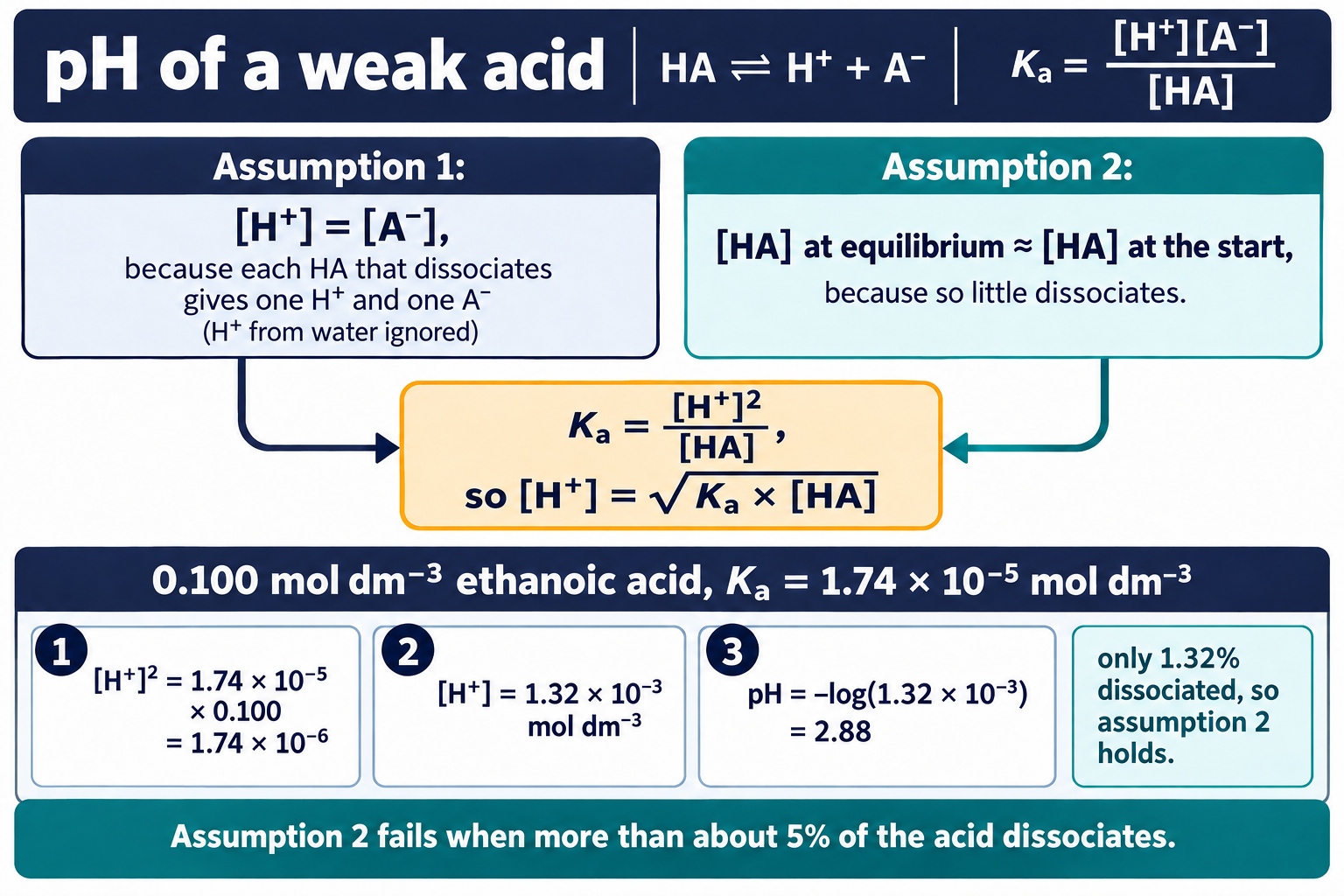
The two assumptions used for a weak acid, the formula that follows from them, and the pH of 0.100 mol dm⁻³ ethanoic acid worked step by step.
Exam focus: State both assumptions in words when asked. Write Ka = ([H⁺]²) / ([HA]) before substituting, and keep the unrounded [H⁺] in your calculator until the pH.
Check: pH of Weak Acids
Calculate the pH of weak monoprotic acids from Ka or pKa, and the concentration needed for a given pH, with acids and values not used on this page.
Finding Ka From pH
Measuring the pH of a weak acid of known concentration gives [H⁺]. The same two assumptions then give Ka.
- [H⁺] = 10⁻ᵖᴴ.
- Assume [A⁻] = [H⁺] and [HA] = the starting concentration.
- Ka = ([H⁺]²) / ([HA]), then pKa = −log Ka if asked.
Worked example 1: from a concentration
A 0.0200 mol dm⁻³ solution of a weak acid HX has pH 3.10.
Step 1. [H⁺] = 10⁻³·¹⁰ = 7.94 × 10⁻⁴ mol dm⁻³.
Step 2. Ka = ((7.94 × 10⁻⁴)²) / (0.0200).
Worked example 2: from a known mass
1.22 g of benzoic acid, C₆H₅COOH (M = 122.0 g mol⁻¹), is dissolved and made up to 500 cm³. The pH is 2.95.
Step 2. [H⁺] = 10⁻²·⁹⁵ = 1.12 × 10⁻³ mol dm⁻³.
Step 3. Ka = ((1.12 × 10⁻³)²) / (0.0200).
- This is the usual way Ka is found in the laboratory, with a calibrated pH meter.
- pKa can also be read from a titration curve (page 5): at half-neutralisation, pH = pKa.
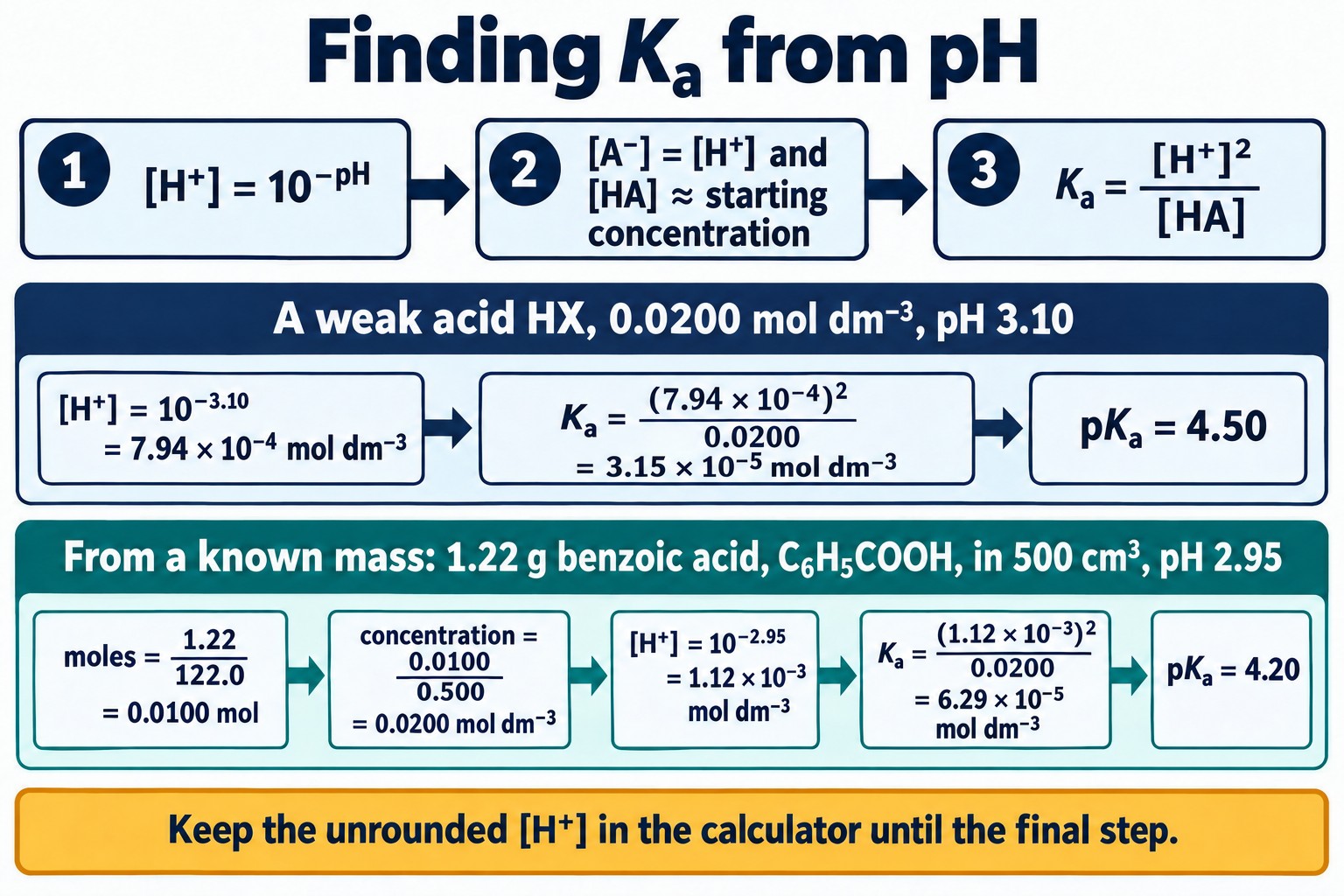
Finding Ka from a measured pH: a weak acid of known concentration, and benzoic acid made up from a known mass, each giving Ka and pKa.
Exam focus: For a known mass, find the concentration first: moles = (mass) / (M), then divide by the volume in dm³. Square [H⁺] before dividing by [HA].
When the Approximations Break Down
The two assumptions work well for most weak acids. Each one fails in a known situation.
| Assumption | Fails when | Why |
|---|---|---|
| [HA]eq ≈ [HA]start | the acid is a “stronger” weak acid, or very dilute | more than about 5% dissociates, so [HA] falls noticeably |
| [H⁺] = [A⁻] | the acid is very dilute or very weak | H⁺ from water is no longer negligible |
| [H⁺] = [A⁻] | a salt of the acid is added | A⁻ then comes mostly from the salt: this is a buffer |
Example: chloroethanoic acid
- You will not be asked to solve the quadratic. You may be asked to explain why the approximation fails.
- Weak bases behave in the same way: ammonia is only slightly protonated, NH₃ + H₂O ⇌ NH₄⁺ + OH⁻.
Remember: The approximation is safe when the percentage dissociated is small (below about 5%). A large Ka or a very low concentration makes it unreliable.
Quick Check: Concentration Against Strength
Estimate the pH of each new solution before you rank them, because the strongest acid is not always the lowest pH.
Common Exam Points
Say
- “Ka = ([H⁺][A⁻]) / ([HA])“, with units mol dm⁻³.
- “Assume [H⁺] = [A⁻], and that the dissociation is so small that [HA] at equilibrium equals its initial concentration.”
- “The acid with the smaller pKa is the stronger acid.”
- “[H⁺] = √(Ka × [HA]) = √(1.74 × 10⁻⁶) = 1.32 × 10⁻³ mol dm⁻³.”
Do not say
- “[H⁺] = [HA]” for a weak acid (that is only true for a strong acid).
- “Ka = ([H⁺]²) / ([HA])” as the definition (that is the simplified form after the assumptions).
- “A larger pKa means a stronger acid” (it means a weaker acid).
- “Ka increases when the acid is diluted” (only temperature changes Ka).
Watch for
- Data given as pKa: convert to Ka first with Ka = 10⁻ᵖᴷᵃ.
- Data given as a mass and volume: find the concentration in mol dm⁻³ first.
- A question asking whether the assumptions are valid: work out the percentage dissociated.
- Weak monoprotic acids only: these methods do not apply to sulfuric acid or to a strong acid.
Check: Ka From Data and the Limits of the Approximations
Find Ka and pKa from pH data and masses, and judge when the assumptions hold, for acids not used on this page.
FAQs
Use these quick answers to check Ka, pKa and the pH of weak acids.
What does Ka tell me about a weak acid?
Ka = ([H⁺][A⁻]) / ([HA]) measures how far the acid dissociates. A larger Ka means the equilibrium lies further to the right, so the acid is stronger. Ka has units of mol dm⁻³ and changes only with temperature.
Does a larger pKa mean a stronger acid?
No, the reverse. pKa = −log Ka, so a larger Ka gives a smaller pKa. Chloroethanoic acid, pKa 2.86, is stronger than ethanoic acid, pKa 4.76. Each pKa unit is a factor of ten in Ka.
What are the two assumptions for the pH of a weak acid?
First, [H⁺] = [A⁻], because each HA that dissociates gives one of each and H⁺ from water is negligible. Second, [HA] at equilibrium equals the starting concentration, because so little dissociates. Then [H⁺] = √(Ka × [HA]).
How do I find Ka from a measured pH?
Convert the pH to [H⁺] using 10⁻ᵖᴴ. Assume [A⁻] = [H⁺] and [HA] equals the starting concentration, then Ka = ([H⁺]²) / ([HA]). A 0.0200 mol dm⁻³ acid of pH 3.10 has Ka = 3.15 × 10⁻⁵ mol dm⁻³.
When does the weak acid approximation stop working?
When more than about 5% of the acid dissociates, as with a fairly strong weak acid or a very dilute solution, [HA] falls noticeably. In a very dilute or very weak acid, H⁺ from water is also no longer negligible.

Copyright notice: This OLS revision content, including the explanations, layout, diagrams, tables and embedded learning structure, is authored for Online Learning System by Dr. Mohammed Al-Fatah. It may not be copied, reproduced, redistributed or adapted without written permission.
Keep this note — free
Save your progress across every Edexcel IAL topic. A free account remembers which topics you have covered, saves your question scores, and syncs across your phone and laptop.
- Track every topic you have finished
- Keep your practice-question scores
- No payment, no card, free forever
Already registered? Log in