pH and Strong Acids
A concise revision guide to pH: the definition pH = −log[H⁺], converting between pH and hydrogen ion concentration, why the pH scale is logarithmic, strong and weak acids in terms of dissociation, and calculating the pH of a strong acid, including after dilution.
- 14.3
- 14.4
- 14.5
- 14.6-a
- 14.6-b
- 14.6-c
- 14.7
What these spec points say
- 14.3 be able to define the term ‘pH’
- 14.4 be able to calculate pH from hydrogen ion concentration
- 14.5 be able to calculate hydrogen ion concentration from pH using [H+] = 10^-pH
- 14.6-a understand strong acids in terms of degree of dissociation
- 14.6-b understand weak acids in terms of degree of dissociation
- 14.6-c understand the difference between strong and weak acids in terms of degree of dissociation
- 14.7 be able to calculate the pH of a strong acid
Strong and weak acids in water
At the same concentration, hydrochloric acid dissociates completely, while ethanoic acid dissociates only slightly and in both directions.
© Dr. Mohammed Al-Fatah – onlinelearningsystem.net
Before You Start
This page builds on page 1, Brønsted–Lowry Acids, Bases and Conjugate Pairs: an acid is a proton donor, and H⁺(aq) is shorthand for the oxonium ion, H₃O⁺.
- Your AS notes on acids (Typical Reactions of Acids) give the moles and concentration work used here.
- You need the log button on your calculator, and its inverse, 10ˣ.
GCSE Recap: Acids, Alkalis and the pH Scale
Three quick questions on the GCSE ideas this page builds on.
Defining pH
Hydrogen ion concentrations range from about 1 mol dm⁻³ down to about 10⁻¹⁴ mol dm⁻³. The pH scale turns this huge range into simple numbers.
pH = −log[H⁺]
[H⁺] = 10⁻ᵖᴴ
- The log is to base 10, and [H⁺] is in mol dm⁻³.
- The minus sign makes most pH values positive.
- A higher [H⁺] gives a lower pH.
Worked examples: [H⁺] to pH
Example 1. [H⁺] = 0.0100 mol dm⁻³. pH = −log(0.0100) = 2.00.
Example 2. [H⁺] = 2.50 × 10⁻³ mol dm⁻³. pH = −log(2.50 × 10⁻³) = 2.60.
Worked examples: pH to [H⁺]
Example 3. pH = 3.40. [H⁺] = 10⁻³·⁴⁰ = 3.98 × 10⁻⁴ mol dm⁻³.
Example 4. pH = 11.20. [H⁺] = 10⁻¹¹·²⁰ = 6.31 × 10⁻¹² mol dm⁻³.
Exam focus: Give pH to 2 decimal places unless told otherwise. Learn the definition as an equation, pH = −log[H⁺], with the square brackets: they mean concentration in mol dm⁻³.
A Logarithmic Scale
Because pH is a logarithm, each step of one pH unit is a factor of ten in [H⁺].
| pH | [H⁺] / mol dm⁻³ | Compared with pH 3 |
|---|---|---|
| 1 | 1 × 10⁻¹ | 100 times more H⁺ |
| 2 | 1 × 10⁻² | 10 times more H⁺ |
| 3 | 1 × 10⁻³ | reference |
| 4 | 1 × 10⁻⁴ | 10 times less H⁺ |
| 7 | 1 × 10⁻⁷ | 10 000 times less H⁺ |
- A fall of 2 pH units means [H⁺] is 100 times greater.
- A change of 0.30 units means [H⁺] has doubled or halved, because log 2 = 0.30. From pH 4.00 to 4.30, [H⁺] halves.
- pH can be negative: any solution with [H⁺] above 1 mol dm⁻³ has a pH below 0.
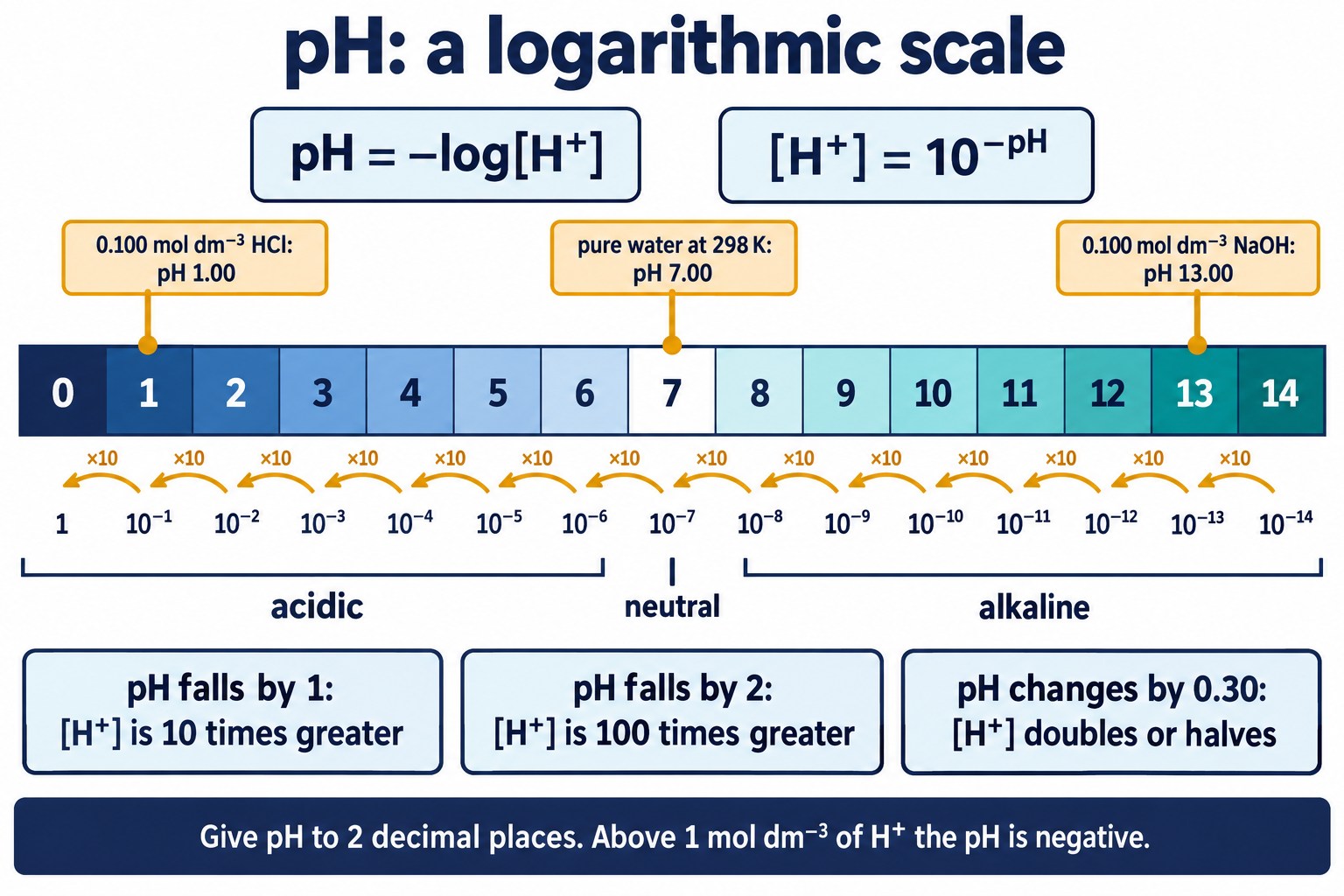
The pH scale from 0 to 14 with the hydrogen ion concentration under each value: every step of one pH unit is a factor of ten.
Remember: A small change in pH is a large change in [H⁺]. A solution of pH 2 is not twice as acidic as one of pH 4; it has 100 times the hydrogen ion concentration.
Check: pH and [H⁺]
Convert between pH and hydrogen ion concentration, and use the factor-of-ten scale, with values not used on this page.
Strong and Weak Acids
Acids differ in how far they dissociate (ionise) in water. This is the degree of dissociation.
| Strong acid | Weak acid | |
|---|---|---|
| Dissociation | complete: every molecule gives H⁺ | partial: only a small fraction gives H⁺ |
| Equation | HCl(aq) → H⁺(aq) + Cl⁻(aq) | CH₃COOH(aq) ⇌ CH₃COO⁻(aq) + H⁺(aq) |
| Arrow | one way | equilibrium, lying to the left |
| Examples | HCl, HBr, HI, HNO₃, H₂SO₄ | carboxylic acids, HCN, H₂CO₃ |
| 0.100 mol dm⁻³: [H⁺] | 0.100 mol dm⁻³ | 1.32 × 10⁻³ mol dm⁻³ |
| 0.100 mol dm⁻³: pH | 1.00 | 2.88 |
- Only 1.32% of the ethanoic acid molecules are dissociated at any instant, about 1 in 75.
- Bases work the same way. Sodium hydroxide is a strong base; ammonia is a weak base: NH₃ + H₂O ⇌ NH₄⁺ + OH⁻ lies far to the left.
- Equal amounts of a strong and a weak acid need the same amount of alkali to neutralise them. As H⁺ is removed, more weak acid dissociates.
Strong is not the same as concentrated
- Strength is about the degree of dissociation.
- Concentration is about the amount of acid in each dm³ of solution.
- A dilute solution of a strong acid can have a lower [H⁺] than a concentrated solution of a weak acid.
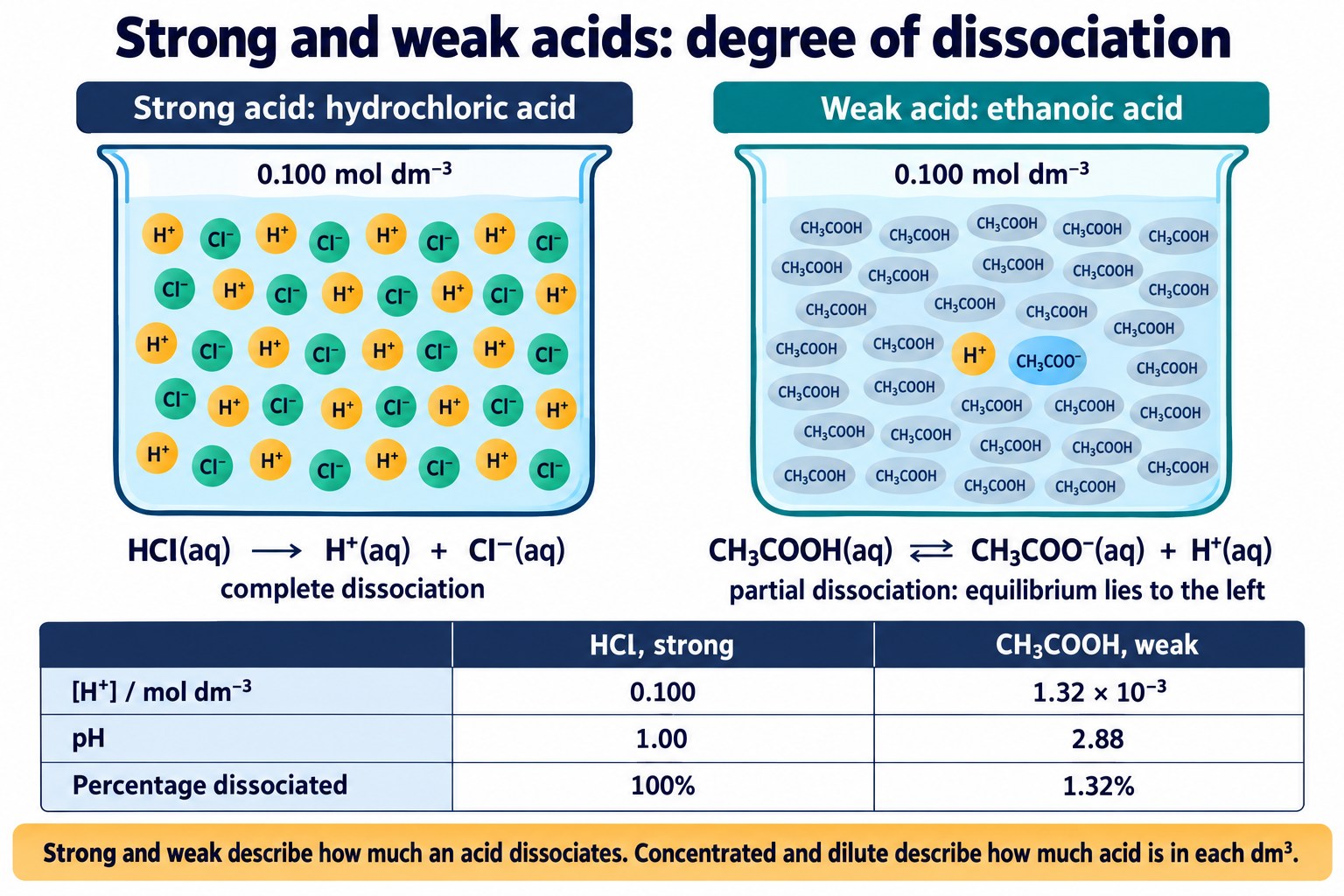
A strong acid fully dissociated beside a weak acid that is mostly molecules, at the same concentration, with the hydrogen ion concentration, pH and percentage dissociated of each.
Definitions: A strong acid dissociates completely in water. A weak acid dissociates only partially. Use “dilute” and “concentrated” for the amount of acid, never for its strength.
Quick Check: Strength or Concentration?
Pick the one accurate statement in each set, using acids that are new to this page.
pH of Strong Monoprotic Acids
A strong monoprotic acid, HA, dissociates completely and each molecule releases one H⁺. So [H⁺] = the concentration of the acid.
- Find the concentration of the acid in mol dm⁻³, from moles and volume if needed.
- Write [H⁺] = concentration of acid.
- pH = −log[H⁺], to two decimal places.
Worked example 1: from a concentration
Step 1. Hydrochloric acid, 0.0500 mol dm⁻³: [H⁺] = 0.0500 mol dm⁻³.
Answer. pH = −log(0.0500) = 1.30.
Worked example 2: from a mass
0.365 g of hydrogen chloride is dissolved in water and made up to 250 cm³. Find the pH.
Step 1. Moles of HCl = (0.365) / (36.5) = 0.0100 mol.
Step 2. Concentration = (0.0100) / (0.250) = 0.0400 mol dm⁻³ = [H⁺].
Answer. pH = −log(0.0400) = 1.40.
Worked example 3: a negative pH
Answer. 2.00 mol dm⁻³ hydrochloric acid: pH = −log(2.00) = −0.30.
Worked example 4: concentration from pH
Exam focus: Show [H⁺] before the pH. If the data is a mass, convert to moles, then divide by the volume in dm³. When [H⁺] is above 1 mol dm⁻³ the pH is negative, and that is allowed.
Check: pH of Strong Acids
Calculate the pH of strong monoprotic acids from concentrations and masses, and the reverse, for acids and amounts not used on this page.
Sulfuric Acid and Dilution
Sulfuric acid
Sulfuric acid is diprotic: each H₂SO₄ can release two H⁺ ions. In calculations assume both are released, so [H⁺] = 2 × [H₂SO₄].
Step 1. 0.0250 mol dm⁻³ H₂SO₄: [H⁺] = 2 × 0.0250 = 0.0500 mol dm⁻³.
Answer. pH = −log(0.0500) = 1.30.
In reality the second step, HSO₄⁻ ⇌ H⁺ + SO₄²⁻, is not complete, so the measured pH is a little higher. Use the assumption unless a question says otherwise.
Diluting a strong acid
Diluting a strong acid tenfold divides [H⁺] by 10, so the pH rises by exactly 1.
Step 1. 25.0 cm³ of 0.100 mol dm⁻³ HCl (pH 1.00) is made up to 250 cm³: a tenfold dilution.
Step 2. New concentration = (0.100 × 25.0) / (250) = 0.0100 mol dm⁻³.
| Dilution | Strong acid, HCl | Weak acid, CH₃COOH |
|---|---|---|
| none, 0.100 mol dm⁻³ | pH 1.00 | pH 2.88 |
| ×10, 0.0100 mol dm⁻³ | pH 2.00 (up 1) | pH 3.38 (up about 0.5) |
- The weak acid pH rises by only about half a unit. Dilution shifts its equilibrium to the right, so a larger fraction dissociates: 1.32% becomes 4.17%.
- However far an acid is diluted, its pH approaches 7 but never rises above it. Very dilute acids also get H⁺ from water.
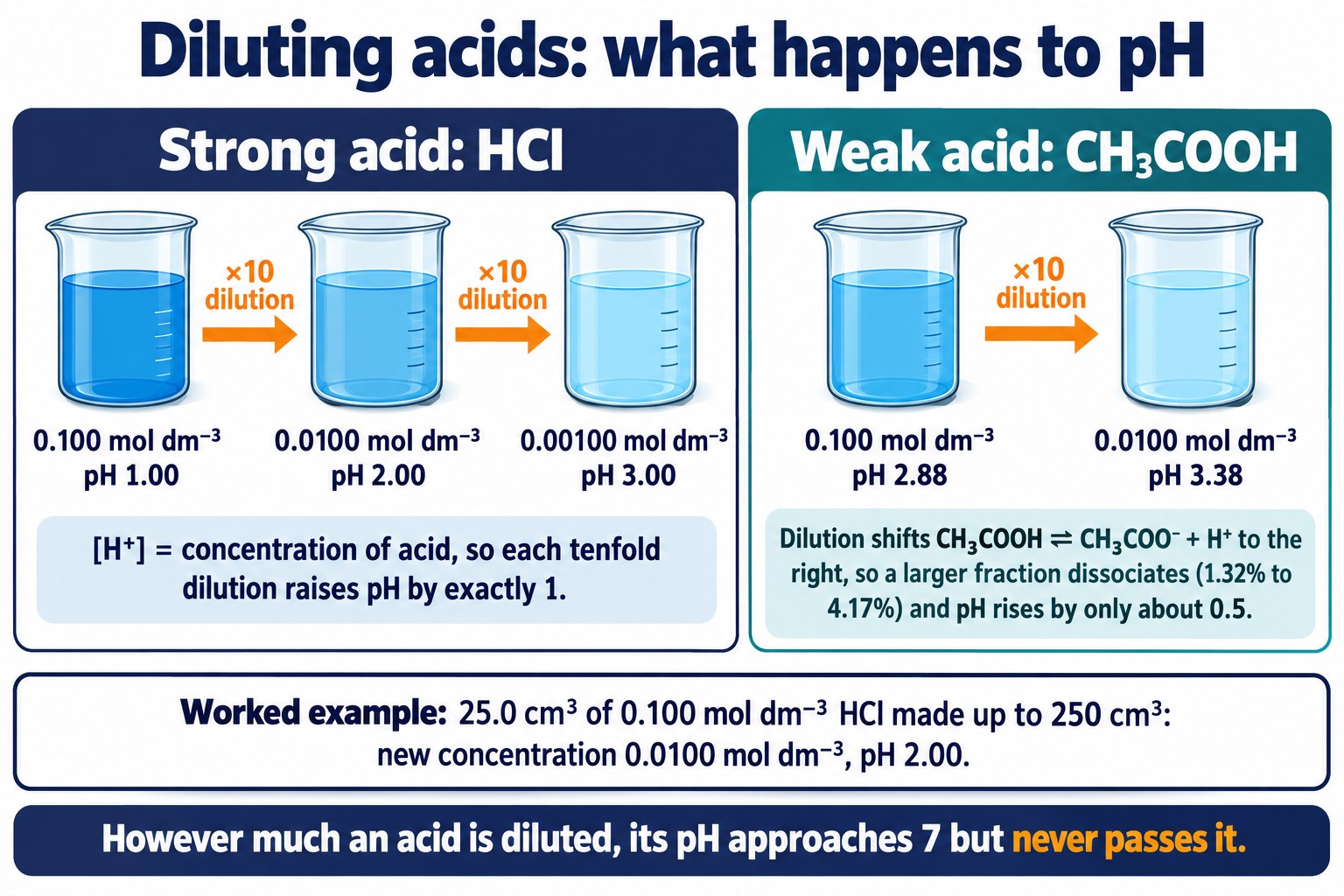
Tenfold dilutions of a strong acid, where pH rises by one unit each time, beside a weak acid, where pH rises by only about half a unit because more of it dissociates.
Remember: Sulfuric acid gives 2 × its concentration of H⁺. A strong monoprotic acid gives 1 ×. Each tenfold dilution of a strong acid adds exactly 1 to the pH.
Common Exam Points
Say
- “pH = −log[H⁺]”, with square brackets.
- “A strong acid is completely dissociated in water.”
- “HCl is a strong acid, so [H⁺] = [HCl] = 0.0500 mol dm⁻³ and pH = 1.30.”
- “Diluting a strong acid tenfold raises its pH by 1.”
Do not say
- “pH = log[H⁺]” (the minus sign is part of the definition).
- “A strong acid is a concentrated acid” (strength is the degree of dissociation).
- “pH 1 is ten times more acidic than pH 3” (it is 100 times the [H⁺]).
- “HCl ⇌ H⁺ + Cl⁻” (a strong acid has a one-way arrow).
Watch for
- Volumes in cm³: divide by 1000 before finding a concentration.
- Sulfuric acid in a “strong monoprotic acid” question: it is diprotic, so double [H⁺].
- pH quoted to 2 decimal places, even when [H⁺] is a round number: pH 2.00, not 2.
- Negative pH values: they are correct for strong acids above 1 mol dm⁻³.
Check: Strength, Sulfuric Acid and Dilution
Compare strong and weak acids, and calculate pH for sulfuric acid and diluted strong acids, with examples not used on this page.
FAQs
Use these quick answers to check pH and the pH of strong acids.
Why does a higher [H⁺] give a lower pH?
pH = −log[H⁺]. The log of a number below 1 is negative, and the minus sign makes the pH positive. As [H⁺] increases, its log becomes less negative, so the pH value falls.
How many times more acidic is pH 2 than pH 4?
Each pH unit is a factor of ten in [H⁺], so a solution of pH 2 has 100 times the hydrogen ion concentration of one at pH 4. A change of 0.30 units means [H⁺] has doubled or halved.
What is the difference between a strong acid and a concentrated acid?
Strength describes the degree of dissociation: a strong acid dissociates completely, a weak acid only partially. Concentration describes the amount of acid in each dm³. A dilute strong acid can have a lower [H⁺] than a concentrated weak acid.
Can pH be negative?
Yes. Any solution with [H⁺] greater than 1 mol dm⁻³ has a negative pH. For 2.00 mol dm⁻³ hydrochloric acid, pH = −log(2.00) = −0.30, which is a perfectly acceptable answer.
Why does diluting a strong acid tenfold raise the pH by exactly 1?
For a strong monoprotic acid, [H⁺] equals the acid concentration. A tenfold dilution divides [H⁺] by 10, and because log 10 = 1, the pH rises by exactly one unit, for example from 1.00 to 2.00.

Copyright notice: This OLS revision content, including the explanations, layout, diagrams, tables and embedded learning structure, is authored for Online Learning System by Dr. Mohammed Al-Fatah. It may not be copied, reproduced, redistributed or adapted without written permission.
Keep this note — free
Save your progress across every Edexcel IAL topic. A free account remembers which topics you have covered, saves your question scores, and syncs across your phone and laptop.
- Track every topic you have finished
- Keep your practice-question scores
- No payment, no card, free forever
Already registered? Log in